
More than 60% of dealer websites load pricing in a way that leaves AI crawlers seeing an empty page
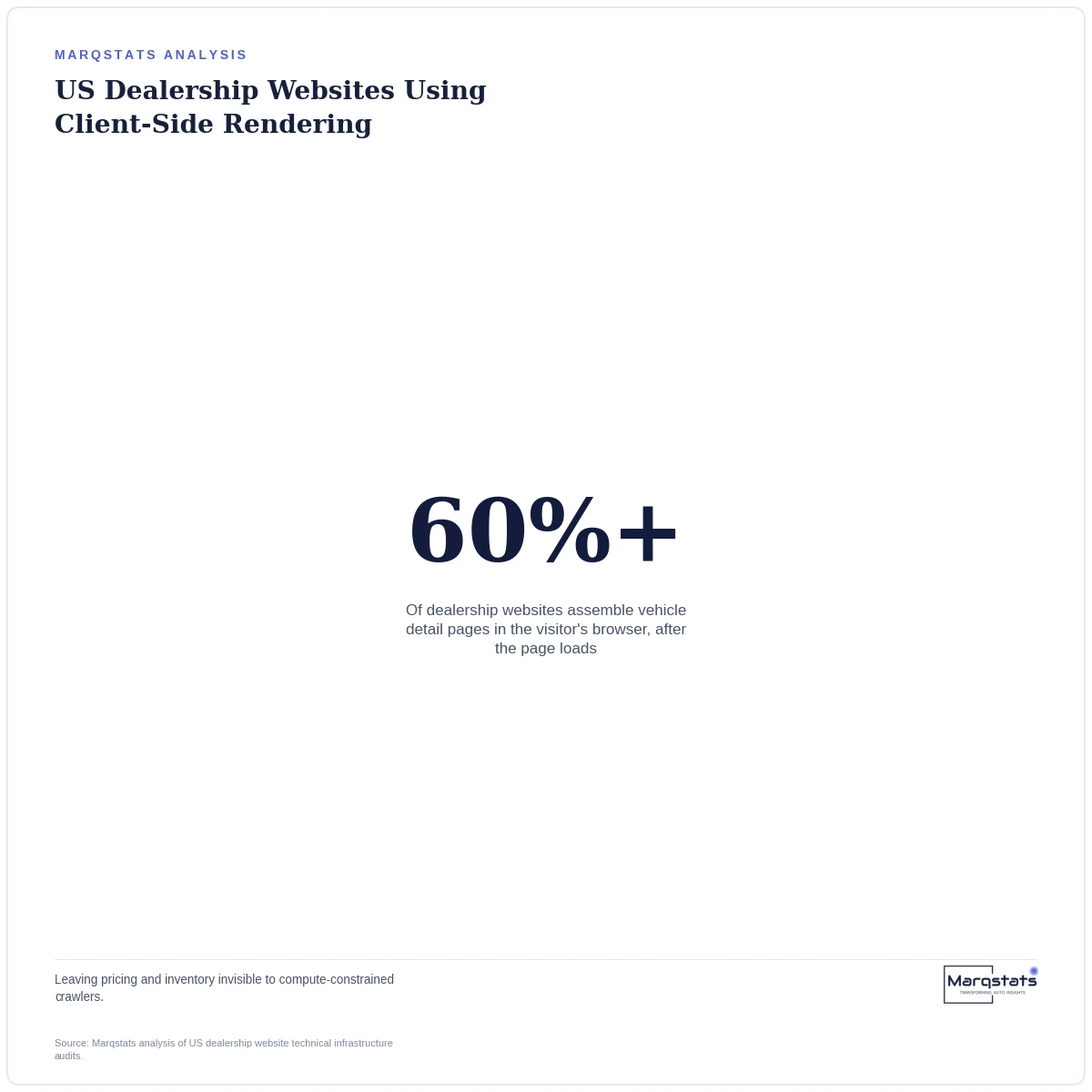
Here's a technical detail that has a surprisingly large commercial impact: more than 60% of United States dealership websites use a web development technique called client-side rendering to display vehicle detail pages - and this single architectural choice is quietly making the majority of dealer inventory invisible to the automated systems that generative search platforms rely on.
What client-side rendering actually means
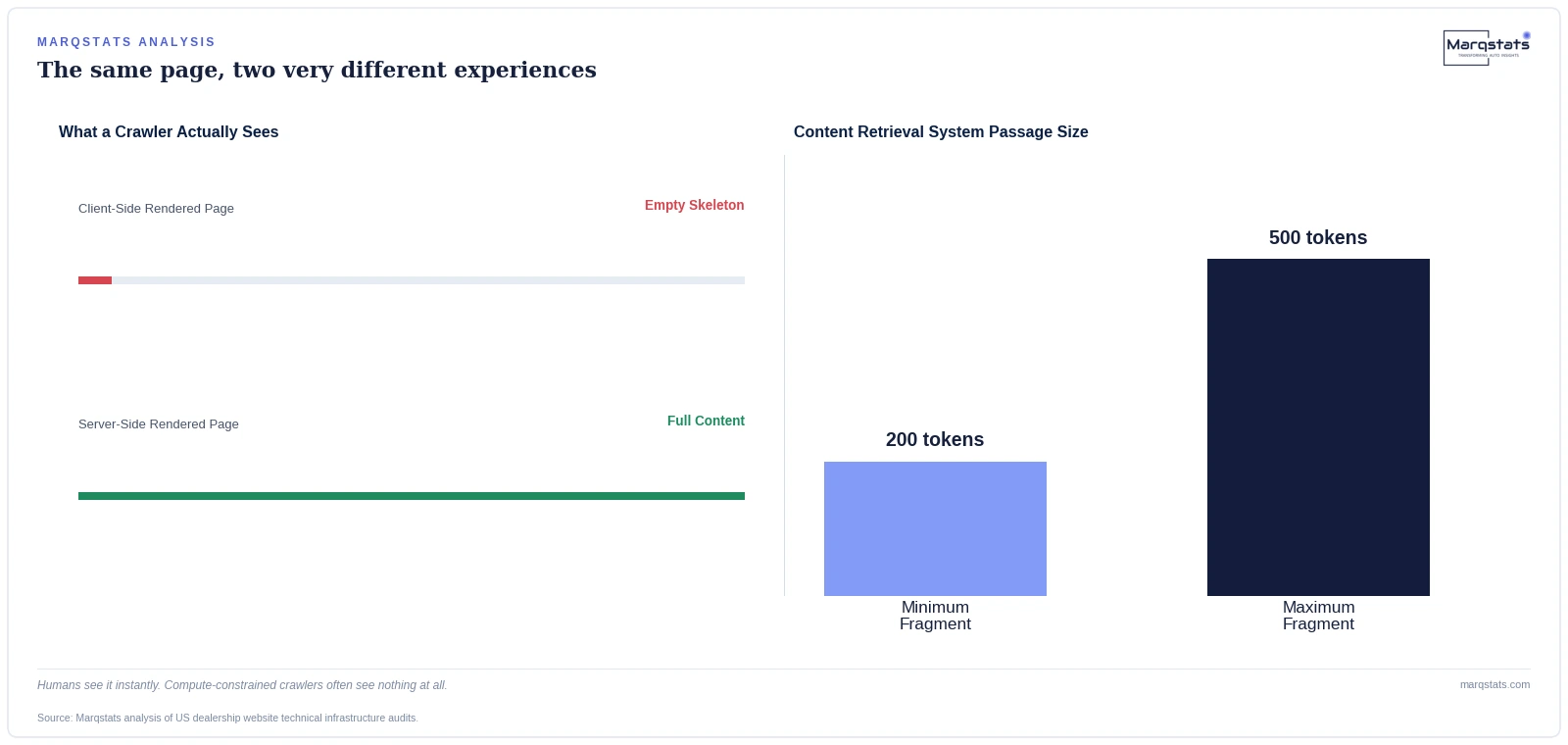
When a dealership website uses client-side rendering, the vehicle price, availability, trim details and specifications aren't present in the initial page a server sends out. Instead, the server sends a mostly empty page skeleton, along with a JavaScript program that runs inside the visitor's own web browser after the page loads. That JavaScript program then fetches the actual vehicle data and inserts it into the page dynamically, right there in the browser.
For a human visitor using a modern web browser, this process is invisible and near-instant. The browser runs the JavaScript automatically, the page fills in with content, and the visitor never notices the two-step process happened at all.
A human's browser fills in the blanks automatically. A specialized crawler often just sees the blanks.
— Marqstats Analyst Team
Why this breaks down for generative retrieval crawlers
Specialized web crawlers deployed by generative search engines operate under genuinely strict compute and latency constraints, since they need to process an enormous volume of pages across the entire web efficiently. Running a full JavaScript execution environment for every single page crawled, the way a human's browser does, is computationally expensive at that scale. As a result, these crawlers frequently parse only the raw HTML response a server returns initially, skipping the JavaScript execution step entirely.
The practical consequence: a dealership using client-side rendering sends these crawlers exactly the same empty page skeleton a human browser receives before its JavaScript runs. The vehicle price, the trim details, the availability status, none of it is present in what the crawler actually reads. Functionally, from the crawler's perspective, the page contains no vehicle information at all - even though a human visitor viewing the identical URL sees a fully populated, informative page seconds later.
Why this matters more now than it used to
Client-side rendering isn't a new or unusual web development pattern - it's been common practice for years, adopted for legitimate reasons including faster perceived page interactivity and simpler content management workflows. The reason it's become a genuine commercial liability now, specifically, is the rise of generative retrieval as a primary discovery channel. Traditional search crawlers have, over time, developed increasingly sophisticated capability to execute JavaScript and see rendered content, even if imperfectly. The newer, more resource-constrained crawlers built specifically for generative retrieval have generally not caught up to that same level of JavaScript execution capability, reintroducing a visibility gap that traditional search engine optimization practice had mostly solved.
The fix, and why it isn't actually complicated
The solution is a different, well-established rendering approach called server-side rendering, where the server assembles the complete page, including current price and availability, before sending it out, rather than sending an empty skeleton for the browser to fill in later. A crawler reading a server-side rendered page sees the full vehicle information immediately, in the raw HTML response, with no JavaScript execution required at all. This isn't experimental or unproven technology - it long predates the current generative search wave and was originally developed to improve page load speed and traditional search engine crawlability, not specifically for AI visibility.
The counter-argument: is switching rendering approaches actually a large undertaking?
A fair concern for a dealership evaluating this issue is whether switching from client-side to server-side rendering represents a major, costly website rebuild, or something more modest. The honest answer depends heavily on the underlying website platform: some dealership website platforms already support server-side rendering as a configuration option, meaning the switch requires enabling an existing capability rather than rebuilding anything. Others were built exclusively around client-side architecture and would require more substantial platform-level changes, potentially including a full website replatforming, to add server-side rendering support. This is precisely why platform choice matters as much as individual dealership effort here - a dealer's own technical readiness is meaningfully constrained by which underlying website platform they've chosen to build on.
What this means for dealership technical teams
- Ask your website platform provider directly whether vehicle detail pages are server-side rendered or client-side rendered, since this single technical detail largely determines generative crawler accessibility.
- Treat rendering architecture as a prerequisite technical audit before investing in content-level generative optimization techniques, since content improvements deliver no value if a crawler cannot read the underlying page data at all.
- Evaluate platform migration costs against the documented conversion premium of AI-referred traffic, since the investment case for server-side rendering strengthens considerably once that premium is factored in.
The full market picture
Marqstats' complete United States automotive Generative Engine Optimization market analysis, including the full technical implementation landscape, is available in the linked report below.
Related reportUnited States Automotive Generative Engine Optimization Market Size, Share & Forecast 2026 – 2030