A Manufacturing Win With a Repair-Shop Cost
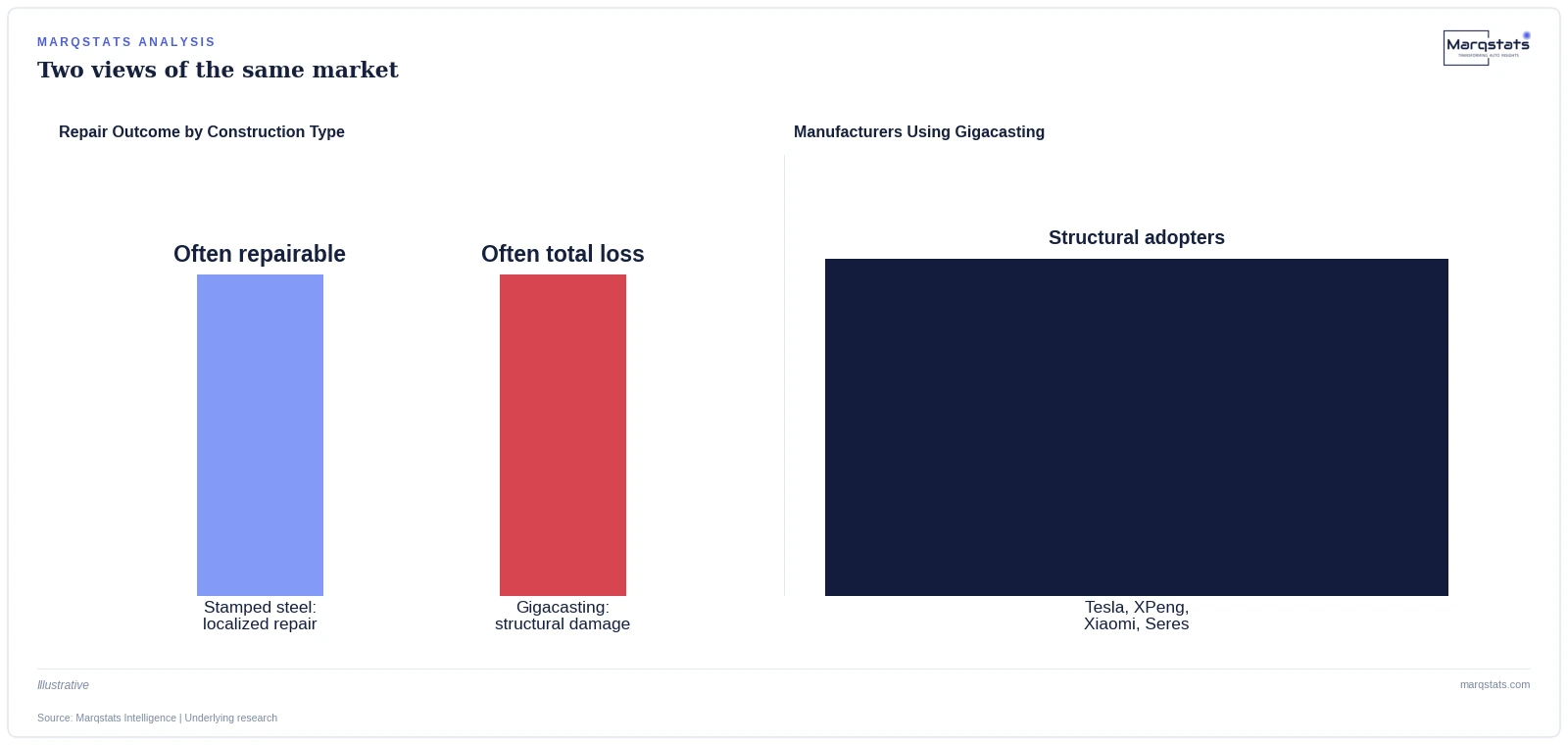
In brief: integrated high-pressure aluminum die-casting — gigacasting — lets automakers replace hundreds of individual stamped sheet-metal parts with a single large casting. Manufacturers including Tesla, XPeng, Xiaomi and Seres have adopted it widely. It's a genuine manufacturing efficiency breakthrough. It's also created a collision-repair problem nobody fully solved before scaling the technology.
Why You Can't Just Fix a Cracked Casting
Structural aluminum gigacastings cannot be straightened using conventional hydraulic frame equipment, and they cannot be repaired with localized torch heating — thermal exposure alters the structural alloy's temper, causing micro-fracturing and structural yield failure. Every technique a traditional body shop would reach for on stamped steel simply doesn't work here.
What Happens Instead
On a traditional car, a dented sub-frame gets straightened. On a gigacast car, it gets replaced — or the car gets written off.
— Marqstats Analyst Team
Impact damage extending to the mounting points of a rear cast sub-frame often requires complete replacement of the entire structural casting. Given the cost and complexity of that replacement, insurers frequently conclude a total write-off is more economical than attempting the repair — for damage that, on a comparable stamped-steel vehicle, might have been a routine, localized panel job.
It's Not Just the Metal, Either
Front and rear bumper covers on these platforms integrate dense sensor arrays — 77 GHz millimeter-wave radars, ultrasonic transceivers, wide-angle cameras — requiring collision centers to invest heavily in ADAS radar calibration targets, optical alignment boards, and OEM software handshakes just to put a car back on the road safely after even a moderate impact.
A Named Comparison: Why This Differs From Traditional Unibody Damage
Traditional stamped-steel unibody construction, whatever its other drawbacks, gave collision shops decades of established repair technique: sectioning, straightening, localized panel replacement. Gigacasting doesn't have that accumulated repair knowledge base yet, and the material science itself — the specific way heat treatment affects cast aluminum's structural properties — genuinely limits what repair techniques can ever exist for it, not just what's been developed so far.
What This Means for Insurers and Repair Networks
The practical implication: insurers pricing EV collision coverage on gigacast platforms specifically should model total-loss probability as structurally higher than on comparable stamped-steel vehicles, not as a temporary gap repair technique will eventually close. Repair networks should treat ADAS calibration and ecosystem investment as a baseline cost of competing for this segment's collision work at all.