
A Registration Share That Leads the Country by a Wide Margin
That gap between the headline number and the underlying operational reality is worth understanding in detail before drawing conclusions.
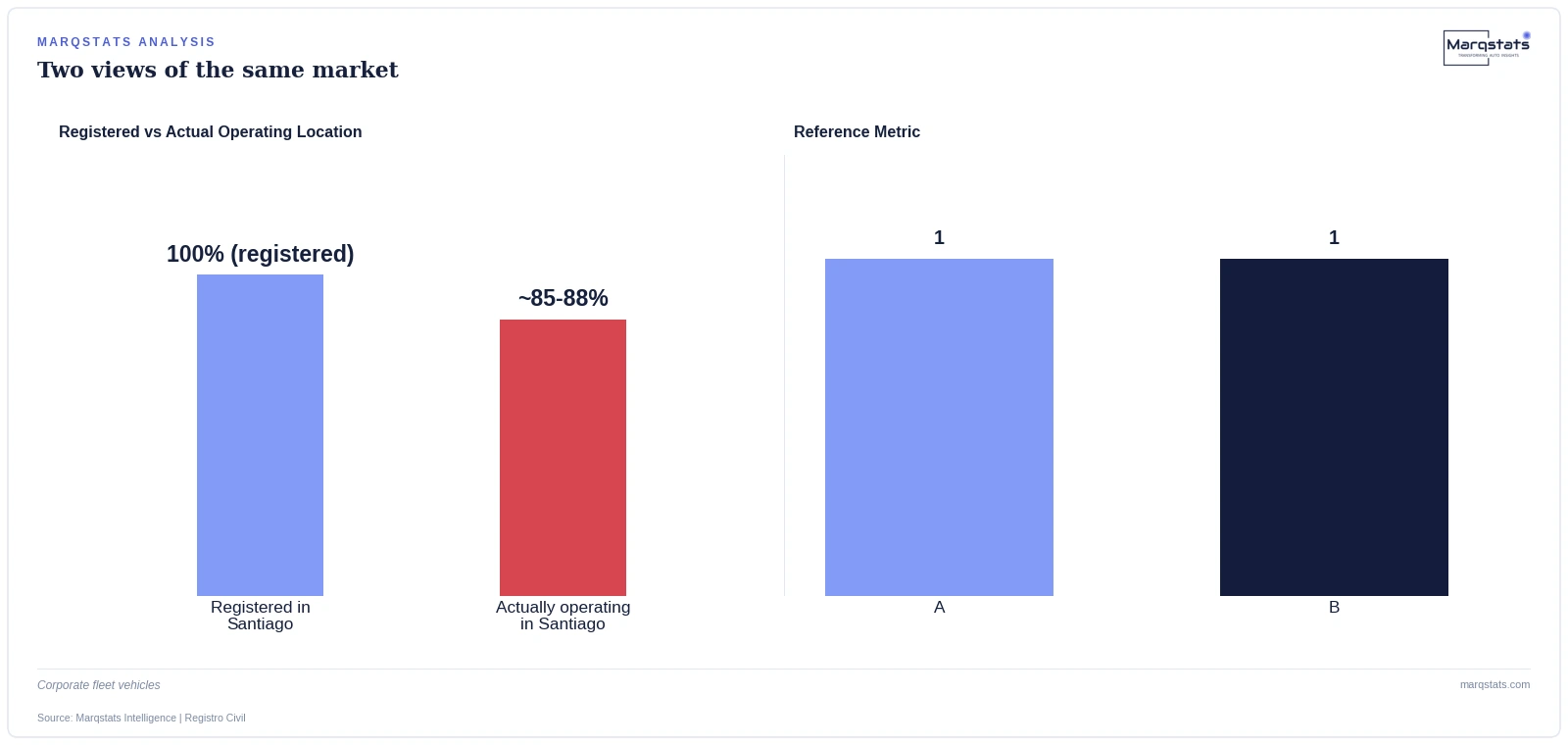
In brief: official Chilean vehicle data attributes approximately 88% of cumulative electric vehicle registrations to Greater Santiago. Read that as proof nearly all of Chile's EV servicing activity happens in the capital, and you'd be missing a genuine, documented gap.
Why Corporate Fleets Register Where They Don't Operate
This is an entirely routine business decision at the individual company level, with a genuine cumulative effect on national statistics.
Major commercial leasing operators -- ALD Automotive, Arval Relsa, Mitta among them -- register utility pickups, corporate passenger cars and light commercial vans at their legal headquarters in northern and eastern Santiago communes including Las Condes, Huechuraba and Pudahuel. That's a routine administrative decision, not a reflection of where the vehicles spend their operating lives.
Where a Meaningful Slice of Those Vehicles Actually Work
That distinction between registration location and actual service location shapes real business decisions on the ground.
Registered in Santiago. Working the Atacama.
— Marqstats Analyst Team
Operational tracking reveals that 12% to 15% of these corporate fleets operate continuously in northern mining support applications around Antofagasta, Calama and Tarapacá, or in southern agricultural zones -- not in the capital at all.

A Named Comparison: Why This Splits Service Demand in a Specific, Predictable Way
The underlying research is specific about how this plays out operationally: basic wear servicing, fluid top-offs and tire replacements happen at regional service centers near where these vehicles actually work, while warranty claims and major electrical powertrain diagnostics get routed back to central Santiago facilities. That's a genuinely predictable, two-tier servicing pattern -- not a random scatter -- which makes it something regional workshop investment can actually plan around.
Why This Two-Tier Pattern Is Unlikely to Simplify
Corporate leasing headquarters decisions and regional operational deployment are driven by entirely separate business logics -- tax and administrative convenience on one side, actual project location on the other -- meaning there is little structural reason to expect Chile's registration-versus-circulation gap to narrow as the corporate fleet continues expanding.
What This Means for Regional Workshop Investment
The practical takeaway: parts distributors and workshop investors in Antofagasta, Calama and similar mining-adjacent regions should expect steady demand for basic mechanical and tire servicing specifically, while recognizing that complex electrical and warranty work will likely continue routing back to Santiago regardless of local capability investment, given how the underlying corporate fleet relationships are structured.