
A Real Credential That Almost Nobody Actually Holds Yet
The scale of the shortage becomes clearer once the actual percentage is stated plainly.
It's worth understanding exactly what this specific bottleneck looks like before assuming the market simply lacks demand for independent EV service.
Chile has a genuine legal framework for who's allowed to work on electric vehicle batteries. The problem isn't the framework itself -- it's how few technicians have actually earned the credential it requires.
What the Certification Actually Covers
This is a specific, genuinely technical credential, not a general safety awareness course anyone can complete quickly or casually.
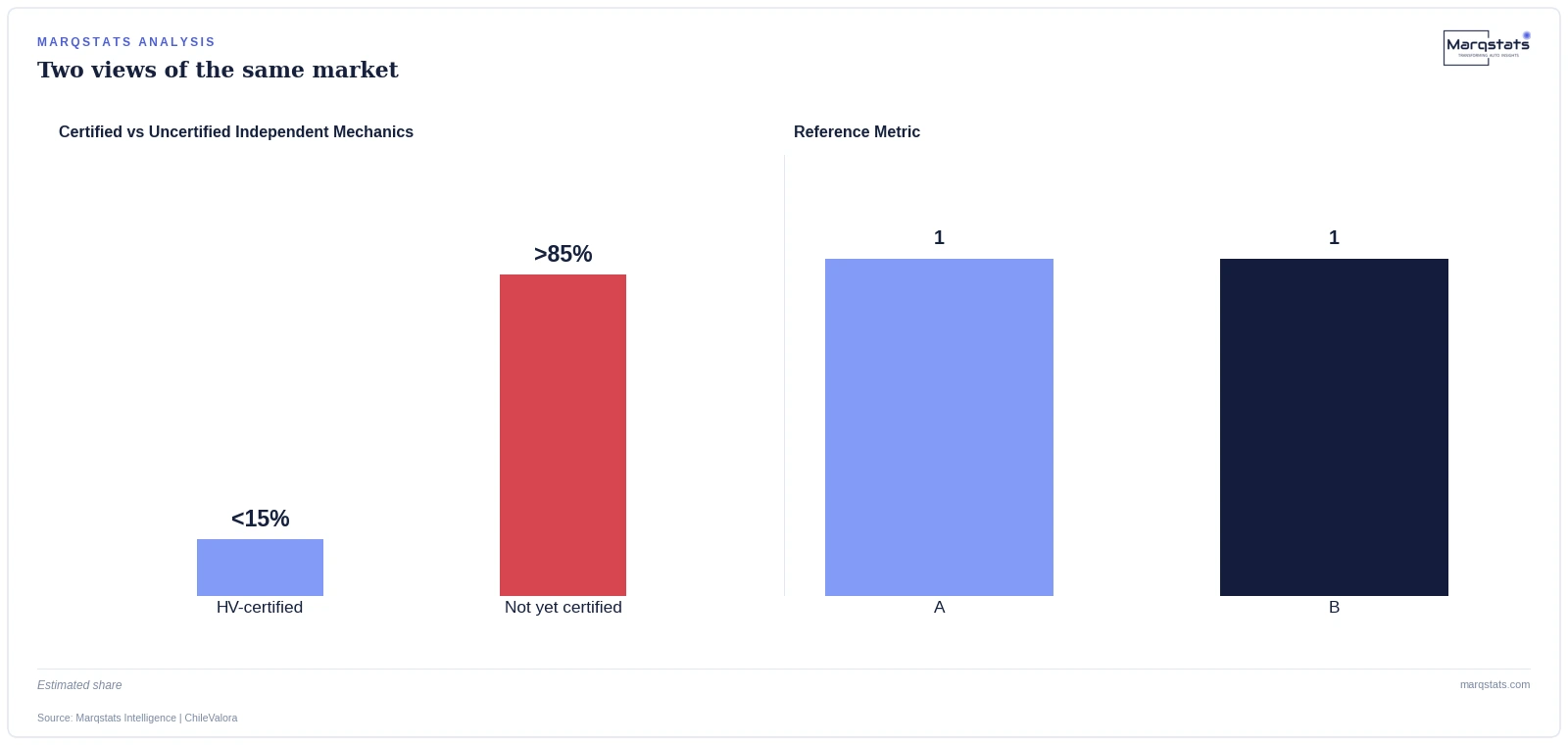
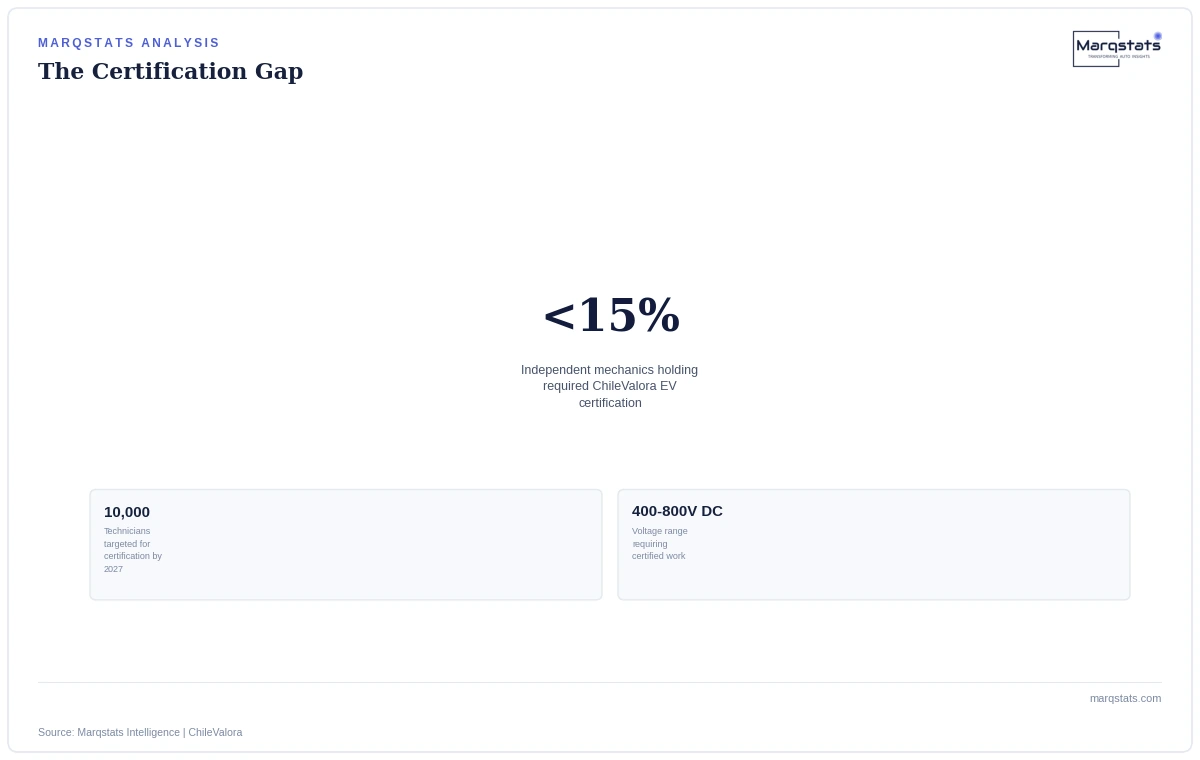
Servicing traction battery systems operating between 400 and 800 volts DC requires certification under ChileValora's Perfil Ocupacional P-4520-7412-001-V01, covering safe high-voltage isolation, zero-potential verification, insulated diagnostic tool use, and module-level battery repair. Fewer than 15% of mechanics in independent workshops currently hold it.
Why the Gap Persists Despite a Clear Legal Path
It's fundamentally a mismatch between legal readiness and actual workforce readiness, and the two are simply moving at genuinely different speeds right now.
That timing mismatch between legal framework and actual workforce capacity is the real story here.
The credential exists, the pathway to earn it exists through institutions like Duoc UC and INACAP, and the demand for certified technicians is documented and growing. What's missing is simply time and throughput -- training a meaningful national cohort of certified technicians takes years, not a single course cycle.
A Named Comparison: Why the Response Is Institutional, Not Just Individual
Recognizing which specific type of coordinated response is actually underway changes how quickly the national gap should genuinely be expected to close over time.
Rather than leaving this to individual workshops to solve independently, ANAC and ChileValora formalized an institutional labor pact specifically targeting 10,000 certified technicians between 2026 and 2027 -- a scale of coordinated response that goes beyond what any single training provider or dealership network could achieve alone. That's a genuinely different approach than markets where certification scaling is left purely to market forces.
Why This Specific Bottleneck Is Genuinely Unlikely to Close Overnight
Certification pipelines take real time to reach scale regardless of institutional urgency, meaning this specific labor constraint should be treated as a multi-year structural feature of the market rather than a gap likely to close within a single training cycle.
What This Means for Workshops Right Now
Timing this decision correctly matters more here than in markets where certified capacity is already widely and readily available to newcomers.
The practical takeaway: independent workshops that get technicians certified early, ahead of the 2026-2027 national training push reaching full scale, position themselves for a genuine first-mover advantage in a market where certified capacity is currently the binding constraint on service capacity, not customer demand.