A Network Most Countries Would Envy
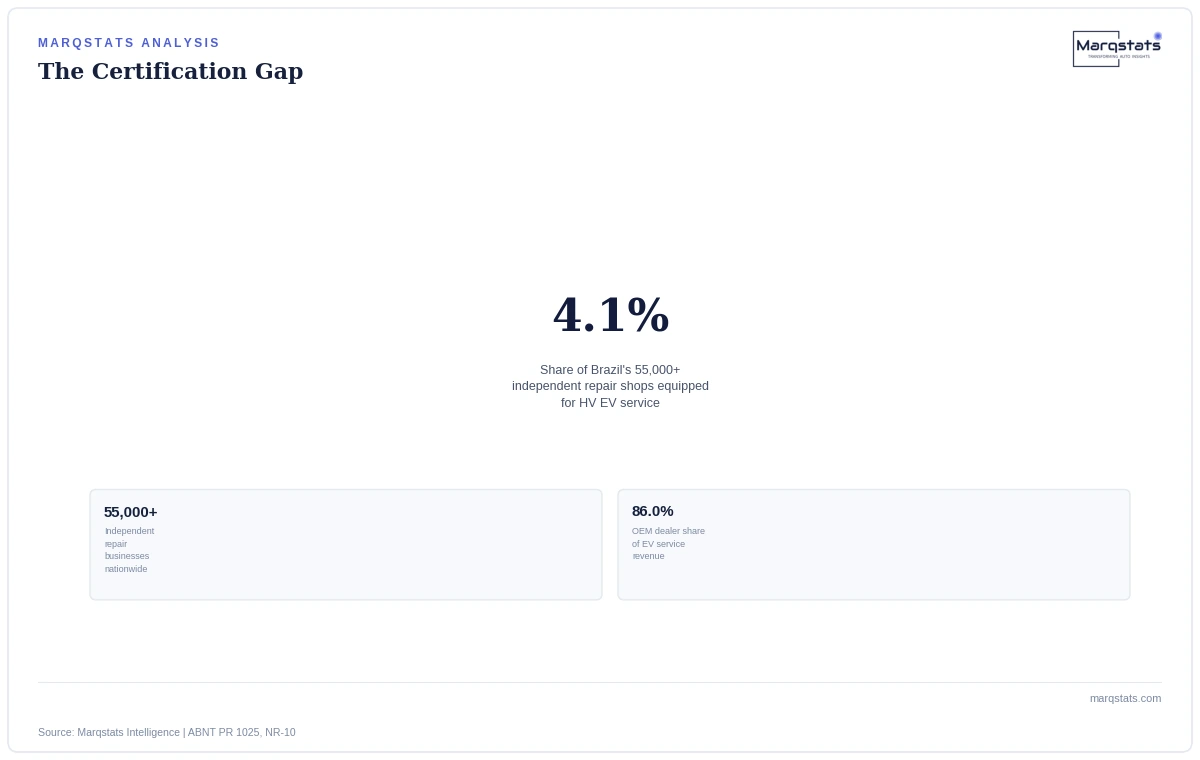
Brazil has more than 55,000 independent auto repair businesses operating nationwide — a genuinely enormous, geographically distributed workforce most countries assessing their own aftermarket capacity would consider a real competitive advantage.
For EV service specifically, almost none of that capacity is actually usable.
The Number Behind the Gap
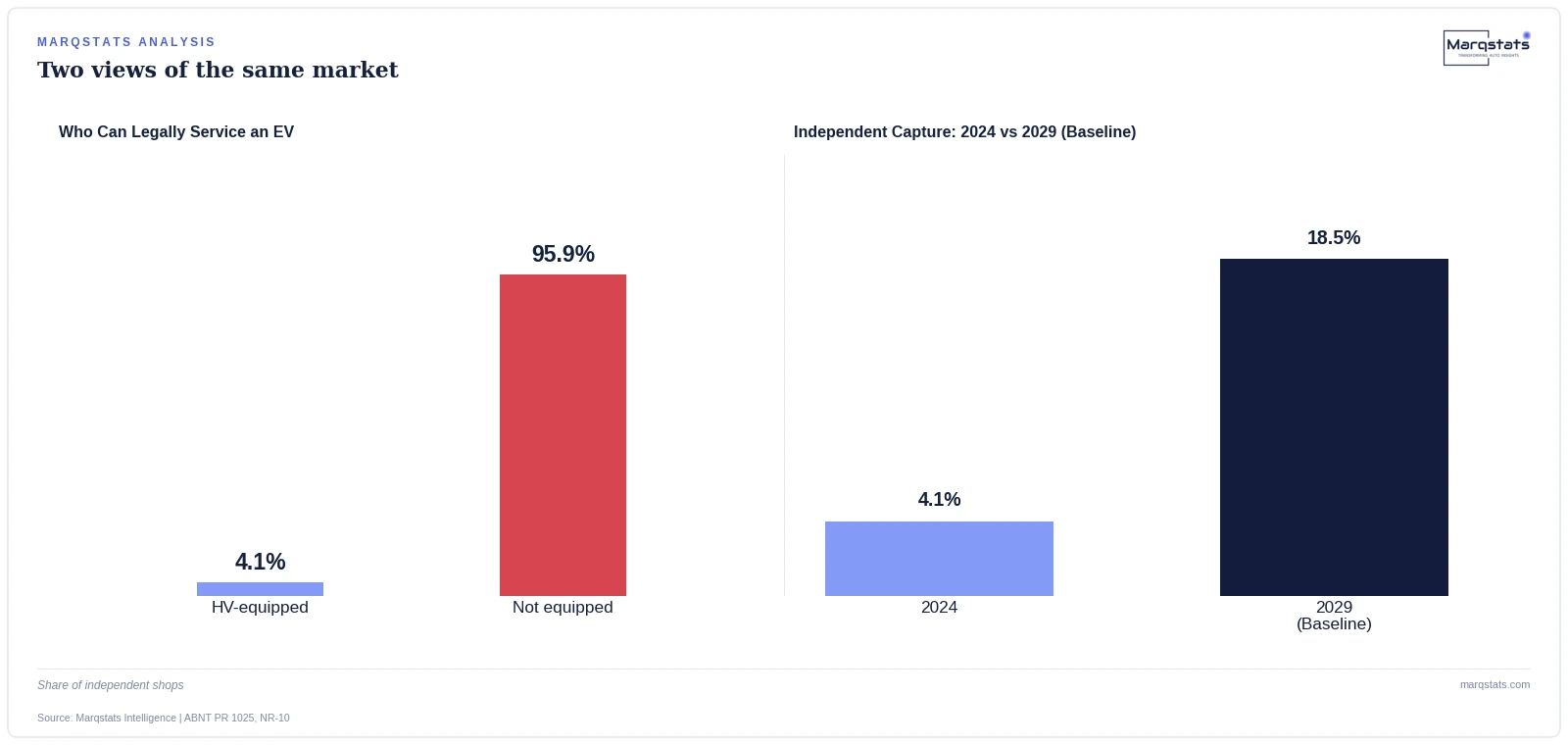
Fewer than 4.1% of those 55,000-plus workshops have invested in the high-voltage bay isolation, 1,000V insulated tooling, and technician safety certifications mandated by ABNT PR 1025 and NR-10. The rest remain confined to non-electrified mechanical work — tire balancing, suspension replacement, collision repair — regardless of how much unmet EV service demand exists in their own neighborhoods.
Why This Isn't Just One Barrier
The gap isn't a single obstacle a workshop could clear with one decision. It's a stack: ABNT PR 1025 and NR-10 certification requirements, dedicated high-voltage bays with insulated tooling, and recurring diagnostic scanner subscriptions running R$ 12,000 to R$ 28,000 per vehicle brand family annually — four to five times what ICE diagnostic access costs. Each requirement alone might be manageable. Together, they add up to a genuinely steep bar.
Where the Work Goes Instead
With most independents structurally unable to compete, OEM authorized dealerships capture 86.0% of light electrified vehicle service revenue — reinforced further by manufacturer warranties running 5 to 8 years on high-voltage batteries and electric drive units, which keep owners returning to franchised networks specifically to protect that coverage.
A Named Comparison: Why This Gap Is Closing, Slowly
This isn't a permanently fixed number. The Instituto da Qualidade Automotiva had certified over 9,400 automotive technical professionals nationwide by March 2025, and SENAI began rolling out ABNT PR 1025-aligned training curricula in January 2025. The underlying research's own Baseline Scenario projects independent capture climbing from 4.1% to 18.5% by 2029 — a real, meaningful shift, even if it still leaves dealerships holding the clear majority of the market.
The Recurring Cost That Compounds the Gap
It isn't just a one-time investment holding independents back either. Even after clearing the certification bar, workshops face ongoing diagnostic software licensing costs running into the thousands of reais annually per vehicle brand, meaning the barrier to entry doesn't disappear after the first year -- it becomes a recurring cost independents have to plan around indefinitely.
What This Means for Anyone Planning Around This Market
The practical takeaway: Brazil's independent repair capacity, while enormous in raw count, isn't yet a meaningful competitive force in EV-specific service. Anyone assessing this market's near-term structure should weight the certification and capital pipeline, not shop count, as the variable that actually determines independent capacity.