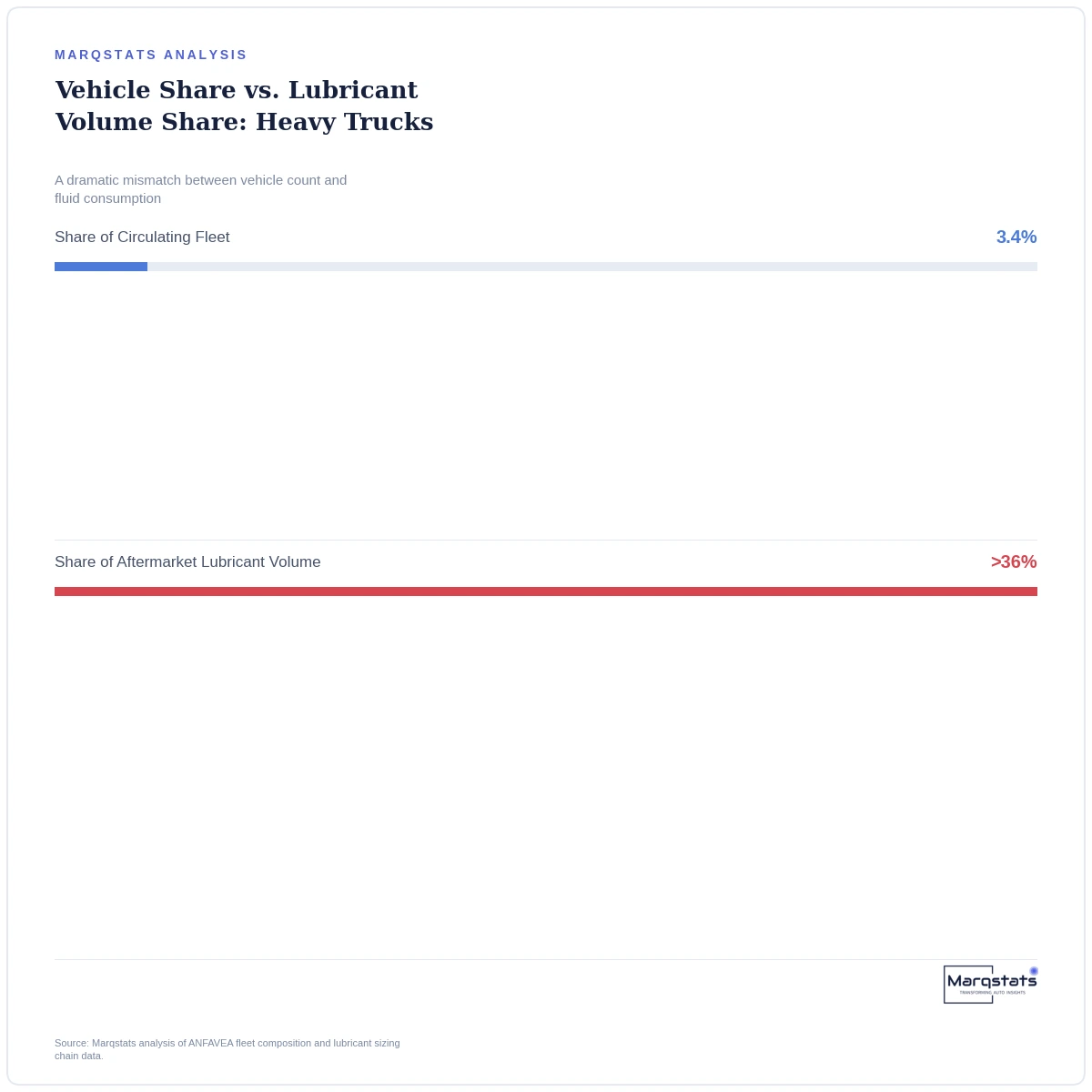
3.4% of Brazil's vehicles are trucks. They drink more than a third of all the country's lubricant.
If you sized Brazil's automotive lubricants market purely by counting vehicles, you'd get the story badly wrong. Passenger cars vastly outnumber heavy trucks on Brazilian roads. But when it comes to how much oil actually gets sold, trucks punch dramatically above their numbers.
The numbers that explain the gap
Brazil's circulating four-wheeled fleet includes just 2.24 million heavy trucks, a genuinely small slice of the roughly 52 million-vehicle total fleet. Yet that small slice consumes more than a third of all automotive aftermarket lubricant volume in the country. The explanation comes down to two multiplying factors: how much oil each vehicle holds, and how often that oil gets changed.
Why one truck holds as much oil as ten cars
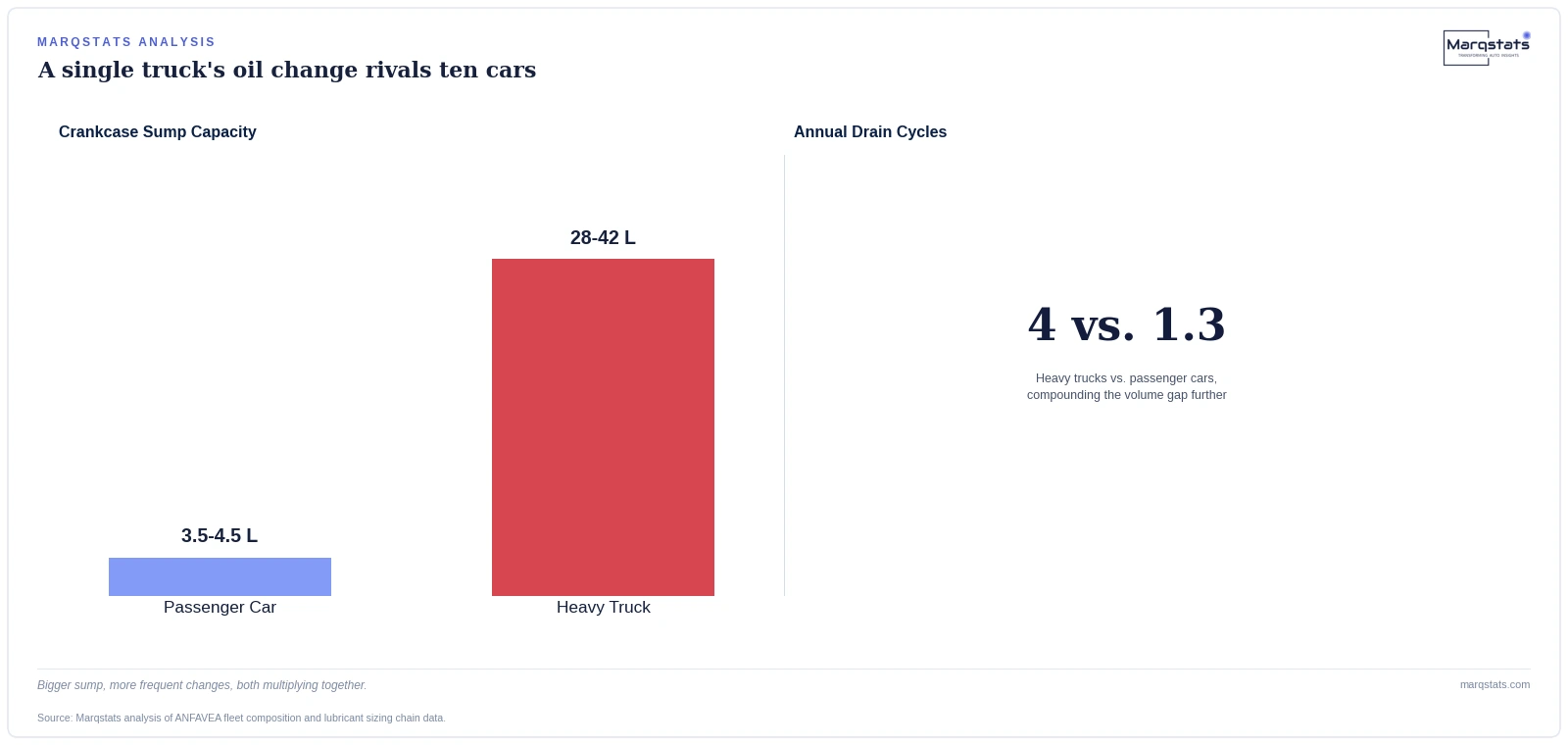
A typical Brazilian passenger car carries an engine oil sump capacity of 3.5 to 4.5 litres. A long-haul diesel tractor unit, by contrast, carries 28 to 42 litres, roughly eight to ten times more oil per vehicle. That's before accounting for how often each vehicle needs an oil change.
A single truck's oil change can use as much fluid as ten passenger cars combined.
— Marqstats Analyst Team
Why trucks also change oil more often
Long-haul diesel tractors operate under genuinely severe conditions, logging between 80,000 and 150,000 kilometers annually, several times the typical annual mileage of a passenger car. That intensity of use translates directly into service frequency: heavy trucks undergo roughly four full drain cycles per year, compared to just 1.3 cycles for the average passenger car. Multiply a larger sump by more frequent changes, and the per-vehicle volume gap between a truck and a car widens even further than the sump capacity comparison alone would suggest.
Why this segment matters even more given Brazil's economic geography
This concentration of demand in commercial trucking isn't incidental to Brazil's broader economic structure, it reflects it directly. Brazil is one of the world's largest agricultural exporters, and long-haul freight transport, moving grain, soy and other commodities from inland production regions to coastal ports, depends almost entirely on road transport rather than rail. The Midwest region specifically, Brazil's agribusiness heartland, generates outsized heavy-duty lubricant demand precisely because multi-trailer road trains hauling grain across unpaved and highway corridors require frequent oil changes to protect engines running continuously under heavy load.
Why regulatory change is adding even more value to this segment
Proconve P8, Brazil's equivalent to the international Euro VI heavy-duty emissions standard, is reinforcing this segment's importance in dollar terms specifically, not just physical volume. The standard mandates Low-SAPS chemical limits to protect Diesel Particulate Filter systems from ash-related fouling, requiring API CK-4 and comparable premium formulations rather than legacy CI-4 and CH-4 oils. As Proconve P8-compliant trucks expand to represent an estimated 38% of the circulating diesel truck fleet by 2030, this already-dominant volume segment is also becoming a higher-value one.
The counter-argument: could electrification of heavy freight eventually erode this segment's dominance?
A fair question is whether battery-electric or hydrogen-powered heavy trucks might eventually displace diesel in Brazilian long-haul freight, reducing this segment's outsized lubricant demand the way electrification threatens combustion-dependent volume elsewhere. This is a reasonable long-term consideration, though heavy-duty electrification faces genuinely steeper technical barriers than passenger vehicle electrification, battery weight and range constraints are far more punishing for a vehicle already carrying tens of tonnes of freight across Brazil's vast interior distances, and charging infrastructure across the country's most freight-intensive corridors remains largely undeveloped. Diesel combustion, and the substantial lubricant demand it generates, is likely to remain the dominant heavy-freight technology in Brazil considerably longer than in more geographically compact, infrastructure-dense markets.
What this means for blenders and distributors
- Lubricant blenders should prioritize heavy-duty commercial formulations and Proconve P8 compliance specifically, given the disproportionate volume and rising value this segment represents relative to its vehicle count.
- Distributors serving agribusiness-heavy regions like the Midwest should maintain robust heavy-duty diesel oil inventory specifically, given the concentrated demand grain transport corridors generate.
- Investors evaluating this market should weight heavy commercial vehicle segment trends more heavily than passenger vehicle trends alone would suggest, given the outsized volume this category represents.
The full market picture
Marqstats' complete Brazilian automotive lubricants aftermarket analysis, including the full vehicle category segmentation, is available in the linked report below.
Related reportBrazil Automotive Lubricants Aftermarket Size, Share & Forecast 2026 – 2030