The 223,912 figure is three markets wearing one number
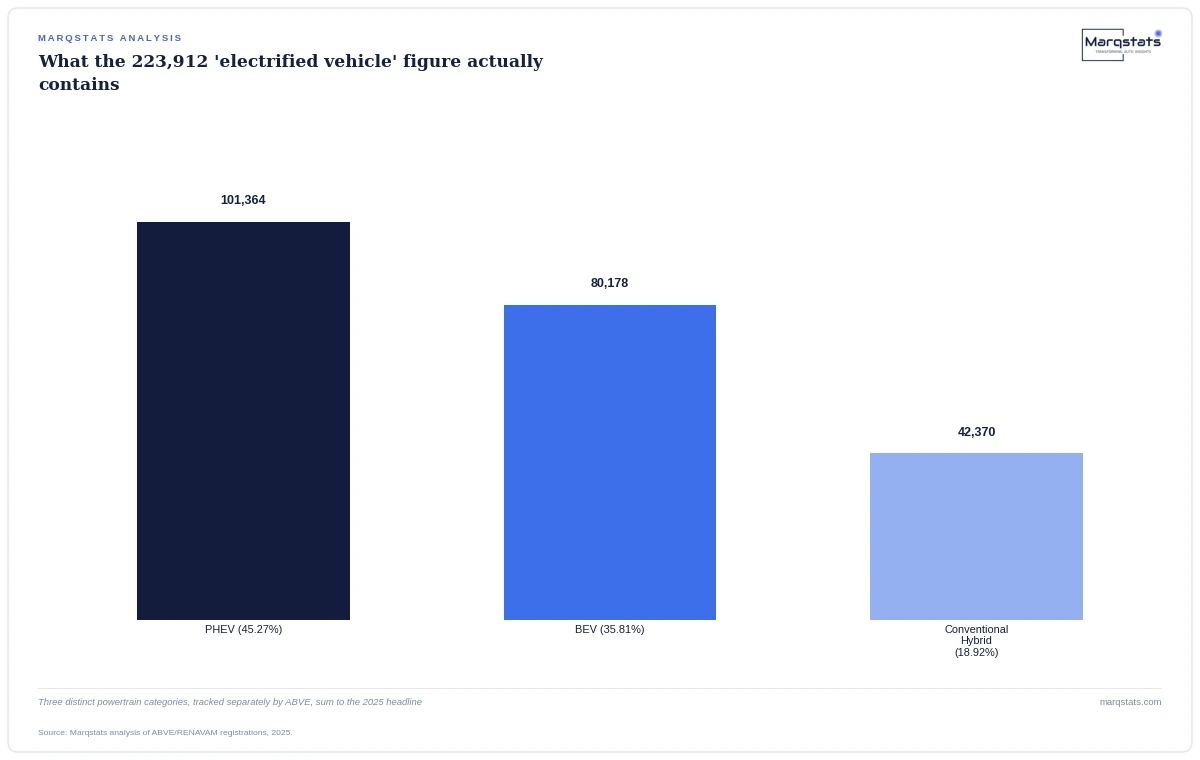
Brazil registered 223,912 "electrified vehicles" in 2025, a number that circulates in Brazilian media as if it described one market. It does not. The figure is the sum of three distinct powertrain categories tracked separately by the Associação Brasileira do Veículo Elétrico (ABVE): 101,364 plug-in hybrids (45.27%), 80,178 battery-electric vehicles (35.81%), and 42,370 conventional hybrids (18.92%). A reader who takes 223,912 as "how many EVs Brazil sold" overstates the battery-electric market by roughly 2.8 times and understates the plug-in hybrid market's true weight in the mix.
This is not a case of sloppy reporting inflating a real number. ABVE itself publishes the combined figure prominently, and the underlying category breakdown requires a reader to open the detailed tables rather than the headline release. The confusion is structural, not accidental — and it has a second layer most coverage misses entirely.
Ask what a Brazilian "electrified vehicle" statistic actually counts before comparing it to any other country's figures. The category boundary moved once already, in January 2025, and it can move again.
— Marqstats Research
ABVE quietly redrew the boundary in January 2025
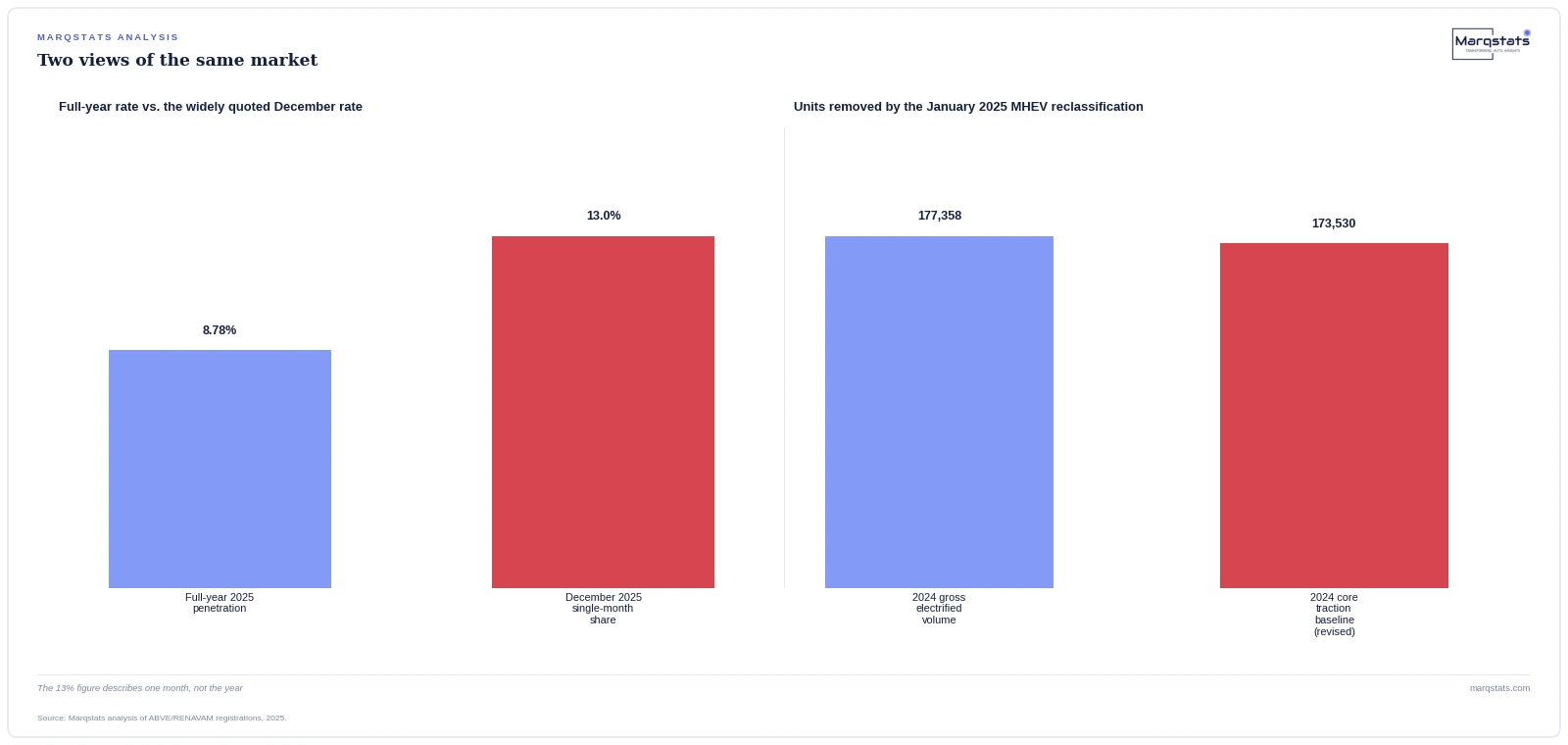
In January 2025, ABVE removed 12-volt and 48-volt mild hybrids — vehicles with a small motor-generator that cannot drive the wheels on electric power alone — from its headline electrified-vehicle series. Comparing ABVE's 2024 gross electrified volume of 177,358 units against its core traction-electrified baseline of 173,530 units isolates the removed wedge precisely: 3,828 non-traction mild-hybrid units in that one reconciliation alone, and 61,340 units removed from the broader historical series once the reclassification was applied retroactively.
The practical effect is that anyone comparing a 2025 ABVE figure against a pre-2025 figure without checking methodology is comparing two different definitions of "electrified vehicle." A mild hybrid that would have counted toward the headline number in 2023 does not count in 2025's core series, even though the vehicle itself has not changed. This is a defensible statistical decision — a car that cannot move on electricity alone is a different product from one that can — but it is a decision, made on a specific date, and it is invisible unless a reader checks the fine print.
The single-month statistic that overstates the full-year picture
A second, separate distortion shows up in a widely quoted "13% electrified market share" figure for late 2025. That number is real, but it describes a single month: December 2025, when 33,905 electrified units out of 260,800 total light-vehicle registrations produced an 13.0% monthly share. Applied to the full year, the picture is materially smaller — 223,912 electrified units out of 2,549,517 total light-vehicle sales, an 8.78% full-year penetration rate. Within that full-year figure, PHEVs alone represented 3.98% of all light-vehicle sales in Brazil, the number a market-sizing exercise should actually anchor to.
December is not a representative month for Brazilian vehicle sales. Year-end tax planning, dealer year-end incentives and fleet-renewal cycles concentrate registrations in the final quarter, and electrified vehicles — still a purchase decision skewed toward higher-income, more deliberate buyers — appear to concentrate even more heavily in that window than combustion vehicles do. A single strong month is evidence of a trend, not a description of the year.
What the clean number should be used for
For any comparison across years, across countries, or against a policy target such as Programa Mover's 20%-by-2030 electrification goal, the usable figure is the post-reclassification, full-year, single-powertrain number: 101,364 PHEV units, or 80,178 BEV units, each as its own series. Neither the combined 223,912 total nor the December single-month rate should anchor a forecast, a competitive benchmark, or a regulatory-compliance calculation — each answers a different, narrower question than the one most readers assume it answers.
Related reportBrazil PHEV Market Size, Share & Forecast 2026 – 2030A car that cannot move on electric power alone is a different product from one that can, and the statistics should say so.
— Marqstats Research, on ABVE's January 2025 mild-hybrid reclassification
- Ask whether a Brazilian EV statistic covers BEVs, PHEVs, conventional hybrids, or all three combined.
- Check the publication date against January 2025 — figures before and after that date use different category boundaries.
- Treat any single-month share figure as a snapshot, not a full-year rate, especially for December.
Is this just pedantry about definitions?
A reasonable objection is that this is definitional nitpicking — every country's vehicle statistics involve boundary judgments, and Brazil's are no more arbitrary than the European Union's separate treatment of full hybrids and mild hybrids, or the United States' distinction between plug-in and non-plug-in hybrids in federal tax-credit eligibility. On this view, pointing out that 223,912 blends three categories is true but not especially newsworthy; every national statistic requires a reader to check what it measures.
That objection holds for the category boundary itself, but not for how the boundary is used. The issue this piece raises is not that ABVE draws lines between BEVs, PHEVs and hybrids — that distinction is standard and defensible. The issue is that Brazilian media, and some international coverage drawing on Brazilian sources, routinely quotes the combined 223,912 figure as if it answered a single-powertrain question, most often "how many electric vehicles did Brazil sell." A reader using that figure to benchmark Brazil's battery-electric market against, say, Germany's or China's BEV-only figures is comparing a three-category sum against a one-category count, and the resulting comparison systematically favors Brazil. The fix is not a different Brazilian methodology; it is reading the existing one correctly.
Where this shows up in practice
The distinction matters most in three recurring contexts. First, cross-country comparisons: a chart placing Brazil's "223,912 electrified vehicles" next to another market's BEV-only registration count is not comparing like with like, and will make Brazil's battery-electric market look larger, relative to that peer, than it actually is. Second, policy compliance tracking: Programa Mover's 20%-by-2030 electrification target is defined against total light-vehicle sales, and confirming progress toward it requires knowing which of the three powertrain categories — or which combination — the target actually counts, a detail the law's public summaries do not always make explicit. Third, investment and supply-chain planning: a battery supplier or charging-network operator sizing Brazilian demand needs the BEV-plus-PHEV plug-in total (181,542 units in 2025), not the 223,912 figure that also includes conventional hybrids with no plug and no grid-charging demand at all.