A Regulation That Goes Deeper Than Most People Expect
Understanding the actual structure matters directly for anyone planning a workshop's service capability, not just as regulatory trivia.
Most drivers assume servicing an EV either requires special training or it doesn't. Austria's actual regulatory framework, OVE-Richtlinie R 19:2024, is more granular than that binary suggests — it defines four distinct tiers, each permitting a genuinely different scope of work.
What Each Tier Actually Allows
Each level builds directly on the qualifications and permitted scope of the one beneath it.
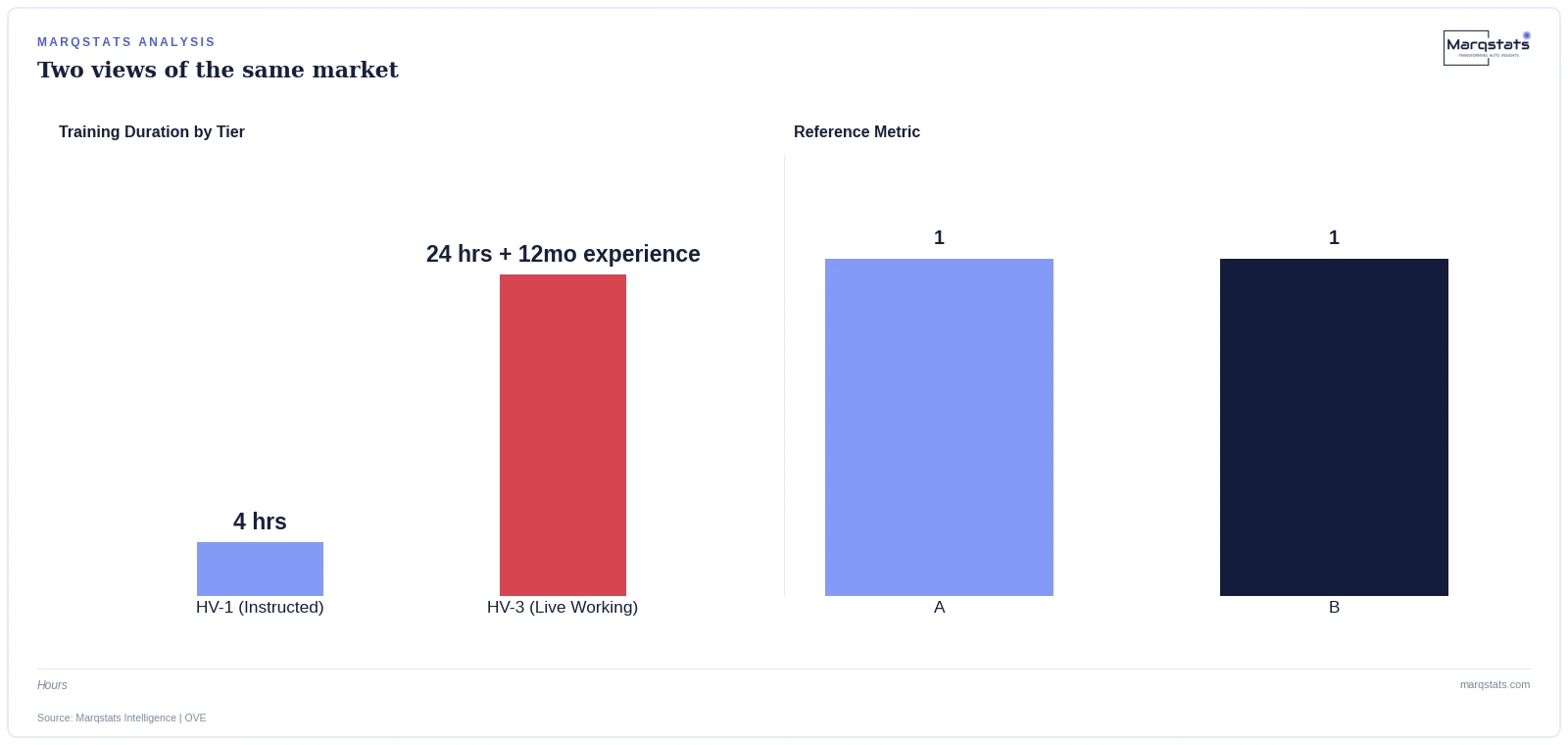
HV-0 covers basic hazard awareness for non-technical staff like service advisors and lot drivers. HV-1, a 4-hour course, lets tire technicians and general mechanics work on intact, energized vehicles without touching the high-voltage system directly — tire changes, suspension work, friction brake service. HV-2, a 16-to-24-hour program, authorizes de-energizing the system entirely and replacing isolated components. HV-3, the top tier, permits live circuit work and physically opening a battery enclosure.
The Detail Most People Miss: HV-3 Isn't Just More Training
That distinction changes the realistic timeline for building this capability internally.
HV-3 certification isn't simply a longer course than HV-2 — it specifically requires at least 12 months of documented field experience working as an HV-2 technician first. That's a genuine time barrier on top of the training hours, not just an additional exam to pass.

A Named Comparison: Why This Differs From a Simple Pass/Fail Certification
Many professional certifications are binary — you either hold the credential or you don't, and it covers everything in the field. Austria's framework is deliberately layered instead, matching training investment to the actual risk of the work being performed. A tire technician doesn't need battery-opening credentials to mount tires safely on an EV; a technician opening a crash-damaged battery pack needs far more than a 4-hour course. That precision is exactly why independent workshops without HV-2 or HV-3 staff are legally barred from advanced repairs — the law is enforcing a genuine, graduated risk boundary, not an arbitrary gate.
Why This Structure Isn't Likely to Simplify
As battery chemistries and voltage architectures grow more complex, particularly with 800-volt platforms becoming standard on new models, there's little reason to expect Austria's regulators to collapse this four-tier structure into something simpler -- if anything, the granularity is likely to persist as the safest way to match training investment to genuinely different risk levels of work.
What This Means for Workshop Hiring and Investment
The practical takeaway: independent workshops should map their service ambitions directly onto this tier structure before investing — a shop targeting routine tire and brake work only needs HV-1 staff, while one pursuing complex battery repair work needs to budget for the full HV-2-to-HV-3 pipeline, field experience requirement included.