5G Is About to Take Over Every New Connected Car. Here's the Timeline.
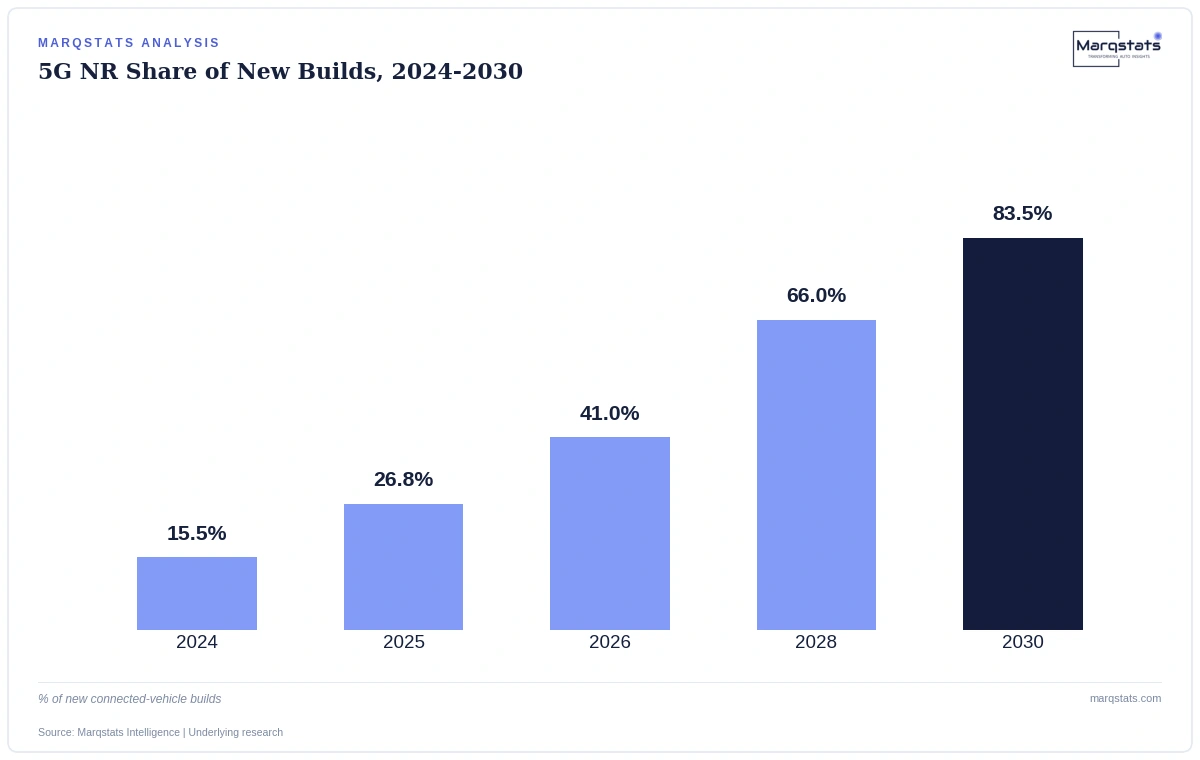
In 2024, 5G New Radio hardware made up just 15.5% of new connected-vehicle builds worldwide. By 2030, that share is projected to hit 83.5%. That's one of the fastest hardware transitions documented anywhere in the connected-car industry — and it's happening for a specific, technical reason, not just because 5G is newer and faster.
The Actual Numbers Along the Way
The curve isn't a straight line — it accelerates. 5G NR penetration reaches 26.8% in 2025, crosses 41.0% by 2026, passes the majority mark at 66.0% by 2028, and reaches 83.5% by 2030. Meanwhile 4G LTE's own share compresses from 84.5% in 2024 to just 16.5% by 2030 — 5G isn't just gaining share, it's becoming the default while 4G becomes the exception.
Why This Timeline Deserves Attention Now, Not Later
Two forecast years from this analysis's own base year, the majority crossover already sits well within any reasonable near-term planning horizon for automakers, suppliers and infrastructure investors alike — not a distant, abstract milestone but a genuinely close one.
Why 5G Specifically, and Why Now
The driver isn't consumer demand for faster infotainment streaming — it's latency. Cooperative perception (vehicles sharing sensor data with each other and roadside infrastructure in real time) and centralized edge-compute handoffs, where processing shifts dynamically between onboard systems and cloud infrastructure, both require transmission latencies that 4G LTE structurally cannot deliver at scale. As centralized zonal compute architecture becomes the industry standard, the underlying network has to keep pace, and only 5G's latency profile does.
A Named Comparison: How Germany's Own Infrastructure Compares
Germany, covered elsewhere in this coverage set, already shows roughly 95% national 5G surface coverage — network infrastructure genuinely ready to support this hardware transition well ahead of it actually happening at the vehicle level. That gap between network readiness and vehicle-side adoption is itself informative: the bottleneck on 5G connected-car adoption isn't cellular infrastructure in mature markets at all, it's hardware cost and automaker platform refresh cycles, which move meaningfully slower than network buildout does.
Who's Actually Driving This Transition
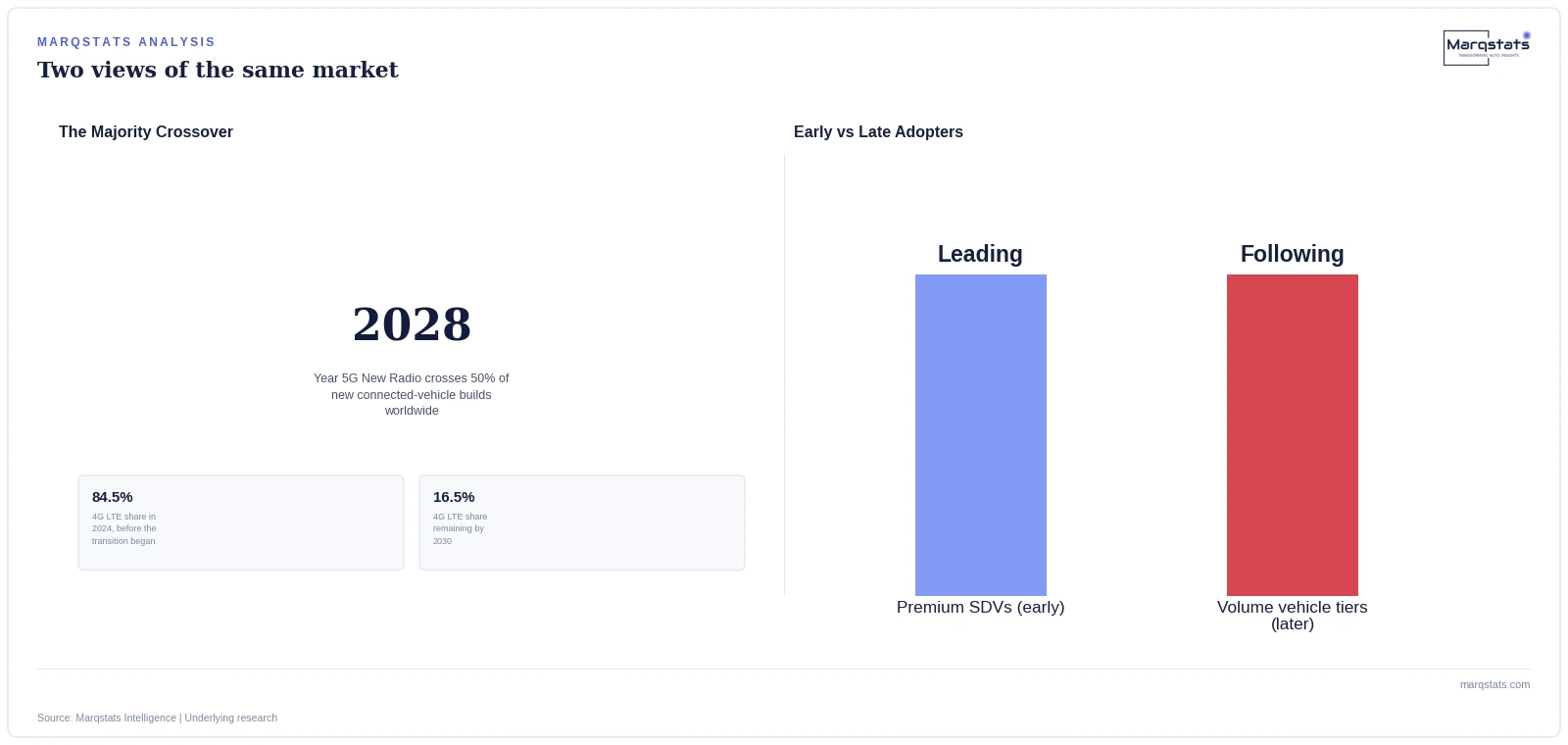
Early 5G adoption concentrated specifically in premium software-defined electric vehicles across China, North America and Europe — the vehicle segment with both the compute architecture and the price point to absorb 5G hardware costs first. As component costs fall along the predictable curve component pricing typically follows, the technology broadens into volume vehicle tiers, which is exactly what the 2026-to-2028 acceleration in the projection reflects.
Why This Transition Looks Different From Past Cellular Generation Shifts
Previous cellular generation transitions in the automotive space — 3G to 4G, for instance — were driven primarily by network sunset schedules forcing hardware replacement on existing vehicles, a reactive, retrofit-driven pattern. This 4G-to-5G shift is different: it's proactive, driven by new-vehicle feature requirements rather than legacy network retirement, which is precisely why the adoption curve looks like a genuine S-curve accelerating through the middle years rather than a slower, more linear retrofit-paced transition.
What This Means for Anyone in the Hardware Supply Chain
Tier-1 suppliers and chipmakers still weighted toward 4G LTE production capacity have a narrowing window to shift — the majority crossover at 2028 is only two forecast years away from this report's own base year, meaning capacity planning decisions made today will land squarely in the middle of this transition, not ahead of or behind it.
That distinction matters for forecasting too — a proactive, feature-driven transition is more sensitive to component cost curves and automaker platform cycles than to any single network shutdown date, meaning the 2028 crossover point modeled here could plausibly shift if 5G hardware costs fall faster or slower than currently assumed, in a way a retrofit-driven transition tied to a fixed shutdown date typically wouldn't.