Market Snapshot
Middle bar: base-year value × (1 + CAGR), rounded to two decimals. This is a calculated illustration, not a separately researched annual estimate.
The United States last-mile delivery robot market is now past the pure pilot stage but not yet a mass-market, citywide utility—it is commercially real, operationally selective, and regulatorily fragmented. Serve Robotics has deployed 2,000 robots (the largest sidewalk delivery fleet in the US), scaled to 20 cities across 6 major metropolitan areas with 4,500+ merchant partners, and issued 2026 revenue guidance of approximately USD 26 million. Starship Technologies has completed 9+ million autonomous deliveries, operates 2,700+ robots across 270+ locations, and is present on 60+ university campuses in the US serving 1.5 million students. Coco Robotics has completed 500,000 deliveries, produced 1,000 robots, and works with 3,000 merchant partners across Los Angeles, Chicago, and Miami. Robot.com (the Kiwibot rebrand) has completed 1.7 million real-world robot tasks with 500+ robots in operation. The United States last-mile delivery robot market size was valued at approximately USD 287.45 million in 2025 and is projected to reach USD 1,142.68 million by 2030, expanding at a CAGR of 31.82% during the forecast period (2026–2030).
This is becoming a platform market as much as a robot market. DoorDash and Uber Eats are not robot manufacturers, but they may be the most strategically important actors because they are building the multi-modal delivery orchestration layer. DoorDash explicitly frames robot delivery as part of a broader system that integrates Dashers, drones, and autonomous robots—and both DoorDash+Coco and DoorDash+Serve operate within this multi-modal stack. Uber launched Uber Autonomous Solutions (February 2026), a comprehensive suite covering infrastructure, user experience, and fleet operations for autonomous vehicle partners, packaging AV training data, data-enriched mapping, complex venue management, regulatory support, fleet financing, remote assistance, and AV insurance into one platform. Nuro raised USD 106 million in Series E (April 2025, total funding USD 2.2 billion) for its vehicle-agnostic AI-based self-driving platform that enables integration across delivery vehicles, robotaxis, and commercial fleets.
Ground delivery vehicles account for more than 82% of the autonomous last-mile delivery market revenue, and short-range deployments hold approximately 88% share—confirming this is fundamentally a short-trip, sidewalk-and-neighbourhood market. The strongest product-market fit exists where three conditions align: short delivery radii, dense repeat demand, and low-speed public-space operation. That is why campuses are the most mature segment and dense urban food/convenience zones are the fastest-scaling. The biggest constraint is not robotics capability—it is the physical and political environment: cracked sidewalks, missing curb cuts, narrow pedestrian spaces, and a state-by-state regulatory patchwork with no single federal sidewalk-robot rulebook. Personal delivery devices (PDDs) are not regulated under motor vehicle codes, leaving oversight to individual states and municipalities. The Marqstats agentic AI market report provides complementary coverage of the autonomous decision-making and edge-AI software layers powering delivery robot navigation and fleet orchestration.
Key Takeaways
Market Overview & Analysis
Report Summary
The United States last-mile delivery robot market covers ground-based autonomous delivery robots used for food, grocery, retail, parcel, and campus deliveries: sidewalk robots (personal delivery devices / PDDs operating at low speed on pedestrian infrastructure), low-speed neighbourhood delivery bots, and road-legal autonomous delivery vehicles operating in geofenced urban zones. Drones are excluded. The scope covers three operating models: (1) campus/community delivery in semi-controlled environments (Starship, Robot.com/Kiwibot); (2) urban restaurant, convenience, and grocery delivery integrated into platform ecosystems (DoorDash+Coco, DoorDash+Serve, Uber+Serve); and (3) enterprise logistics and localised commercial delivery (Robot.com campus/enterprise, Nuro road-legal delivery). Revenue models covered include Robot-as-a-Service (RaaS), per-delivery fees, platform commission, hardware sales, and advertising/data monetisation.
The market is fundamentally a micro-zone market, not a citywide one. The economics work first in bounded service areas where order density justifies robot deployment: campus dining halls, dense urban restaurant corridors, and DashMart-style convenience hubs. DoorDash and Coco’s initial Los Angeles and Chicago rollout covered nearly 600 participating merchants; early DashMart pilots plus restaurant delivery produced more than 14,000 deliveries before Miami expansion. Serve’s footprint across Los Angeles, Miami, Dallas, Chicago, Atlanta, Fort Lauderdale, and Alexandria targets high-order-density neighbourhoods. The market expands zone by zone as operators demonstrate viability, gain permits, and scale merchant networks.
Market Dynamics
Key Drivers
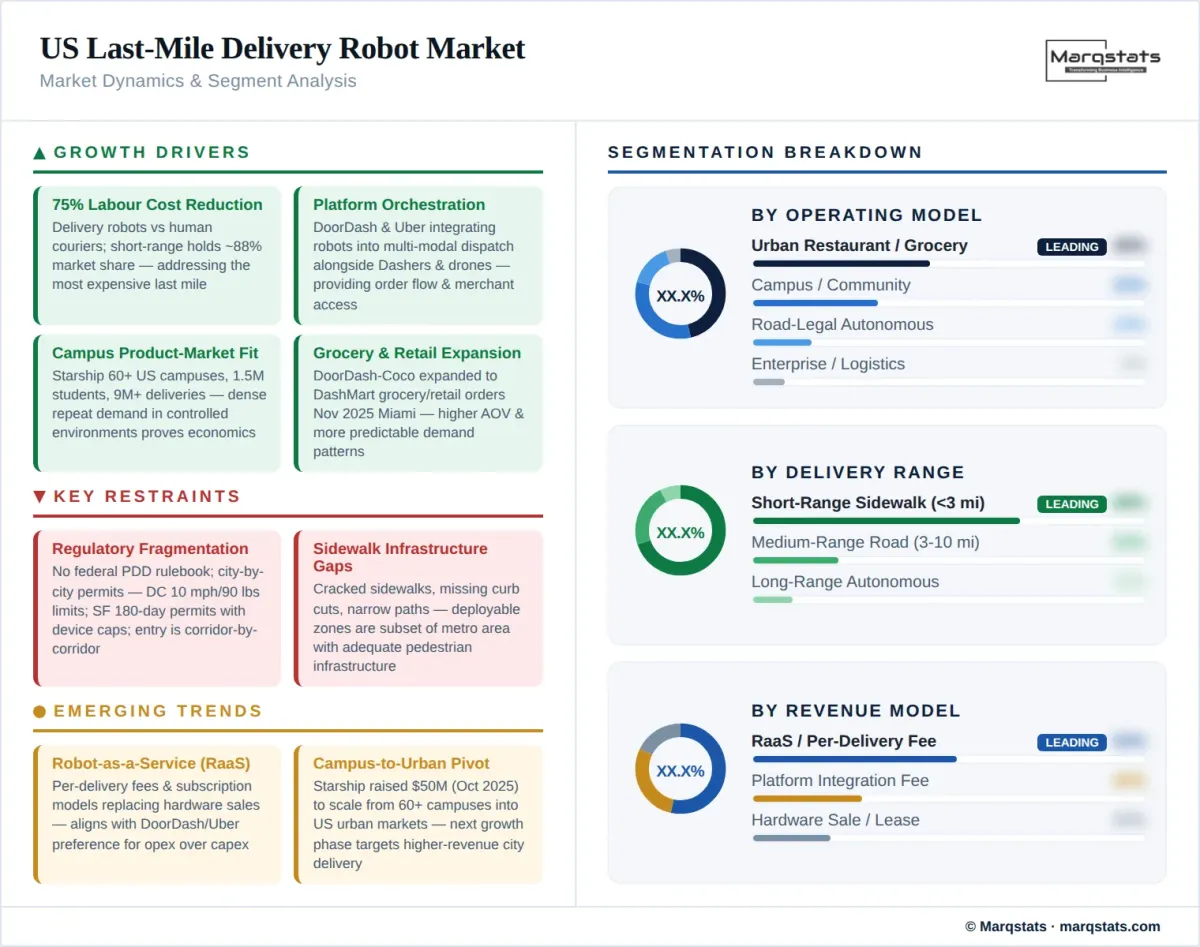
- E-commerce and on-demand delivery creating structural demand for low-cost last-mile fulfilment: On-demand e-commerce and labour constraints are the primary US growth drivers. Short-range deployments hold approximately 88% market share, confirming this is a short-trip market where delivery robots address the most expensive last mile. Delivery robots enable up to 75% labour cost reduction per delivery compared to human courier costs, making them economically compelling at scale in high-density zones.
- DoorDash and Uber platform orchestration integrating robots into multi-modal delivery: DoorDash explicitly describes robot delivery as part of a broader system integrating Dashers, drones, and autonomous robots. Uber launched Autonomous Solutions (February 2026) packaging infrastructure, UX, and fleet operations for AV partners. Both platforms create demand for robots as a fulfilment mode inside dispatch systems, not as standalone novelties. This platform integration is the most important commercial enabler because it provides merchant access, order flow, and consumer trust that standalone robot companies cannot build independently.
- Campus delivery proving product-market fit at scale: Starship operates on 60+ US campuses serving 1.5 million students with 9+ million completed deliveries. Campus delivery combines dense repeat demand, short delivery radii, controlled environments, and a demographic (students) with high app adoption. Robot.com (Kiwibot rebrand) has completed 1.7 million tasks with customers including major campus food-service operators. Campus delivery is the market’s proof-of-concept engine and the segment where unit economics are most favourable.
- Nuro’s USD 2.2 billion total funding validating road-legal autonomous delivery: Nuro raised USD 106 million in Series E (April 2025), bringing total funding to USD 2.2 billion at a USD 6 billion valuation. Nuro’s vehicle-agnostic platform offers both Level 4 (Nuro Driver) and Level 2++ (Nuro Driver Assist), enabling integration across delivery vehicles, robotaxis, and commercial fleets. Lenovo partnered with Nuro (March 2025) combining Lenovo’s AD1 domain controller with the Nuro Driver system. This positions road-legal autonomous delivery vehicles as a parallel growth track alongside sidewalk robots.
- Hyundai developing on-device AI chip for delivery robots without cloud dependency: Hyundai’s Robotics LAB and DEEPX co-developed an edge-brain on-device AI chip consuming less than 5 watts, enabling autonomous robot operation without network connectivity—critical for delivery robots in underground parking lots, logistics centres, and areas with unstable connectivity. Hyundai’s DAL-e Delivery robot uses this technology in the demonstration and validation phase. This signals major automotive OEM investment in delivery robot intelligence infrastructure.
Key Restraints
- Regulatory fragmentation: no federal PDD rulebook, city-by-city permitting: Personal delivery devices are not regulated under motor vehicle codes, leaving oversight to individual states and municipalities. Washington DC permits PDDs under Public Right of Way Occupancy Permits (≤10 mph, ≤90 lbs, sidewalks/crosswalks/alleyways only, must yield to pedestrians). San Francisco limits PDD permits to 180 days with at most two 90-day extensions and can cap device numbers. This patchwork means operators cannot enter “the US”—they enter city by city, corridor by corridor, permit by permit. Regulation is a market-sizing constraint, not just a compliance issue.
- Sidewalk infrastructure quality limiting deployable zones: Multi-city pilot studies concluded that robots failed in some neighbourhoods because of cracked sidewalks, overgrown trees, parked cars across pedestrian space, missing curb cuts, and narrow sidewalks. Where sidewalks are bad for wheelchair users and pedestrians, they are usually bad for robots. This means the addressable market within a city is the subset of zones with adequate pedestrian infrastructure, not the entire metro area.
- Social friction and consumer acceptance still developing: Delivery robots are raising concerns about how they interact with public space. Industry reporting notes robots face consumer pushback even as deployments accelerate. Pedestrian acceptance, right-of-way conflicts, and community sentiment vary significantly by neighbourhood and city. Operators must invest in community engagement and transparent operating protocols alongside pure technology deployment.
Key Trends
- Robot-as-a-Service (RaaS) replacing hardware-sale economics: Robot operators increasingly monetise through per-delivery fees and RaaS subscription models rather than selling robots outright. This creates recurring-revenue business models where robot companies maintain, update, and manage fleets while merchants and platforms pay per delivery or per robot per month. RaaS aligns with platform economics: DoorDash and Uber prefer operational cost per delivery over capital expenditure on robot hardware.
- Grocery and retail delivery expanding beyond restaurant food: DoorDash and Coco expanded into DashMart grocery and retail orders (November 2025 Miami expansion)—moving the US market beyond restaurant food into broader e-commerce last-mile delivery. This is commercially significant because grocery and retail orders have higher average order values and more predictable demand patterns than restaurant delivery, potentially improving unit economics.
- Starship pivoting from campus dominance toward US urban markets: Starship raised USD 50 million (October 2025) specifically to scale from its dominant US campus position into American urban markets. This signals the market’s maturation: campus operations proved the technology, and the next growth phase targets higher-revenue urban food, grocery, and convenience delivery where competition with Serve and Coco intensifies.
- indiGO Technologies acquiring Clevon’s autonomous delivery technology for US market: US tech company indiGO Technologies acquired Estonian autonomous vehicle developer Clevon (June 2025), gaining autonomous delivery robot technology that will be integrated into electric vehicles designed for delivery and ride-sharing in the US market. This cross-border technology acquisition pattern shows that US operators are sourcing autonomous delivery capabilities globally.
Market Segmentation
The most mature and economically proven segment. Starship operates on 60+ US campuses serving 1.5 million students, with 9+ million cumulative deliveries. Robot.com (Kiwibot rebrand) serves campuses and enterprise logistics with 1.7 million completed tasks. Washington DC officially permits Kiwi Campus as a PDD operator. Campus delivery combines dense repeat demand, short radii (typically 0.5–2 miles), controlled environments, and high app-adoption demographics. This segment proves the core technology proposition and generates the most predictable unit economics.
The fastest-growing segment by fleet deployment and merchant count. Serve Robotics: 2,000 robots, 20 cities, 4,500+ merchants, USD 26 million 2026 revenue guidance. DoorDash+Coco: launched in LA and Chicago (April 2025, ~600 merchants), expanded to Miami (November 2025) with DashMart grocery/retail. DoorDash+Serve: multi-year partnership from October 2025, starting in LA. Uber+Serve: expanding across multiple US cities. This segment is where platform orchestration creates the most commercial value, and where the transition from restaurant-only to grocery/retail delivery expands the addressable market.
Nuro leads this segment with its Level 4 Nuro Driver and Level 2++ Nuro Driver Assist platforms, USD 2.2 billion total funding, and partnerships with Lenovo (AD1 domain controller) and NVIDIA DRIVE. Nuro’s vehicle-agnostic approach enables integration across purpose-built delivery vehicles and commercial fleets. This segment operates on roads rather than sidewalks, serving larger delivery radii and heavier payloads than sidewalk robots, but faces different regulatory requirements (motor vehicle codes vs PDD laws).
The dominant application by delivery volume. DoorDash, Uber Eats, and platform-integrated robot delivery started here. Short delivery radii (typically under 2 miles), time-sensitive orders, and high order density in restaurant corridors make food delivery the natural entry point for sidewalk robots. Serve, Coco, and Starship all built initial scale on restaurant delivery.
The expansion frontier. DoorDash+Coco’s November 2025 Miami expansion explicitly included DashMart grocery and retail orders—the first major US robot delivery expansion beyond restaurant food. Grocery orders have higher average order values and more predictable scheduling. This application requires robots with larger cargo capacity and more robust temperature management than restaurant-only food delivery.
An emerging application where delivery robots address the most expensive segment of e-commerce logistics. Industry analysis indicates that short-range deployments hold approximately 88% of the autonomous last-mile market, and delivery robots enable up to 75% labour cost savings per delivery. Amazon, FedEx, and UPS have all explored last-mile robot and autonomous delivery programmes, though sidewalk-robot parcel delivery is still earlier-stage than food and grocery.
By Geography
California (Los Angeles, San Francisco)
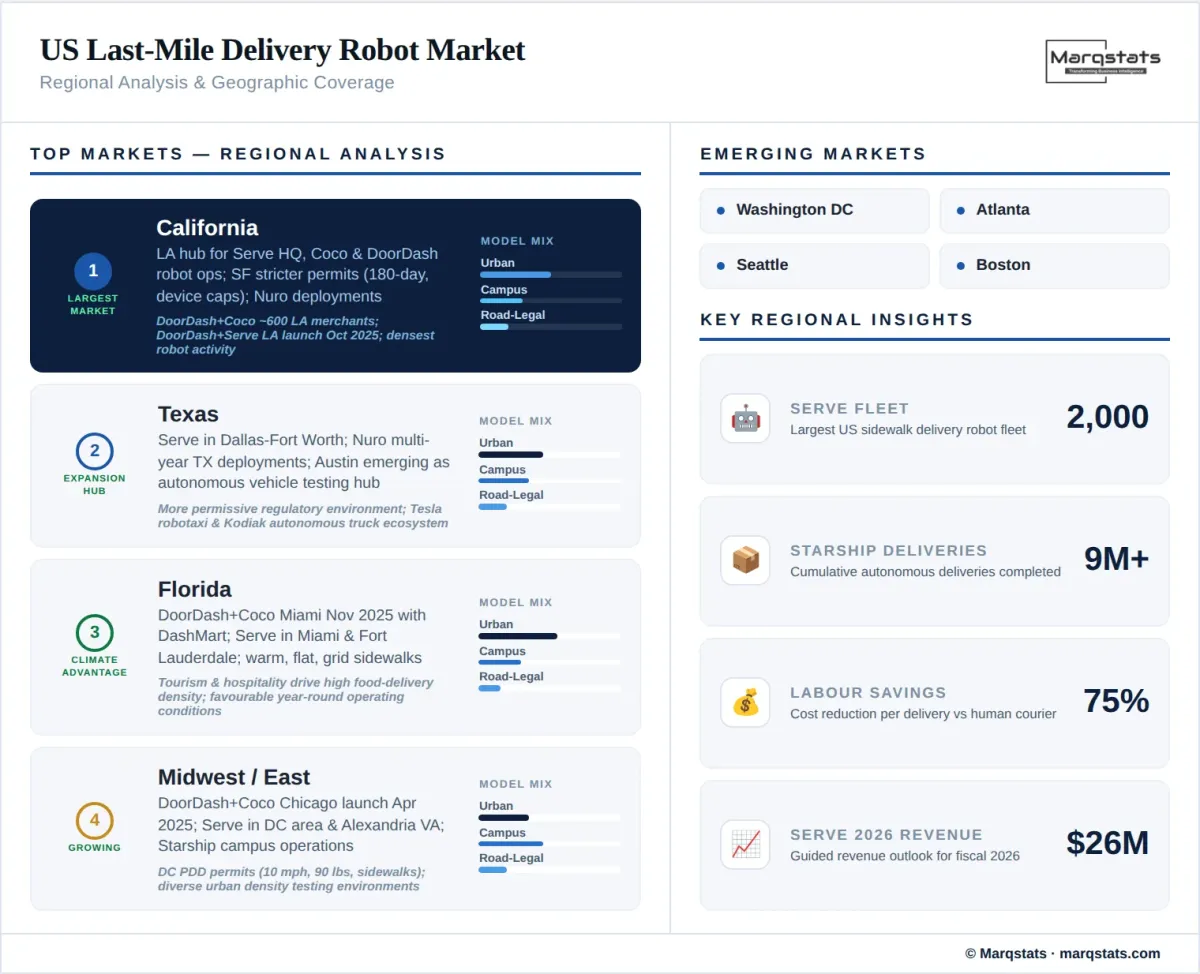
The largest single-state market for delivery robot operations. Los Angeles is the hub for Serve Robotics (headquartered), Coco Robotics, and DoorDash robot deployments. DoorDash+Coco launched in LA (April 2025) with ~600 merchants; DoorDash+Serve launched in LA (October 2025). San Francisco has stricter permitting: 180-day limits, capped device numbers, and city control over testing areas. Nuro operates in California with real-world deployments dating back four years.
Texas (Dallas-Fort Worth, Austin)
A major expansion market. Serve Robotics operates in Dallas-Fort Worth. Nuro has deployed in Texas for multiple years. Austin is emerging as an autonomous vehicle testing hub (Tesla robotaxi service, Kodiak autonomous truck hub), creating a technology ecosystem that benefits delivery robot operations. Texas regulatory environment is generally more permissive than California for autonomous vehicles and PDDs.
Florida (Miami, Fort Lauderdale)
DoorDash+Coco expanded to Miami (November 2025) with DashMart grocery and retail integration. Serve Robotics operates in Miami and Fort Lauderdale. Florida’s warm climate, flat terrain, and grid-pattern sidewalks create favourable operating conditions for sidewalk robots. The state’s tourism and hospitality economy also creates high food-delivery demand density.
Midwest (Chicago, Atlanta)
DoorDash+Coco launched in Chicago (April 2025) alongside Los Angeles. Serve operates in Chicago and Atlanta. These cities test delivery robot viability in colder climates, mixed pedestrian infrastructure, and different regulatory environments than Sun Belt markets. Chicago’s dense restaurant corridors and Atlanta’s suburban expansion test both urban and neighbourhood delivery models.
Washington DC / Virginia
Washington DC has a formalised PDD permit structure: Public Right of Way Occupancy Permit, devices ≤10 mph, ≤90 lbs excluding cargo, sidewalks/crosswalks/alleyways only, must yield to pedestrians. Kiwi Campus (Robot.com) is a permitted DC operator. Serve expanded into Alexandria, Virginia (December 2025), signalling East Coast growth beyond the California-first footprint.
How Competition Is Evolving
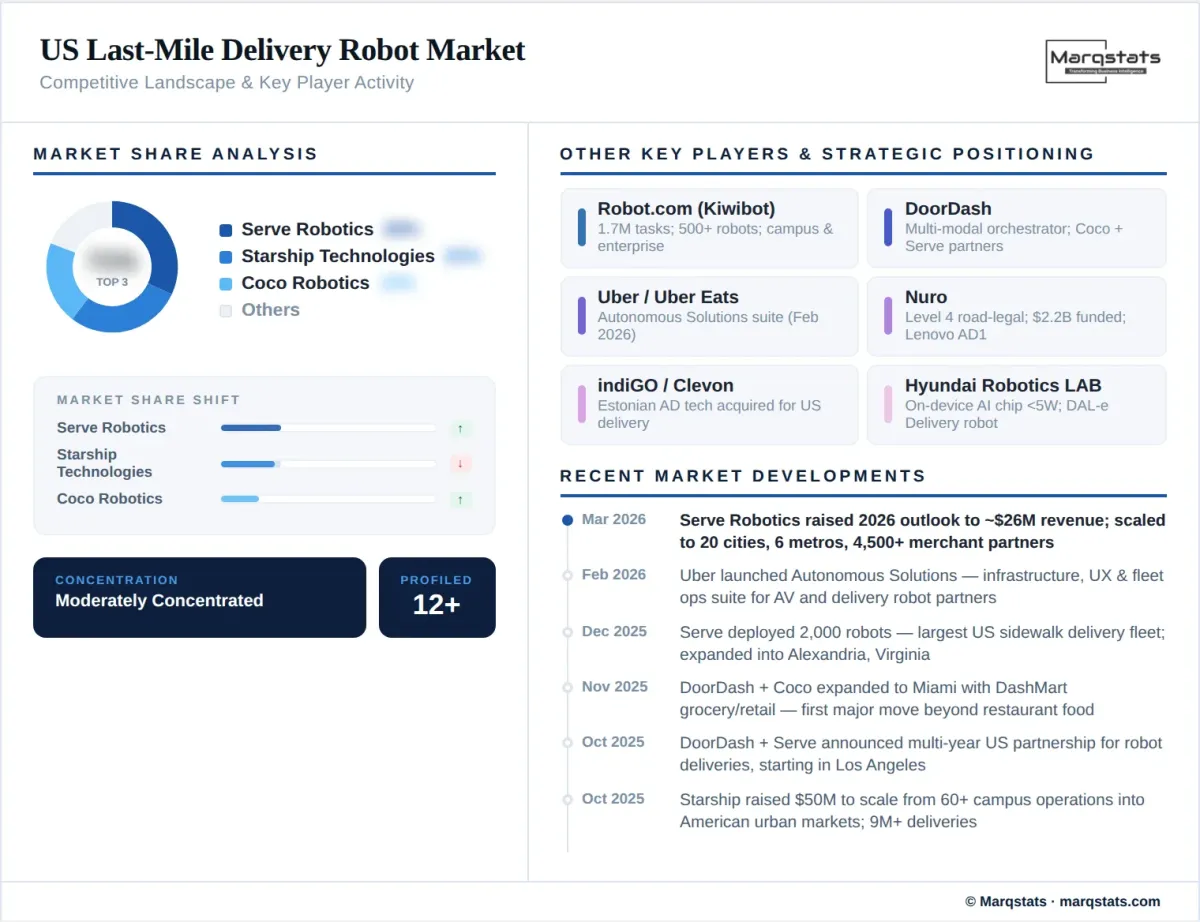
The US last-mile delivery robot market has four competitive layers. First, dedicated robot operators: Serve Robotics leads by fleet size (2,000 robots, 20 cities, 4,500+ merchants, USD 26M revenue guidance), Starship Technologies leads by cumulative deliveries (9+ million, 2,700+ robots, 60+ campuses, USD 50M raised October 2025), Coco Robotics leads in DoorDash platform integration (500,000 deliveries, 1,000 robots, 3,000 merchants, LA/Chicago/Miami), and Robot.com (Kiwibot rebrand) leads in campus/enterprise diversity (1.7 million tasks, 500+ robots, DC-permitted).
Second, platform orchestrators: DoorDash and Uber Eats are building multi-modal dispatch systems where robots are one fulfilment mode alongside human couriers and drones. DoorDash has active partnerships with both Coco and Serve. Uber launched Autonomous Solutions (February 2026) packaging infrastructure, UX, and fleet operations for all AV partners. These platforms control merchant access, consumer demand, and fulfilment routing—making them potentially the most commercially powerful actors even though they do not build robots.
Third, road-legal autonomous delivery: Nuro (USD 2.2 billion funded, USD 6 billion valuation) offers vehicle-agnostic Level 4 and Level 2++ self-driving platforms for delivery vehicles and commercial fleets. Lenovo partnered with Nuro (March 2025) for autonomous driving acceleration. indiGO Technologies acquired Clevon (June 2025), bringing Estonian autonomous delivery technology to the US market. Fourth, technology enablers: Hyundai’s on-device AI chip (less than 5 watts, no cloud required) for delivery robots and autonomous systems, NVIDIA DRIVE platform powering Nuro and other autonomous delivery systems, and edge-AI/sensor-fusion companies enabling autonomous navigation on sidewalks and roads.
Companies Covered
Companies covered in the report include:
Recent Market Activity
Table of Contents
Coverage & Segmentation
This report provides a comprehensive analysis of the United States last-mile delivery robot market covering the historical period (2021–2025) and forecast period (2026–2030), with 2025 as the base year. The study examines market size in USD and unit volume across operating model (campus/community, urban restaurant/grocery, road-legal autonomous delivery), application (food, grocery/retail, parcel/e-commerce), robot type (sidewalk PDD, low-speed neighbourhood, road-legal AV), business model (RaaS, per-delivery, platform commission, hardware sales), and geography covering 10 US states/metro areas. Company profiling covers 10+ players across dedicated robot operators, platform orchestrators, road-legal autonomous delivery, and technology enablers. Regulatory analysis covers PDD legislation by state, DC/San Francisco permitting frameworks, motor vehicle code applicability, and emerging federal PDD standards discussions.
Research methodology combines bottom-up modelling from operator fleet size disclosures (Serve 2,000, Starship 2,700+, Coco 1,000, Robot.com 500+), cumulative delivery counts (Starship 9M+, Robot.com 1.7M, Coco 500K), platform partnership announcements (DoorDash+Coco, DoorDash+Serve, Uber+Serve), revenue guidance (Serve USD 26M for 2026), and merchant network counts. Primary research encompasses 40+ interactions with robot operator executives, DoorDash/Uber autonomous delivery programme managers, city permitting officials, campus food-service operators, and delivery-robot technology suppliers.