Market Snapshot
Middle bar: base-year value × (1 + CAGR), rounded to two decimals. This is a calculated illustration, not a separately researched annual estimate.
The global Mobility-as-a-Service (MaaS) market was valued at USD 7.80 billion in 2025 and is projected to reach USD 32.50 billion by 2030, expanding at a CAGR of 33.08% during the forecast period 2026–2030. MaaS remains fundamentally a governance and payments integration market more than a pure application market. The gap between the “one app for all transport” vision and actual adoption is largely a payment interoperability, data-sharing, and institutional coordination gap. The strongest public evidence of progress is occurring through fare and ticketing modernisation—account-based ticketing, open-loop contactless payment, stored value integrations—and city-scale platforms that combine journey planning with incentives, such as Beijing’s MaaS platform with its carbon-inclusive campaign reaching over 24 million cumulative users and approximately 3 million daily active users.
MaaS should be understood as an integrated mobility concept enabling travellers to plan, book, and pay for multimodal transport through a single digital interface, using pay-as-you-go and subscription models. However, “full integration” requires aligning heterogeneous systems with fundamentally different business models: public transport fares, private micromobility pricing, ride-hail dispatch economics, parking rules, and subsidy programmes. OECD research consistently identifies public transport integration and governance—data sharing, revenue allocation, and customer relationship ownership—as the major determinants of whether MaaS scales beyond pilots. The practical path to progress is therefore layered: cities typically start with integrated journey planning (information layer), add booking and entitlements via APIs or deep links (transaction layer), and only later reach unified payment and subscriptions (settlement layer).
The market is now experiencing consolidation and business model rationalisation. umob’s April 2024 acquisition of MaaS Global (Whim)—which had reached 1 million users and 30 million rides—signals both the economic pressure on pure subscription MaaS models and the need for scale. Meanwhile, Lyft completed its acquisition of FREENOW in July 2025, creating one of the largest global multi-mobility apps and potentially doubling Lyft’s addressable market to over 300 billion personal vehicle trips per year. Singapore expanded contactless transit payment acceptance with American Express in May 2025. The Los Angeles Mobility Wallet pilot frames MaaS-like integration as mobility equity infrastructure. These developments indicate that viable MaaS is evolving from consumer-subscription apps toward payment layer infrastructure, city-backed platforms, and super-app integrations anchored by public transport.
Key Takeaways
Market Overview & Analysis
Report Summary
The Mobility-as-a-Service market encompasses digital platforms that integrate multiple transport modes—public transit, ride-hailing, car sharing, micromobility (e-scooters, e-bikes), bike sharing, shuttle services, and parking—into a single interface for planning, booking, and payment. The market covers the full integration stack: journey planning and real-time information, booking and entitlements, payment and ticketing (including account-based ticketing and mobility wallets), clearing and revenue allocation between operators, and the underlying data infrastructure (GTFS feeds, real-time APIs, operator data sharing agreements). The market serves consumers (B2C), employers and corporations (B2B corporate mobility), and public agencies and transport authorities (B2G mobility orchestration).
A recurring structural problem in MaaS is that full integration requires aligning heterogeneous systems with different business models. Public transport operates on fare policies with transfer rules, caps, and concessions. Private micromobility runs on per-minute or per-ride pricing. Ride-hail operates on dynamic dispatch and surge economics. Parking has its own municipal rule set. OECD research documents the institutional and contractual friction—especially around revenue allocation and public service obligations—as core barriers to scaling beyond pilots. Without robust ticketing integration and settlement agreements, MaaS frequently stalls at the “planner app” stage, as underscored by UITP’s ticketing-focused analysis.
The most durable MaaS progress in 2024–2026 is occurring through payment and ticketing layers rather than consumer app subscriptions. Account-based ticketing, interoperable payment rails, and mobility wallets are becoming the practical infrastructure of integrated mobility. Several public-sector “mobility wallet” initiatives reframe MaaS as an equity tool—bundling mobility credits usable across transit and shared modes rather than forcing all services into a single commercial subscription. The Los Angeles Mobility Wallet pilot illustrates this direction. Meanwhile, the European Commission’s Eurobarometer-related communication highlights growing demand for seamless travel and signals continued EU interest in ticketing and booking integration as part of mobility policy.
Market Dynamics
Key Drivers
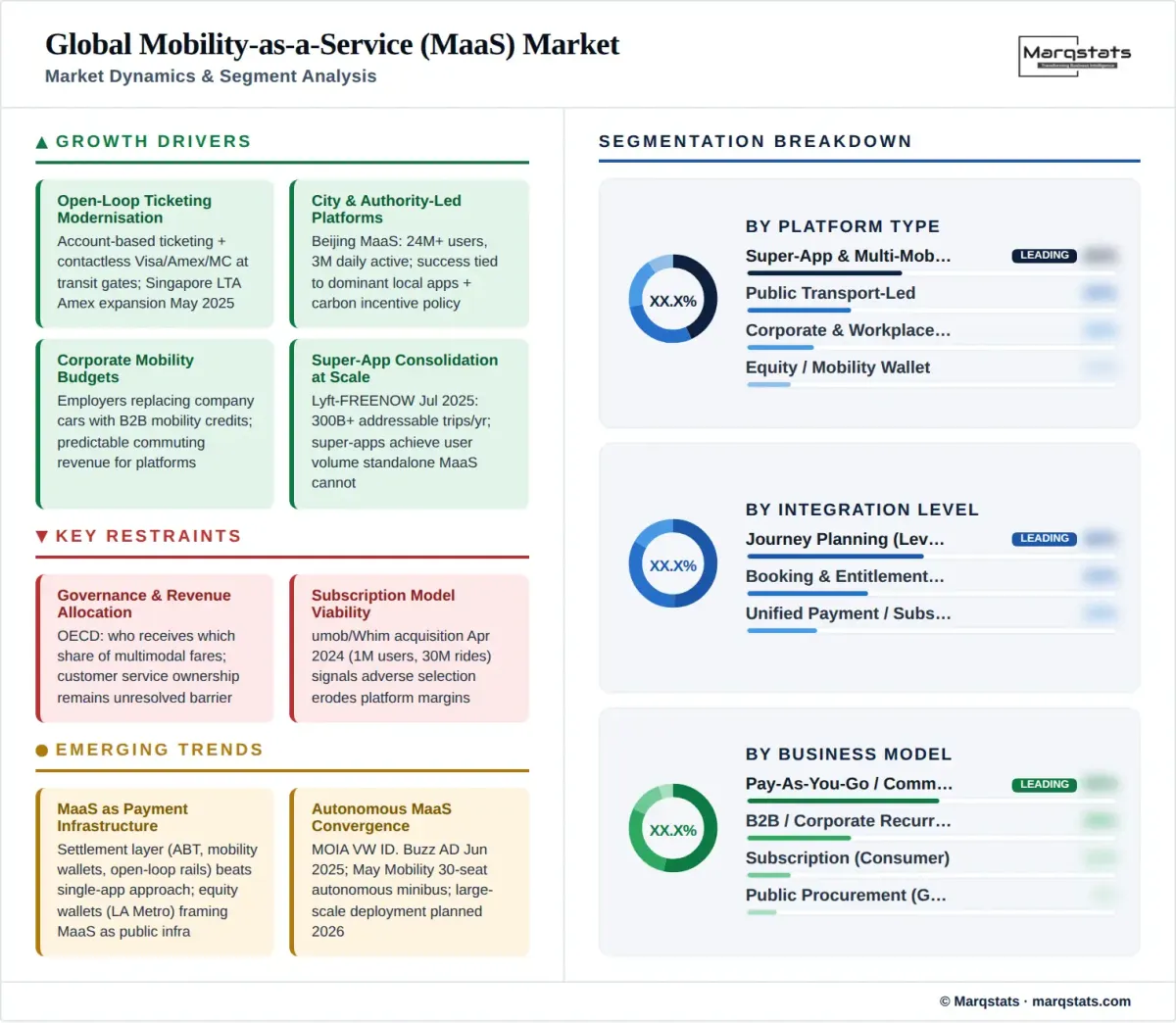
- Ticketing modernisation and open-loop payment reducing friction: The transition from closed-loop transit cards to account-based ticketing and open-loop contactless payment (Visa/Mastercard/Amex tap-to-pay at transit gates) is creating the payment substrate on which MaaS can operate. Singapore’s LTA expanded contactless payment acceptance with American Express in May 2025. Open-loop payment eliminates the need for dedicated transit cards, enabling tourists and occasional riders to access public transport seamlessly—a foundational requirement for multimodal integration.
- City mobility strategy and public transport authority engagement: The strongest MaaS deployments are city-backed or authority-led rather than pure startup ventures. Beijing’s MaaS platform (24M+ users, 3M daily active) succeeded because it was embedded in dominant local apps and aligned with carbon incentive policy. Transport authorities control fare policy, data access, and customer relationships—the three elements that determine whether third-party platforms can reach settlement-level integration or remain at journey planning only.
- Corporate mobility and employer-sponsored transit benefits: Employers are increasingly offering mobility credits, salary sacrifice schemes, and commuter benefit programmes as alternatives to company car fleets and parking subsidies. Corporate MaaS platforms bundle transit passes, micromobility credits, and ride-hail allowances into employee mobility budgets, creating a B2B demand channel that provides recurring revenue for platform operators and predictable utilisation for mode operators.
- Climate and equity policy priorities supporting mobility wallets: Public climate goals and transport equity mandates are creating institutional demand for MaaS-like integration. The LA Metro Mobility Wallet pilot frames integrated mobility access as a universal basic mobility (UBM) concept—distributing mobility credits across transit and shared modes to underserved communities. Carbon-inclusive mechanisms, as deployed in Beijing’s MaaS platform, incentivise mode shift from private cars to public and shared transport by crediting verified carbon reductions.
- Super-app and multi-mobility platform consolidation: Lyft’s July 2025 acquisition of FREENOW created one of the largest global multi-mobility apps, integrating taxis, private vehicles, car sharing, e-scooters, and e-bikes within a single app across Europe and North America. This super-app consolidation model provides the user base and transaction volume that standalone MaaS startups have struggled to achieve, suggesting that viable MaaS may increasingly be embedded within large platform ecosystems rather than operating as independent services.
Key Restraints
- Governance, revenue allocation, and operator coordination complexity: OECD research consistently identifies governance as the core MaaS scaling barrier. Revenue allocation between public transit operators, private micromobility companies, and ride-hail platforms requires contractual frameworks that define who receives what share of each multimodal fare. Customer service ownership (refunds, disruption handling, liability) is a persistent failure mode. Most cities lack the institutional machinery to negotiate and enforce these multi-party agreements.
- Subscription model sustainability under economic pressure: umob’s acquisition of MaaS Global (Whim)—despite Whim reaching 1 million users and 30 million rides—demonstrates that subscription-based MaaS economics remain challenging. Users tend to optimise subscriptions toward the most expensive modes (ride-hail, car rental), creating adverse selection that erodes platform margins. Pay-as-you-go and mobility wallet models are proving more financially sustainable than all-you-can-ride subscriptions.
- Fragmented fare rules and concession structures: Public transport fare policies involve complex transfer rules, zonal pricing, concession categories (students, seniors, disabled), and peak/off-peak differentials that resist monetisable bundles. Integrating these rules into MaaS platforms requires deep API access to fare engines that many transit agencies have not yet built or exposed. Without accurate fare calculation, MaaS payment integration fails.
- Data sharing and digital infrastructure gaps: MaaS platforms require real-time data feeds (GTFS-RT, SIRI) from every integrated operator. In many cities, operators lack the digital maturity to provide reliable real-time APIs. Data governance concerns—who owns user journey data, how it can be used commercially, and privacy compliance—create additional friction. National and city data infrastructure (open APIs, standardised feeds) remains a prerequisite that is unevenly deployed.
Key Trends
- MaaS as payment infrastructure rather than consumer app: The market’s centre of gravity is shifting from “one app for all transport” toward payment and settlement infrastructure that enables multimodal fare integration. Account-based ticketing, mobility wallets, and open-loop payment systems are the operational backbone of viable MaaS. This infrastructure-first approach allows multiple consumer-facing apps to access the same integrated payment layer rather than requiring all users to adopt a single MaaS app.
- Autonomous mobility services converging with MaaS platforms: MOIA (Volkswagen subsidiary) unveiled the VW ID. Buzz AD in June 2025, a fully autonomous production vehicle designed specifically for mobility services. MOIA’s AD MaaS software platform uses AI to manage fleets, support passengers, and connect with existing apps, with large-scale autonomous mobility services planned for 2026 in Europe and the US. May Mobility partnered with Tecnobus to develop a 30-seat autonomous electric minibus for transit agencies and fleet operators. These autonomous MaaS deployments represent a convergence of autonomous driving, fleet orchestration, and integrated mobility platforms.
- Mobility roaming and cross-border integration emerging: The European Commission’s signals about seamless booking and ticketing highlight demand for mobility roaming—the ability for travellers to use their MaaS credentials across cities and countries without re-registering or downloading new apps. Cross-operator integration requires standardised APIs, interoperable identity systems, and settlement agreements between platform operators in different jurisdictions.
- Equity-focused MaaS expanding the addressable market: Universal Basic Mobility (UBM) and mobility wallet programmes are expanding MaaS beyond affluent urban early adopters to underserved communities. The LA Mobility Wallet pilot, US DOT event-integrated ticketing proposals, and transit agency-backed credit programmes reframe MaaS as public infrastructure serving equity goals rather than purely commercial subscription services.
Market Segmentation
Public transport-led platforms are the most durable MaaS deployments because they anchor multimodal integration around the mode with the highest daily ridership, lowest marginal cost per trip, and strongest institutional governance. Beijing’s MaaS platform (24M+ users, 3M daily active) exemplifies this approach. These platforms typically start as journey planners integrated with transit fare engines, progressively adding shared mode booking and payment. Success depends on transport authority willingness to open fare APIs and share customer data under governed frameworks.
Super-apps that aggregate multiple mobility services within existing high-traffic platforms represent the fastest path to scale. Lyft-FREENOW (taxis, private vehicles, car sharing, e-scooters, e-bikes across Europe and North America), Grab (Southeast Asia), and DiDi (China) operate at transaction volumes that standalone MaaS startups cannot match. These platforms leverage existing user bases, payment infrastructure, and driver/operator networks to add multimodal integration incrementally.
Corporate MaaS platforms serve employers offering mobility budgets, commuter benefits, and fleet alternatives. These B2B platforms bundle transit passes, micromobility credits, ride-hail allowances, and parking into employee mobility accounts. Revenue is recurring (employer-funded) and usage is predictable (commuting patterns), making this segment more financially sustainable than consumer subscription MaaS.
Government-backed mobility wallet programmes distribute mobility credits across transit and shared modes to underserved populations. The LA Metro Mobility Wallet pilot and US DOT event-integrated ticketing proposals exemplify this model. These platforms are funded through public procurement rather than user subscriptions, creating a distinct revenue model tied to equity policy budgets and climate funding.
The base integration level providing multimodal journey planning and real-time arrival information without booking or payment. Most MaaS deployments globally remain at this level, offering route comparison and deep links to individual operator apps. This level requires GTFS/GTFS-RT data feeds but no fare integration or settlement agreements.
Mid-level integration enabling booking and ticket entitlements via APIs or deep links within the MaaS platform, but with separate payment processing per operator. Users can plan and book within one app but may process payments through individual operator payment systems.
Full integration enabling single-payment multimodal journeys, subscription bundles, and mobility wallets with unified settlement across operators. This level requires robust fare integration, revenue allocation agreements, and clearing infrastructure. Few MaaS deployments globally have reached this level at scale, though account-based ticketing and mobility wallet programmes are creating the foundation.
By Geography
Europe
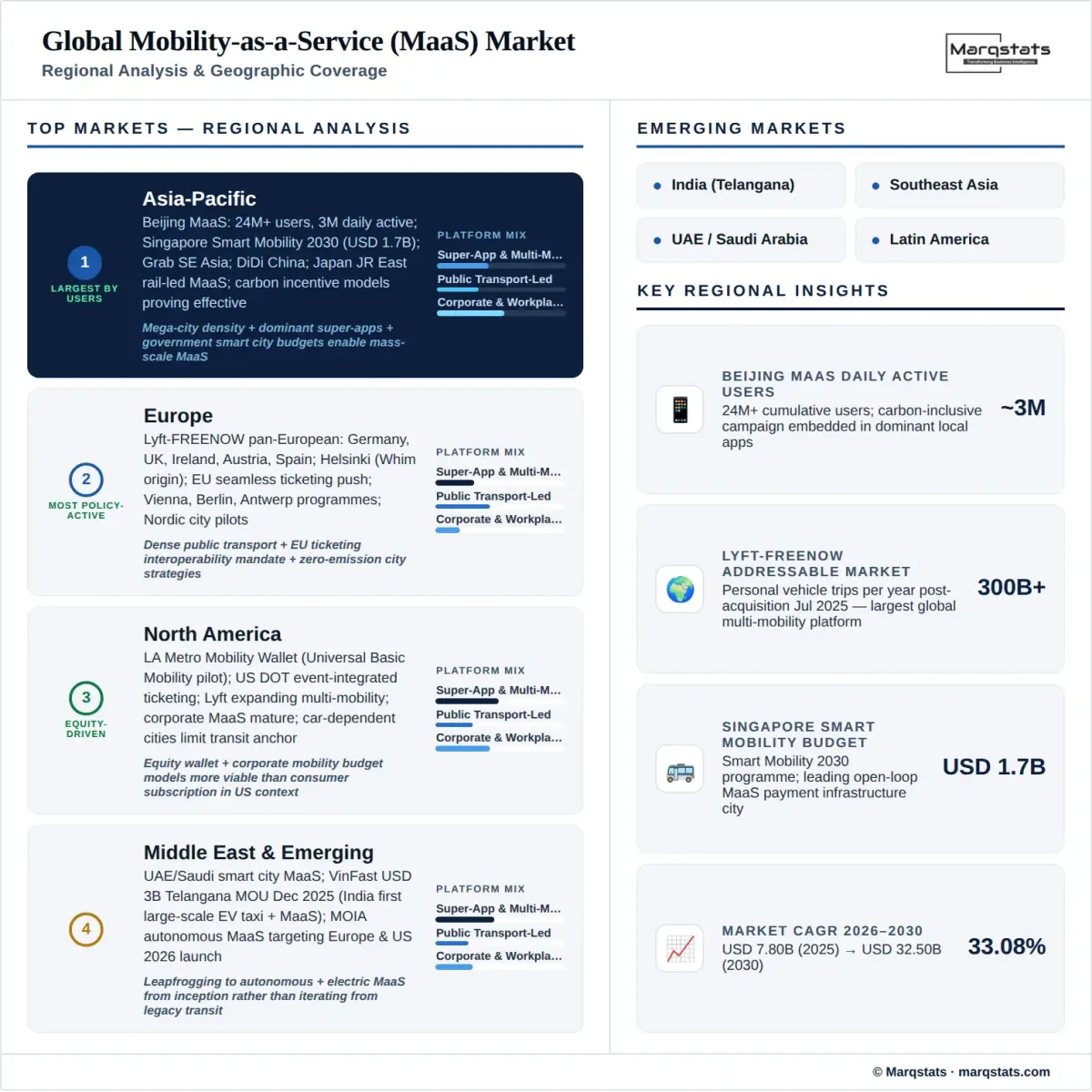
Europe is the most policy-active MaaS market, driven by strong public transport systems, city-level zero-emission mobility strategies, and EU interest in seamless ticketing and booking integration. The European Commission’s Eurobarometer-related communication highlights growing demand for integrated travel. Key deployments include Helsinki (Whim/umob origin), Berlin, Vienna, Antwerp, and multiple Nordic cities. Lyft’s FREENOW acquisition created a pan-European multi-mobility platform across Germany, UK, Ireland, Austria, and Spain. The EU’s revised urban mobility framework encourages multimodal integration and ticketing interoperability. Europe’s main advantage is dense public transport networks and high digital payment readiness; its main constraint is fragmented operator landscapes requiring complex multi-party governance.
Asia-Pacific
Asia-Pacific leads MaaS by user scale, driven by mega-city population density, dominant super-apps, and government-backed smart city programmes. Beijing’s MaaS platform reached 24M+ users and 3M daily active users with carbon-inclusive incentives. Singapore is a leading MaaS testbed with the Smart Mobility 2030 programme, LTA’s open-loop payment expansion (Amex contactless acceptance, May 2025), and a USD 1.7 billion smart mobility budget. Grab (Southeast Asia) and DiDi (China) function as de facto MaaS platforms with ride-hail, micromobility, and transit integration. Japan’s MaaS initiatives are rail-operator-led (JR East, Tokyu), leveraging the country’s dense rail networks and cashless payment systems.
North America
North America’s MaaS market is shaped by lower public transit density, car-dependent urban design, and a fragmented operator landscape. The Los Angeles Mobility Wallet pilot is the most significant recent development, framing MaaS as equity infrastructure. US DOT event-integrated ticketing proposals (LA Metro) aim to integrate trip planning with event ticketing. Lyft’s FREENOW acquisition extends its multi-mobility capability from Europe to North America. Corporate MaaS is relatively advanced, with employers offering mobility budgets as alternatives to company cars. The main constraint is limited public transport coverage in most US cities outside New York, Washington DC, San Francisco, and Chicago.
Middle East and Emerging Markets
The UAE, Saudi Arabia, and select emerging markets are developing MaaS through smart city programmes and public-private partnerships. VinFast’s December 2025 MOU with Telangana, India proposed a USD 3 billion multi-sector ecosystem including India’s first large-scale electric taxi fleet and MaaS platform using GSM technology. MOIA plans autonomous MaaS services in Europe and potentially the US starting 2026 using VW ID. Buzz AD vehicles. These markets are leapfrogging traditional MaaS evolution by integrating autonomous vehicles and electric fleets from inception.
How Competition Is Evolving
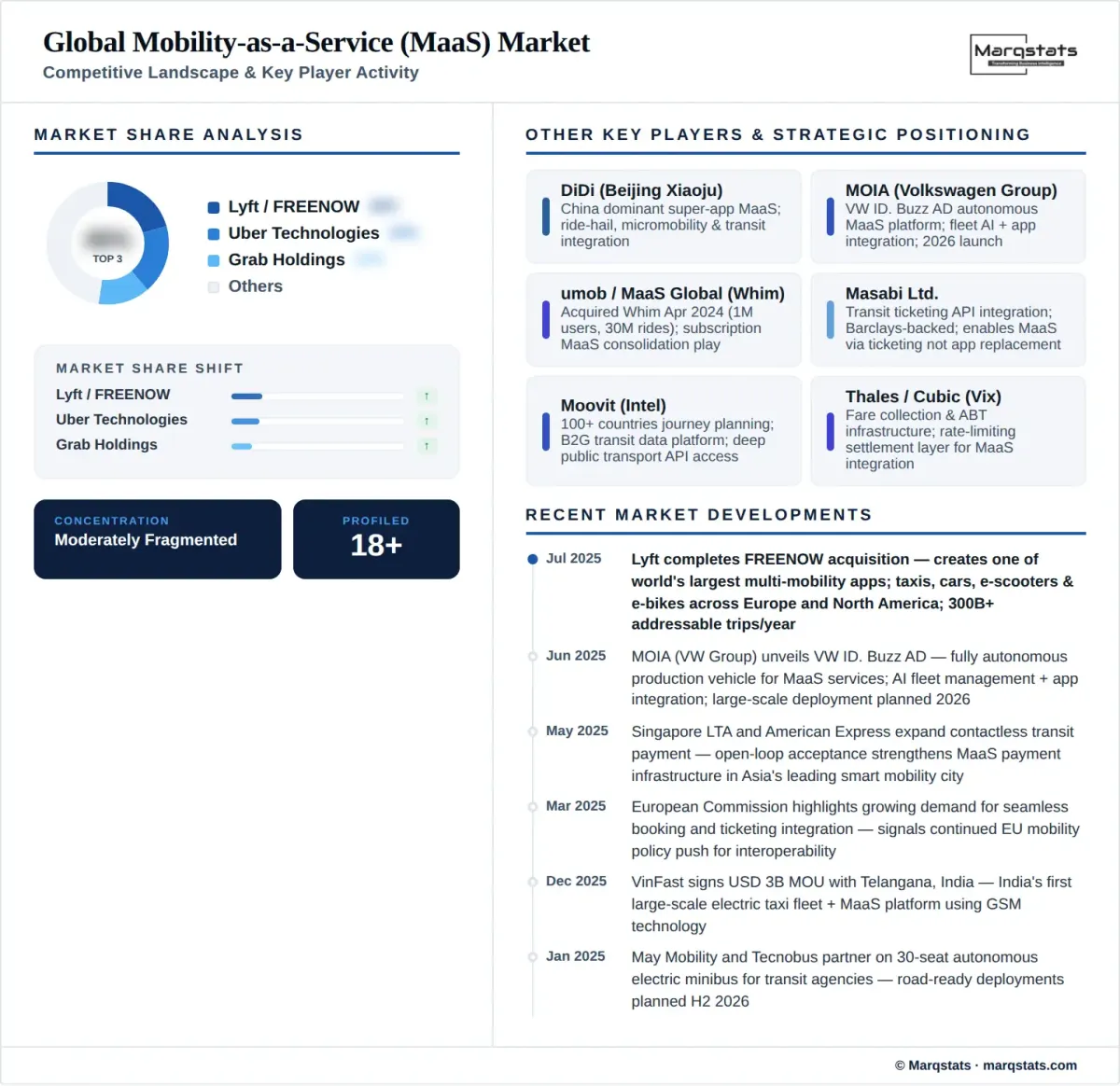
The MaaS competitive landscape operates across four layers: mobility platform operators, public transport ticketing infrastructure vendors, payment and identity providers, and shared mobility operators that plug into MaaS ecosystems. Among platform operators, Lyft-FREENOW is the largest global multi-mobility platform following the July 2025 acquisition. umob (having acquired MaaS Global/Whim in April 2024) represents the consolidation of subscription MaaS models. Grab and DiDi dominate Asia-Pacific super-app MaaS. MOIA (VW Group) is positioning autonomous MaaS as a turnkey solution for cities and fleet operators.
In public transport ticketing infrastructure, Thales sells mass-transit ticketing solutions representing the foundation many MaaS deployments depend on. Masabi promotes embedding ticket purchase into MaaS apps, emphasising practical MaaS through ticketing integration rather than full platform replacement. Cubic Transportation Systems (Vix Technology) provides fare collection and account-based ticketing platforms. These vendors are increasingly pivotal because ticketing and settlement infrastructure is the rate-limiting factor for MaaS integration, not journey planning or user interface.
Payment and identity integration is being driven by open-loop payment expansion (Visa, Mastercard, American Express contactless at transit gates), mobile wallets (Apple Pay, Google Pay), and emerging mobility-specific payment rails. The competitive winners in MaaS will be those who control the settlement layer—the clearing and revenue allocation between operators—rather than those who merely aggregate journey planning information.
Companies Covered
Companies covered in the report include:
Recent Market Activity
Table of Contents
Coverage & Segmentation
This report provides a comprehensive analysis of the global Mobility-as-a-Service market covering the historical period 2021–2025 and forecast period 2026–2030, with 2025 as the base year. The study examines market size in value (USD billion), segmented by platform type (public transport-led, super-app/multi-mobility, corporate MaaS, equity/mobility wallet), integration level (journey planning, booking, unified payment), service type (ride-hailing, car sharing, micromobility, transit, shuttle), business model (subscription, pay-as-you-go, B2B/corporate, public procurement), and geography (Europe, Asia-Pacific, North America, emerging markets). The competitive landscape profiles 18 leading platform operators, ticketing infrastructure vendors, and shared mobility providers.
Primary research includes structured interviews with 40+ industry stakeholders spanning MaaS platform operators, public transport authorities, ticketing and payment technology vendors, shared mobility operators, city mobility planners, and policy researchers. Secondary research draws from OECD mobility analysis, UITP MaaS ticketing reports, VREF research, IEA transport data, ACEA registration statistics, company disclosures, and city programme documentation. All market estimates represent Marqstats Intelligence proprietary calculations.