Market Snapshot
Middle bar: base-year value × (1 + CAGR), rounded to two decimals. This is a calculated illustration, not a separately researched annual estimate.
The India commercial two-wheeler market — encompassing all petrol, hybrid, and battery-electric scooters, motorcycles, and mopeds deployed for paid commercial applications including food delivery, grocery and quick commerce, parcel and courier delivery, pharmaceutical logistics, and bike-taxi services — was valued at USD 2.80 billion in 2025 and is projected to reach USD 6.20 billion by 2030, expanding at a CAGR of 17.24% during the 2026–2030 forecast period. While B2C buyers still constitute approximately 91.25% of India's total two-wheeler market by value, the commercial end-user segment is growing significantly faster — delivery and logistics fleets expanding at a 6.55% CAGR through 2031 at the macro level, with the hyperlocal subsector accelerating at approximately 39% year-on-year as quick commerce dark-store density deepens and Tier-2 city expansion compounds the fleet requirement.
India's commercial two-wheeler fleet crossed 28 million units by FY2025 — the world's largest commercially-deployed two-wheeler pool — anchored by delivery agents who account for approximately 80% of fleet ownership. Approximately 65% of this fleet remains concentrated in Tier-I cities (Delhi, Bengaluru, Hyderabad, Mumbai, Chennai, and Kolkata), though rapid expansion into Tier-2 and Tier-3 cities is being driven by quick commerce platform scale-up, dark-store proliferation, and e-commerce penetration into smaller urban centres. The fleet's application split is led by grocery delivery (the largest segment by fleet size), food delivery, bike taxi, and e-commerce and courier delivery. Platform disclosures from Zomato (400+ cities, 51,000+ active EV delivery partners), Swiggy (~691,000 average monthly transacting delivery partners in Q2FY26), Amazon India (500+ cities, 10,000 EVs in fleet), and Flipkart (10,000+ EVs, 100% EV last-mile by 2030) provide the most reliable quantitative anchors for fleet scale at the national level.
The commercial two-wheeler vehicle market is undergoing two structural shifts simultaneously: fleet electrification, which is lifting average selling prices as EV models price at a 30–50% premium to equivalent ICE scooters, and fleet professionalisation, as platforms move from rider-owned vehicle models toward fleet-as-a-service, rental, and battery-swap access models. India's annual electric two-wheeler registrations reached approximately 1.28 million units in calendar year 2025 — with an estimated 10–15% of new deliveries going into commercial applications — setting the stage for rapid EV penetration within the commercial fleet through 2030. Government policy through PM E-DRIVE (October 2024 to March 2026), FAME-II's legacy subsidies, and active state-level incentives across Delhi, Maharashtra, Uttar Pradesh, and Tamil Nadu are the primary demand accelerators, though subsidy continuity remains the sector's highest-impact planning risk.
Key Takeaways
Market Overview & Analysis
Report Summary
The India commercial two-wheeler market covers all scooters, motorcycles, and mopeds — regardless of powertrain (ICE, electric, or hybrid) — that are deployed for paid commercial use in India. The five primary application categories are: (1) food delivery platforms (Zomato, Swiggy); (2) grocery and quick commerce platforms (Blinkit, Zepto, Swiggy Instamart, BigBasket, Amazon Fresh, Flipkart Minutes); (3) parcel and e-commerce logistics (Amazon India, Flipkart/Ekart, Delhivery, Xpressbees, DTDC, Blue Dart); (4) pharmaceutical and healthcare delivery (1mg, PharmEasy, Apollo Pharmacy); and (5) bike-taxi services (Rapido, Ola Bike, InDrive). The study period is 2021–2030, with 2025 as base year.
This market is distinct from the broader India two-wheeler market — which is dominated by personal/B2C buyers — in three important ways. First, commercial buyers evaluate vehicles primarily on total cost of ownership (TCO), uptime, and payload suitability rather than brand aspiration or design. Second, demand is institutionally driven: fleet procurement decisions are made by platforms, fleet operators, and logistics companies, not individual consumers. Third, the commercial segment is experiencing structural demand acceleration from a directionally different source than personal 2Ws — the exponential growth of on-demand delivery platforms, which has created a recurring, high-utilisation vehicle replacement and expansion cycle that is relatively insulated from the consumer sentiment cycles affecting personal two-wheeler sales.
The active delivery two-wheeler fleet in India is estimated at approximately 1.2 million units in 2025–26 — triangulated from Swiggy's disclosed average monthly transacting delivery partners (~691,000 by Q2FY26), Zomato's active delivery partners (~473,000 in FY25), and NCAER-Prosus's finding of 1.37 million direct employment in food delivery alone. Adjusting for multi-apping overlap, non-2W modes (bicycles, three-wheelers), and additional platforms (quick commerce specialists, grocery, hyperlocal, pharma), the active delivery two-wheeler fleet sits at approximately 1.0–1.5 million units, with 1.2 million as the modelling midpoint. The wider commercial 2W fleet — including bike taxis and courier/parcel — expands this to the 28 million figure indicated by industry analyses, though this includes many vehicles used part-time for commercial purposes.
Market Dynamics
Key Drivers
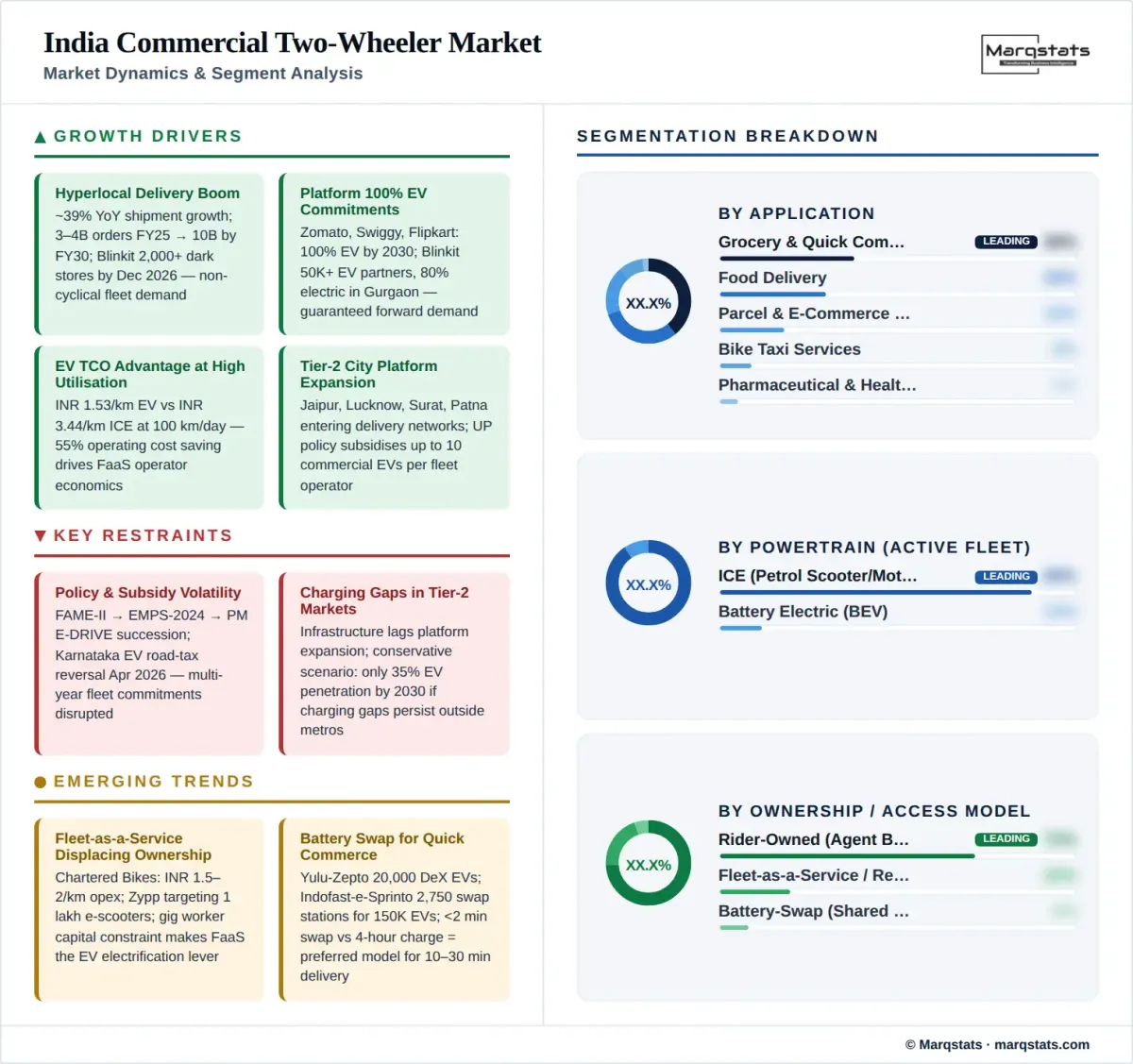
- Hyperlocal delivery boom creating structural fleet demand: India's on-demand hyperlocal shipments are growing at approximately 39% year-on-year, from 3–4 billion in FY25 to a projected 10 billion by FY30 per independent analyses. This growth is led by quick commerce — Blinkit, Zepto, and Swiggy Instamart collectively operate approximately 1,200+ dark stores across 100+ cities with plans for aggressive further expansion — creating a recurring, non-cyclical demand for delivery two-wheelers that grows with every new dark store opened.
- E-commerce expansion into Tier-2 and Tier-3 cities pulling fleet demand beyond metros: India's e-commerce shipments are estimated at 4.8–5.5 billion in FY25 and projected to grow at 23–24% CAGR, reaching 15–17 billion by FY30. As platforms expand fulfilment beyond the six Tier-1 metros — where approximately 65% of today's commercial 2W fleet is concentrated — hundreds of new cities are being added to delivery networks, each requiring incremental fleet additions for last-mile delivery.
- Fleet electrification driving ASP uplift and OEM investment: EV models priced at INR 90,000–1,30,000 versus ICE equivalents at INR 65,000–90,000 are lifting per-vehicle revenue significantly. As EV penetration in the commercial fleet rises from an estimated 12% in 2025 toward the 60%+ base-case target by 2030, the commercial two-wheeler vehicle market's total value grows faster than unit volumes, with every ICE replacement by an EV adding approximately 30–50% to per-unit ASP.
- Platform commitments to 100% EV fleets creating guaranteed forward demand: Zomato (100% EV by 2030, EV100 member since 2021), Swiggy (100% low-carbon delivery fleet by 2030), Flipkart (100% EV last-mile by 2030), and BigBasket (60% EV fleet by 2030) have collectively committed to full electrification on 5–7 year horizons. These corporate commitments, reported in statutory sustainability disclosures (BRSR, sustainability reports), represent guaranteed demand signals for OEMs and fleet operators planning commercial EV procurement.
- Growing gig workforce expanding addressable fleet pool: India's delivery-based gig workers have grown at approximately 21% annually over the past three years and are projected to continue at 18–23% CAGR over the next five years per independent analyses. Every new delivery partner added to platforms represents a new vehicle requirement — whether rider-owned, rented, or platform-facilitated — directly expanding the addressable commercial two-wheeler vehicle market.
Key Restraints
- Policy and subsidy volatility creating procurement uncertainty: The rapid succession of FAME-II → EMPS-2024 → PM E-DRIVE for EV incentives, combined with state-level reversals (Karnataka's planned EV road-tax reintroduction, Karnataka Amendment Act 2026), creates planning risk for fleet operators and OEMs making multi-year EV procurement commitments. Subsidy changes directly affect net vehicle cost, which can shift the ICE-EV TCO balance and delay fleet electrification timelines.
- Charging infrastructure gaps limiting EV fleet expansion beyond Tier-1: The 4,356 charging stations operational in Thailand by end-2025 far exceed India's public charging density in most Tier-2 delivery markets. Platforms explicitly acknowledge charging access — including fragmented building permissions, limited hub charging, and charging queue downtime — as binding operational constraints on EV delivery fleet scaling. This infrastructure gap is the primary reason the conservative 2030 forecast scenario shows only 35% EV penetration in the delivery fleet.
- Vehicle suitability gap for high-utilisation delivery duty cycles: Most commercial two-wheelers in India are ICE commuter scooters or motorcycles adapted for delivery use rather than purpose-built fleet vehicles. High-utilisation delivery conditions (80–120 km/day, frequent stop-start, payload carrying) accelerate wear, reduce resale values, and create higher maintenance costs than OEM warranty assumptions are designed for. The EV equivalent problem — limited models well-suited for full-day delivery with adequate range, fast charging, and payload capacity — is explicitly acknowledged by both Zomato and Swiggy in their platform disclosures.
- Rider financing access constraints limiting fleet conversion: With approximately 1.37 million delivery workers predominantly from lower-income demographic segments, access to formal vehicle financing for EV purchase remains limited. Vehicle acquisition costs for EVs (INR 90,000–1,30,000) versus gig worker monthly earnings create a payback period concern that traditional NBFC financing has not fully solved, making rental and fleet-as-a-service models essential for EV penetration — but dependent on fleet operator capital availability.
Key Trends
- Fleet-as-a-Service displacing outright ownership as the primary access model for delivery EVs: Platforms are building in-app EV rental booking, financing tie-ups with NBFCs, and fleet operator partnerships specifically because outright EV purchase is not viable for most gig workers. Chartered Bikes reports quick commerce now contributes 50% of revenue with a 20% fleet expansion over the past year, operating costs of INR 1.5–2/km versus INR 4 for petrol. This FaaS model is the structural enabler of fleet electrification without requiring individual rider capital commitment.
- Purpose-built commercial two-wheelers entering the market: OEMs are launching delivery-specific models with features designed for high-utilisation commercial use — Quantum Bziness EMO (200 kg payload, 20-minute fast charge), Hero Electric NYX HX (150 kg payload, utility-oriented), and Yulu DeX (battery-swap, purpose-built delivery workflow). This signals a shift from consumer-spec vehicles adapted for delivery to genuinely purpose-engineered fleet SKUs.
- Battery swapping maturing as the quick-turnaround solution: For quick commerce specifically, where delivery windows are 10–30 minutes and daily vehicle utilisation is highest, battery swapping — which reduces charging downtime to under two minutes — is the operationally preferred model. Yulu-Zepto's deployment of 20,000 shared DeX EVs, Indofast Energy's partnership with e-Sprinto for 20,000 EVs using 2,750 swap stations, and the government's battery-as-a-service policy enablement (sale of EVs without batteries) are collectively maturing the swap ecosystem.
- Tier-2 and Tier-3 city expansion creating new fleet demand pools: With Tier-1 city delivery density approaching saturation for major platforms, incremental fleet growth is migrating to cities like Jaipur, Lucknow, Coimbatore, Surat, and Patna. These markets have lower EV infrastructure readiness, making ICE fleet expansion the near-term reality while charging and swap network investment follows. This dynamic sustains ICE commercial two-wheeler demand through 2027–2028 even as Tier-1 markets electrify.
Market Segmentation
Food delivery is the most mature commercial two-wheeler application in India and the origin of the commercial 2W fleet ecosystem. Zomato and Swiggy — the two dominant food delivery platforms — collectively deploy approximately 1.1–1.2 million average monthly active delivery partners by FY26, with the majority operating two-wheelers. Zomato reported 51,000+ active EV delivery partners across 400+ cities in January 2025, with 8% of food delivery orders delivered by EVs in FY24. Swiggy reported EV delivery partners growing 7× year-on-year with 70+ EV models and 50+ ecosystem collaborators. Food delivery remains the platform with the most developed EV enablement infrastructure: in-app charging/swapping discovery, EV rental access, NBFC financing tie-ups, and EV awareness events (Zomato reported 200+ EV melas in FY24). Fleet ownership in food delivery is predominantly agent-owned, with vehicles typically selected by riders from available consumer-grade ICE scooters (Hero Splendor, Honda Activa, TVS Jupiter) or consumer-grade EVs (TVS iQube, Bajaj Chetak, Ola S1X).
Grocery delivery historically deployed the largest commercial two-wheeler fleet in India by application — confirmed by independent fleet composition analysis. The quick commerce sub-segment (Blinkit, Zepto, Swiggy Instamart, BigBasket Now, Flipkart Minutes, Amazon Now) is now the fastest-growing fleet driver within grocery, with dark-store density driving intense per-city fleet concentration. BigBasket reports 7,431 EVs in its fleet with approximately one in three vehicles electric and a 60% EV target by 2030. Blinkit (Zomato) reports 50,000+ EV delivery partners by March 2025, with Gurgaon reaching 80% electric fleet — the highest EV penetration of any Indian city for a major platform. The Yulu-Zepto partnership targeting 20,000 shared DeX EVs across Bengaluru, Mumbai, Navi Mumbai, Delhi, and Gurugram reflects the quick commerce sector's preference for battery-swap models that minimise downtime between ultra-fast delivery windows. This application is the primary demand engine for purpose-built delivery EVs and battery-swap infrastructure investment.
Parcel and e-commerce logistics represents the third-largest commercial two-wheeler application. Amazon India's delivery operation reports 10,000 EVs across 500+ cities (milestone reached October 2024), with more than 90% of e-commerce delivery vehicles being agent-owned or operated via third-party logistics partners. Flipkart has deployed 10,000+ EVs and installed chargers at approximately 2,900 last-mile delivery hubs nationwide, providing the most developed charging-at-hub infrastructure among Indian logistics operators. Delhivery, Xpressbees, DTDC, Blue Dart, and Gati operate the courier and express logistics segment, where two-wheelers handle small parcel first-and-last-mile. Fleet composition in this segment leans toward motorcycles (Honda CB Shine, Hero HF Deluxe, TVS Raider) for longer inter-hub routes, with scooters for dense urban last-mile. EV adoption in this segment is lower than food delivery or quick commerce due to the more variable route profiles and less concentrated charging infrastructure at logistics hubs.
Pharmaceutical delivery is an emerging and high-growth commercial two-wheeler application, driven by the rapid scaling of online pharmacy platforms (1mg, PharmEasy, Apollo Pharmacy, Netmeds) and the expansion of prescription medicine delivery alongside OTC products. The application is distinct from food/grocery delivery in that it has stricter compliance requirements (cold chain for some products, narcotics compliance), typically shorter delivery windows, and a different order size and weight profile. Two-wheelers with sealed cargo boxes are the preferred vehicle for pharmaceutical delivery. EV adoption in pharmaceutical delivery is in early stages, with most platforms still operating ICE fleets for reliability reasons in markets where EV charging access is limited.
Bike taxi is a distinct commercial two-wheeler application — the vehicle carries a passenger rather than cargo — with Rapido as the dominant platform, followed by Ola Bike and InDrive. Regulatory status varies significantly by state: some states (including Telangana, Karnataka, Maharashtra, and parts of north India) have permitted or tolerated bike taxi operations while others have imposed restrictions. Rapido is estimated to have the largest active bike taxi fleet in India and has been expanding into hyperlocal goods delivery as a platform extension. Bike taxi vehicles are typically agent-owned motorcycles (Honda CB Shine, Hero Splendor, Bajaj Pulsar) rather than scooters, and EV penetration remains low given the longer operating ranges required for taxi use versus short-hop delivery. The proposed legalisation of two-wheeler ride-hail services nationwide could significantly expand the bike taxi commercial fleet pool.
ICE two-wheelers remain the dominant powertrain in India's commercial fleet, accounting for approximately 88% of the active delivery fleet in 2025. The dominant ICE models in commercial use are commuter-segment motorcycles and scooters positioned for fuel efficiency and reliability: Honda Activa (scooter, ~60 kmpl), Hero Splendor Plus (motorcycle, ~65–70 kmpl), TVS Jupiter (scooter), Bajaj Platina (motorcycle), and Hero HF Deluxe. These vehicles are typically bought by delivery agents at INR 60,000–85,000 ex-showroom, financed via consumer NBFC loans, and operated for 3–5 years before replacement. The per-km cost for an ICE delivery scooter at high utilisation (100 km/day) runs approximately INR 3.44/km — a benchmark against which EVs compete on TCO but not acquisition cost. ICE fleet share is projected to decline as EV penetration accelerates, but will remain meaningful through 2028 in Tier-2 markets and in applications (bike taxi, courier long-haul) with range or charging constraints.
Battery electric vehicles represent approximately 12% of India's active delivery fleet in 2025 — an estimated 140,000–160,000 units — growing rapidly toward a base-case 60% penetration by 2030. The delivery-suitable EV models in active commercial deployment include the TVS iQube (2.2–5.3 kWh variants, 94–212 km claimed range), Bajaj Chetak 3001/350x (127–153 km), Ather 450 series (corporate programme available for organisations), Ola S1X Gen3 (up to 242 km IDC range), Hero Electric NYX HX (150 kg payload, 165 km claimed, utility-oriented), Yulu DeX (battery-swap, purpose-built for delivery workflows), and Quantum Bziness EMO (200 kg payload, 20-minute fast charge, fleet-specific). The commercial-EV per-km cost advantage is significant at high utilisation — approximately INR 1.53/km versus INR 3.44/km for ICE — driven primarily by lower energy costs. However, battery downtime, charging infrastructure gaps, and higher upfront acquisition costs are the barriers that fleet-as-a-service and battery-swap models are designed to overcome.
By Geography
Delhi NCR
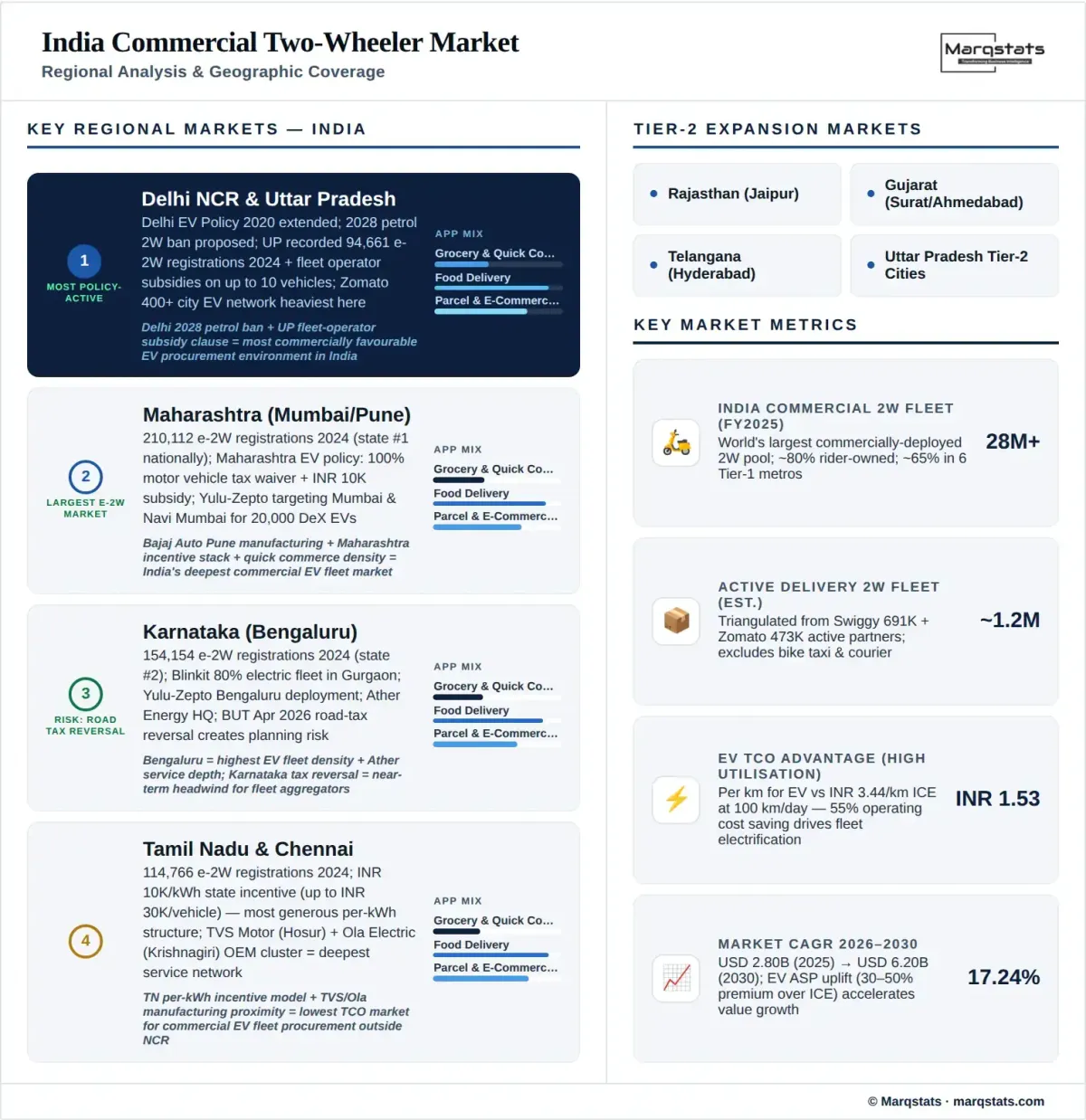
Delhi NCR is India's largest and most policy-active commercial two-wheeler market. Delhi's EV policy (extended to March 2026 under the 2020 framework, with EV Policy 2.0 under development) proposes to restrict new petrol two-wheeler registrations from 2028 — a structural mandate that would force commercial fleet electrification in India's largest city. Zomato's EV delivery programme spans 400+ cities nationally but is heaviest in Delhi NCR. Uttar Pradesh's EV policy is particularly relevant for fleet operators given its explicit subsidy clause allowing aggregator and fleet operator buyers to claim purchase subsidies on up to 10 commercial vehicles. VAHAN-based data shows Uttar Pradesh recorded 94,661 e-2W registrations in 2024 — indicating significant delivery fleet EV adoption in the NCR-UP corridor. The Delhi government's announcement of 1 in 4 new vehicles to be EV by 2024 reflects the aggressive EV policy orientation that makes NCR the most policy-supportive market for commercial EV fleet procurement.
Mumbai Metropolitan Region and Maharashtra
Maharashtra is India's largest e-2W registration state with 210,112 registrations in 2024 per VAHAN-based parliamentary data — reflecting both high consumer EV adoption and significant commercial fleet electrification. The Maharashtra EV policy (effective April 2025–March 2030) provides 100% motor vehicle tax waiver and 10% of ex-factory cost subsidy up to INR 10,000 for electric two-wheelers. Mumbai, Pune, and Nashik are major commercial two-wheeler markets with active quick commerce (Blinkit, Zepto, Swiggy Instamart), food delivery, and parcel logistics operations. The Yulu-Zepto partnership explicitly targets Mumbai and Navi Mumbai for shared DeX EV deployment. Maharashtra's OEM base — Bajaj Auto (Pune) and Ather Energy (Hosur, Tamil Nadu, with Maharashtra dealer presence) — ensures strong service network depth for fleet operators.
Bengaluru and Karnataka
Karnataka recorded 154,154 e-2W registrations in 2024 — the second-highest state tally nationally — driven by Bengaluru's position as India's tech and startup capital with high gig economy density. Blinkit has reported that 80% of its Gurgaon last-mile fleet is electric, and Bengaluru is cited as a key city in the Yulu-Zepto shared EV deployment. Karnataka's policy posture, however, carries risk: April 2026 reporting indicates the state was planning introduction of lifetime road tax on EVs under an Amendment Act, reversing earlier exemptions — a direct cost increase for commercial fleet operators. Karnataka's EV policy does include provisions for reserving 20% parking spots for EV charging in new buildings in Bengaluru, supporting fleet hub charging access. Ather Energy is headquartered in Bengaluru and operates its most developed service network there, giving commercial fleet operators a strong service infrastructure advantage.
Tamil Nadu and Chennai
Tamil Nadu recorded 114,766 e-2W registrations in 2024 and hosts major OEM manufacturing (TVS Motor in Hosur, Ola Electric in Krishnagiri) that creates deep service network advantages for commercial fleet operators in the state. The Tamil Nadu EV policy 2023 provides a demand incentive of INR 10,000/kWh for electric two-wheelers up to INR 30,000 per vehicle — the most generous per-kWh incentive structure among major Indian states. Chennai is a major food delivery and e-commerce logistics market, with Swiggy, Zomato, Amazon, and Flipkart all operating significant delivery fleets. Tamil Nadu's manufacturing base and policy support make it one of India's strongest commercial EV fleet markets outside the NCR.
Uttar Pradesh, Rajasthan, and Emerging Tier-2 Markets
Uttar Pradesh (94,661 e-2W registrations in 2024) and Rajasthan (76,735) collectively represent the fastest-growing commercial two-wheeler markets outside the established metros, driven by e-commerce and quick commerce platform expansion into cities like Lucknow, Kanpur, Varanasi, Agra, Jaipur, and Jodhpur. UP's EV policy is the most explicitly fleet-operator-friendly in India, providing subsidies claimable on up to 10 commercial vehicles per aggregator/fleet operator — a direct incentive for fleet-scale EV procurement. The Tier-2 city expansion of dark-store networks (Blinkit guided toward 2,000+ stores by December 2026, Zepto operating 1,147+ dark stores) is creating delivery fleet demand in cities that are new to the commercial two-wheeler market, predominantly served by ICE vehicles today but with EV infrastructure investment following platform expansion.
How Competition Is Evolving
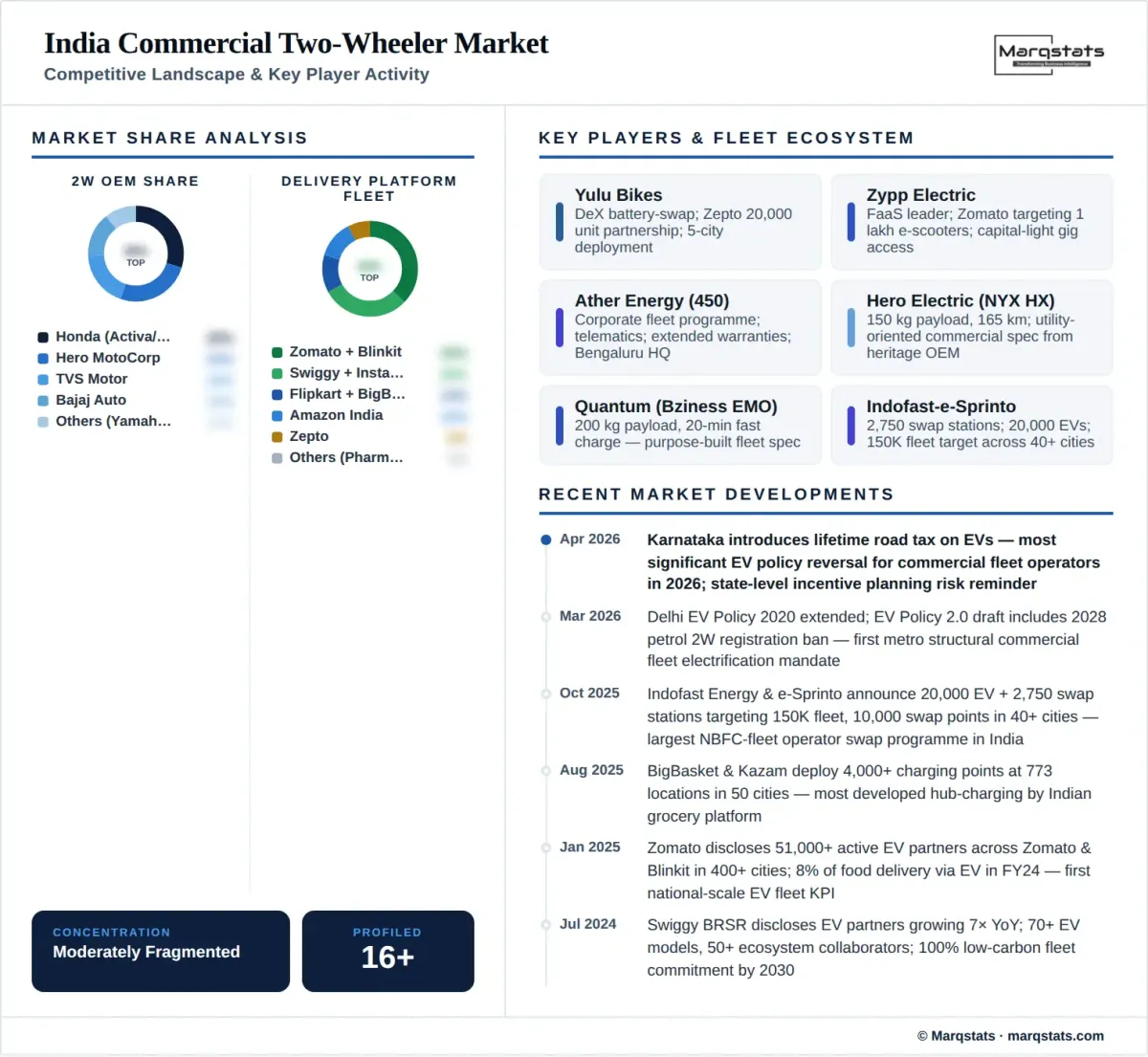
The India commercial two-wheeler market is best understood as a multi-layered ecosystem rather than a single competitive arena. The competitive dynamics differ across three distinct layers: the vehicle/OEM layer, the fleet operator/FaaS layer, and the platform/demand aggregator layer. At the vehicle level, ICE market leadership is held by Honda Motorcycle & Scooter India (HMSI), Hero MotoCorp, TVS Motor Company, and Bajaj Auto — who together account for over 85% of total two-wheeler sales in India. In the commercial EV segment, market leadership is disputed: Ola Electric holds the highest volume in consumer-grade EVs that spill into delivery use, TVS iQube has the strongest platform partnership track record (TVS-Swiggy MoU, TVS-Zomato deployment plan), and purpose-built delivery players (Yulu, Hero Electric, Quantum) serve the specifically-commercial end of the market.
At the fleet operator level, Zypp Electric (partnered with Zomato, targeting 1 lakh e-scooters), Yulu (partnered with Zepto, 20,000 DeX EVs), Chartered Bikes (quick commerce as 50% of revenue), Rapido (bike taxi + delivery), and Indofast Energy-e-Sprinto (20,000 EVs, 2,750 swap stations) are the primary intermediaries between platforms and individual riders. These operators are increasingly important because they allow platforms to electrify fleet without requiring gig worker capital commitment. At the platform level, competitive intensity between Blinkit (Zomato), Swiggy Instamart, Zepto, Amazon, and Flipkart is directly driving fleet investment as faster delivery speed requires denser, better-equipped fleets. Industry analyses indicate that EV fleet cost advantages (INR 1.5–2/km versus INR 4/km for petrol) are becoming a competitive differentiator between platforms at the unit-economics level, creating a direct business incentive to accelerate fleet electrification beyond sustainability commitments alone.
The OEM competitive landscape is evolving from consumer-spec vehicles adapted for commercial use toward purpose-built delivery platforms. This shift is being driven by platform procurement pressure (platforms explicitly stating that limited suitable EV models are a barrier), OEM recognition of fleet programmes as a stable bulk-procurement channel, and the competitive entry of purpose-built delivery EV specialists (Quantum Bziness EMO, Yulu DeX). Independent assessments indicate that the first OEM to establish reliable 200+ km range, sub-30-minute fast charge, and 100 kg+ payload in a sub-INR 1,00,000 price point will capture dominant commercial fleet share — a product gap that remains unfilled as of 2025.
Companies Covered
Companies covered in the report include:
Recent Market Activity
Table of Contents
Coverage & Segmentation
This report provides a comprehensive analysis of the India commercial two-wheeler market covering the 2021–2030 study period, with 2025 as the base year, historical data from 2021 to 2025, and a forward-looking forecast from 2026 to 2030. The study covers all scooters, motorcycles, and mopeds — regardless of powertrain (ICE, EV, or hybrid) — deployed for commercial use across five primary applications: food delivery, grocery and quick commerce, parcel and e-commerce delivery, pharmaceutical and healthcare delivery, and bike-taxi services. Market sizing encompasses new vehicle sales to commercial buyers, fleet operator vehicle procurement, and rental/FaaS fleet additions. Charging infrastructure and battery-swap networks are covered as enabling ecosystem elements rather than as separate market segments.
Geographic analysis covers India's major commercial two-wheeler markets: Delhi NCR (including Uttar Pradesh Tier-2 cities), Mumbai Metropolitan Region and Maharashtra, Bengaluru and Karnataka, Tamil Nadu and Chennai, and the rapidly expanding Tier-2 and Tier-3 markets across Rajasthan, Gujarat, Madhya Pradesh, and Andhra Pradesh. Policy analysis is centred on FAME-II, EMPS-2024, PM E-DRIVE, state-level EV policies (Delhi, Maharashtra, Uttar Pradesh, Karnataka, Tamil Nadu), and the AIS-156 battery safety standards framework. Primary research includes 40+ interviews with fleet operators, OEM commercial sales teams, platform procurement officials, NBFC financing executives, and government transport officials across India's major commercial two-wheeler markets.