Statistics & Highlights

Market Snapshot

Market size in USD Billion
$0.82B
2025
Base year
$1.07B
2026
Estimated
  
$3.18B
2030
Forecast
Largest market
Delhi-NCR (aggregator mandate, BluSmart legacy, Uber Green, Evera)
Fastest growing
Airport Taxi Corridors (Bengaluru 50%+ electric, Refex eVeelz)
Dominant segment
Platform-Led EV Ride-Hailing (Uber fleet-partner model)
Concentration
Highly Concentrated
CAGR
31.04%
2026 – 2030
GROWTH
+$2.36B
Absolute
STUDY PARAMETERS
Base year2025
Historical period2021 – 2025
Forecast period2026 – 2030
Units consideredValue (USD BN), Fleet Size (Vehicles)
REPORT COVERAGE
Segments covered7 segments
Regions covered6 regions (city/state clusters)
Companies profiled15+
Report pages220+
DeliverablesPDF, Excel, PPT
Executive Summary

Key Takeaways

Market valued at USD 824 million in 2025, projected to reach USD 3.18 billion by 2030 at 31.04% CAGR — ride-hailing market ~USD 2 billion, forecast USD 11 billion by 2033. 365 million km in Uber EVs in 2025. 32% of Indian consumers use ride-hailing weekly. Fleet vehicles travel 50,000+ km/year vs 12,000 km personal.
BluSmart suspended operations (April 2025) with 8,000+ taxis after SEBI/Gensol investigation — entered insolvency July 2025. Had claimed 9% market share in New Delhi. Strongest cautionary event in India’s e-cab market: financing and governance risk, not technology risk, caused the collapse. Uber explored acquisition discussions for BluSmart assets.
Delhi mandates 100% electric aggregator fleet by April 2030 with phased targets — 5% EV within 6 months of onboarding, 15% within 1 year, 25%/2 years, 50%/3 years, 75%/4 years, 100%/5 years. AIS-140 certified tracking and panic buttons required. The strongest city-level ride-hailing EV mandate in India.
Uber is the most important scaled pathway: 365 million EV km, fleet-partner model with Refex, Lithium, Everest — Uber Green launched in Delhi, Mumbai, Bengaluru (2023). Refex partnership: 1,000 EVs by 2026 across Chennai, Hyderabad, Bengaluru, Mumbai (March 2025). Lithium Urban: 1,000+ electric sedans via Uber Rentals/Premier.
EVs substantially cheaper to own for taxi drivers due to high annual mileage and running-cost dominance — 2025 cost-of-ownership analysis confirms TCO advantage for high-utilisation fleets. CNG is next-cheapest. But charging infrastructure, uptime, and financing remain the gating operational barriers.
Vingroup signed USD 3 billion MoU with Telangana for India’s first large-scale electric taxi fleet (December 2025) — VinFast vehicles, GSM technology, mobility-as-a-service platform. Also evaluating EV manufacturing. Telangana supporting land, clearances, and incentives. Largest single foreign investment commitment targeting India’s e-cab segment.
Market Insights

Market Overview & Analysis

Report Summary

The India electric taxi and ride-hailing market covers four-wheeler battery-electric vehicles operating as taxis on ride-hailing platforms (Uber, Ola, Rapido) and through managed fleet operators (Refex Green Mobility, Lithium Urban, Everest Fleet), as well as regional and specialist electric taxi operators (Evera Cabs, Snap-E, Shoffr) and government cooperative initiatives (Sahkar Taxi, announced March 2025). The scope includes the EV-cab vehicle layer, dedicated charging hub networks and fleet depot infrastructure, fleet financing and leasing models, platform-level EV integration (Uber Green, Ola Electric categories), city-level aggregator EV mandates, and airport/corporate transport corridors. Electric two-wheeler bike-taxi operations (Rapido, Ola Bike) and three-wheeler auto services are referenced for market-mix context but excluded from the four-wheeler core scope.

India’s e-cab market operates through three overlapping models. The platform-led model sees large apps like Uber add EVs through fleet partners and products like Uber Green. The pure-play EV operator model was represented by BluSmart before its April 2025 suspension. The fleet-operator model sees companies like Refex, Lithium Urban, and Everest Fleet own or manage vehicles and supply them into app ecosystems, airport channels, and corporate transport. This structure makes India very different from markets where ride-hailing brands simply electrify their own driver base—the Indian market depends on fleet financing, managed charging, vehicle access, and city-specific regulatory pockets. Ride-hailing trip share is shifting toward autos and two-wheelers (including Rapido with approximately 14% ride-hailing market share), while cabs are still growing in absolute terms but losing mix share.

Market Dynamics

Key Drivers

  • High-utilisation fleet economics making EVs substantially cheaper than diesel/CNG for taxi operators: A 2025 cost-of-ownership analysis found EVs are substantially cheaper to own in the taxi segment because high annual mileage (50,000+ km/year) makes running costs dominant over capital cost. CNG is the next-cheapest. Electric taxis have lower per-km fuel and maintenance costs, creating a structural TCO advantage that grows with fleet utilisation. This is the core economic driver for fleet-led EV adoption.
  • Delhi aggregator mandate creating the strongest regulatory pull in India: Delhi’s 2023 Motor Vehicle Aggregator and Delivery Service Provider Scheme sets phased EV targets for newly onboarded passenger four-wheelers: 5% within 6 months, 15%/1 year, 25%/2 years, 50%/3 years, 75%/4 years, 100%/5 years. All-electric fleet required by April 1, 2030. AIS-140 certified tracking and panic buttons mandatory. Delhi also agreed in principle (January 2026) to allow privately owned EVs to operate as shared taxis, potentially widening the supply base.
  • Uber’s fleet-partner model scaling EV rides to 365 million km in 2025: Uber Green launched in Delhi, Mumbai, and Bengaluru (2023). Partnership with Refex Green Mobility to deploy 1,000 EVs by 2026 across Chennai, Hyderabad, Bengaluru, and Mumbai (March 2025). Earlier partnership with Lithium Urban deployed 1,000+ electric sedans via Uber Rentals/Premier across Delhi NCR, Mumbai, Bengaluru, Hyderabad, and Pune. Uber’s approach—partnering with fleet operators rather than relying on individual driver-owned EVs—is the most scalable model in India because fleets handle bulk vehicle procurement, centralised charging, and driver onboarding.
  • Airport corridors proving the EV-cab model: Bengaluru airport introduced 175 electric compact SUVs with Refex eVeelz (June 2024), taking the airport taxi fleet to over 50% electric. Airport operations offer controlled queuing, predictable dispatch, branded service, and planned charging/downtime—exactly the conditions EV fleets need. Airport, premium rides, scheduled rides, and corporate transport are the beachhead use cases where four-wheeler EVs dominate.
  • 29 states and UTs have notified EV policies as of June 2025: NITI Aayog’s India Electric Mobility Index shows near-universal state-level EV policy coverage. State incentives include road-tax waivers, registration-fee exemptions, and charging infrastructure support. Kerala’s draft EV policy set a target for at least 15% of aggregator/operator urban fleets to transition to EVs by 2025. State-level policy is more important than central subsidies for e-cabs because PM E-DRIVE does not directly subsidise electric passenger cars for taxi use.

Key Restraints

  • BluSmart collapse demonstrating financing and governance risk: BluSmart suspended operations (April 2025) with 8,000+ taxis after SEBI investigation linked to affiliate Gensol. Entered insolvency (July 2025). This was India’s highest-profile e-cab failure and showed that financing, governance, and fleet-level capital discipline are existential risks for pure-play EV-cab models. Lenders, OEMs, and platform partners will be more cautious about any future pure-play operator.
  • Tata Motors electric taxi supply constraints and limited OEM model choice: India’s electric four-wheeler market is dominated by a small number of models suitable for taxi duty. Supply constraints from Tata Motors (the dominant e-4W OEM) have periodically limited fleet operator access to vehicles. Limited model diversity means fleet operators have few alternatives if one OEM faces production constraints, delivery delays, or pricing changes. Vingroup’s VinFast entry (December 2025 Telangana MoU) could diversify supply if manufacturing materialises.
  • PM E-DRIVE not subsidising electric passenger cars for taxi use: The central scheme incentivises e-2Ws, e-3Ws, e-ambulances, e-trucks, and e-buses, while supporting charging infrastructure. But it does not directly subsidise the electric four-wheelers that taxi fleets depend on. This policy gap leaves the e-cab segment reliant on state-level tax treatment, aggregator mandates, fleet financing, and platform partnerships rather than a strong national demand subsidy.
  • Ride-hailing mix shifting toward autos and two-wheelers, compressing cab share: Industry analysis shows autos and two-wheelers are taking a growing share of total ride-hailing trips in India, while cabs are still growing in absolute terms but losing mix share. Rapido’s bike-taxi model holds approximately 14% ride-hailing market share. This means India’s e-cab market competes not only against ICE taxis but also against modal substitution within ride-hailing itself.

Key Trends

  • Platform-plus-fleet partnerships replacing pure-play operator models post-BluSmart: Uber’s Refex, Lithium Urban, and Everest Fleet partnerships are the template for how India’s e-cab market scales: fleet operators handle vehicle procurement, charging, maintenance, and driver supply while platforms provide demand. This model distributes risk more broadly than BluSmart’s vertically integrated approach. Uber explored acquisition discussions for BluSmart assets, confirming that the demand is real even when the operator fails.
  • Vingroup/VinFast USD 3 billion MoU with Telangana for large-scale electric taxi fleet (December 2025): India’s first proposed large-scale electric taxi fleet using VinFast vehicles with GSM technology and a mobility-as-a-service platform. The MoU spans 2,500 hectares across electric mobility, smart urban development, healthcare, education, and renewable energy. Vingroup may evaluate EV manufacturing in India. This is the largest foreign investment commitment specifically targeting India’s e-cab and mobility sector.
  • Sahkar Taxi government cooperative ride-hailing model (March 2025): The government-backed cooperative ride-hailing initiative represents a potential new competitive model—government-supported, driver-owned cooperative taxi services that could accelerate EV adoption through institutional procurement and financing. This approach differs from both the platform-led and pure-play fleet models.
  • Vayve Mobility CT5 solar electric taxi with 330 km range: Vayve Mobility’s purpose-built solar-electric city taxi features a solar rooftop running 4,000+ km/year on solar power, 330 km range, consecutive fast charging, 500-litre boot space, connected car features, LED advertisement panel, and remote fleet management (May 2024). Purpose-built electric taxis designed from the ground up for fleet operations represent the next generation of India’s e-cab vehicle ecosystem.
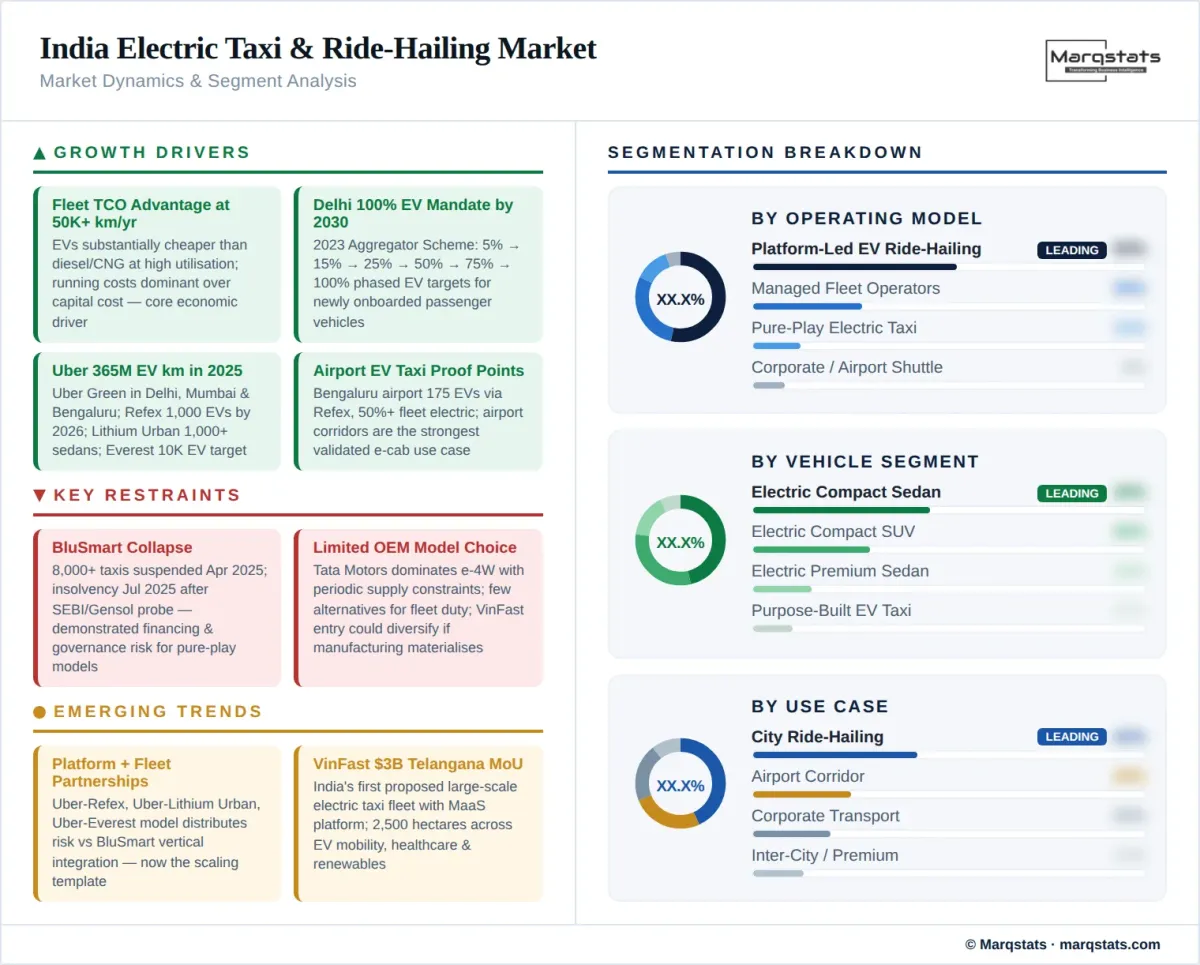
India Electric Taxi Ride Hailing Market Dynamics Segment Analysis Infographic
Segment Analysis

Market Segmentation

Platform-Led EV Ride-Hailing
Leading

Uber is the largest platform player with Uber Green (Delhi, Mumbai, Bengaluru), 365 million EV km in 2025, and fleet partnerships with Refex (1,000 EVs by 2026), Lithium Urban (1,000+ sedans), and Everest Fleet. Ola Cabs (approximately 34% market share) has plans for electric fleet integration. Platform-led models leverage existing ride demand and driver networks while partnering with fleet operators for EV supply and charging.

Pure-Play Electric Taxi Operators

BluSmart was the category leader (8,000+ taxis, charging hubs in Delhi/Mumbai/Bengaluru, 9% New Delhi share) before April 2025 suspension and July 2025 insolvency. Regional operators include Evera Cabs (Delhi NCR electric taxi), Snap-E (Kolkata electric taxi), and Shoffr (premium electric chauffeur service). The pure-play model offers differentiated branding and service quality but carries higher financing and governance risk.

Managed Fleet Operators

Refex Green Mobility / Refex eVeelz serves airport, B2B, and platform supply—including Bengaluru airport (175 EVs, 50%+ airport fleet electric) and Uber partnership (1,000 EVs by 2026). Lithium Urban is a corporate fleet specialist with managed charging hubs. Everest Fleet has 18,500+ cars across seven metros targeting 10,000 EVs by 2026. These operators solve bulk procurement, centralised charging, and professional fleet management—the critical enabling layer for India’s e-cab market.

Government Cooperative and Institutional

Sahkar Taxi (March 2025) is a government-backed cooperative ride-hailing model. Delhi agreed in principle (January 2026) to allow privately owned EVs as shared taxis. Vingroup/VinFast’s Telangana MoU proposes India’s first large-scale electric taxi fleet with government partnership. These models add institutional procurement and financing pathways alongside private-sector fleet operators.

Airport Taxi Corridors
Leading

The strongest proof-of-concept for India’s e-cab market. Bengaluru airport: 175 electric SUVs via Refex eVeelz, 50%+ airport fleet electric (June 2024). BluSmart had strong airport positioning in Delhi before suspension. Airport corridors offer controlled queuing, predictable demand, branded service, and planned charging—ideal for EVs.

Premium and Scheduled Rides

Uber Green, Uber Rentals/Premier, and Shoffr serve the premium segment where riders value EV quietness, cleanliness, and brand positioning. Corporate scheduled rides offer predictable revenue and route planning. These use cases command higher fares that offset higher EV capital costs.

Urban On-Demand Ride-Hailing

The mass market where EVs compete against CNG and diesel taxis and against modal substitution to autos and bike-taxis (Rapido ~14% market share). Delhi’s aggregator mandate is the strongest policy driver for urban on-demand EV conversion. India ride-hailing surge pricing and cancellation rates create consumer experience issues that structured EV fleets (with professional drivers and managed dispatch) can partially address.

Corporate Transport and B2B2C

Lithium Urban specialises in corporate fleet transport using managed EV fleets with dedicated charging. Refex investor materials describe B2B2C passenger mobility with four-wheeler EVs. Corporate transport provides predictable demand, recurring revenue, and simplified charging logistics—making it one of the most commercially viable e-cab use cases.

Regional Analysis

By Geography

Delhi-NCR

The most regulated and highest-visibility e-cab market. Delhi’s 2023 Aggregator Scheme mandates 100% electric fleet by April 2030 with phased targets. Delhi EV Policy 2020 includes road-tax and registration-fee waivers. Delhi agreed in principle (January 2026) to allow private EVs as shared taxis. BluSmart had its strongest presence here (9% market share before suspension). Uber Green active. Evera Cabs operates Delhi NCR electric taxi service.

Bengaluru

The strongest airport e-cab proof point. Bengaluru airport: 175 electric SUVs via Refex eVeelz, 50%+ airport fleet electric (June 2024). Uber Green active. Strong corporate transport demand from IT/tech corridor. Lithium Urban and Refex both have Bengaluru operations. Karnataka has a notified EV policy.

Mumbai

Third-largest e-cab market. BluSmart had charging hubs in Mumbai before suspension. Uber Green active. Refex partnership targets Mumbai (March 2025). Dense urban congestion and high ride-hailing demand create strong e-cab potential. Maharashtra has a notified EV policy with incentives.

Hyderabad / Telangana

Vingroup/VinFast signed USD 3 billion MoU with Telangana (December 2025) including India’s first proposed large-scale electric taxi fleet with MaaS platform. Refex partnership targets Hyderabad (March 2025). Telangana’s gig-worker welfare framework (2026) affects ride-hailing operations. Emerging as a major e-cab market with institutional backing.

Chennai / Tamil Nadu

Refex Green Mobility headquartered in Chennai. Uber-Refex partnership targets Chennai (March 2025). Tamil Nadu has a notified EV policy. Growing corporate transport demand from manufacturing and IT sectors.

Pune, Kolkata, and Emerging Cities

Uber’s Lithium Urban partnership covered Pune. Snap-E operates electric taxi service in Kolkata. Kerala’s draft EV policy targets 15% aggregator fleet EV transition. As state policies mature and charging density improves, Tier I cities beyond the top 5 represent the next expansion wave for electric ride-hailing.
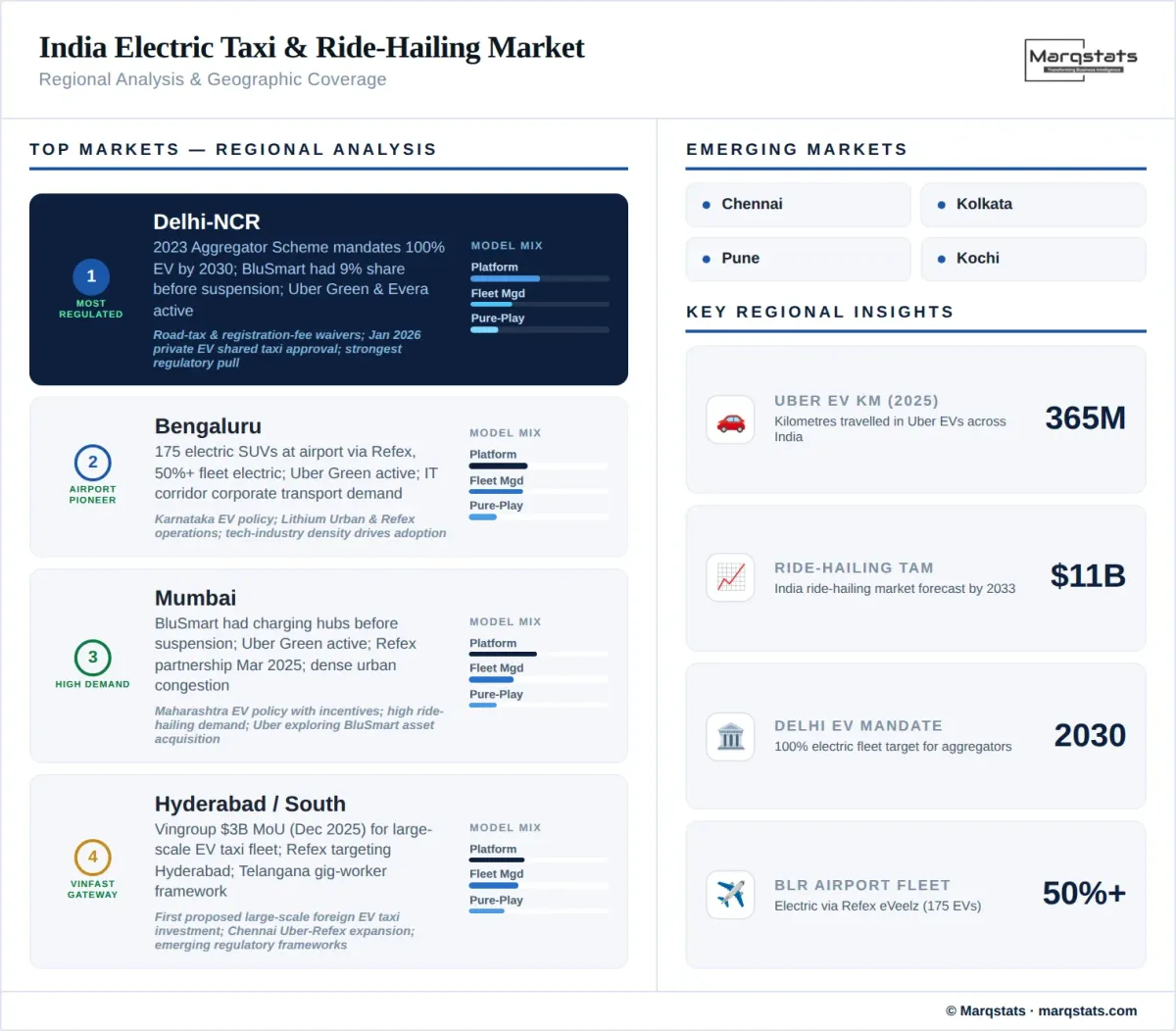
India Electric Taxi Ride Hailing Market Regional Analysis Infographic
Competitive Landscape

How Competition Is Evolving

Three competitive layers define this market. Platform operators control ride demand and rider relationships: Uber (approximately 50% market share in India ride-hailing, 365 million EV km in 2025, Uber Green in Delhi/Mumbai/Bengaluru, fleet partnerships with Refex, Lithium, Everest), Ola Cabs (approximately 34% market share, electric fleet plans), and Rapido (approximately 14% market share, primarily bike-taxi and auto but expanding four-wheeler). Uber’s fleet-partner approach is the dominant scaling model post-BluSmart.

Fleet operators and managed-fleet specialists provide the EV vehicle and charging layer: Refex Green Mobility / eVeelz (airport + B2B + platform supply, Bengaluru airport 175 EVs/50%+ electric, Uber 1,000 EV partnership), Lithium Urban (corporate fleet specialist, 1,000+ electric sedans via Uber Rentals/Premier), Everest Fleet (18,500+ cars across 7 metros, CNG-and-EV fleet, targeting 10,000 EVs by 2026), and the insolvency estate of BluSmart (8,000+ taxis, Uber explored acquisition discussions). Regional operators: Evera Cabs (Delhi NCR), Snap-E (Kolkata), Shoffr (premium chauffeur). Government initiatives: Sahkar Taxi cooperative (March 2025).

Vehicle suppliers and new entrants shape the supply side: Tata Motors is the dominant electric four-wheeler OEM for taxi applications but faces supply constraints. Vingroup/VinFast (USD 3B Telangana MoU, proposed large-scale electric taxi fleet using VinFast vehicles with GSM technology, December 2025) represents the most significant new supply-side entrant. Vayve Mobility’s CT5 solar electric taxi (330 km range, solar rooftop, fleet management, May 2024) is a purpose-built taxi concept. MG Motor, BYD, and Hyundai represent additional OEM options as model diversity improves.
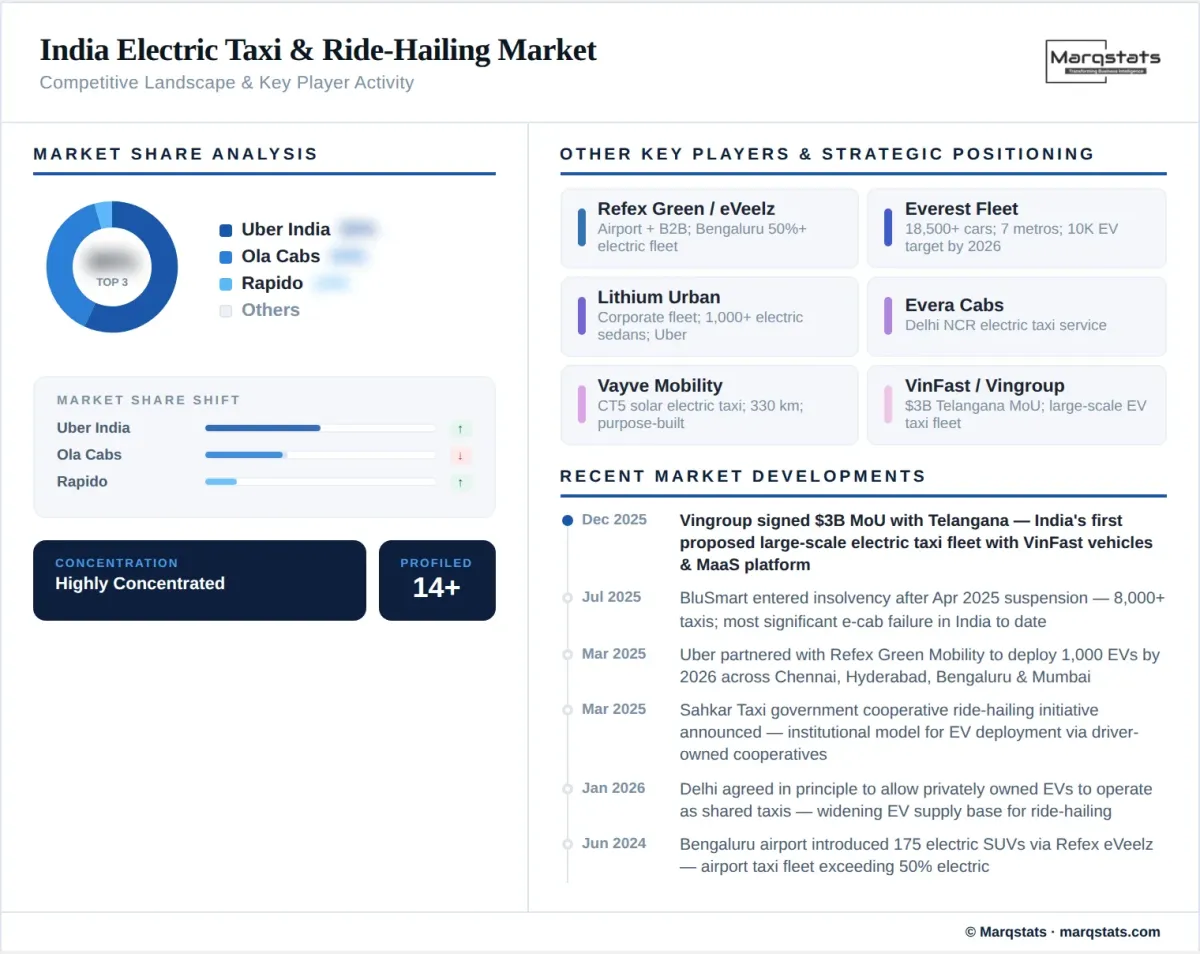
India Electric Taxi Ride Hailing Market Competitive Landscape Infographic
Major Players

Companies Covered

The report profiles 15+ companies with full strategy and financials analysis, including:

Uber India (~50% market share, 365M EV km 2025, Uber Green, Refex/Lithium/Everest partnerships)
Ola Cabs (~34% market share, electric fleet plans)
Rapido (~14% market share, primarily bike-taxi/auto, expanding four-wheeler)
Refex Green Mobility / eVeelz (airport + B2B + Uber, Bengaluru airport 50%+ electric)
Lithium Urban Technologies (corporate fleet, 1,000+ electric sedans, Uber Rentals/Premier)
Everest Fleet (18,500+ cars, 7 metros, targeting 10,000 EVs by 2026)
BluSmart (suspended April 2025, insolvency July 2025, 8,000+ taxis, Uber acquisition discussions)
Evera Cabs (Delhi NCR electric taxi service)
Snap-E (Kolkata electric taxi)
Shoffr (premium electric chauffeur service)
Sahkar Taxi (government cooperative ride-hailing, March 2025)
Tata Motors (dominant e-4W OEM for taxi, supply-constrained)
Vingroup / VinFast (USD 3B Telangana MoU, large-scale electric taxi fleet, Dec 2025)
Vayve Mobility (CT5 solar electric taxi, 330 km range, purpose-built, May 2024)
MG Motor / BYD / Hyundai (expanding e-4W model options for fleet buyers)
PM E-DRIVE (₹2,000 crore for EV charging infrastructure)
Ministry of Power 2024 charging and swapping guidelines
Fleet depot charging operators (Lithium Urban hubs, Refex managed charging)
Note: Full company profiles include revenue analysis, product portfolio, SWOT, and recent strategic developments.
Latest Developments

Recent Market Activity

Dec 2025
Vingroup signed USD 3 billion MoU with Telangana for multi-sector ecosystem including India’s first proposed large-scale electric taxi fleet using VinFast vehicles with GSM technology and MaaS platform — across ~2,500 hectares.
Jul 2025
BluSmart entered insolvency proceedings after April 2025 suspension — 8,000+ taxis, charging hubs in Delhi/Mumbai/Bengaluru. The most significant e-cab failure in India to date.
Apr 2025
BluSmart suspended operations with 8,000+ taxis following SEBI investigation linked to affiliate Gensol — had claimed 9% market share in New Delhi. Uber subsequently explored acquisition discussions for BluSmart assets.
Mar 2025
Uber partnered with Refex Green Mobility to deploy 1,000 EVs by 2026 across Chennai, Hyderabad, Bengaluru, and Mumbai — expanding platform-plus-fleet model post-BluSmart.
Mar 2025
Sahkar Taxi government cooperative ride-hailing initiative announced — a new institutional model for electric taxi deployment through driver-owned cooperatives.
Jan 2026
Delhi government agreed in principle to allow privately owned EVs to operate as shared taxis — potentially widening EV supply base for ride-hailing beyond commercially registered fleet vehicles.
Jun 2024
Bengaluru airport introduced 175 electric compact SUVs with Refex eVeelz — taking airport taxi fleet to over 50% electric. Strongest airport e-cab proof point in India.
May 2024
Vayve Mobility showcased CT5 solar electric taxi with 330 km range — solar rooftop (4,000+ km/year solar), 500L boot, connected car, LED ad panel, remote fleet management. Purpose-built for fleet operations.
2025
Uber reported 365 million km travelled in Uber EVs in India in 2025, with riders spending 54 million hours in electric vehicles across the platform.
2025
29 states and union territories had notified EV policies as of June 2025 (NITI Aayog India Electric Mobility Index), with 4 more in draft stage.
2025
Cost-of-ownership analysis confirmed EVs are substantially cheaper to own for taxi operators due to running-cost dominance at 50,000+ km/year annual mileage.
2025
Everest Fleet said it had 18,500+ cars across seven metros and was targeting 10,000 EVs by 2026.
Report Structure

Table of Contents

1. Introduction
1.1 Study Assumptions & Market Definition
1.1.1 Four-Wheeler Electric Cabs on Ride-Hailing Platforms and Fleet Operators
1.1.2 Three Operating Models: Platform-Led, Pure-Play, Managed Fleet
1.1.3 Bike-Taxi and Auto-Rickshaw EV Operations Referenced, Not Core Scope
1.2 Scope of the Study
1.2.1 By Operating Model
1.2.2 By Use Case
1.2.3 By City / State Cluster
1.3 Executive Summary
1.4 Market Snapshot
2. Research Methodology
2.1 Research Framework
2.2 Secondary Research
2.3 Primary Research (40+ Interactions)
2.4 Bottom-Up Platform EV Km, Fleet Count, and City Mandate Modelling
3. Ride-Hailing Market Context
3.1 India Ride-Hailing Market: ~USD 2 Billion, Forecast USD 11 Billion by 2033
3.2 32% of Consumers Use Ride-Hailing Weekly; 57% Prefer Over Own Vehicle
3.3 Fleet Vehicles Travel 50,000+ km/Year vs 12,000 km Personal
3.4 Ride-Hailing Mix Shifting Toward Autos and Two-Wheelers
3.5 Cab Segment Growing Absolute but Losing Mix Share
3.6 Surge Pricing and Cancellation as Consumer Experience Issues
4. EV Economics for Taxi Fleets
4.1 EVs Substantially Cheaper to Own at 50,000+ km/Year (2025 TCO Analysis)
4.2 CNG as Next-Cheapest Option Where Refuelling Infrastructure Exists
4.3 Running-Cost Dominance Over Capital Cost at High Mileage
4.4 Charging Access, Uptime, and Financing as Operational Barriers
5. Policy and Regulatory Framework
5.1 Delhi Aggregator Scheme 2023: 100% Electric by April 2030
5.1.1 Phased Targets: 5%/6mo, 15%/1yr, 25%/2yr, 50%/3yr, 75%/4yr, 100%/5yr
5.1.2 AIS-140 Tracking and Panic Button Requirements
5.2 Delhi EV Policy 2020: Road-Tax and Registration-Fee Waivers
5.3 Delhi January 2026: Private EVs Allowed as Shared Taxis (In Principle)
5.4 PM E-DRIVE: Charging Infrastructure but No E-4W Taxi Subsidy
5.5 Ministry of Power 2024 Charging and Swapping Guidelines
5.6 Kerala Draft EV Policy: 15% Aggregator Fleet EV Target by 2025
5.7 NITI Aayog: 29 States/UTs Have Notified EV Policies (June 2025)
5.8 Policy Gap: No Central Demand Subsidy for Electric Passenger Cars in Taxi Use
6. Market Dynamics
6.1 Market Drivers
6.1.1 TCO Advantage at 50,000+ km/Year Fleet Utilisation
6.1.2 Delhi Aggregator Mandate: 100% Electric by April 2030
6.1.3 Uber Fleet-Partner Model Scaling to 365M EV km in 2025
6.1.4 Airport Corridors Proving EV-Cab Model
6.1.5 29 States/UTs With Notified EV Policies
6.2 Market Restraints
6.2.1 BluSmart Collapse: Financing and Governance Risk
6.2.2 Tata Motors Supply Constraints and Limited OEM Model Choice
6.2.3 PM E-DRIVE Not Subsidising Electric 4W Taxis
6.2.4 Ride-Hailing Mix Shift Toward Autos and Two-Wheelers
6.3 Market Trends
6.3.1 Platform-Plus-Fleet Partnerships Post-BluSmart
6.3.2 Vingroup/VinFast USD 3B Telangana Electric Taxi MoU
6.3.3 Sahkar Taxi Government Cooperative Model
6.3.4 Vayve Mobility CT5 Solar Electric Taxi
7. Market Size & Growth Forecasts, 2021–2030
7.1 By Operating Model
7.1.1 Platform-Led EV Ride-Hailing
7.1.1.1 Revenue Analysis (USD, 2021–2030)
7.1.1.2 Uber (365M EV km, Uber Green, Refex/Lithium/Everest Partnerships)
7.1.1.3 Ola Cabs (~34% Share, Electric Fleet Plans)
7.1.1.4 Rapido (~14% Share, Bike-Taxi/Auto, Four-Wheeler Expansion)
7.1.2 Pure-Play Electric Taxi Operators
7.1.2.1 BluSmart (8,000+ Taxis, Suspended Apr 2025, Insolvency Jul 2025)
7.1.2.2 Evera Cabs (Delhi NCR Electric Taxi)
7.1.2.3 Snap-E (Kolkata Electric Taxi)
7.1.2.4 Shoffr (Premium Electric Chauffeur)
7.1.3 Managed Fleet Operators
7.1.3.1 Refex Green Mobility / eVeelz (Airport + B2B + Uber Partnership)
7.1.3.2 Lithium Urban Technologies (Corporate Fleet, 1,000+ Sedans)
7.1.3.3 Everest Fleet (18,500+ Cars, 7 Metros, 10,000 EV Target)
7.1.4 Government Cooperative and Institutional
7.1.4.1 Sahkar Taxi (Government Cooperative, March 2025)
7.1.4.2 Delhi Private EV Taxi Decision (January 2026)
7.1.4.3 Vingroup / VinFast Telangana MoU (December 2025)
7.2 By Use Case
7.2.1 Airport Taxi Corridors
7.2.1.1 Bengaluru Airport (175 EVs, 50%+ Electric, Refex eVeelz)
7.2.1.2 Delhi Airport (BluSmart Legacy)
7.2.2 Premium and Scheduled Rides
7.2.2.1 Uber Green, Uber Rentals/Premier
7.2.2.2 Shoffr Premium Chauffeur
7.2.3 Urban On-Demand Ride-Hailing
7.2.3.1 Delhi Aggregator Mandate Impact
7.2.3.2 Competition With CNG and Modal Substitution
7.2.4 Corporate Transport and B2B2C
7.2.4.1 Lithium Urban Corporate Fleet
7.2.4.2 Refex B2B2C Passenger Mobility
7.3 By City / State Cluster
7.3.1 Delhi-NCR
7.3.1.1 Aggregator Scheme 2023 (100% EV by Apr 2030)
7.3.1.2 EV Policy 2020 (Road-Tax, Registration Waivers)
7.3.1.3 BluSmart Legacy (9% Market Share Before Suspension)
7.3.1.4 Uber Green, Evera Cabs
7.3.1.5 Private EV Taxi Decision (Jan 2026)
7.3.2 Bengaluru
7.3.2.1 Airport 175 EVs / 50%+ Electric (Refex eVeelz, Jun 2024)
7.3.2.2 IT Corridor Corporate Transport
7.3.2.3 Uber Green, Lithium Urban, Refex
7.3.3 Mumbai
7.3.3.1 BluSmart Charging Hubs (Pre-Suspension)
7.3.3.2 Uber-Refex Partnership (Mar 2025)
7.3.4 Hyderabad / Telangana
7.3.4.1 Vingroup/VinFast USD 3B MoU (Dec 2025)
7.3.4.2 Uber-Refex Partnership Target
7.3.4.3 Telangana Gig-Worker Welfare Framework
7.3.5 Chennai / Tamil Nadu
7.3.5.1 Refex Headquarters
7.3.5.2 Uber-Refex Partnership Target
7.3.6 Pune
7.3.6.1 Uber-Lithium Partnership Coverage
7.3.7 Kolkata
7.3.7.1 Snap-E Electric Taxi Operations
7.3.8 Kerala
7.3.8.1 Draft EV Policy: 15% Aggregator EV Target
7.3.9 Ahmedabad / Gujarat
7.3.10 Jaipur / Emerging Tier II
8. Competitive Landscape
8.1 Three Competitive Layers
8.2 Platform Operator Profiles
8.2.1 Uber India (~50% Share, 365M EV km, Fleet Partnerships)
8.2.2 Ola Cabs (~34% Share, Electric Plans)
8.2.3 Rapido (~14% Share, Bike-Taxi/Auto, 4W Expansion)
8.3 Fleet Operator Profiles
8.3.1 Refex Green Mobility / eVeelz
8.3.2 Lithium Urban Technologies
8.3.3 Everest Fleet
8.3.4 BluSmart (Insolvency Estate)
8.4 Regional and Specialist Profiles
8.4.1 Evera Cabs
8.4.2 Snap-E
8.4.3 Shoffr
8.4.4 Sahkar Taxi
8.5 Vehicle OEM and New Entrant Profiles
8.5.1 Tata Motors (Dominant E-4W, Supply-Constrained)
8.5.2 Vingroup / VinFast (USD 3B Telangana MoU)
8.5.3 Vayve Mobility (CT5 Solar Taxi)
8.5.4 MG Motor / BYD / Hyundai
9. BluSmart Case Study: Rise, Collapse, and Market Implications
9.1 8,000+ Taxi Fleet, Charging Hubs, 9% Delhi Share
9.2 SEBI Investigation and Gensol Affiliate Risk
9.3 Suspension (April 2025) and Insolvency (July 2025)
9.4 Uber Acquisition Discussions Post-Collapse
9.5 Lessons: Financing, Governance, and Operational Discipline
10. Market Opportunities and Strategic Recommendations
10.1 Airport Corridors as Proven Beachhead
10.2 Platform-Plus-Fleet as Post-BluSmart Scaling Model
10.3 City-Level Mandate Alignment
10.4 Corporate Transport as Predictable Revenue Base
10.5 Strategic Recommendations
10.5.1 For Ride-Hailing Platforms
10.5.2 For Fleet Operators
10.5.3 For Vehicle OEMs
10.5.4 For Investors
11. Appendix
11.1 Research Methodology
11.2 List of Abbreviations
11.3 List of Tables
11.4 List of Figures
11.5 Disclaimer
11.6 About Marqstats Intelligence
Study Scope & Focus

Coverage & Segmentation

This report provides a comprehensive analysis of the India electric taxi and ride-hailing market covering the historical period (2021–2025) and forecast period (2026–2030), with 2025 as the base year. The study examines market size in USD across operating model (platform-led, pure-play, managed fleet, government cooperative), use case (airport corridor, premium/scheduled, urban on-demand, corporate transport), and geography covering 10 city/state clusters. Company profiling covers 15+ players across platform operators, fleet operators, regional specialists, vehicle OEMs, and charging infrastructure. Policy analysis covers Delhi Aggregator Scheme 2023, Delhi EV Policy 2020, PM E-DRIVE, Ministry of Power charging guidelines, Kerala draft EV policy, and NITI Aayog EV Mobility Index.

Research methodology combines bottom-up modelling from platform EV km disclosures (Uber 365M km), fleet operator vehicle counts (BluSmart 8,000+, Everest 18,500+, Refex airport 175), city-level aggregator mandate tracking, airport e-cab fleet data, ride-hailing market share estimates (Uber ~50%, Ola ~34%, Rapido ~14%), and EV TCO analysis for high-utilisation taxi fleets. Primary research encompasses 40+ interactions with ride-hailing platform mobility directors, fleet operators, airport taxi coordinators, OEM fleet sales teams, charging hub operators, and state transport department officials across Delhi-NCR, Bengaluru, Mumbai, Hyderabad, Chennai, and Pune.
Frequently Asked Questions

FAQs About the India Electric Taxi and Ride-Hailing Market

The market is valued at approximately USD 824 million in 2025 and projected to reach USD 3.18 billion by 2030 at 31.04% CAGR. India’s broader ride-hailing market is ~USD 2 billion, forecast USD 11 billion by 2033. Uber reported 365 million km travelled in EVs in India in 2025. Fleet vehicles travel 50,000+ km/year, making EVs substantially cheaper on TCO.
BluSmart suspended operations in April 2025 with 8,000+ taxis after a SEBI investigation linked to affiliate Gensol. It entered insolvency proceedings in July 2025. BluSmart had claimed 9% market share in New Delhi with charging hubs in Delhi, Mumbai, and Bengaluru. Uber subsequently explored acquisition discussions for BluSmart’s assets. The collapse was caused by financing and governance risk, not technology failure.
Delhi’s 2023 Motor Vehicle Aggregator Scheme sets phased EV targets for newly onboarded passenger four-wheelers: 5% within 6 months, 15%/1 year, 25%/2 years, 50%/3 years, 75%/4 years, 100%/5 years. All-electric fleet required by April 1, 2030. AIS-140 tracking and panic buttons mandatory. In January 2026, Delhi also agreed in principle to allow private EVs as shared taxis.
Platforms: Uber (~50% share, 365M EV km, Uber Green, Refex/Lithium/Everest partnerships), Ola (~34%), Rapido (~14%). Fleet operators: Refex eVeelz (Bengaluru airport 50%+ electric, Uber 1,000 EV partnership), Lithium Urban (corporate, 1,000+ sedans), Everest Fleet (18,500+ cars, 10,000 EV target). Regional: Evera Cabs, Snap-E, Shoffr. New entrant: Vingroup/VinFast (USD 3B Telangana MoU).
Airport corridors offer controlled queuing, predictable dispatch, branded service, and planned charging/downtime—exactly what EV fleets need. Bengaluru airport introduced 175 electric SUVs via Refex eVeelz (June 2024), taking the airport taxi fleet to 50%+ electric. BluSmart’s strongest pre-suspension positioning was in airport rides. Airports are the proven beachhead for India’s e-cab market.
Yes, a 2025 cost-of-ownership analysis found EVs are substantially cheaper to own in the taxi segment because high annual mileage (50,000+ km/year) makes running costs dominant over capital cost. CNG is the next-cheapest option. However, cost parity alone is not enough—charging access, vehicle uptime, and financing remain the operational gating factors.
In December 2025, Vingroup signed a USD 3 billion MoU with Telangana for a multi-sector ecosystem including India’s first proposed large-scale electric taxi fleet using VinFast vehicles with GSM technology and a mobility-as-a-service platform. The MoU spans ~2,500 hectares. Vingroup may also evaluate EV manufacturing. It is the largest foreign investment targeting India’s e-cab segment.
Yes, Marqstats offers customization including city-level aggregator mandate tracking, platform EV km analysis, fleet operator benchmarking, airport e-cab fleet assessment, TCO modelling at varying utilisation levels, charging hub economics, and BluSmart insolvency impact analysis. Contact sales@marqstats.com or +91 934-180-0264.
PDF report (220+ pages), Excel data workbook with segment-level forecasts by operating model, use case, and city/state (10 clusters), PowerPoint summary deck, and 12 months of analyst email support.