Market Snapshot
Key Takeaways
Market Overview & Analysis
Report Summary
The Japan synthetic fuel and e-fuel market is a policy-led, pre-commercial market that is not yet generating material fuel-sales revenues at retail scale. Rather, it is best understood as a structured programme investment market encompassing government-funded R&D grants and NEDO project expenditure, domestic demonstration plant capital and operating costs, OEM and oil-company engine-compatibility and fuel-quality validation investments, overseas supply-chain project participation and equity investment, and early procurement agreements for demonstration-scale supply. Japan's official government position, most recently stated in the 7th Strategic Energy Plan approved by Cabinet in February 2025, places synthetic fuels — alongside hydrogen, ammonia, and e-methane — within Japan's next-generation energy sources, with commercialisation targeted for the early 2030s.
Japan's synthetic fuel programme operates across three distinct product pathways: e-gasoline (synthetic petrol), e-diesel (synthetic diesel for commercial vehicles, shipping, and heavy equipment), and e-methanol (synthetic methanol for shipping and chemical feedstock applications). The December 2025 roadmap revision also formally incorporated bio-based synthetic fuel routes — where biomass provides the carbon feedstock alongside green hydrogen — as a more economically achievable intermediate step toward fully renewable synthetic fuels. METI working materials frame end uses as automobiles, shipping, and aviation (sustainable aviation fuel, SAF), making Japan's synthetic fuel programme effectively a multi-sector low-carbon liquid fuels policy, not purely an automotive story.
The competitive ecosystem in Japan is consortium-based rather than OEM- or oil-company-only. ENEOS leads domestic technology development and demonstration with NEDO grant support; Idemitsu leads overseas supply-chain development through its HIF Global MOU and equity investment; Toyota leads vehicle-side demand validation through the CN fuels consortium study with Idemitsu, ENEOS, and Mitsubishi Heavy Industries; AICE (the Research Association of Automotive Internal Combustion Engines) is the designated NEDO project entity for improving synthetic fuel utilisation efficiency in both passenger car and heavy-duty vehicle engines; and JOGMEC provides public capital support for overseas asset participation. This consortium model reflects Japan's recognition that no single company can independently commercialise the entire synthetic fuel value chain from renewable hydrogen production through CO2 capture, fuel synthesis, logistics, and end-use validation.
Market Dynamics
Key Drivers
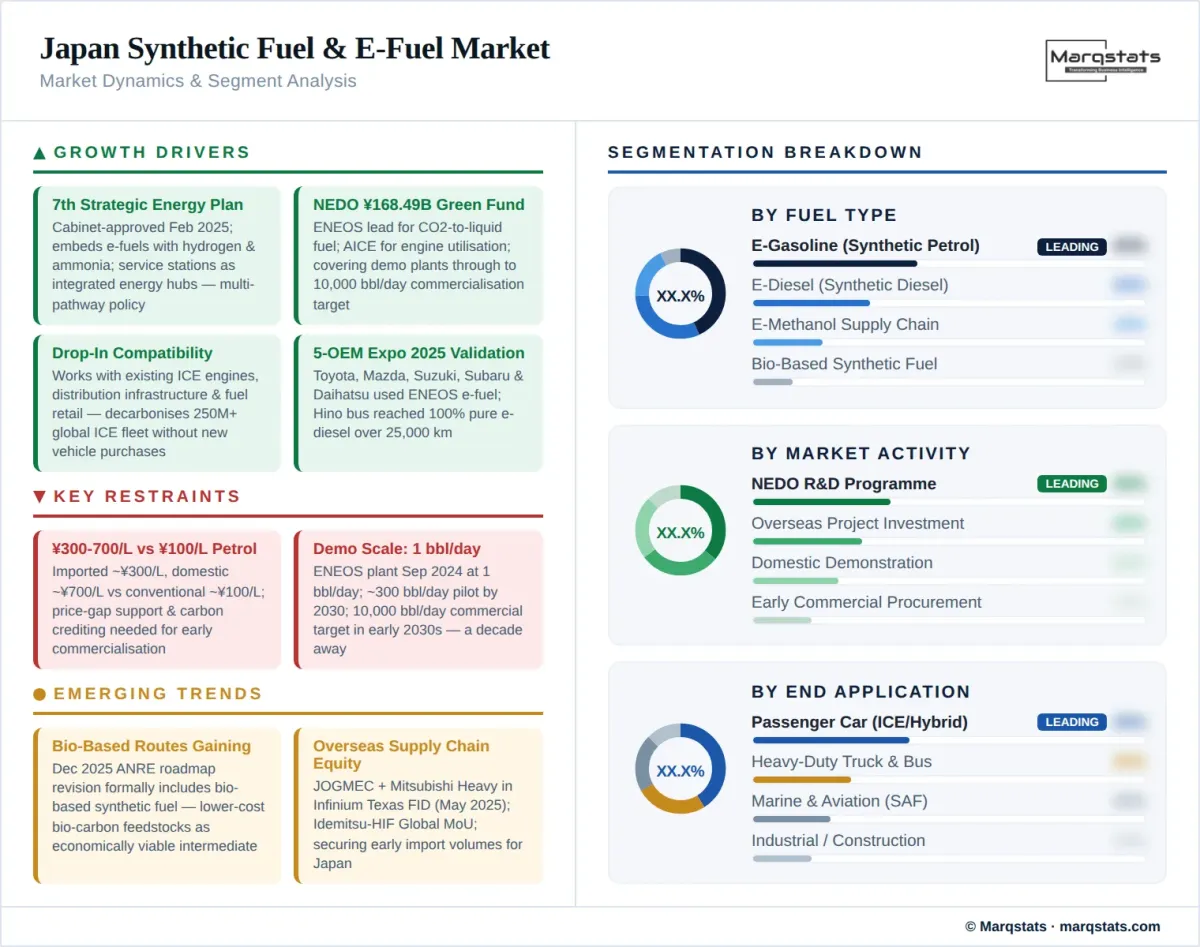
- 7th Strategic Energy Plan and government commercialisation target for early 2030s: Japan's Cabinet-approved 7th Strategic Energy Plan (February 2025) formally embeds e-fuels within the country's next-generation energy framework, alongside hydrogen and ammonia, and positions service stations as future integrated energy hubs supplying petroleum, hydrogen, e-fuels, and biofuels. The plan's multi-pathway energy philosophy — explicitly rejecting a single-technology decarbonisation path — creates the policy stability that underpins NEDO funding commitments and industry investment decisions stretching into the early 2030s.
- NEDO Green Innovation Fund providing up to ¥168.49 billion in multi-year programme support: NEDO's umbrella Green Innovation Fund project for CO2-derived fuels covers synthetic fuels, SAF, synthetic methane, and green LPG, with ENEOS as the designated entity for high-efficiency CO2-to-liquid-fuel process development and AICE as the entity for synthetic fuel utilisation improvement in passenger and heavy-duty vehicles. This sustained public funding — covering technology development, pilot plant construction, and commercial plant formation — is the primary mechanism through which Japan is compressing the timeline from 1 barrel/day demonstration to the 10,000 barrel/day commercialisation scale target.
- Drop-in compatibility preserving existing engine, distribution, and retail infrastructure: METI's public-private synthetic fuel commercialisation summary explicitly states that synthetic fuels have fossil-fuel-like energy density, can use existing tankers, ships, and petrol stations, and are compatible with internal combustion engines without modification. This infrastructure reuse argument — avoiding the multi-trillion-yen cost of replacing Japan's liquid-fuel distribution network and retail forecourt infrastructure — is a core driver of government and industry willingness to invest in synthetic fuels as a complement to electrification rather than a competing technology.
- OEM carbon-neutral engine platforms creating guaranteed demand-side validation pool: Toyota, Mazda, and Subaru's May 2024 commitment to new engine development explicitly incorporating compatibility with e-fuels, biofuels, and liquid hydrogen ensures that Japan's next-generation engine platforms create a built-in validation and eventual demand base for synthetic fuel. Toyota's new 1.5L and 2.0L engines targeting a 2028 launch with carbon-neutral fuel compatibility, combined with Mazda's rotary engine concepts, represent the industry-wide signal that internal combustion engine investments and synthetic fuel investments are complementary bets, not competing ones.
- Energy security imperative driving strategic overseas supply-chain investment: Japan's near-total dependence on fossil-fuel imports creates a structural premium on diversifying to domestically compatible energy sources with diversified supply origins. JOGMEC's first e-fuel investment (FY2024, Infinium Texas project reaching FID in 2025) and Idemitsu's HIF Global partnership — targeting procurement of e-methanol and synthetic fuel from overseas projects from the early 2030s — reflect a government-industry consensus that Japan's future synthetic fuel supply will combine domestic demonstration-scale production with strategic overseas project participation, reducing both energy import dependence and geographic supply concentration.
Key Restraints
- Production economics remain far above conventional fuel parity: METI indicative figures of approximately ¥300/L for imported supply and ¥700/L for fully domestic production compare with roughly ¥100/L for conventional gasoline. Japan's own policy documents explicitly acknowledge that early-stage commercialisation will require price-gap support mechanisms — whether through carbon-based fuel taxation reform, CO2-reduction value crediting, or mandatory blending obligations — and that the timeline to unsubsidised market parity remains uncertain given renewable hydrogen cost trajectories.
- Domestic supply still at demonstration scale — 10,000 bbl/day target a decade away: ENEOS's integrated demonstration plant completed in September 2024 operates at 1 barrel per day. The NEDO technology goal of approximately 300 barrels per day on a pilot scale by 2030, with commercialisation at 10,000 barrels per day in the early 2030s, means that domestically produced Japanese synthetic fuel will not be available at meaningful transportation-sector volumes within the 2025–2030 forecast period. Market volumes in this window are dominated by demonstration supply, quality verification programmes, and early procurement from overseas projects.
- Feedstock economics — renewable hydrogen and CO2 costs — subject to supply-chain disruption risk: Japan's October 2025 project revision — shifting from renewable-energy-based to bio-based synthetic fuel due to rising construction costs — illustrates how sensitive the economics are to feedstock and capital expenditure trajectories. Green hydrogen remains expensive in Japan due to limited domestic renewable power capacity, and CO2 capture at sufficient purity for fuel synthesis adds further cost. Both feedstocks are subject to supply-chain and energy-price volatility that complicates long-term project financing and off-take pricing.
- Absent mandatory blending obligation limiting near-term retail demand pull: Unlike biofuel mandates in Brazil or Europe, Japan has not yet established a mandatory e-fuel blending obligation for the automotive fuel market. The near-term bioethanol roadmap — E10 by FY2030, E20 from FY2040 — provides a clearer regulatory demand signal for bioethanol than for synthetic fuel. Without a mandatory e-fuel blending target, near-term demand for synthetic fuel in Japan's automotive market depends on voluntary OEM and fleet operator purchasing and premium applications, rather than broad retail pull.
Key Trends
- Bio-based synthetic fuel routes gaining policy legitimacy as economically viable intermediate pathway: The December 2025 ANRE roadmap revision's formal inclusion of bio-based synthetic fuel — using biomass-derived carbon alongside green hydrogen for fuel synthesis — reflects a pragmatic policy shift acknowledging that fully renewable-electrolysis-based e-fuel will not be commercially viable at mass-market scale within the 2030s at current hydrogen costs. Bio-based routes, which utilise lower-cost bio-carbon feedstocks and can achieve faster cost reductions, are now positioned alongside electrolysis-based e-fuels as complementary pathways toward the shared goal of carbon-neutral liquid transportation fuels.
- Multi-OEM demand validation at Expo 2025 compressing the lab-to-market timeline: The simultaneous use of ENEOS synthetic fuel by five OEMs — Toyota, Mazda, Suzuki, Subaru, and Daihatsu — in passenger vehicles, and the Hino commercial bus reaching 100% pure synthetic diesel operation, transformed Expo 2025 Osaka from a technology demonstration into a multi-stakeholder proof-of-concept for the entire Japanese automotive industry. The significance is not the fuel volumes consumed but the breadth of OEM participation, which legitimises the engine-compatibility argument across Japan's main automotive platform families.
- Overseas project participation becoming a core component of Japan's supply strategy: The combination of Idemitsu's HIF Global partnership for e-fuel procurement from overseas projects from the early 2030s, JOGMEC's equity investment in Infinium's Texas second commercial e-fuels project (FID 2025), and Mitsubishi's co-investment alongside JOGMEC reflects a Japan-government-endorsed model where domestic technology demonstration is complemented by strategic ownership stakes in overseas large-scale production assets. This mirrors Japan's existing LNG and hydrogen supply-chain strategies and suggests that future e-fuel import corridors to Japan will be structurally similar to today's LNG terminal and shipping infrastructure.
- International rule-making and carbon accounting frameworks becoming competitive battleground: Japan co-hosted the first Ministerial Meeting on Sustainable Fuels with Brazil in September 2025, attended by representatives from 34 countries and organisations, covering e-fuels alongside biofuels and e-methane. Japan's active engagement in shaping the international recognition of synthetic fuels' environmental value — particularly how lifecycle CO2 reductions are credited in global carbon accounting and trade frameworks — is a strategic investment alongside technology development, since synthetic fuels that are not internationally recognised as carbon-neutral will be unable to command the regulatory and market premiums that justify their production costs.
Market Segmentation
E-gasoline — synthetic petrol produced from green hydrogen and captured CO2 via Fischer-Tropsch or similar synthesis processes — is the segment with the broadest potential vehicle compatibility in Japan's passenger car market, given the dominance of petrol-powered vehicles in Japan's light-vehicle fleet. ENEOS used synthetic-gasoline blends at Expo 2025 across Toyota, Mazda, Suzuki, Subaru, and Daihatsu passenger vehicles, validating multi-OEM engine compatibility in a controlled demonstration environment. The new carbon-neutral-fuel-compatible engines announced by Toyota and Mazda — targeting 2028 launch — are explicitly designed to maximise efficiency on both e-gasoline and biofuel blends, ensuring a growing pool of OEM-validated demand as commercial supply scales. Near-term e-gasoline volumes are limited to NEDO-funded demonstration supply and voluntary fleet programmes; mass-market availability depends on achieving production economics competitive with bioethanol at commercial scale.
E-diesel — synthetic diesel for heavy-duty trucks, buses, construction equipment, and agricultural machinery — is the segment where Japan's drop-in-compatibility argument is most commercially compelling. Commercial vehicles operate on fixed schedules, carry high-value payloads, and have long asset replacement cycles, making the ability to decarbonise through fuel substitution without fleet replacement particularly valuable for operators. Hino's Expo 2025 bus demonstrating 100% pure synthetic diesel operation at approximately 25,000 km is the clearest near-term validation of e-diesel in Japanese commercial transportation. Hino's simultaneous involvement in both the e-fuel bus programme and fuel-cell heavy truck development (Profia Z FCV) reflects the Japanese commercial vehicle industry's genuine multi-pathway approach, where neither synthetic fuel nor electrification is treated as an exclusive bet.
E-methanol — synthetic methanol produced from green hydrogen and CO2 — and bio-based synthetic fuel variants are gaining strategic importance as both lower-cost pathways to the carbon-neutral liquid fuel goal and as strategic products for Japan's shipping decarbonisation ambitions. Idemitsu's HIF Global partnership includes e-methanol alongside synthetic fuel, and Idemitsu's disclosed 500,000-tonne target by 2035 is specifically for e-methanol supply from domestic and overseas sources, reflecting its centrality to Idemitsu's carbon-neutral portfolio. The December 2025 roadmap revision formalising bio-based synthetic fuel pathways acknowledges the commercial reality that bio-carbon feedstocks can achieve production economics closer to market parity in the near term than fully electrolysis-based routes.
Automotive end use — passenger cars, SUVs, and light commercial vehicles — represents the largest eventual addressable market for e-gasoline in Japan given fleet scale, but will remain a niche demonstration and premium market through 2030. Japan's near-term gasoline decarbonisation policy is more concretely structured around bioethanol blending — E10 by FY2030 per the November 2024 METI announcement, with E20 from FY2040 — than around mandatory e-fuel content. The automotive e-fuel opportunity through 2030 is therefore primarily a fleet demonstration, corporate sustainability procurement, and racing or motorsport premium market, complemented by the gradual introduction of ENEOS synthetic-gasoline blends through voluntary channels. Toyota and three companies' May 2024 study explicitly targeting introduction of CN fuels into Japan's automobile market around 2030 defines the institutional ambition without yet creating mandatory purchase volumes.
Commercial heavy-duty transportation is the highest-value near-term e-diesel market in Japan, where fleet operators' fixed-route predictability, high daily fuel consumption, and sensitivity to cargo payload constraints make synthetic diesel's drop-in compatibility especially attractive. NEDO and Hino's Expo 2025 commercial vehicle programme is Japan's first structured commercial-vehicle e-diesel deployment and provides the fuel quality, engine compatibility, and operational data required to support early commercial procurement agreements from the early 2030s. AICE's NEDO programme specifically targeting improvement of synthetic fuel utilisation efficiency and backfire reduction in heavy-duty engines directly addresses the technical barriers to expanding e-diesel adoption in Japan's truck and bus fleet.
Shipping is a strategically important end-use for Japan's synthetic fuel programme given the country's island geography, the importance of maritime trade to its economy, and the shipping sector's difficulty in electrifying long-distance ocean voyages. E-methanol is the primary synthetic fuel pathway relevant for shipping, since its energy density and handling characteristics are compatible with existing bunker fuel distribution infrastructure and newer dual-fuel ship engine designs. Japan's September 2025 co-hosting of the first Ministerial Meeting on Sustainable Fuels — which included e-methanol alongside biofuels and e-fuels in the sustainable fuels discussion framework — reflects the government's recognition that shipping will be one of the first large-volume end-use markets for synthetic methanol as production scales.
By Geography
Kanto — Tokyo and Kanagawa (ENEOS R&D and Policy Hub)
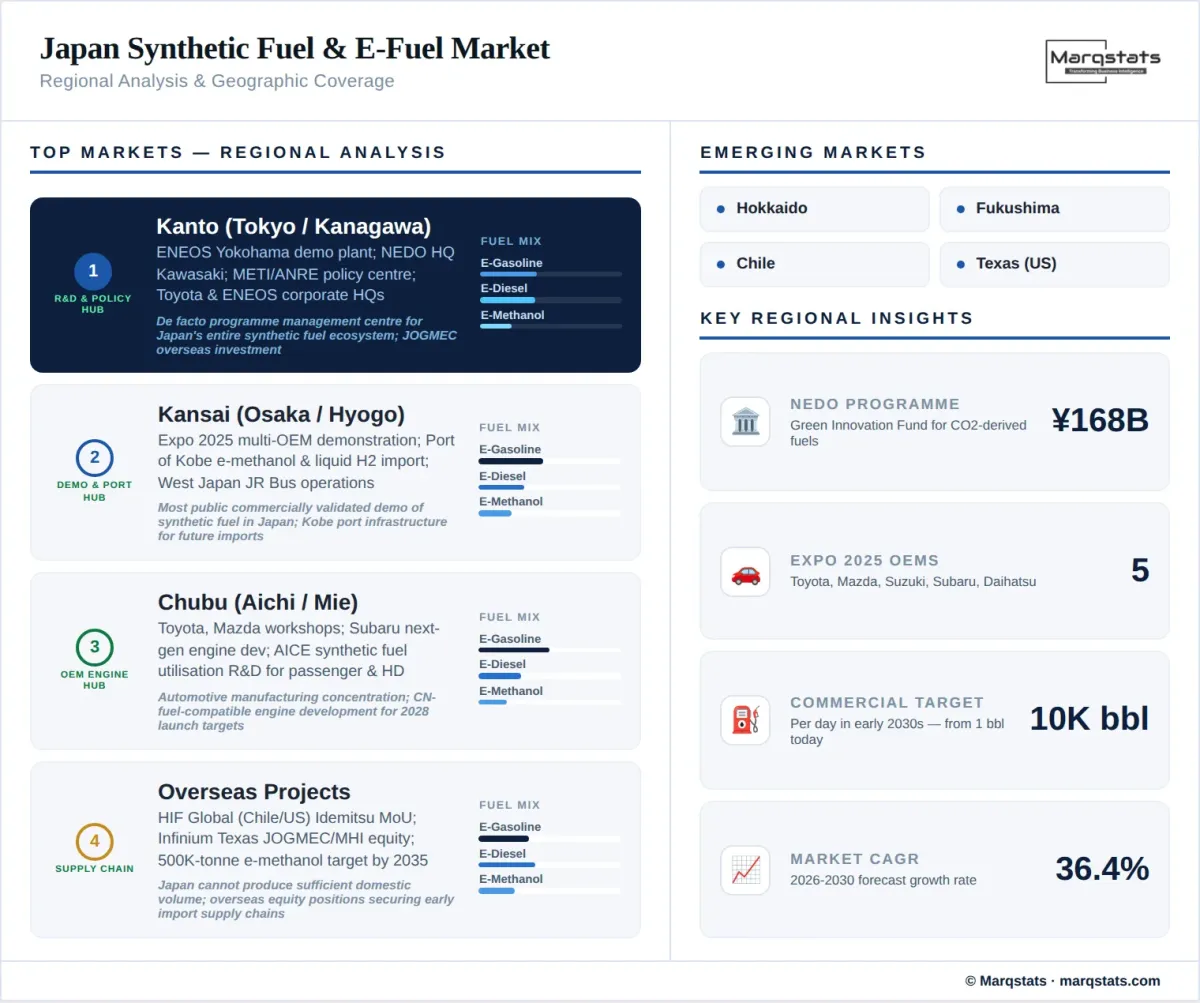
The Kanto region is Japan's primary synthetic fuel R&D, policy, and corporate strategy hub. ENEOS's Central Research and Development Centre in Naka Ward, Yokohama (Kanagawa Prefecture) is the site of the experimental plant that produced the synthetic e-fuel used in the Expo 2025 Osaka bus demonstration. Tokyo is home to the corporate headquarters of ENEOS, Idemitsu, JOGMEC, Toyota's government relations and policy functions, and the METI/ANRE teams responsible for the synthetic fuel commercialisation roadmap. NEDO is headquartered in Kawasaki (Kanagawa), making Kanto the de facto policy and programme management centre for Japan's entire synthetic fuel ecosystem.
Kansai — Osaka, Hyogo, and Nara (Expo Demonstration and Port Infrastructure)
Kansai's significance in Japan's synthetic fuel market was amplified by Expo 2025 Osaka, which served as the first real-world multi-OEM demonstration environment for both e-diesel (Hino bus) and e-gasoline blends (Toyota, Mazda, Suzuki, Subaru, Daihatsu passenger vehicles). The Expo's location in Osaka, combined with ENEOS and West Japan JR Bus's participation, created Japan's most public and commercially validated demonstration of synthetic fuel in mobile transportation to date. The Port of Kobe (Hyogo) is separately relevant for Japan's e-methanol and liquid hydrogen import infrastructure, given Kawasaki Heavy Industries' liquid hydrogen import terminal at Kobe Port — potential infrastructure for future synthetic fuel import logistics.
Chubu — Aichi and Nagano (Automotive Manufacturing and ICE Engine Production)
Chubu is the industrial heart of Japan's internal combustion engine manufacturing ecosystem and therefore the region with the strongest structural demand interest in synthetic fuel as a carbon-neutral engine fuel. Toyota's manufacturing headquarters and R&D operations, Hino's production facilities, and the dense cluster of Tier-1 and Tier-2 engine component suppliers — including TPR's piston ring production plant in Nagano, which holds a 60% global cylinder liner market share — are all concentrated in this region. The region's automotive industry has the strongest commercial motivation to support synthetic fuel commercialisation as a path to preserving its existing manufacturing assets and skills base in a decarbonising automotive market.
Overseas Supply Chains — North America, South America, and Middle East
Japan's synthetic fuel strategy explicitly includes overseas production sites as a core supply component. Infinium's second commercial e-fuels project in Texas — where JOGMEC and Mitsubishi are equity investors and which reached Final Investment Decision in 2025 — represents Japan's clearest near-term overseas supply asset in the United States. HIF Global's e-fuel projects in Chile and other locations, where Idemitsu has an investment interest through its HIF MOU, represent the South American supply chain route. Japan and Brazil's co-hosting of the first Ministerial Meeting on Sustainable Fuels in September 2025 reinforces the Japan-Brazil sustainable fuel supply relationship. These overseas investment positions follow Japan's established model for energy security — securing equity stakes in upstream supply assets to guarantee physical molecule access and preferential pricing in early commercial phases.
How Competition Is Evolving
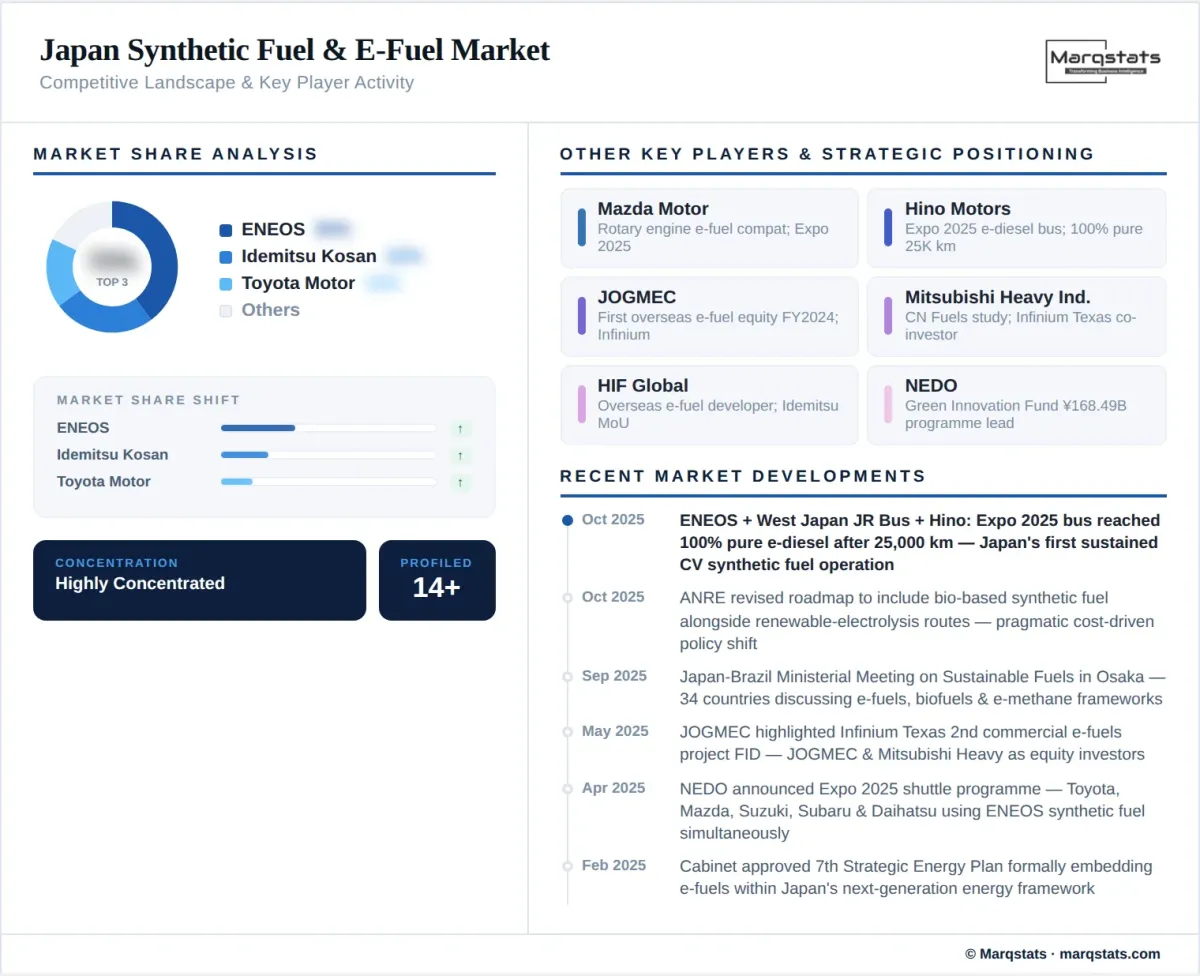
Japan's synthetic fuel competitive landscape is characterised by consortium-based collaboration rather than direct commercial rivalry in the near term, reflecting the fact that all major players are still investing in developing the market rather than competing for share within it. The competitive dynamics will shift as the market approaches commercialisation in the early 2030s, at which point fuel producers, supply-chain asset owners, and technology licensors will compete on production cost, supply reliability, and carbon accounting credentials.
ENEOS holds the strongest position in domestic technology leadership and fuel-supply demonstration capability. As the NEDO-designated entity for high-efficiency CO2-to-liquid-fuel process development, the operator of Japan's first integrated synthetic fuel demonstration plant, and the fuel supplier for both the Expo 2025 passenger vehicle and commercial vehicle programmes, ENEOS has established itself as the dominant domestic synthetic fuel supply brand. Its competitive advantage is technology depth and government programme integration; its constraint is that its current demonstration plant at 1 barrel per day is multiple orders of magnitude below commercial scale, and that the October 2025 revision toward bio-based synthetic fuel reflects genuine economic pressure on its renewable-electrolysis-based roadmap.
Idemitsu Kosan occupies the overseas supply-chain builder position, with its HIF Global MOU covering e-fuel procurement from overseas projects and a disclosed investment in HIF alongside a 500,000-tonne e-methanol target for 2035. Idemitsu's strategy is complementary to ENEOS — where ENEOS is building domestic technology and demonstration capability, Idemitsu is securing future import supply through equity positions in commercial-scale overseas projects. Together, they represent the two legs of Japan's dual-track synthetic fuel supply strategy: domestic production for energy security and technology sovereignty, and overseas procurement for near-term commercial scale. Toyota leads the automotive demand-validation ecosystem through its CN fuels consortium study with Idemitsu, ENEOS, and Mitsubishi Heavy Industries, and its leadership of the multi-pathway engine strategy with Mazda and Subaru.
Companies Covered
The report profiles 16+ companies with full strategy and financials analysis, including:
Recent Market Activity
Table of Contents
Coverage & Segmentation
This report provides a comprehensive analysis of Japan's synthetic fuel (e-fuel) and carbon-neutral liquid fuel market covering the 2021–2030 period, with 2025 as the base year. The study examines the full synthetic fuel value chain from green hydrogen and CO2 feedstock procurement through Fischer-Tropsch and related synthesis processes, domestic demonstration and pilot plant investment, overseas supply-chain project participation and equity investment, fuel quality verification and OEM engine compatibility validation, and early commercial procurement programmes in automotive, heavy commercial vehicle, and shipping applications. Regulatory coverage spans Japan's 7th Strategic Energy Plan, ANRE synthetic fuel commercialisation roadmap, NEDO Green Innovation Fund project structure, METI public-private synthetic fuel programme, and Japan's bioethanol blending policy (E10 by FY2030, E20 from FY2040). Geographic coverage is primarily Japan, with sections on overseas supply-chain assets in North America (Infinium Texas), South America (HIF Global), and the strategic context of the Japan-Brazil Ministerial Meeting on Sustainable Fuels. Related Marqstats reports cover the Japan Hydrogen Fuel Cell Trucks and Buses Market (japan-hydrogen-fuel-cell-trucks-buses) and the India Telematics and Fleet Safety Systems Market (india-telematics-fleet-safety).
Primary research included 40+ interviews with OEM carbon-neutral fuel programme leads, oil company synthetic fuel project teams, NEDO programme officers, METI energy policy specialists, engine component manufacturers, and logistics and fleet operator procurement managers with interest in carbon-neutral transportation fuel options. Secondary research drew from METI public-private synthetic fuel programme summaries, ANRE next-generation fuel policy pages and roadmap documents, NEDO Green Innovation Fund project disclosures, JOGMEC investment announcements, Japan's 7th Strategic Energy Plan, OEM press releases and investor presentations, Expo 2025 Osaka programme materials, and Japan's 2025 Energy White Paper.