Market Snapshot
Key Takeaways
Market Overview & Analysis
Report Summary
The India EV battery pack market encompasses complete energy storage and power delivery systems designed for battery electric vehicles—integrating multiple lithium-ion battery cells into modules and enclosures with battery management systems (BMS) for safe, efficient electricity storage and power delivery to vehicle motors. The market scope covers batteries used exclusively in battery electric vehicles; plug-in hybrid, hybrid, and fuel-powered vehicles are excluded. Component-level revenue from standalone BMS, casing, and thermal management systems is excluded from market size calculations.
India’s EV sales reached approximately 1.97 million units in FY2025, a 16.9% year-over-year increase from 1.75 million in FY2024. Electric two-wheeler battery pack demand dominated at approximately 1.18 million registrations (~60% of EV sales), while electric car battery pack volumes for 4W passenger vehicles exceeded 100,000 units for the first time, growing 18.2% year-over-year. Electric three-wheeler battery packs recorded approximately 700,000 units, representing 57% of total three-wheeler sales in India. Electric commercial vehicle battery pack demand is accelerating from a smaller base, with 14,028 e-buses allocated under PM E-DRIVE and the medium-and-heavy commercial vehicle sub-segment growing at nearly 80% CAGR.
The distinction between battery pack assembly and cell manufacturing in India is critical to understanding the market’s current state. The vast majority of Indian players—including Cygni Energy, Battrixx (now Geon), Inverted Energy, and OPG Mobility—perform pack assembly using imported cells. Only Ola Electric has commenced indigenous cell manufacturing under the PLI-ACC scheme, producing NMC 2170 cylindrical cells at its Tamil Nadu gigafactory. This assembly-versus-manufacturing gap represents both the sector’s most significant constraint and its largest investment opportunity. India’s battery pack import dependence for lithium, cobalt, and nickel—with INR 20,000 crore worth of battery storage equipment imported annually—underscores the urgency of closing this gap through gigafactory buildouts and critical mineral security strategies.
Market Dynamics
Key Drivers
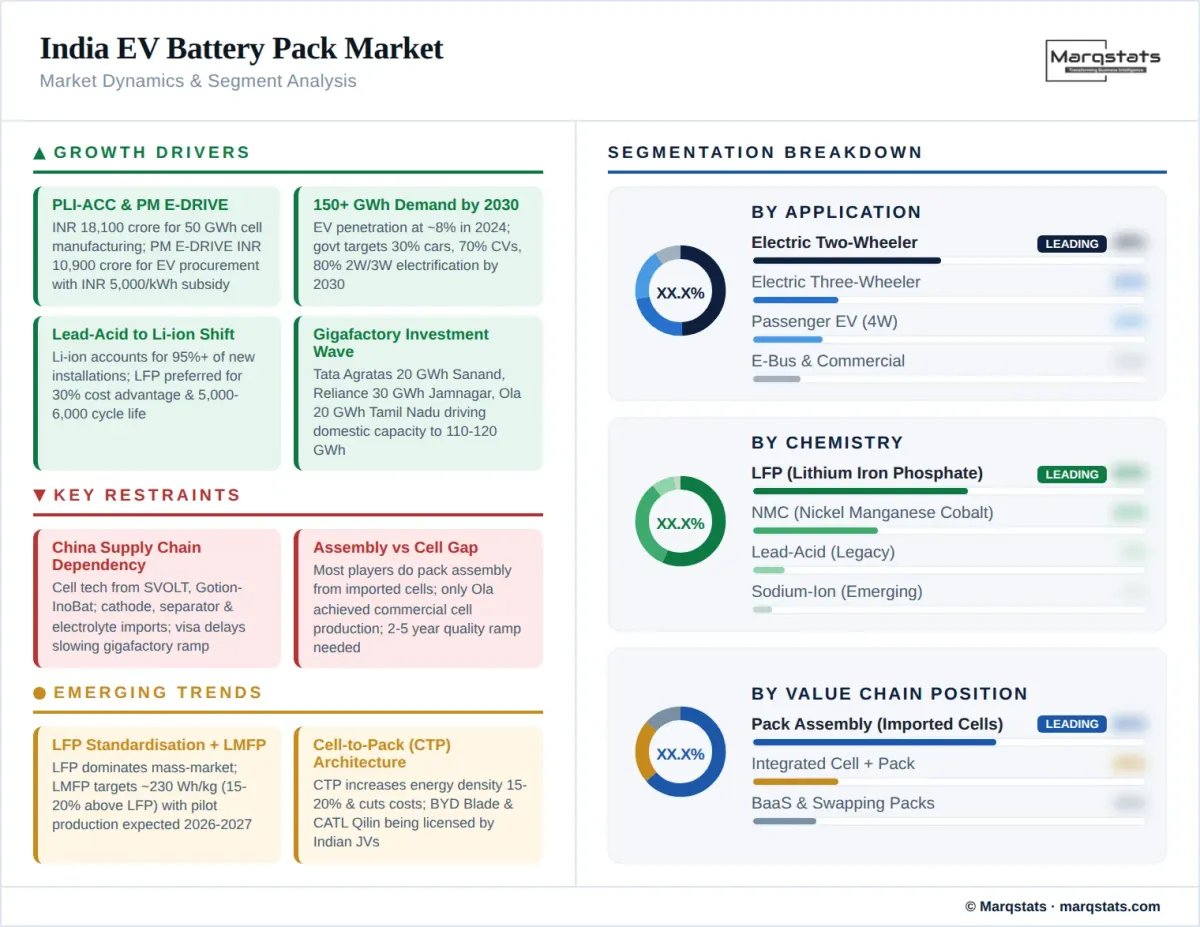
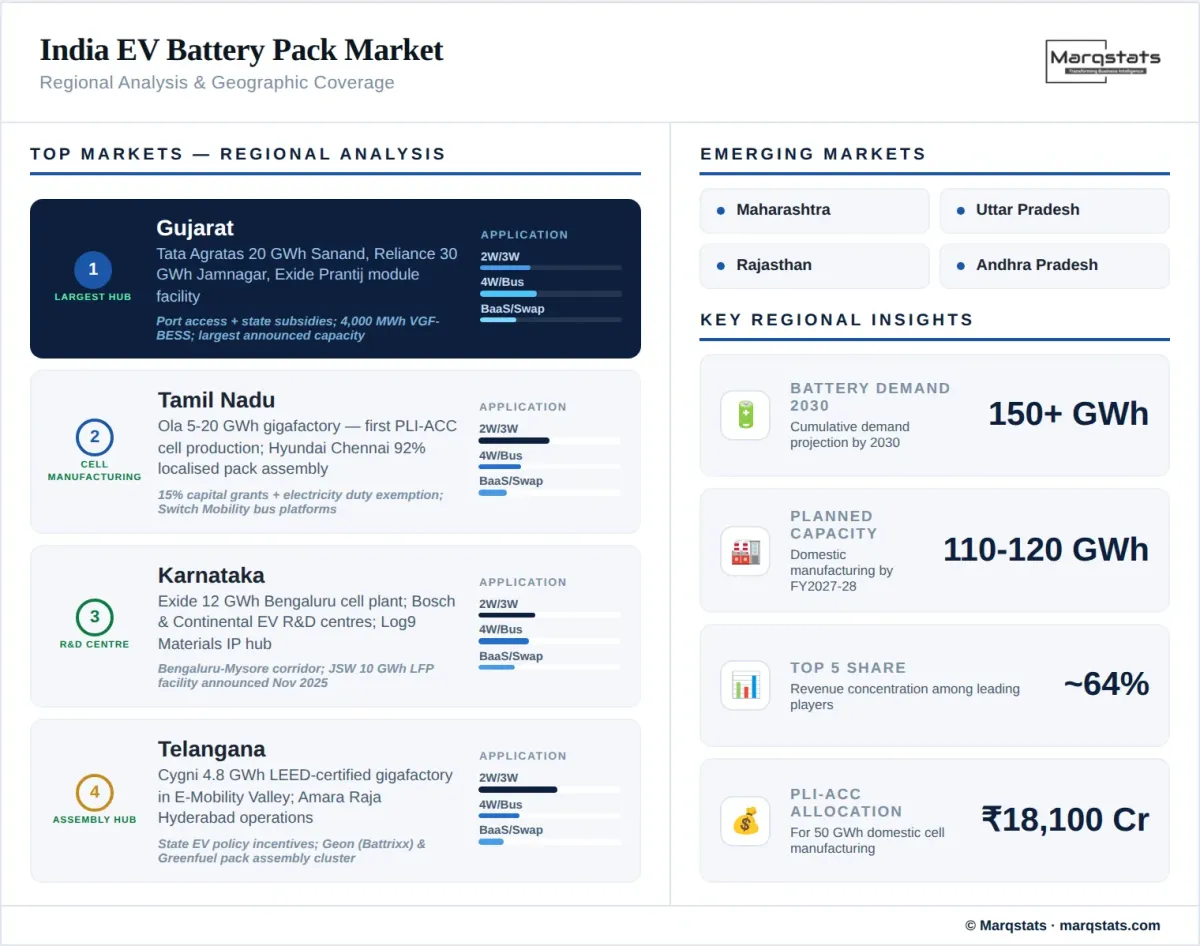
- PLI-ACC scheme and PM E-DRIVE policy acceleration: The PLI-ACC scheme designates INR 18,100 crore (~USD 2.03 billion) for 50 GWh domestic cell manufacturing. However, independent analyses indicate only 2.8% (1.4 GWh) was delivered by October 2025, all by Ola Electric, highlighting implementation challenges. PM E-DRIVE allocates INR 10,900 crore for EV procurement and charging infrastructure through March 2028, supporting 2.479 million electric two-wheelers, 14,028 electric buses, and 5,643 e-trucks with battery-capacity-linked incentives of INR 5,000/kWh in FY2024–25. Domestic battery manufacturing capacity is projected to scale from approximately 8 GWh in 2023 to 110–120 GWh by FY2027–28, driven by both PLI and non-PLI investments exceeding the government’s initial allocation.
- Rapid EV adoption creating cumulative battery demand of 150+ GWh by 2030: India’s EV penetration reached approximately 8% of total vehicle sales in 2024. The government’s 2030 targets—30% electrification of private cars, 70% of commercial vehicles, and 80% of two- and three-wheelers—translate to estimated annual battery demand exceeding 150 GWh. As FAME-era EVs (2019–2024) approach battery end-of-life, a secondary replacement market is emerging that will further expand demand for both OEM and aftermarket battery packs. India’s charging infrastructure has grown to 29,277 public stations as of November 2025, with 72,000 new chargers planned by FY2026.
- Lead-acid to lithium-ion transition accelerating across segments: Lead-acid batteries retained 53.2% market share in India’s broader battery market in 2025 but are declining rapidly as lithium-ion battery pack technology gains dominance across EV applications. Ola Electric’s S1 pack priced at approximately INR 45,000 undercuts lead-acid total cost of ownership for two-wheelers, while lithium-ion’s 3–5x longer cycle life and 40% lower lifetime costs drive adoption in telecom backup, e-rickshaws, and industrial applications. Battery pack prices in India are trending toward sub-INR 50,000 for three-wheelers by late 2026 as Exide and Amara Raja scale production.
- India gigafactory battery EV capacity exceeding 68 GWh in 2025: Domestic installed and announced capacity reached 68 GWh in 2025, representing 40%+ growth over 2024. Non-PLI players are driving the largest expansions: Tata Agratas has committed INR 13,000 crore (~USD 1.5 billion) for a 20 GWh facility in Sanand, Gujarat, with construction targeted by 2026 and operations by 2028. Reliance New Energy’s Jamnagar gigafactory plans 30 GWh total capacity, with Phase 1 (2 GWh sodium-ion) commissioned in September 2025 using Faradion IP. Exide Energy Solutions opened a 3 GWh production line in Pune in July 2025 (INR 2,100 crore investment) using SVOLT technology transfer. Amara Raja Energy & Mobility’s gigafactory in Hyderabad (E-Mobility Valley) targets 16 GWh cell capacity expandable to 30 GWh by 2035, with Gotion-InoBat technology licensing.
- Grid-scale BESS and sodium-ion battery expansion beyond mobility: The VGF scheme for Battery Energy Storage Systems expanded to 43.2 GWh by FY2028 with cumulative INR 9,160 crore budgetary support across 15 states. Reliance’s 2 GWh sodium-ion battery facility at Jamnagar, commissioned September 2025 using Faradion IP, represents a pivotal diversification beyond lithium-ion for grid storage and potentially EV applications. Annual BESS demand is projected at 236 GWh by 2031–32. The India Energy Storage Alliance (IESA) roadmap targets 50+ GWh by 2027 and 100+ GWh by 2030 across mobility and stationary applications.
Key Restraints
- China dependency across the battery supply chain: India’s battery ecosystem relies heavily on Chinese technology transfers and component imports. Exide’s cell manufacturing uses SVOLT technology, Amara Raja licenses from Gotion-InoBat, and most cathode, separator, and electrolyte materials are imported from China. Independent analyses report that visa delays for Chinese technicians have slowed gigafactory commissioning timelines. India imports approximately INR 20,000 crore worth of battery storage equipment annually, with lithium, cobalt, and nickel representing critical mineral exposure. While lithium reserves discovered in Jammu & Kashmir hold long-term promise, commercial-scale domestic mining timelines extend well beyond 2028.
- Battery pack assembly vs. cell manufacturing gap constraining value capture: Most Indian players—including Cygni Energy (4.8 GWh pack assembly gigafactory in Hyderabad), Geon (formerly Battrixx), Inverted Energy, Trontek, and OPG Mobility—perform pack assembly from imported cells, not cell manufacturing. Only Ola Electric has achieved commercial-scale cell production. As of May 2024, Bharat Test House remained India’s sole accredited battery cell testing agency under PLI-ACC. Initial gigafactory ramp-ups require 2–5 years for quality stabilization and 5–7 years for global competitiveness, creating a prolonged transition period during which India remains dependent on imported cells.
- High capital intensity and PLI scheme implementation challenges: Cell manufacturing demands investment of approximately INR 225 crore (~USD 25 million) per GWh under PLI-ACC, creating steep barriers for MSMEs. Of the 50 GWh PLI-ACC target, none of the beneficiaries had met December 2024 milestones as of early 2025, resulting in zero incentive disbursement and a budgetary allocation reduction from INR 250 crore to INR 15.42 crore. Long gestation periods and continued reliance on imports have prompted beneficiaries to request timeline extensions.
- Charging infrastructure lag in Tier-2/3 cities constraining non-metropolitan demand: While India had 29,277 public charging stations as of November 2025 (up from 6,586 in 2023), charger density remains weak in smaller towns. The government targets 1.32 million charging stations by 2030, but 59% of fast-charging points are still concentrated in Tier-2/3 cities near national highways rather than within residential or commercial zones. Uneven deployment constrains EV adoption and battery pack demand growth outside major metropolitan areas.
Key Trends
- LFP lithium iron phosphate battery standardization with LMFP on the horizon: LFP chemistry dominates India’s mass-market EV segments, with growing demand for LFP over traditional lithium-ion chemistries confirmed by multiple industry analyses. The Piaggio-Amara Raja LFP collaboration and Hyundai Creta Electric’s LFP pack assembly at Chennai exemplify this shift. Next-generation LMFP (lithium-manganese-iron-phosphate) chemistry targets ~230 Wh/kg energy density (15–20% above LFP’s ~170 Wh/kg) while maintaining thermal stability and cycle life. Pilot production is anticipated in 2026–2027, with commercial scale-up between 2027–2030.
- Cell-to-pack (CTP) architecture eliminating module-level packaging: CTP increases energy density by 15–20% and reduces per-kWh costs by eliminating intermediate module assembly. BYD’s Blade Battery and CATL’s Qilin (CTP 3.0) represent commercial deployments being licensed by Indian joint ventures including Tata-Agratas and Exide-SVOLT. CTP is particularly beneficial for large-format prismatic cells in commercial vehicles and buses with 150–300+ kWh pack sizes. Indian patent filings in battery technology grew 34% in 2024, led by Log9 Materials and Reliance, signalling a shift from assembly to indigenous IP creation.
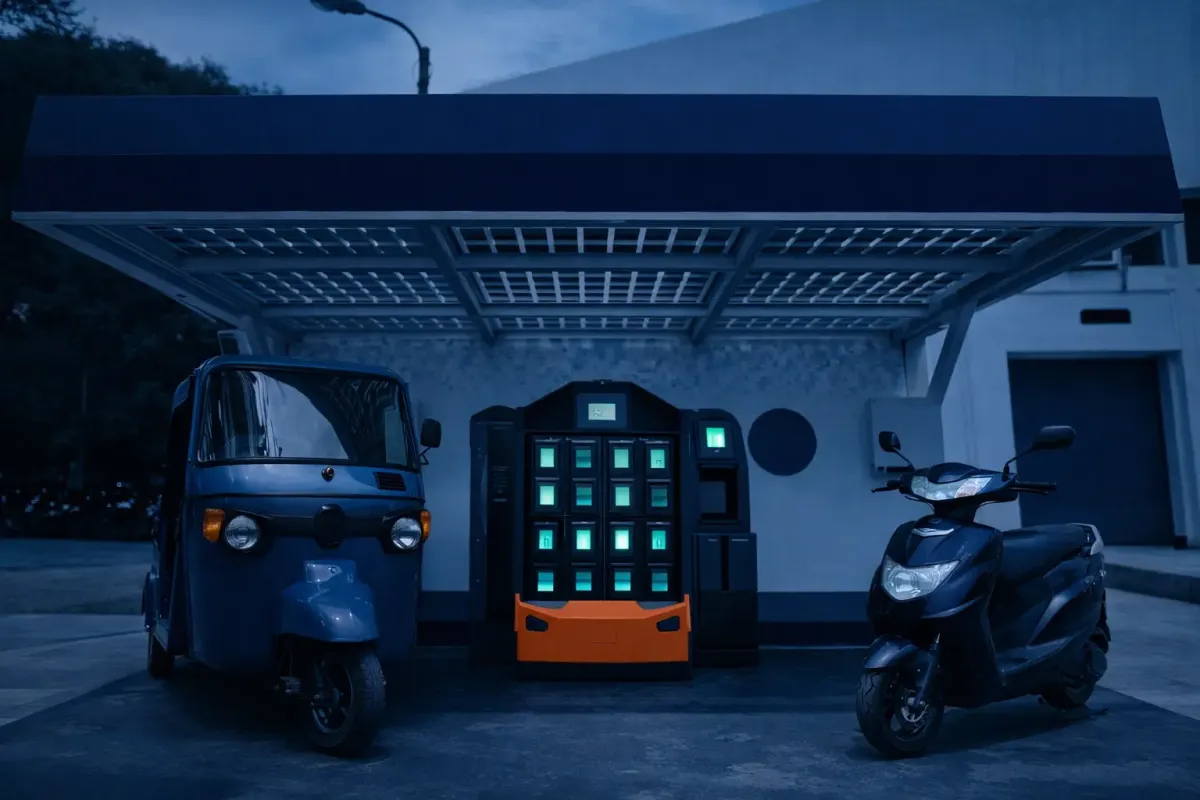
- Battery-as-a-Service (BaaS) and battery swapping models expanding: BaaS decouples battery ownership from vehicle purchase, reducing upfront costs for consumers and fleet operators. Suzuki is exploring battery rental models for the e-VITARA launch, while Ather Energy reportedly processes 8,000+ swap transactions daily. SUN Mobility, Mahindra, and Olectra are piloting battery swapping for e-3W, LCV, and e-bus fleets. Standardized, high-cycle-life LFP packs for commercial and last-mile delivery segments drive this trend. The Marqstats India EV battery swapping market report provides detailed coverage of this expanding segment.
- Battery Aadhaar digital traceability and recycling circular economy: In January 2026, India’s Ministry of Road Transport and Highways released draft guidelines for the Battery Pack Aadhaar system—assigning a unique 21-character alphanumeric code to each pack for lifecycle traceability. India’s battery recycling circular economy for EVs is nascent but growing, with regulations encouraging extended producer responsibility. NavPrakriti started operations of a lithium-ion battery recycling facility near Kolkata in October 2025, with 1,000 tonnes per month mechanical pre-treatment capacity. Industry analyses project India can unlock a USD 3.5 billion lithium-ion battery recycling industry by 2030.
- Solid-state battery R&D positioning for post-2030 disruption: The solid-state battery market in India is projected to grow at 33.5% CAGR to 2031. While still at pilot and R&D stage, solid-state batteries promise higher energy density, faster charging, and improved safety by replacing liquid electrolytes with solid alternatives. Several Indian research institutions are exploring commercialization pathways, though near-term commercial viability remains limited. Current market growth continues to be driven by lithium-ion LFP and NMC chemistries.
Market Segmentation
The electric two-wheeler battery pack segment represents the largest volume driver in the India EV battery pack market, with approximately 1.18 million units registered in FY2025—accounting for nearly 60% of total EV sales and 6% of new two-wheeler registrations. Typical pack capacities range from 1.5–4 kWh, with the segment collectively generating approximately USD 686 million in battery pack revenue in 2025. Sales leadership is concentrated among Ola Electric, TVS Motor Company, Bajaj Auto, and Ather Energy, which command over 80% of the segment. PM E-DRIVE allocates INR 3,679 crore in demand incentives for 2.479 million two-wheeler purchases, with battery-capacity-linked subsidies directly stimulating pack demand. Ola Electric’s indigenous NMC 2170 cell and 4680 Bharat Cell—India’s first domestically developed lithium-ion cell—represent landmark milestones for two-wheeler battery pack localization.
Electric three-wheeler battery packs constitute the highest-utilization replacement demand segment, with approximately 700,000 units sold in FY2025 representing 57% of total three-wheeler sales. High daily utilization rates (often 100+ km/day for e-rickshaws and cargo applications) drive frequent battery replacement cycles, creating sustained aftermarket demand. Typical pack capacities range from 7–13 kWh using LFP or NMC chemistry. Mahindra Last Mile Mobility leads with 37.3% market share in the L5 e-3W category for FY2024–25. States like West Bengal, Bihar, and Assam are experiencing rapid adoption, with affordable short-range models making significant sales contributions. Battery pack prices targeting sub-INR 50,000 for three-wheelers by late 2026 will further accelerate adoption.
The electric car battery pack segment is the highest-value application by revenue per unit, with pack capacities ranging from 19.2 kWh (Tata Tiago EV) to 82.5 kWh (premium SUVs). Sales surged 18.2% year-over-year in FY2025 to exceed 107,541 units, with EV penetration reaching 2.7% of total passenger vehicle sales. The Hyundai Creta Electric battery pack assembled locally at Chennai with 92% localization represents a landmark for domestic production. In 2025, 18+ new electric car models were launched or announced, including the Maruti Suzuki e-VITARA (with planned battery localization), Tata Harrier EV, Mahindra XEV 7e with INGLO battery packs, and BYD Sealion 7. Automakers are prioritizing larger batteries of 45–82.5 kWh with claimed ranges of 400–700 km. LFP chemistry dominates mass-market 4W applications, while NMC is reserved for premium, long-range vehicles. This segment is projected to grow at 52%+ CAGR through 2030, driven by new model launches and declining battery pack prices.
Electric commercial vehicle battery packs represent the highest-capacity segment, ranging from 100–400+ kWh per vehicle across e-buses, medium-and-heavy commercial vehicles (M&HCV), and light commercial vehicles (LCVs). Under PM E-DRIVE, 14,028 electric buses are allocated for procurement across nine metropolitan cities with populations exceeding 4 million, driving concentrated demand for large-format LFP packs. Olectra leads e-bus deployments using BYD’s Blade Battery technology with scalable 261–324 kWh packs for MSRTC, GSRTC, and TSRTC fleets. Switch Mobility’s EiV12 platform offers modular NMC/LFP packs from 189–423 kWh with dual-gun CCS2 fast charging. JBM Auto’s Ecolife e-bus platform targets 20,000 annual bus capacity. The M&HCV sub-segment is growing at nearly 80% CAGR from a low base, while LCV battery packs (Tata Ace EV, Mahindra Zeo, Euler HiLoad, Altigreen neEV) with 11–21 kWh LFP packs serve expanding e-commerce last-mile logistics demand.
LFP chemistry commands the dominant share of India’s EV battery pack installations across two-wheelers, three-wheelers, mass-market passenger vehicles, LCVs, and grid-scale BESS applications. Its 30% per-kWh cost advantage over NMC, thermal runaway onset of 250–270°C (significantly exceeding NMC’s 210°C), and 5,000–6,000 cycle life make it optimally suited for Indian operating conditions where ambient temperatures frequently exceed 40°C. The 2022 expiration of key LFP patents has enabled domestic production by Himadri Speciality Chemical (targeting 200,000 tonnes of LFP cathode material) and Altmin (piloting carbon-coated LFP in Hyderabad). JSW Energy announced a 10 GWh LFP facility in Karnataka in November 2025 for its renewable-plus-storage pipeline. PLI-ACC’s technology-agnostic stance permits beneficiaries to select LFP, and the Piaggio-Amara Raja collaboration specifically targets LFP supply for electric vehicles.
NMC batteries serve premium, long-range passenger vehicles and select high-performance commercial applications requiring higher energy density (~250 Wh/kg vs. LFP’s ~170 Wh/kg). Ola Electric’s indigenous NMC 2170 cell manufacturing at its Tamil Nadu gigafactory represents the first domestic NMC cell production in India. Amara Raja’s Mahbubnagar gigafactory plans a 2 GWh NMC line producing 2170 cylindrical cells. Switch Mobility’s bus platforms and several premium passenger EVs continue to deploy NMC chemistry. However, higher costs, shorter cycle life (1,500–2,000 cycles), and dependence on imported cobalt and nickel are constraining NMC’s market share expansion relative to LFP across mass-market segments.
Sodium-ion battery technology represents an emerging alternative to lithium-ion, with Reliance New Energy’s Jamnagar gigafactory commissioning a 2 GWh sodium-ion line in September 2025 using Faradion IP acquired through its UK acquisition. Sodium-ion cells use abundant, low-cost sodium as the charge carrier, eliminating dependence on lithium, cobalt, and nickel—addressing India’s critical mineral import vulnerability. While currently targeting grid storage and stationary applications, sodium-ion technology holds potential for low-speed EVs and two-wheeler applications in the medium term. Other emerging technologies including solid-state batteries (projected 33.5% CAGR to 2031) and LTO (lithium titanate) remain in pilot or niche-application stages.
Prismatic cells dominate the India EV battery pack market with over 95% share, driven by superior space utilization, higher energy density, and compatibility with cell-to-pack architecture. BYD’s Blade Battery and CATL’s Qilin platform both utilize large-format prismatic LFP cells. Prismatic dominance spans all major applications—passenger vehicles, commercial vehicles, buses, and grid storage. Domestic pack assemblers including Exide, Amara Raja, and Octillion Power Systems predominantly work with prismatic format cells.
Cylindrical cells (2170 and 4680 formats) are deployed in select two-wheeler applications and some passenger vehicles. Ola Electric’s 4680 Bharat Cell and Amara Raja’s 2170 NMC production line represent domestic manufacturing milestones. Cylindrical format offers manufacturing maturity and robust safety characteristics but lower space utilization compared to prismatic alternatives.
Pouch cells occupy a niche position in select premium passenger vehicles where flexible packaging geometry is required. Exide Energy Solutions’ Bengaluru gigafactory (12 GWh target) will produce pouch format alongside prismatic and cylindrical cells using SVOLT technology. Pouch cells offer high energy density but face thermal management challenges under Indian climate conditions.
The 400V battery architecture dominates India’s EV market with approximately 90% share, driven by cost-efficiency, compatibility with existing charging infrastructure, and reliable performance without the complexity of higher-voltage systems. The vast majority of two-wheelers, three-wheelers, mass-market passenger vehicles, LCVs, and city buses operate on 400V platforms. Domestic BMS and thermal management system design is predominantly optimized for 400V architectures.
The 800V architecture is gaining traction in premium passenger vehicles and select commercial applications requiring ultra-fast charging capabilities. Hyundai’s Ioniq 5 (84 kWh) and upcoming premium electric SUVs are expected to drive 800V adoption. Higher voltage enables faster DC charging, reduced cable weight, and improved efficiency, but requires more sophisticated battery management systems and charging infrastructure investment.
By Geography
Gujarat
Gujarat hosts strategically critical battery manufacturing facilities within the Dahej-Barmer PCPIR corridor and Sanand industrial zone. Tata Agratas has committed INR 13,000 crore (~USD 1.5 billion) for a 20 GWh battery gigafactory in Sanand, with construction by 2026 and operations by 2028. Reliance New Energy’s Jamnagar complex plans 30 GWh total capacity, with Phase 1 (2 GWh sodium-ion using Faradion IP) commissioned September 2025. Exide’s Gujarat (Prantij) facility specializes in module and pack production with a 1.5 GWh order book. Gujarat receives 4,000 MWh under VGF-BESS, reflecting its dual role as a manufacturing hub and solar energy powerhouse. Robust port access and state subsidies for capital-intensive investments strengthen Gujarat’s position as India’s largest battery manufacturing state by announced capacity.
Tamil Nadu
Tamil Nadu’s automotive corridor anchors India’s EV battery pack assembly and cell manufacturing ecosystem. Ola Electric’s Tamil Nadu gigafactory (5 GWh initial, targeting 20 GWh) represents the country’s first PLI-ACC beneficiary to achieve commercial cell production, manufacturing NMC 2170 cells and pioneering the 4680 Bharat Cell. Hyundai’s Chennai plant began assembling EV battery packs for the Creta Electric in 2025, achieving 92% localization. Switch Mobility manufactures modular bus platforms in Chennai. The state’s electricity-duty exemptions and 15% capital grants under its EV policy attract continued investment.
Karnataka
Karnataka’s Bengaluru-Mysore corridor serves as India’s premier R&D and advanced manufacturing hub for EV batteries. Exide Energy Solutions’ greenfield gigafactory in Bengaluru targets 12 GWh capacity (Phase I: 6 GWh by end of 2026) using SVOLT technology, producing both LFP and NMC cells in pouch, prismatic, and cylindrical formats. JSW Energy announced a 10 GWh LFP facility in Karnataka in November 2025 for its renewable-plus-storage pipeline. The state hosts R&D centres for Ather Energy, Log9 Materials, and Tata AutoComp, with the dedicated Karnataka EV cluster attracting cell, module, and pack manufacturing investments.
Maharashtra
Maharashtra leads in EV adoption volumes and hosts the Pune-Mumbai industrial belt’s pack assembly and OEM operations. Exide opened a 3 GWh production line in Pune in July 2025 with INR 2,100 crore investment, signing an MoU with Hyundai and Kia in May 2025 for local EV battery supply. Maharashtra’s EV policy mandates 25% battery-electric share in state vehicle purchases. The state receives 4,000 MWh under VGF-BESS. Mahindra’s new EV manufacturing and battery assembly plant in Chakan (launched January 2025) with INGLO battery packs for Electric Origin SUVs positions Maharashtra as a key production hub.
Telangana and Andhra Pradesh
Telangana’s E-Mobility Valley in Hyderabad is emerging as a significant battery manufacturing cluster. Amara Raja Energy & Mobility’s mega giga corridor in Mahbubnagar targets 16 GWh cell capacity and 5 GWh pack capacity, expandable to 30 GWh by 2035, using Gotion-InoBat technology licensing. Cygni Energy launched Phase-I of its 4.8 GWh BESS gigafactory in Hyderabad’s E-Mobility Valley in May 2025—India’s first LEED-certified battery gigafactory (note: pack assembly, not cell manufacturing). Andhra Pradesh hosts Amara Raja’s legacy lead-acid manufacturing base in Tirupati, with lithium-ion expansion underway. Both states receive 2,000 MWh combined under VGF-BESS allocations.
Rest of India
Northern India (Delhi-NCR, Uttar Pradesh, Haryana) contributes approximately 18% of battery pack consumption nationally, driven by e-commerce last-mile delivery fleets and JBM Auto’s Ecolife e-bus manufacturing. West Bengal hosts Exide’s legacy and expanding lithium-ion operations. Kerala recorded the highest EV penetration rate at 7.9% in FY2025. Over 500 electric buses operate across Kerala, West Bengal, Madhya Pradesh, Odisha, and Assam, with plans to expand to 2,000+ by 2027. State transport agencies are procuring Tata Starbus (250 kWh), Olectra C9 (261–324 kWh), and JBM Ecolife (200–288 kWh) e-buses. The combined four states of Gujarat, Tamil Nadu, Karnataka, and Maharashtra concentrate 72% of India’s installed and announced battery manufacturing capacity, reflecting port access, industrial ecosystems, and state-level incentive structures.
How Competition Is Evolving
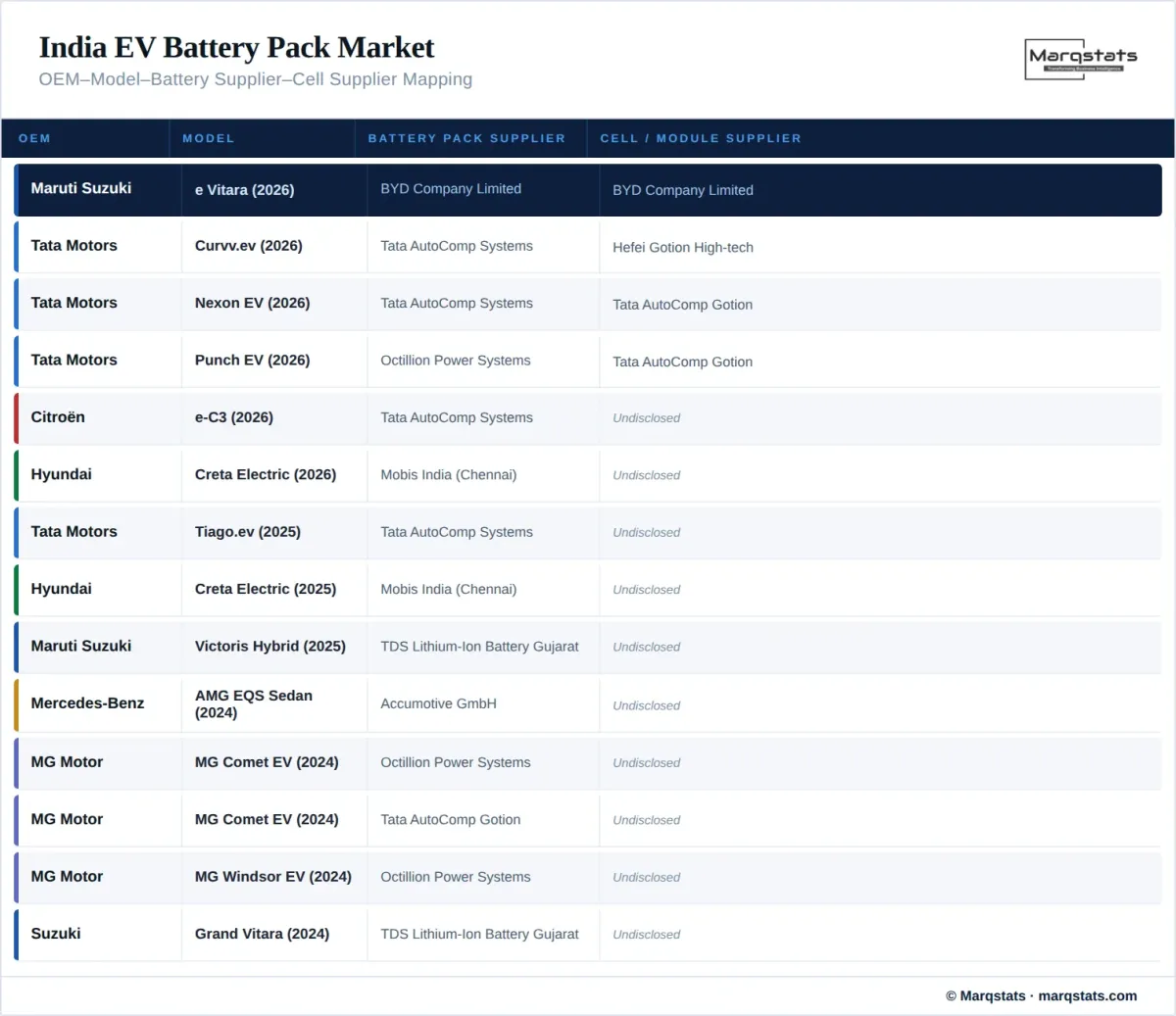
The India EV battery pack market exhibits a moderately concentrated competitive structure, with the top ten players accounting for over 76% of revenue in 2024. Ola Electric commands the leading position at approximately 18.6% market share, followed by Tata Motors (through Tata AutoComp Gotion joint venture) at 14.6%, Octillion Power Systems at 11.5%, LG Energy Solution at 10.1%, Bajaj Auto at 8.9%, CATL at 4.7%, Mahindra at 3.9%, BYD at 2.8%, and Exide at 1.2%. International cell suppliers—CATL, Denso, LG Energy Solution, and BYD—compete alongside domestic players for OEM contracts, particularly in the high-value passenger vehicle and commercial vehicle segments.
Vertical integration is the dominant strategic theme during 2024–2026. OEMs including Ola Electric, Tata Motors (through Agratas), and Mahindra are investing in captive cell manufacturing and pack assembly to control costs and secure supply chains. Established battery specialists Amara Raja and Exide are pursuing gigafactory-scale capacity with technology partnerships—Amara Raja licensing from Gotion-InoBat (China) and Exide from SVOLT (China)—highlighting the market’s continued China dependency for technology access.
Key strategic themes across the competitive landscape include: (1) aggressive gigafactory investments totalling 150+ GWh of announced capacity by 2030; (2) modular pack design enabling battery swapping and rapid replacement, exemplified by Olectra’s Blade Battery platform and Switch Mobility’s EiV12; (3) chemistry optimization with LFP dominant for mass-market segments and NMC reserved for premium applications; (4) Battery-as-a-Service pilots by Maruti Suzuki (e-VITARA battery rental), Ather Energy (swap network), and SUN Mobility; (5) CCS2 fast-charging deployment up to 240 kW for commercial fleets; and (6) advanced telematics, smart BMS, and SaaS platforms for thermal management, predictive maintenance, and TCO optimization. Indian patent filings in battery technology grew 34% in 2024, led by Log9 Materials and Reliance New Energy, signalling a strategic shift from pure assembly to indigenous intellectual property creation.
Companies Covered
The report profiles 22++ companies with full strategy and financials analysis, including:
Recent Market Activity
Table of Contents
Coverage & Segmentation
This report provides a comprehensive analysis of the India EV battery pack market covering the historical period (2021–2025) and forecast period (2026–2030), with 2025 as the base year. The study examines market size and revenue forecasts in USD millions, unit volume analysis, growth trends, competitive landscape dynamics including India EV battery pack market share by company, and segment-level forecasts across application types (electric two-wheelers, three-wheelers, passenger vehicles, commercial vehicles), battery chemistry (LFP, NMC, LTO, sodium-ion, others), battery form factor (prismatic, cylindrical, pouch), voltage platforms (400V, 800V), and state-level geographic analysis covering Gujarat, Tamil Nadu, Karnataka, Maharashtra, Telangana, Delhi-NCR, and rest of India.
The research methodology combines bottom-up market sizing by application segment and battery chemistry, validated against top-down estimates derived from VAHAN registration data, SIAM sales figures, SMEV industry reports, and 22+ company annual reports. Primary research encompasses interactions with OEMs, cell manufacturers, pack assemblers, BMS developers, fleet operators, and policy stakeholders. Secondary research draws from government databases (Ministry of Heavy Industries, MoRTH, NITI Aayog, MNRE), international agencies (IEA Global EV Outlook, US Geological Survey), PLI-ACC scheme notifications, PM E-DRIVE guidelines, state-level EV policies, and proprietary datasets. Companion Marqstats reports on the India electric bus market, India EV charging infrastructure market, and India EV battery swapping market provide integrated ecosystem intelligence for cross-referencing.