Market Snapshot
Key Takeaways
Market Overview & Analysis
Report Summary
The India electric bus battery pack market covers complete energy storage and power delivery systems for battery electric buses and coaches—integrating lithium-ion cells (primarily LFP, with NMC for intercity applications) into modules and packs with battery management systems (BMS), thermal management systems (liquid cooling), structural enclosures, and safety systems (fire extinguishing, pressure release valves, short-circuit protection). The market scope covers battery packs for fully battery electric vehicles (BEV) only; BEV propulsion accounts for approximately 99% of India’s electric bus market. Plug-in hybrid and fuel cell buses are excluded. Component-level revenue from standalone BMS, chargers, and e-axles sold separately is outside the scope.
The India electric bus battery pack market is fundamentally policy-led and tender-led, not retail-led. Three national programmes shape demand: FAME-II already sanctioned 6,862 e-buses that created the initial installed base; PM E-DRIVE targets 14,028 new buses with INR 4,391 crore in allocation and subsidy directly indexed to battery capacity at INR 10,000/kWh; and PM-eBus Sewa aims to deploy 10,000 buses on a PPP model across 116 cities and 26 States/UTs with INR 20,000 crore central support. Industry analyses project annual e-bus sales could reach approximately 20,000 units by FY28, up from 4,441 units registered in CY2025.
Battery pack capacity requirements span a wide band: urban city buses typically deploy 186–250 kWh (Tata Starbus EV at 186–200 kWh; Tata Ultra 9 EV at 200 kWh), while intercity and luxury coaches require 300–451 kWh (Olectra X2 at 350–400 kWh; Tata Intercity EV 2.0 at 450 kWh; Eka Coach at 451 kWh LFP; Switch Mobility EiV12 at >400 kWh). The PM E-DRIVE subsidy cap of INR 35 lakh at INR 10,000/kWh implies the incentive saturates at approximately 350 kWh, effectively anchoring bus design around large-format battery packs. The CESL tender launched in October 2025 for 10,900 buses specifies a minimum range of 180–200 km per charge, liquid-cooled battery packs, fast-charging via CCS 2.0, and air suspension—all requirements that directly define battery pack specifications.
Market Dynamics
Key Drivers
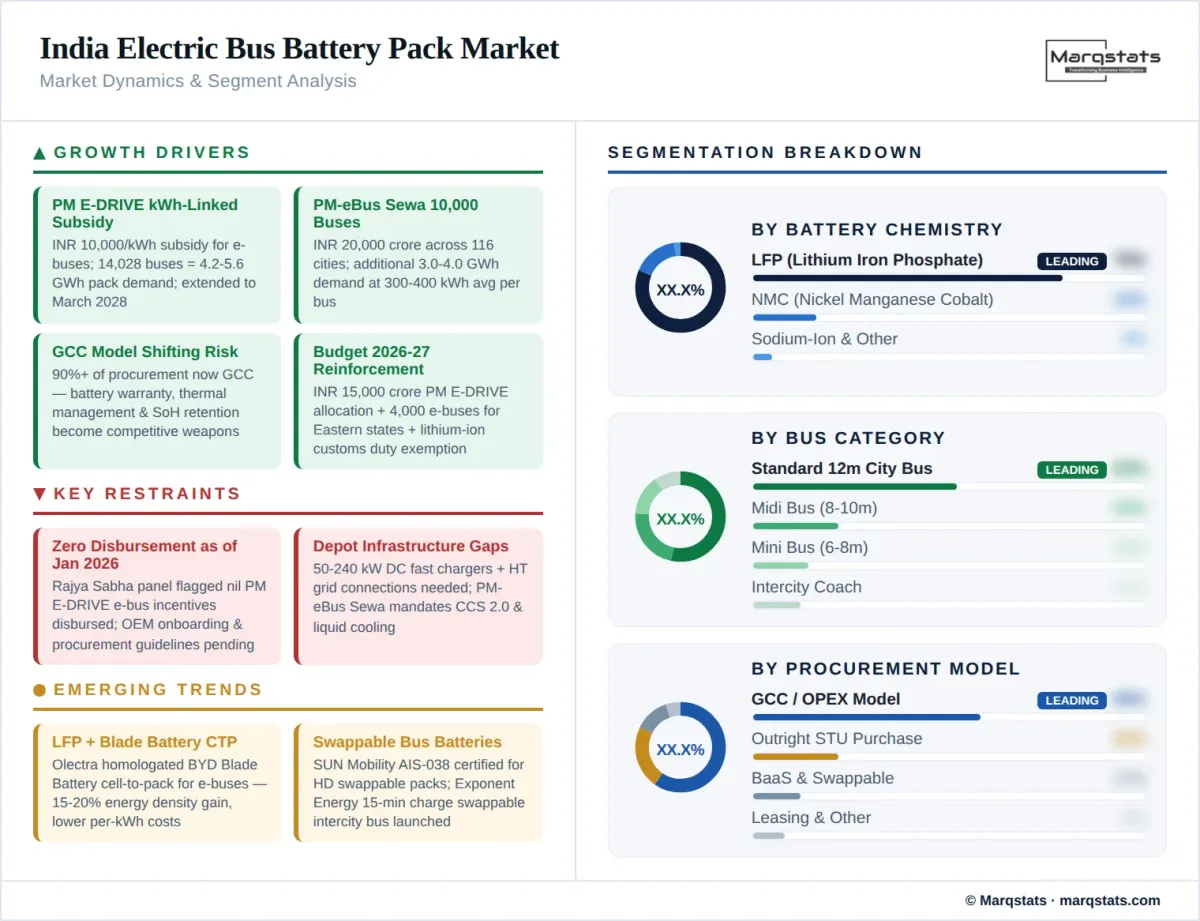
- PM E-DRIVE battery-capacity-linked subsidies creating proportional battery pack demand: The scheme provides subsidies at INR 10,000/kWh for electric buses, subject to maximum incentive caps (INR 35 lakh for >10m to ≤12m standard buses, INR 25 lakh for >8m to ≤10m midi buses, INR 20 lakh for >6m to ≤8m mini buses) and an ex-factory price ceiling of INR 2 crore. This direct indexing to kWh means battery pack demand scales proportionally with bus procurement volumes. If PM E-DRIVE’s 14,028 buses average 300–400 kWh, the programme alone implies approximately 4.2–5.6 GWh of pack demand. PM-eBus Sewa’s 10,000 buses at the same capacity band imply an additional 3.0–4.0 GWh. The scheme was extended to 31 March 2028, lengthening visibility for battery pack manufacturers and localization investments. Union Budget 2026-27 reinforced commitment with INR 15,000 crore PM E-DRIVE allocation for e-buses and e-trucks, plus 4,000 e-buses specifically for Eastern states.
- GCC/OPEX procurement model shifting battery-performance risk downstream: The market is transitioning from outright state transport undertaking (STU) purchases to Gross Cost Contract (GCC) and OPEX models, where private operators procure, operate, and maintain buses while STUs pay per-km fees. Industry analyses confirm over 90% of e-bus procurement now uses GCC, which shifts technology, maintenance, and battery-performance risk to operators. This makes battery warranty terms, thermal management performance, SoH retention rates, and lifecycle cost the primary commercial differentiators—not just upfront battery cost per kWh. PM-eBus Sewa’s explicit 80% SoH replacement clause reinforces this dynamic, requiring operators to replace battery packs when health degrades below 80%, creating ongoing replacement demand.
- Declining battery pack costs improving e-bus economics: Battery packs represent 30–40% of total electric bus cost, making pack pricing the single largest lever for e-bus affordability. LFP pack costs in India are currently at INR 10,000–12,000/kWh, trending downward as domestic assembly scales and PLI-ACC localization takes effect. Industry analyses indicate electric buses now achieve 15–20% lower per-kilometre operating costs versus equivalent AC diesel alternatives over a 12-year GCC lifecycle. Exponent Energy’s 1 MW charging approach demonstrated in partnership with Veera Vahana claims to cut e-bus battery costs by 30–40% by enabling smaller battery packs with ultra-fast charging, potentially disrupting the current large-pack paradigm.
- Phased Manufacturing Programme mandating domestic battery pack production: Under PM E-DRIVE’s PMP for e-buses (M2/M3 category), formalized in March 2025, the traction battery pack must be domestically manufactured—including cell-to-cell connections, bus bars, sensors, wiring/crimping, safety devices, BMS integration, thermal management integration, pressure release valves, and enclosure fitment. Import of battery modules is explicitly prohibited. After 12 months, domestic manufacture of BMS is also required. In March 2026, MHI further tightened localization for the traction motor from 1 September 2026. These cascading localization mandates create captive demand for India-based battery pack assembly and progressively deeper domestic value addition.
- Intercity e-bus expansion driving demand for higher-capacity packs: Intercity electric buses are the fastest-growing application within the e-bus segment, requiring 300–451 kWh battery packs with claimed ranges of 300–500 km. Olectra showcased its Blade Battery platform at Bharat Mobility Expo 2025 with 500 km range and 5,000+ charge cycle lifespan. Tata’s Intercity EV 2.0 features 450 kWh capacity with 400 km range. Eka Mobility’s stainless-steel Coach uses 451 kWh LFP with 300 km range. JBM’s Xpress intercity bus extends the reach of electrification beyond city routes. Private operators like Zingbus plan 50 electric buses in 2026 and 1,000 by 2030 for intercity travel, complementing government procurement programmes.
Key Restraints
- Zero e-bus incentive disbursement under PM E-DRIVE as of January 2026: Despite large allocations, the Rajya Sabha Standing Committee on Industry reported in March 2026 that e-trucks, e-buses, and e-ambulances under PM E-DRIVE showed zero incentive disbursements as of 31 January 2026. The panel flagged that firm timelines for OEM onboarding and procurement guidelines for e-buses had not been finalized, creating uncertainty for battery pack manufacturers planning capacity investments. The PLI-ACC scheme similarly showed only 1 GWh commissioned out of 40 GWh awarded, with no incentives paid. This implementation gap between policy ambition and actual disbursement creates demand timing risk.
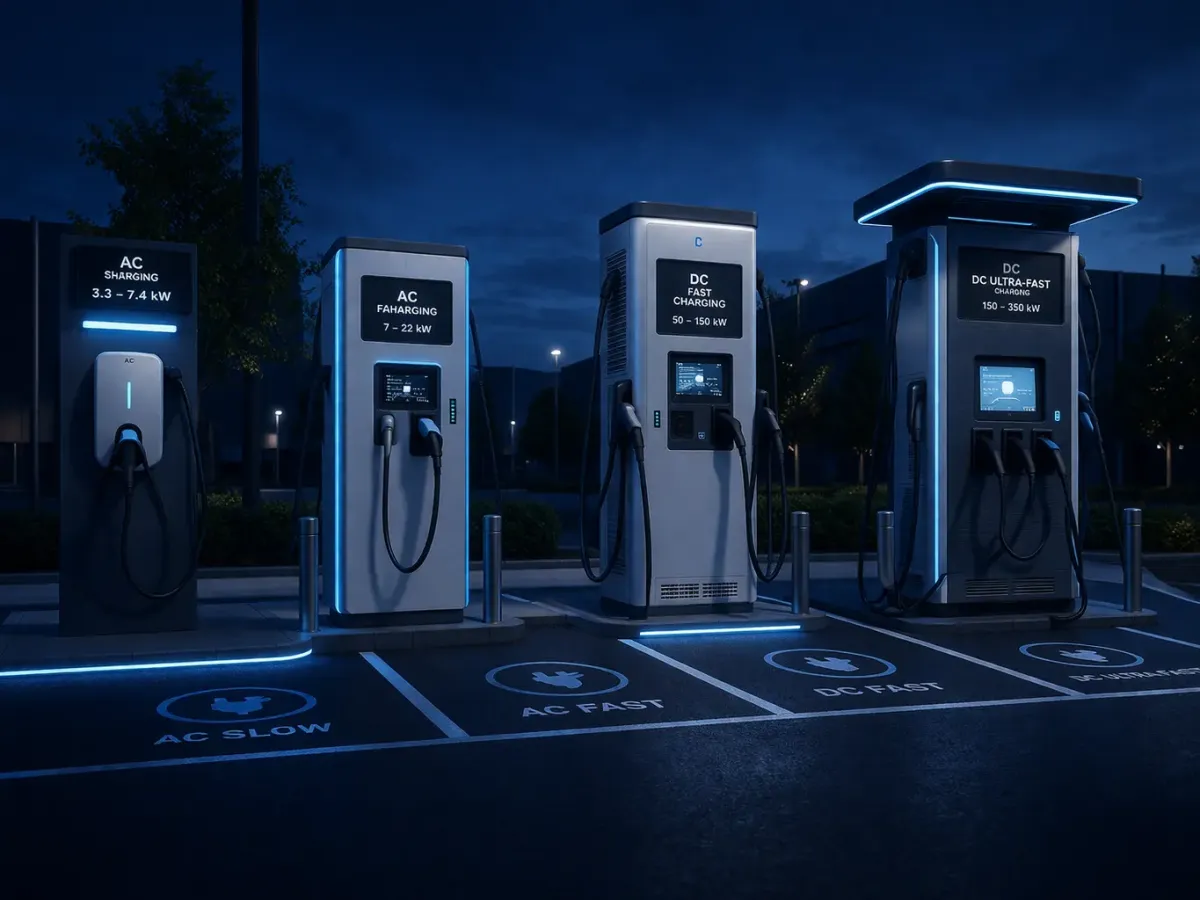
- Depot charging infrastructure requiring high-tension grid connections: Electric bus fleet charging demands dedicated depot infrastructure with 50–240 kW DC fast chargers and grid capacity upgrades. PM E-DRIVE provides for 1,800 fast chargers specifically for e-buses, but high-tension power connections involve lengthy approval processes and capacity constraints, particularly in tier-2 and tier-3 cities targeted by PM-eBus Sewa. PM-eBus Sewa tenders mandate CCS 2.0 fast charging, liquid cooling, and specified minimum ranges per charge—all of which require robust depot electrical infrastructure that many cities lack.
- High upfront capital and battery pack cost concentration: Battery packs constitute 30–40% of e-bus cost, and a standard 12-metre electric bus carries an ex-factory price ceiling of INR 2 crore under PM E-DRIVE. While GCC models spread costs over 12-year contracts, the capital-intensive nature of large battery pack procurement (200–450+ kWh per bus) limits how aggressively operators can bid on tenders. Payment security for operators and timely reimbursement from STUs remain critical concerns.
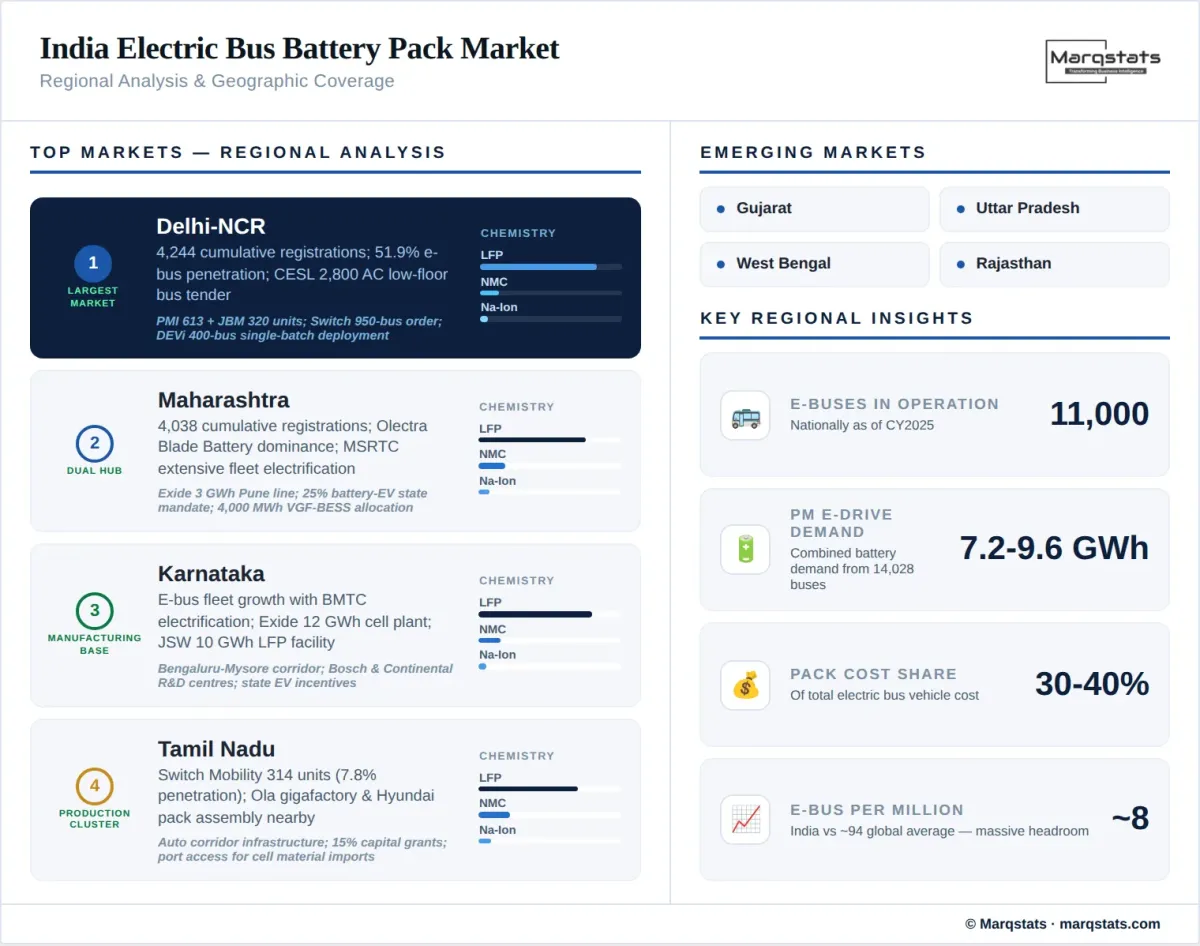
- E-bus penetration concentrated in three states: Industry analyses report that Delhi (~4,244 e-bus registrations), Maharashtra (~4,038), and Karnataka (~2,309) together account for the majority of India’s approximately 11,000 operational e-buses. Broadening deployment to Eastern India, tier-2 cities, and intercity corridors—as envisioned by Budget 2026’s 4,000 e-buses for Eastern states—requires overcoming infrastructure gaps, procurement capacity constraints in smaller cities, and grid readiness challenges.
Key Trends
- LFP chemistry standardization with Blade Battery and cell-to-pack architectures: LFP dominates India’s e-bus battery packs at approximately 79% share, with Olectra achieving homologation approval for its BYD Blade Battery (cell-to-pack) technology for e-buses in Q2 FY2026, with start of production expected by Q4 FY2026. Cell-to-pack architecture eliminates module-level packaging, increasing energy density by 15–20% and reducing per-kWh costs—particularly impactful for large-format bus packs of 200–450 kWh. NMC chemistry is growing at approximately 84% CAGR driven by intercity demand, but LFP’s thermal stability at 250–270°C versus NMC’s 210°C remains the decisive advantage for Indian tropical operating conditions.
- Battery swapping emerging as alternative to large fixed packs: SUN Mobility received AIS-038 certification from ARAI in March 2026 for its modular swappable battery system designed for trucks and buses—the first such certification for heavy commercial vehicles in India. Ashok Leyland’s Circuit S bus already uses SUN Mobility’s swappable platform. Exponent Energy and Veera Vahana launched India’s first swappable intercity e-bus with 15-minute charging in August 2024, claiming 30–40% battery cost reduction through smaller packs paired with ultra-fast charging. Swappable architectures represent a fundamental shift in e-bus battery pack design, potentially reducing per-bus kWh requirements while increasing total system pack inventory.
- Manufacturing capacity scaling to 32,000 e-buses/annum among top four OEMs: Industry analyses report that combined installed manufacturing capacity across Olectra, Switch Mobility, JBM Auto, and PMI Electro Mobility has scaled to approximately 32,000 e-buses per annum. These four players together hold an aggregate order book of approximately 31,000 e-buses, largely under STU/GCC arrangements with 12–24-month execution timelines providing near-term visibility for battery pack procurement. Eka Mobility is increasing planned annual capacity to 10,000 buses.
- Budget 2026 extending customs duty exemptions for battery manufacturing: Union Budget 2026-27 extended basic customs duty exemption on capital goods for lithium-ion cell manufacturing, exempted duties on critical mineral processing equipment, and announced rare earth corridors in Odisha, Kerala, Andhra Pradesh, and Tamil Nadu. These measures reduce battery pack production costs and support domestic localization mandated by PM E-DRIVE’s PMP, benefiting pack assemblers like Tata AutoComp, Exide Energy Solutions, Amara Raja, and Nexcharge.
- ZF AxTrax 2 LF e-axle integration influencing battery pack architecture: ZF secured a multi-year order from a leading Indian OEM for its AxTrax 2 LF electric portal axle for city buses in February 2026, delivering 20% greater energy efficiency versus its predecessor. The 800V SiC inverter with 360 kW continuous power optimizes space for batteries and passenger capacity within the fully integrated low-floor architecture, directly influencing battery pack sizing and placement design in next-generation Indian e-buses.
Market Segmentation
LFP dominates the India electric bus battery pack market with approximately 79% share, making it the defining chemistry for the segment. LFP packs for e-buses are priced at INR 10,000–12,000/kWh with energy density of 120–160 Wh/kg and 3,000–5,000+ charge-discharge cycle life translating to 8–12 years of operational service. Thermal stability at 250–270°C is critical for Indian tropical climate where ambient temperatures routinely exceed 40°C, and integrated liquid cooling channels are standard in bus-grade LFP packs. Olectra’s Blade Battery (BYD platform), Tata Starbus LFP packs, and Eka Mobility’s 451 kWh LFP Coach exemplify the chemistry’s dominance. PM-eBus Sewa tenders mandate advanced battery systems with liquid cooling and automatic fire extinguishing—specifications that favour LFP’s inherent thermal stability. The 2022 LFP patent expiration enabled domestic cathode production, and JSW Energy’s 10 GWh LFP facility in Karnataka will serve both mobility and grid storage demand.
NMC chemistry serves the intercity and premium coach segments where higher energy density (150–220 Wh/kg versus LFP’s 120–160 Wh/kg) is essential for 300–500 km range requirements between charging opportunities. NMC packs are priced at INR 12,000–15,000/kWh with 1,500–2,000 cycle life translating to 5–8 years of service. Switch Mobility’s EiV12 platform deploys NMC packs up to 423 kWh for intercity operations. NMC growth in India’s e-bus battery segment is estimated at approximately 84% CAGR, driven by the expanding intercity e-bus pipeline. However, NMC’s higher thermal management costs, shorter cycle life versus LFP, and dependence on imported cobalt and nickel constrain its adoption to premium applications where energy density justifies the cost differential.
Urban city bus battery packs in the 186–250 kWh range serve standard 9–12 metre buses operating on fixed routes with depot charging. Tata lists 186–200 kWh for the Starbus 9/Ultra 9 EV platform with 150+ km range and 2–3 hour fast charging. This capacity band accounts for the majority of deployed e-bus packs in India, aligning with city transport requirements of 150–200 km daily range. At INR 10,000/kWh (LFP), a 250 kWh pack costs approximately INR 25 lakh—within the midi bus subsidy cap.
Intercity and premium coach battery packs of 300–451+ kWh are the fastest-growing capacity band. Tata’s Intercity EV 2.0 (450 kWh, 400 km range), Olectra’s Blade Battery platform (350–400 kWh, 500 km range claim), Switch EiV12 (>400 kWh), and Eka’s stainless-steel Coach (451 kWh LFP, 300 km range) represent this segment. PM E-DRIVE’s INR 35 lakh standard bus subsidy cap at INR 10,000/kWh saturates at approximately 350 kWh, incentivizing packs in this upper range. Private intercity operators (Zingbus, GreenCell Mobility) are increasingly entering this segment.
Prismatic cells hold approximately 59% share in the global electric bus battery pack market, favoured for their compact rectangular geometry, superior packing efficiency, and compatibility with cell-to-pack architecture. Prismatic format enables optimal space utilization in floor-mounted bus battery configurations. Olectra’s BYD Blade Battery uses large-format prismatic LFP cells in a CTP arrangement. Tata, JBM, and PMI Electro Mobility predominantly source prismatic cells for their bus platforms.
Cylindrical and pouch cells occupy smaller shares in the e-bus battery market. Some early-generation and smaller bus platforms use cylindrical cells (2170 format), but space efficiency and thermal management advantages favour prismatic for large-capacity bus applications.
The GCC model dominates over 90% of India’s e-bus procurement, with private operators procuring, operating, and maintaining buses while STUs pay per-km fees over 12-year contracts. This model transfers battery-performance risk—including degradation, warranty, and replacement—to operators, making battery lifecycle economics the central competitive factor. PM-eBus Sewa’s 80% SoH replacement clause means operators must budget for mid-lifecycle pack replacement, creating recurring battery demand beyond initial procurement.
Legacy outright STU purchasing accounts for a declining share, primarily in smaller municipal corporations with limited capacity for GCC administration. Battery pack procurement in this model is typically bundled with the vehicle purchase, with OEMs managing pack sourcing and integration.
By Geography
Delhi-NCR
Delhi leads India’s e-bus deployment with approximately 4,244 cumulative registrations and the highest single-city penetration at 51.9% of bus registrations being electric. The CESL Phase 1 tender allocated 2,800 AC low-floor buses for Delhi. In February 2026, Switch Mobility flagged off over 200 EiV12 buses as part of a 950-bus total order, while GreenCell Mobility announced deployment of 570 electric buses from Rajghat, Dilshad Garden, and Seemapuri depots. Delhi’s DEVi initiative deployed 400 buses in a single batch. PMI Electro Mobility (613 units) and JBM Auto (320 units) led April–November 2025 registrations in Delhi. The city’s aggressive fleet electrification creates concentrated demand for large-format LFP battery packs with liquid cooling and CCS 2.0 compatibility.
Maharashtra
Maharashtra has approximately 4,038 cumulative e-bus registrations, driven by MSRTC’s extensive fleet electrification. Olectra Greentech dominates with 636 units (Apr–Nov 2025), deploying Blade Battery LFP packs of 261–324 kWh. Pinnacle Mobility/Eka contributed 269 units. The state receives 4,000 MWh under VGF-BESS, and its EV policy mandates 25% battery-electric share in state vehicle purchases. Exide opened a 3 GWh production line in Pune in July 2025, with Hyundai/Kia MoU for local battery supply. Maharashtra’s concentration of both deployment and manufacturing positions it as a dual demand-supply hub for e-bus battery packs.
Karnataka
Karnataka has approximately 2,309 cumulative e-bus registrations and is the largest single-city deployment target under CESL Phase 1, with 4,500 buses allocated for Bengaluru. In January 2026, Eka Mobility and Chartered Speed secured LOCQ for 1,750 buses (39% of Bengaluru’s allocation). Karnataka’s battery manufacturing ecosystem includes Exide’s 12 GWh Bengaluru gigafactory and JSW Energy’s 10 GWh LFP facility. CESL’s Bengaluru allocation specifies 9-metre and 12-metre models across AC/non-AC, low-floor, and standard floor configurations, driving diversified battery pack specifications.
Telangana and Andhra Pradesh
Hyderabad received 2,000 buses under CESL Phase 1 (including 1,025 non-AC 12-metre standard floor plus AC and low-floor units). Olectra’s TSRTC fleet operations are centred in Telangana, with its Greenfield manufacturing plant partially operational at 2,500 units/year capacity (scalable to 5,000 with second shift). Amara Raja’s giga corridor in Mahbubnagar targets 16 GWh cell and 5 GWh pack capacity. Cygni Energy’s BESS gigafactory in Hyderabad’s E-Mobility Valley adds to Telangana’s battery manufacturing cluster.
Gujarat and Western India
Ahmedabad (1,000 BRT AC buses) and Surat (600 AC 9-metre buses) received allocations under CESL Phase 1. Gujarat hosts Tata Agratas’ 20 GWh Sanand gigafactory and Exide’s Prantij lithium-ion pack plant. Gujarat receives 4,000 MWh under VGF-BESS. GSRTC operates Olectra Blade Battery buses across inter-city routes.
Eastern India and Rest of India
Budget 2026-27 specifically allocated 4,000 e-buses for Eastern and Northeastern states, addressing the geographic concentration of deployments. PM-eBus Sewa targets 116 cities across 26 States/UTs, extending procurement beyond metros. State transport agencies in Kerala, West Bengal, Madhya Pradesh, Odisha, and Assam operate over 500 e-buses with plans to scale to 2,000+ by 2027. Kochi, Kolkata, Bhopal, and Guwahati are pilot e-bus cities. Battery pack demand from these regions will require localized depot infrastructure and potentially smaller bus configurations (8–9 metre midi buses with 150–200 kWh packs) suited to tier-2/3 city transit networks.
How Competition Is Evolving
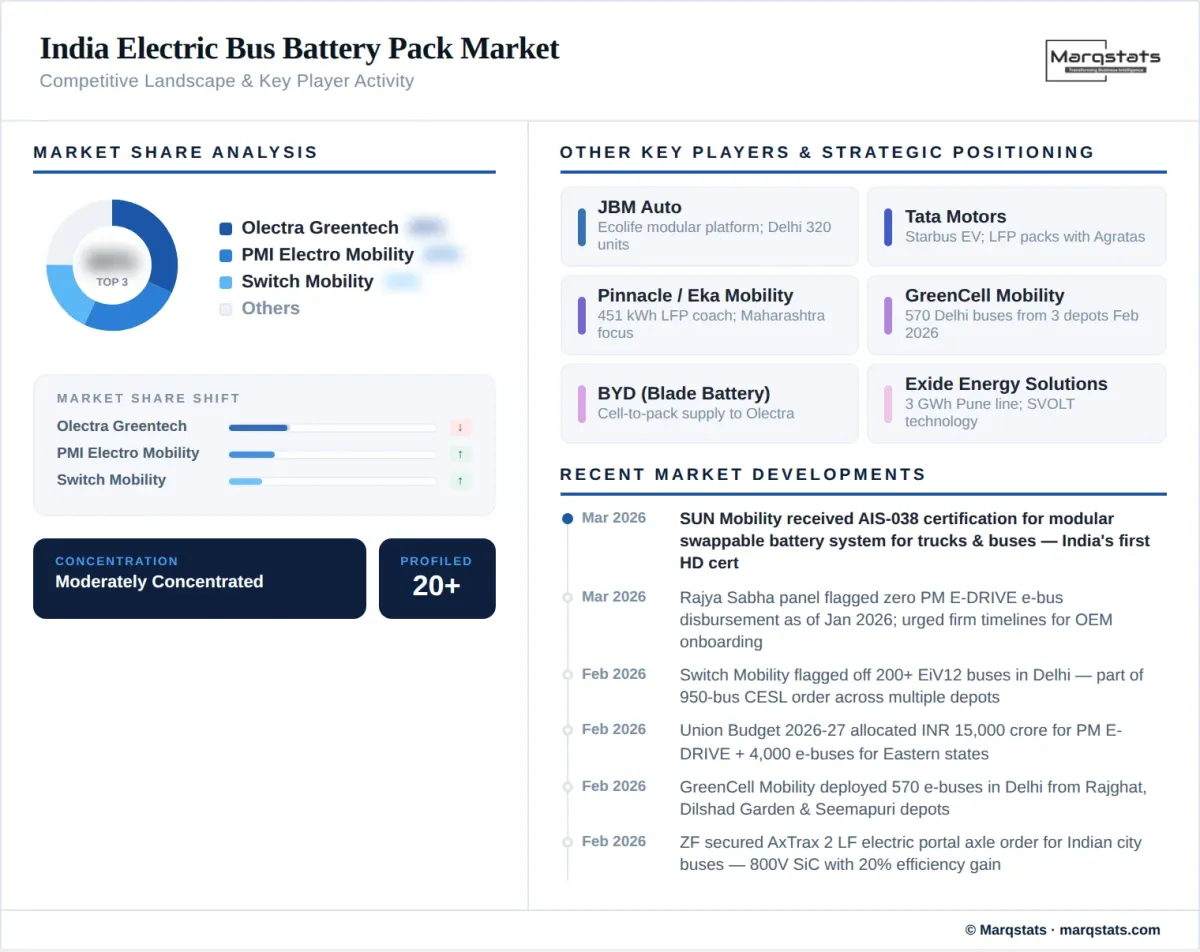
The India electric bus battery pack market features two competitive layers: bus OEMs that integrate battery packs into vehicles, and dedicated battery pack suppliers that manufacture and sell packs to OEMs. On the OEM side, the market underwent dramatic reshuffling in CY2025 and FY2026. In CY2025, PMI Electro Mobility led with 1,041 buses (23.4% share), Olectra Greentech followed at 990 (22.3%), Switch Mobility surged to 950 (21.4%, approximately 600% growth from 136 in 2024), JBM Auto reached 698 (15.7%), and Pinnacle Mobility/Eka grew to 310 (7.0%). Tata Motors collapsed from 1,462 units (39.2% share in 2024) to 223 units (5.0%). In FY2026, Switch Mobility overtook all competitors at 1,166 units, followed by PMI (1,147), JBM (1,061), Olectra (853), and Eka (363), with Tata at just 153 units (down 84% YoY).
The December 2025 PM E-DRIVE mega-tender for 10,900 buses marked the most significant competitive realignment: PMI Electro Mobility (5,210 buses) and Eka Mobility (3,485 buses) secured approximately 80% of the allocation at prices 5–15% below government estimates, while Tata Motors, VE Commercial Vehicles, and JBM Auto secured zero allocations. PMI Electro Mobility has a technology partnership with China’s Beiqi Foton Motor, and Olectra operates under a BYD technology agreement (valid until 2030, restricted to Indian market sales).
On the battery pack supply side, Tata AutoComp Gotion leads domestic manufacture with pack assembly, BMS, bus bars, battery cooling systems, and motors. Exide Energy Solutions is building 12 GWh cell capacity while already active in module and pack production (total EESL investment: INR 42 billion). Amara Raja inaugurated a battery pack assembly plant in August 2024, with its Telangana giga corridor targeting 16 GWh cell and 5 GWh pack capacity using Gotion-InoBat technology. Nexcharge (Exide-Leclanché JV) provides Li-ion pack assembly. Octillion Power Systems achieved a 3,653 battery system single-day production record in December 2025 across passenger vehicles, trucks, and buses. CATL remains the dominant global supplier and key exporter to Indian OEMs. Neuron Energy raised INR 310 million in November 2025 for expansion into four-wheeler and bus battery segments at Chakan, Pune.
Companies Covered
The report profiles 20++ companies with full strategy and financials analysis, including:
Recent Market Activity
Table of Contents
Coverage & Segmentation
This report provides a comprehensive analysis of the India electric bus battery pack market covering the historical period (2021–2025) and forecast period (2026–2030), with 2025 as the base year. The study examines market size in USD, unit volume forecasts, battery pack GWh demand projections, growth trends, competitive dynamics, and segment-level analysis across battery chemistry (LFP, NMC, emerging chemistries), battery pack capacity bands (186–250 kWh urban, 300–451+ kWh intercity), battery form factor (prismatic, cylindrical, pouch), procurement model (GCC, outright purchase, BaaS), and state-level geographic analysis. Company profiling covers 20 players across bus OEMs and battery pack suppliers.
Research methodology combines bottom-up battery pack demand modelling from PM E-DRIVE, PM-eBus Sewa, and state-level procurement data, validated against VAHAN registration data, CESL tender outcomes, FADA retail statistics, and company annual reports. Primary research encompasses interactions with state transport corporations, bus OEMs, battery pack suppliers, fleet operators, and policy stakeholders. Companion Marqstats reports on the India EV battery pack market, India electric bus market, India electric commercial vehicle battery pack market, India EV charging infrastructure market, and India EV battery recycling and circular economy market provide integrated ecosystem intelligence.