Market Snapshot
Key Takeaways
Market Overview & Analysis
Report Summary
Soil microbiome analytics rests on the insight that the billions of microorganisms in each gram of agricultural soil — bacteria, fungi, archaea, protozoa, viruses, and nematodes — collectively govern the biochemical processes that determine soil fertility, plant health, disease suppression, organic matter decomposition, and greenhouse gas flux. Advances in next-generation sequencing (NGS) have made it technically and economically feasible to characterise these communities at scale: 16S rRNA amplicon sequencing profiles the bacterial and archaeal community with high throughput at relatively low cost; internal transcribed spacer (ITS) sequencing profiles fungal communities; and shotgun metagenomics sequences the total genomic content of a soil sample, enabling identification of both community composition and functional gene presence — including genes involved in nitrogen cycling, phosphorus solubilisation, carbon decomposition, and pathogen suppression. AI-powered bioinformatics platforms then translate these raw sequence data into agronomically interpretable outputs: risk scores, nutrient cycling indices, biological fertility indicators, and management prescriptions.
The commercial market has evolved through three distinct phases. In the research phase (pre-2018), soil microbiome sequencing was largely confined to academic soil ecology, with limited commercial application. In the early-commercial phase (2018–2022), dedicated startups — including Biome Makers and Trace Genomics — began offering farmer-facing and ag-input company-facing microbiome testing services, building reference databases and demonstrating agronomic interpretation capability. In the current platform-integration phase (2023–2026), the market is converging around full-stack soil intelligence platforms that combine microbial DNA data with soil chemistry, physical sensing, spatial mapping, and farm management system integration. The EarthOptics–Pattern Ag merger (August 2024), the Miraterra–Trace Genomics asset acquisition (July 2025), and Biome Makers' integrations with Climate FieldView, John Deere, and CNH (March 2025) are the most visible markers of this consolidation-into-integration dynamic.
Competitive differentiation is happening on four dimensions simultaneously: reference database scale and functional annotation quality (the biological intelligence moat); workflow integration depth with digital agriculture and conventional agronomy channels (the go-to-market moat); use-case breadth across farm decisions, input validation, seed trials, and ESG reporting (the revenue-base diversification); and sequencing methodology standardisation, QC rigour, and bioinformatics reproducibility (the scientific credibility moat). Academic reviews published in 2024–2025 note that real-world adoption remains constrained by variability in sequencing methods, coverage depth, cost, and data-analysis complexity — meaning this is simultaneously a technology race, a methodology and trust race, and a workflow integration race.
Market Dynamics
Key Drivers
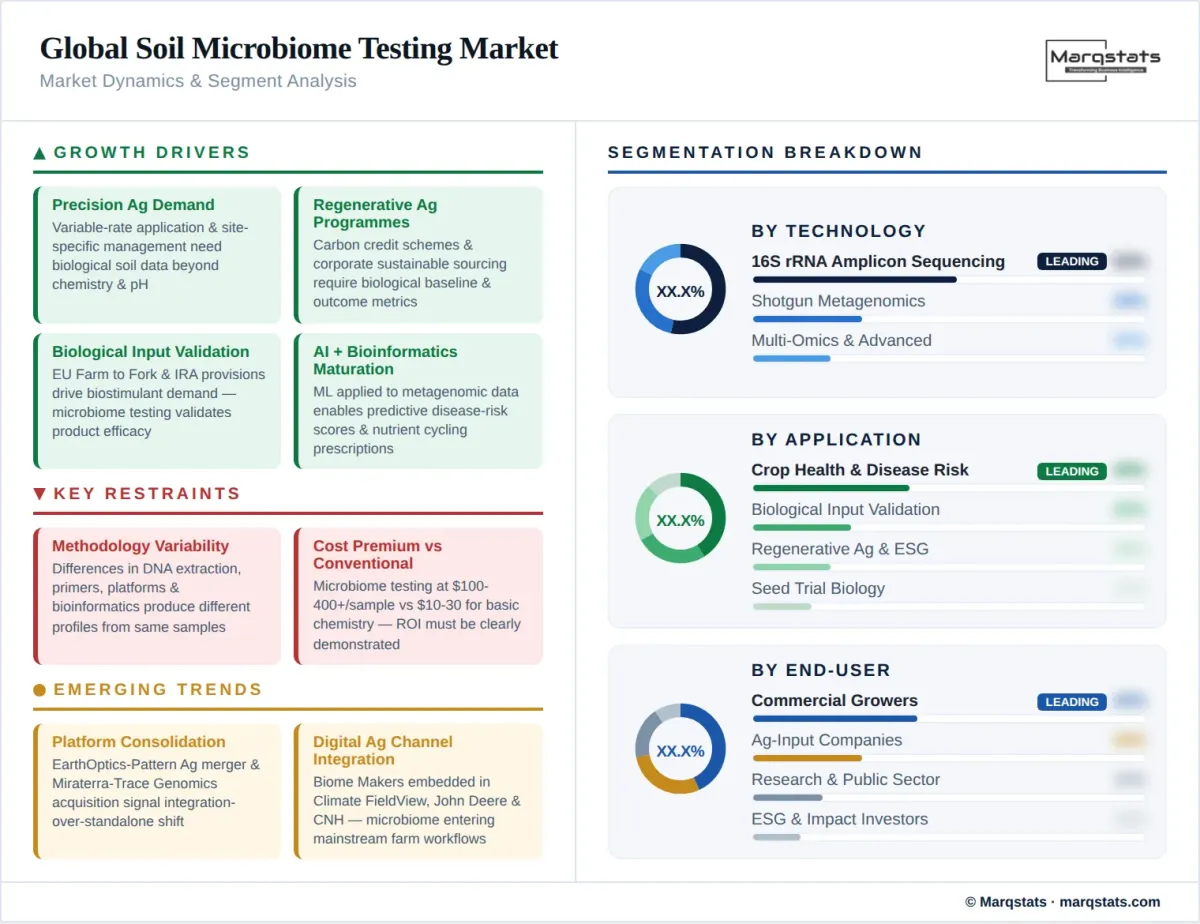
- Precision agriculture adoption creating demand for field-level biological intelligence: The expansion of precision agriculture frameworks — variable-rate application, site-specific management zones, field-by-field decision support — creates a natural demand pull for biological soil data that complements existing nutrient, pH, and physical soil characterisation. Farmers and agronomic advisors managing precision programmes need to understand not just what nutrients are present, but which microbial communities are mineralising organic nitrogen, suppressing soilborne pathogens, or contributing to phosphorus availability at the field level. Biome Makers' BeCrop Farm platform, active in 54+ countries and integrated into Climate FieldView and John Deere Operations Center, exemplifies this precision-agriculture-driven demand pattern.
- Regenerative agriculture and carbon sequestration programmes requiring biological baseline measurement: The global expansion of regenerative agriculture programmes — including farm-level carbon credit schemes, corporate sustainable-sourcing commitments, and government agri-environment incentive payments — is creating structural demand for soil microbiome data as both a baseline indicator and an outcome metric. Demonstrating genuine soil health improvement in regenerative transitions requires biological data that chemical soil testing alone cannot provide. Soilytix's July 2025 partnership with SLM Partners, Nogam, and Migdalo for orchard-yield and sustainability reporting, and Biome Makers' BeCrop regenerative-programme positioning, reflect this regenerative-demand driver directly. This market driver is closely linked to the global agricultural carbon MRV market covered in a separate Marqstats report.
- Biological crop-protection input demand creating biological product validation market: The global shift toward biostimulants, biocontrol agents, and biological fertilisers — driven by EU Farm to Fork pesticide-reduction targets, U.S. IRA sustainable-agriculture provisions, and farmer demand for integrated pest management tools — creates a parallel demand for soil microbiome analytics as a product validation and efficacy-demonstration platform. Seed companies, biological input manufacturers, and agronomic retailers need to demonstrate that biological products measurably shift soil microbial communities in the intended direction. Biome Makers' May 2025 partnership with AgList — enabling biological products tested with BeCrop Trials to be surfaced with third-party validation — is the clearest commercial expression of this driver.
- AI and bioinformatics maturation translating raw sequence data into actionable prescriptions: Advances in machine learning applied to soil metagenomic datasets — including functional gene annotation, predictive modelling of soil nutrient dynamics, disease-risk scoring from pathogen gene prevalence, and carbon sequestration potential estimation — are raising the agronomic value of microbiome data from descriptive profiling to predictive decision support. Elaniti's March 2025 investment and product development announcement, Miraterra's AI-driven platform positioning following its Trace Genomics acquisition, and EarthOptics' Total Farm programme combining DNA data with AI-powered fertility prescriptions all reflect the AI maturation driver.
- NGS cost reduction expanding commercial viability across farm scales: The cost of next-generation sequencing has declined by multiple orders of magnitude since 2007, with 16S rRNA amplicon sequencing now commercially available in agricultural settings for USD 30–80 per sample at scale, and shotgun metagenomics costs continuing to decline toward commercial viability for mid-scale farming operations. This cost trajectory is progressively expanding the addressable market from large-scale precision agriculture operations and research programmes toward mid-scale commercial farms, cooperative farming organisations, and developing-economy smallholder programmes over the 2025–2030 horizon.
Key Restraints
- Sequencing methodology variability limiting reproducibility and cross-study comparability: Academic reviews published in 2024–2025 consistently highlight that differences in DNA extraction protocols, primer choice, sequencing platform, amplicon region selection (V3-V4 vs V4-V5 16S regions), bioinformatics pipelines, and coverage depth produce meaningfully different community profiles from identical soil samples. This methodological variability constrains the ability to compare results across vendors, time periods, and geographies — and creates scepticism among technically sophisticated buyers including seed companies, food manufacturers, and institutional investors who require reproducible, audit-grade data.
- Translation gap between microbial data and actionable farm decisions: Despite significant advances in AI-driven interpretation, a persistent challenge is translating complex microbial community data into farm management recommendations that growers understand, trust, and act upon. The academic literature notes that real-world field studies linking specific microbiome signatures to measurable agronomic outcomes remain limited compared to controlled-environment research. Vendors must bridge this interpretation gap with robust field-trial validation and credible agronomic expertise to drive mainstream farmer adoption.
- High cost relative to conventional soil testing creating adoption friction: Conventional chemical and physical soil testing remains the standard agronomic tool for most commercial farmers globally, with costs typically USD 10–30 per sample for basic analysis. Soil microbiome testing at USD 100–400+ per sample represents a significant cost premium that requires demonstrated ROI in yield improvement, input cost reduction, or compliance value to justify. This cost differential is the primary adoption barrier for mainstream farm-scale deployment outside premium high-value cropping systems.
- Consolidation pressure on standalone point-solution vendors: The EarthOptics–Pattern Ag merger and the Miraterra–Trace Genomics acquisition signal that standalone microbiome testing services without strong distribution channels or differentiated data assets are under competitive pressure. Vendors that cannot demonstrate integration into broader agronomic workflows — through digital platform partnerships, conventional lab channel access, or proprietary reference databases — face a structurally disadvantaged commercial position.
Key Trends
- Platform consolidation: biological data integrating with physical sensing, chemistry, and spatial layers: The dominant commercial trend is the convergence of soil microbial DNA data with conventional soil chemistry, physical sensor data (moisture, temperature, conductivity), satellite-derived crop stress indices, and farm management records. EarthOptics' Total Farm programme — combining GroundOwl sensors, TruBio DNA analysis, TruNutrient chemistry, yield data, and satellite imagery — represents the most commercially advanced expression of this integration trend. This convergence is making standalone microbiome reports commercially unviable and driving market structure toward integrated platform vendors.
- Whole-farm channel integration through legacy ag-lab and digital-agriculture partnerships: Biome Makers' August 2025 partnership with Midwest Laboratories demonstrates that microbiome intelligence is entering the mainstream agronomic testing channel through existing conventional soil-lab networks that have established farmer relationships, sample logistics, and agronomist trust. Simultaneously, integrations with Climate FieldView, John Deere, and CNH embed microbiome data into the digital agriculture platforms that farmers already use for equipment telematics, field records, and prescription maps — dramatically lowering adoption friction.
- ESG reporting, regenerative transitions, and carbon credit claim verification driving non-agronomic demand: Soil microbiome data is increasingly being used not just for crop management decisions but for sustainability reporting, regenerative certification, and biological carbon stock assessment. Soilytix's positioning around investor-backed regenerative orchard programmes explicitly combines agronomy with sustainability reporting utility. This emerging non-agronomic use case is drawing food company procurement teams, impact investors, and sustainability managers into the buyer ecosystem alongside conventional agronomists.
- Multi-omics integration expanding from metagenomics to metatranscriptomics and metabolomics: The most scientifically advanced soil microbiome programmes are moving beyond DNA-based community profiling (metagenomics) toward metatranscriptomics (measuring active gene expression in the soil microbiome) and soil metabolomics (measuring the full suite of microbial metabolic outputs in the soil matrix). These additional omics layers provide richer information about what the microbial community is actually doing — not just which organisms are present — enabling more accurate prediction of nutrient cycling rates, disease suppression activity, and biological fertility status.
Market Segmentation
16S rRNA amplicon sequencing is the dominant technology in commercial soil microbiome testing, estimated at 50–55% of 2025 market revenue, due to its cost-effectiveness (USD 30–80 per sample at scale), high throughput, and well-established bioinformatics workflows for bacterial and archaeal community profiling. The technology targets hypervariable regions (typically V3-V4 or V4-V5) of the 16S ribosomal RNA gene to identify and quantify microbial taxa without sequencing the full genome. Biome Makers' BeCrop platform, which has analysed 200+ crops across 56+ countries powered by a 55-million-organism reference database, is the most commercially scaled 16S-based soil intelligence platform globally. ITS (internal transcribed spacer) amplicon sequencing for fungal community profiling is frequently paired with 16S analysis in comprehensive soil health assessments, particularly in high-value perennial and horticultural systems.
Shotgun metagenomics sequences the total DNA content of a soil sample without prior amplification of target genes, providing a more comprehensive and unbiased view of both community composition and functional gene content — including genes involved in nitrogen fixation (nifH), nitrification (amoA), phosphorus solubilisation, antibiotic resistance, and carbon decomposition. EarthOptics' TruBio analysis and Miraterra/Trace Genomics' platform both incorporate shotgun metagenomics capabilities, enabling functional predictions beyond taxonomic profiling. Shotgun metagenomics costs more per sample (typically USD 150–500+ depending on coverage depth) and requires more complex bioinformatics, but provides richer agronomic insights and is preferred for research-grade soil health characterisation, seed-trial validation, and premium regenerative programme monitoring.
Multi-omics soil analysis — combining metagenomics with metatranscriptomics (RNA-based active gene expression), soil metabolomics (metabolite profiling), and/or metaproteomics (protein expression) — represents the scientific frontier of soil microbiome analytics and the premium end of the commercial market. These approaches capture not just community composition but functional activity, metabolic flux, and response to environmental perturbation. The multi-omics segment is currently small in commercial revenue terms but is growing rapidly as research partnerships between commercial platforms and academic institutions (such as Elaniti's March 2025 Bayer–EIT Food collaboration) translate multi-omics research capability into commercial product features. This segment is expected to be the fastest-growing technology sub-segment through 2030.
Crop health management is the largest application segment, encompassing soil disease risk scoring (identification of soilborne pathogen gene prevalence and suppressive microbial community indicators), nutrient cycling biological fertility assessment, plant-growth-promoting microorganism (PGPM) community profiling, and crop-establishment risk prediction. EarthOptics' selection by FIRST as the sole soil-sample-analysis provider for 2025 FIRST trials (supplying TruNutrient and TruBio analyses across plots) illustrates the demand for biological soil intelligence in commercial seed-trial and crop-planning programmes. Elaniti's March 2025 Bayer collaboration — studying how soil microbiome signals affect early crop establishment, plant growth, and resilience in Europe — sits squarely in this application segment.
Biological input validation is the fastest-growing application segment, driven by the rapid expansion of the biostimulant, biocontrol, and biological fertiliser market and the corresponding need for third-party validation of product efficacy at the soil microbiome level. Seed companies, biological input manufacturers, and agronomic retailers commission soil microbiome analyses to demonstrate that their products measurably shift microbial community composition in the intended direction — providing evidence-based claims for regulatory submissions, retailer listings, and farmer marketing. Biome Makers' BeCrop Trials platform and its May 2025 partnership with AgList (enabling third-party validated biological product discovery) are the most commercially explicit expressions of this application segment.
Regenerative agriculture and ESG reporting is an emerging third application segment, where soil microbiome data is used as a biological outcome metric for carbon farming programme verification, regenerative certification, and corporate sustainability reporting. Unlike conventional soil carbon measurement (which captures total organic carbon stock), microbiome data provides leading indicators of biological soil health trajectory — the functional microbial diversity, decomposer community vitality, and mycorrhizal network density that drive long-term soil carbon accumulation and water retention. Soilytix's July 2025 orchard partnership with SLM Partners (an impact investor in sustainable land management) and Biome Makers' regenerative programme positioning reflect the commercial demand in this segment. This application intersects directly with the global agricultural carbon MRV market.
By Geography
North America
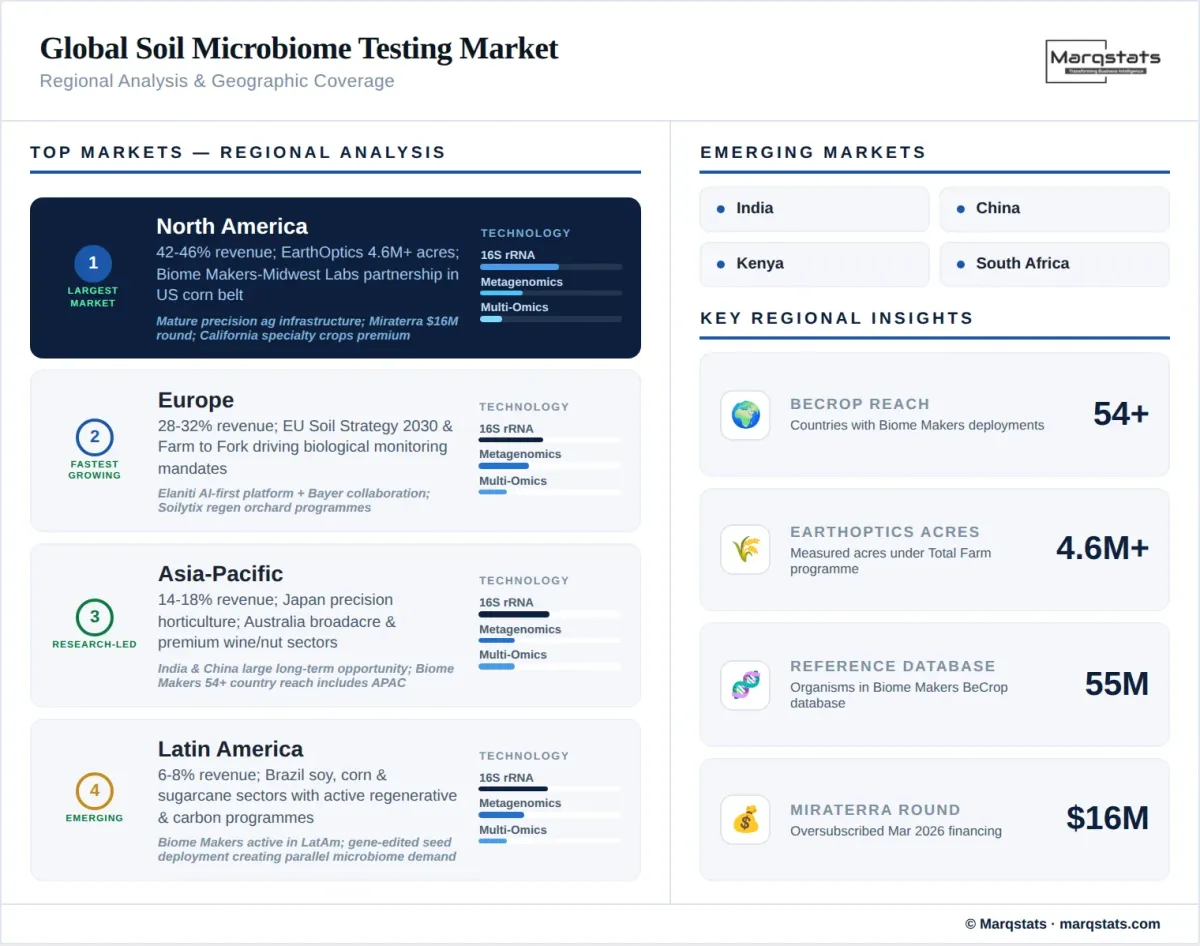
North America is the largest regional market, estimated at 42–46% of 2025 global revenue, underpinned by the United States' mature precision agriculture infrastructure, well-developed conventional soil-testing channel, and venture-capital-backed agri-tech ecosystem. EarthOptics' Total Farm programme — launched April 2025 with 4.6+ million measured acres — is concentrated in North American commodity crop systems. Biome Makers' August 2025 Midwest Laboratories partnership is explicitly designed to deliver microbiome intelligence through the established U.S. soil-testing channel, where Midwest Labs serves tens of thousands of farm clients across the corn belt and soy-producing states. Miraterra's March 2026 USD 16 million financing round signals continued North American investor confidence in integrated soil intelligence. California's specialty crop sector — including wine grapes, almonds, and strawberries — represents a premium early-adopter segment for precision microbiome management alongside orchard and protected-horticulture systems.
Europe
Europe is the fastest-growing regional market, estimated at 28–32% of 2025 revenue, driven by the EU Farm to Fork Strategy's biological input promotion, the EU Soil Strategy for 2030's emphasis on soil health monitoring and the EU Soil Monitoring Law requiring member states to assess and improve soil health, corporate regenerative agriculture supply-chain commitments, and a dense agri-tech innovation ecosystem. Elaniti's emergence in 2025 as a European AI-first soil microbiome platform — backed by new investment and a Bayer–EIT Food collaboration starting in March 2025 — reflects the region's growing commercial activity. The Netherlands, Germany, France, Spain, and the United Kingdom are the most commercially developed European markets, while Eastern European and Mediterranean countries with large grain and specialty-crop sectors represent significant growth pipeline. Soilytix, though headquartered in Europe, is active in orchard and investor-linked programmes across multiple European markets.
Asia-Pacific
Asia-Pacific accounts for approximately 14–18% of 2025 market revenue and is characterised by strong research activity — particularly in Japan, Australia, China, and India — alongside early commercial deployment. Australia's precision broadacre farming sector (wheat, barley, canola) and premium wine and nut sectors represent the most commercially advanced APAC markets for soil microbiome analytics. Japan's precision horticulture and controlled-environment agriculture sectors are an emerging commercial focus. India and China represent large long-term opportunities given their agricultural scale but remain at earlier adoption stages, constrained by cost barriers relative to farming income levels and limited conventional soil-testing infrastructure through which microbiome services could be channelled. Biome Makers' 54+ country deployment includes significant APAC reach.
Latin America
Latin America accounts for approximately 6–8% of 2025 revenue, with Brazil, Argentina, and Colombia as primary markets. Brazil's large-scale soybean, corn, and sugarcane sectors, combined with active regenerative agriculture programmes and growing carbon market activity, create demand for biological soil intelligence in both agronomic management and sustainability reporting contexts. Biome Makers has active commercial engagement in Latin American markets through its BeCrop platform. Cibus's Latin American rice expansion (herbicide-tolerance trait) and gene-edited seed programmes in the region create a parallel pull for soil microbiome data to optimise planting environments for high-value new variety deployments.
Middle East, Africa and Rest of World
Middle East, Africa, and rest of world account for approximately 4–6% of 2025 market revenue, concentrated in South Africa's precision wine and deciduous fruit sectors, Kenya's export horticulture industry, and GCC controlled-environment agriculture. Long-term, the region's large smallholder agricultural base — where soil degradation, nutrient depletion, and climate stress are severe — represents a major structural opportunity for low-cost microbiome analytics as a soil-health monitoring and regeneration tool, though cost barriers and data infrastructure gaps currently constrain commercialisation at scale.
How Competition Is Evolving
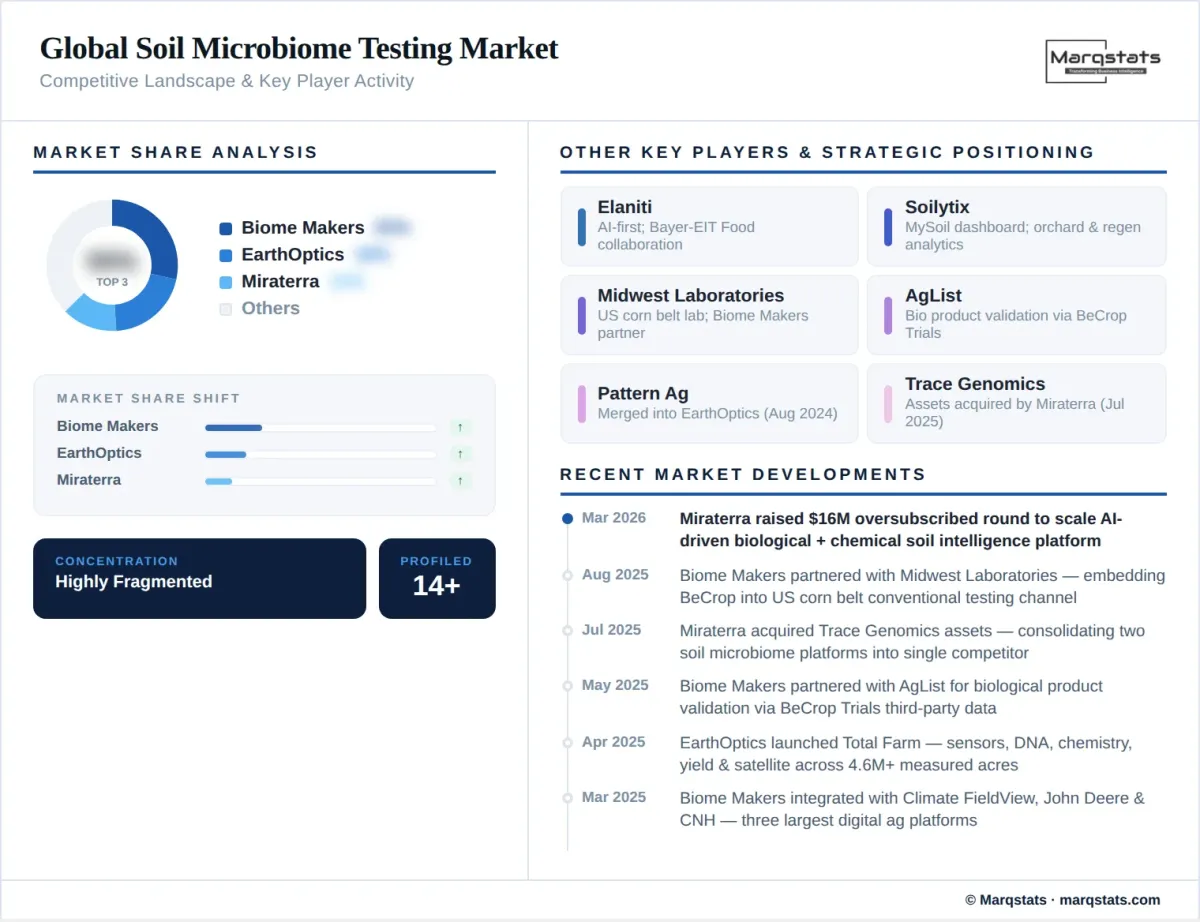
The global soil microbiome analytics market is highly fragmented, with no single dominant commercial leader yet and a competitive field spanning dedicated microbiome intelligence specialists, integrated soil-intelligence platform companies, conventional soil-testing laboratories expanding into biology, and multi-omics research platforms. The market is undergoing visible consolidation — the EarthOptics–Pattern Ag merger (August 2024), Miraterra's acquisition of Trace Genomics assets (July 2025), and Biome Makers' partnership with Midwest Laboratories (August 2025) — as the first wave of standalone sequencing services gives way to integrated platforms with broader data assets and channel access.
Biome Makers holds the strongest visible position in dedicated soil microbiome intelligence. Its BeCrop platform is active in 54+ countries, backed by a 55-million-organism reference database covering 200+ crops, and is now embedded in Climate FieldView (Bayer's leading digital agriculture platform), John Deere Operations Center, and CNH's precision agriculture systems. The May 2025 AgList partnership adds third-party biological product validation as a revenue stream, while the August 2025 Midwest Laboratories partnership provides channel access through one of the most widely used conventional soil labs in the U.S. corn belt. Biome Makers competes on microbial database scale, platform maturity, international reach, and use-case breadth — spanning farm decisions, product trials, and regenerative programme reporting.
EarthOptics is the strongest integrated soil-intelligence platform following its merger with Pattern Ag. Its April 2025 Total Farm programme combines GroundOwl physical soil sensors, TruBio metagenomic DNA analysis, TruNutrient chemistry, yield data, and satellite-derived crop stress imagery into field-level fertility prescriptions and biological risk assessments — the most comprehensive whole-farm soil intelligence product currently in commercial deployment at scale. EarthOptics' selection by FIRST as sole soil-sample-analysis provider for 2025 FIRST trials provides high-visibility seed-company channel access. Miraterra/Trace Genomics is a well-capitalised challenger: the July 2025 Trace asset acquisition and March 2026 USD 16 million oversubscribed financing round position it to compete directly on the AI-plus-chemistry-plus-biology integration that EarthOptics has pioneered. Elaniti is the most important emerging-stage challenger, distinguished by its AI-first product design and its Bayer partnership via EIT Food — giving it corporate R&D credibility and European field data that most early-stage competitors lack. Soilytix occupies a focused niche at the intersection of precision biology, investor-linked regenerative programmes, and sustainability reporting.
Companies Covered
The report profiles 14+ companies with full strategy and financials analysis, including:
Recent Market Activity
Table of Contents
Coverage & Segmentation
This report provides a comprehensive analysis of the global soil microbiome analytics market covering the historical period 2021–2025 and the forecast period 2026–2030, with 2025 as the base year. The study examines market size and revenue forecasts in USD billion, segmented by technology (16S rRNA amplicon sequencing, shotgun metagenomics, multi-omics), application (crop health management and disease risk prediction, biological input validation, regenerative agriculture and ESG reporting), and geography (North America, Europe, Asia-Pacific, Latin America, Middle East/Africa). Scope covers commercial sequencing and bioinformatics services, AI-driven soil intelligence platforms, whole-farm integrated soil data programmes, and biological product testing services when delivered through soil microbiome sequencing methodology. Conventional chemical and physical soil testing services are excluded unless explicitly bundled with microbiome analysis.
Research drew from company press releases, platform documentation, partnership and investment announcements, academic soil microbiome reviews published in 2024–2025 covering sequencing methodology trade-offs and agronomic interpretation challenges, EU Soil Strategy and Soil Monitoring Law legislative documentation, FIRST trial programme publications, and verified commercial milestone data from Biome Makers, EarthOptics, Miraterra, Elaniti, and Soilytix through Q1 2026. The competitive assessment is grounded in publicly verifiable commercial milestones, partnership agreements, financing events, and platform capability disclosures rather than self-reported market share claims.