Market Snapshot
Middle bar: base-year value × (1 + CAGR), rounded to two decimals. This is a calculated illustration, not a separately researched annual estimate.
The global farm carbon MRV market is one of the fastest-scaling data infrastructure categories in agriculture, as voluntary carbon markets, corporate Scope 3 reporting obligations, and sovereign carbon-finance programmes collectively demand credible, auditable, and cost-effective farm-level greenhouse gas quantification. Monitoring, Reporting, and Verification (MRV) — or its digital variant, dMRV — forms the technical backbone that determines whether a carbon credit, an insetting claim, or a supply-chain emissions disclosure can survive registry scrutiny and corporate audit. The global agricultural carbon MRV market was valued at approximately USD 1.52 billion in 2025 and is projected to reach USD 3.48 billion by 2030, expanding at a CAGR of 18.04% during the 2026–2030 forecast period, driven by tightening integrity standards, the convergence of Scope 3 supply-chain programmes with voluntary carbon project pipelines, and the accelerating adoption of satellite-based digital MRV that dramatically reduces per-farm verification costs.
The market encompasses platforms and services used to measure, model, report, and verify greenhouse gas emissions and removals at the farm and landscape level — including soil organic carbon (SOC) sequestration, enteric and manure methane emissions, nitrous oxide (N2O) emissions from fertiliser application, and land-use change carbon. Technology layers span biogeochemical process models (DNDC, DayCent-CR, RothC, CENTURY), remote-sensing and satellite analytics, ground-truthing and soil sampling logistics, data management and farm enrollment platforms, and third-party verification and registry interface services. End-markets are split between voluntary carbon credit projects (the current revenue majority), corporate Scope 3 and insetting programmes, and government-commissioned MRV systems for national climate commitments under Article 6 of the Paris Agreement.
The market is being shaped simultaneously by a standards maturation cycle — including the evolution of Verra's VM0042 methodology to v3.0, the EU's Carbon Removal and Carbon Farming Regulation (CRCF), the ICVCM's Core Carbon Principles (CCP) label, and SustainCERT's validation framework for supply-chain claims — and by a technology convergence toward lower-cost, satellite-first digital MRV architectures. North America dominates current revenue due to the maturity of U.S. soil carbon programmes operating under the Climate Action Reserve and ICVCM-approved protocols. Europe is the fastest-growing demand region, driven by the CRCF framework, rising corporate procurement requirements for primary-data Scope 3 reporting, and active insetting programmes across EU agricultural supply chains.
Key Takeaways
Market Overview & Analysis
Report Summary
Agricultural carbon MRV encompasses the full technical and institutional stack required to quantify, document, and verify greenhouse gas outcomes from farming and land management at a level of rigour sufficient for registry issuance, corporate reporting, or government compliance purposes. The core workflow involves: (1) farm enrollment and baseline establishment (land use history, soil characterisation, management practice documentation); (2) GHG modelling using validated biogeochemical models calibrated to local conditions; (3) remote-sensing validation of practice change and land management at field scale; (4) optional ground-truth soil sampling to anchor model estimates; (5) third-party verification against a registry protocol or reporting standard; and (6) issuance or attestation of the verified outcome as a credit, inset unit, or emissions-intensity disclosure. Digital MRV (dMRV) refers specifically to architectures where remote sensing, machine learning, and process modelling reduce or replace labour-intensive field measurement — a technological shift that is driving the unit economics of per-farm verification from USD 50–200/hectare toward USD 5–20/hectare.
The market entered a transformational phase in 2024–2026. On the demand side, corporate Scope 3 emissions accounting under GHG Protocol standards, the EU Corporate Sustainability Reporting Directive (CSRD), and SEC and FCA climate disclosure frameworks are compelling food and agribusiness companies to move from purchased offsets toward primary-data-based supply-chain MRV — a structural shift that dramatically expands the total addressable market beyond voluntary carbon credits. On the supply side, satellite data density, resolution, and revisit frequency have improved to the point where canopy, tillage, cover crop, and soil disturbance signals can be monitored at sub-field scale, enabling model validation without systematic soil sampling. Simultaneously, the voluntary carbon market is undergoing a credibility restoration cycle: the ICVCM's CCP label, Verra's VM0042 v2.2 (CCP-approved in 2025) and pending v3.0, and the Brussels-based CRCF regulation are collectively raising the floor on what a credible agricultural carbon credit must demonstrate.
The competitive structure has clarified around four platform archetypes: (1) full-stack MRV platforms that own the end-to-end credit or insetting workflow (Indigo Ag, Agreena, Boomitra, Regrow, Soil Capital); (2) enterprise MRV software providers that sell the modelling and data infrastructure to agribusinesses and supply-chain operators without running the offset project themselves (Regrow's supply-chain licensing model, Downforce Technologies); (3) measurement and soil data specialists that provide registry-quality sampling, digital soil maps, or field analytics as inputs to platform or corporate clients (Perennial, EarthOptics, Downforce); and (4) specialist regional operators that focus on specific geographies, crop systems, or emerging-market contexts (Boomitra in South Asia and East Africa, Soil Capital in EU arable, Nanobubble Agritech-adjacent precision-agri sensors). Market participants with capabilities across multiple archetypes — particularly the combination of full-stack project delivery and enterprise supply-chain MRV — are commanding the highest commercial valuations and the most durable customer relationships.
Market Dynamics
Key Drivers
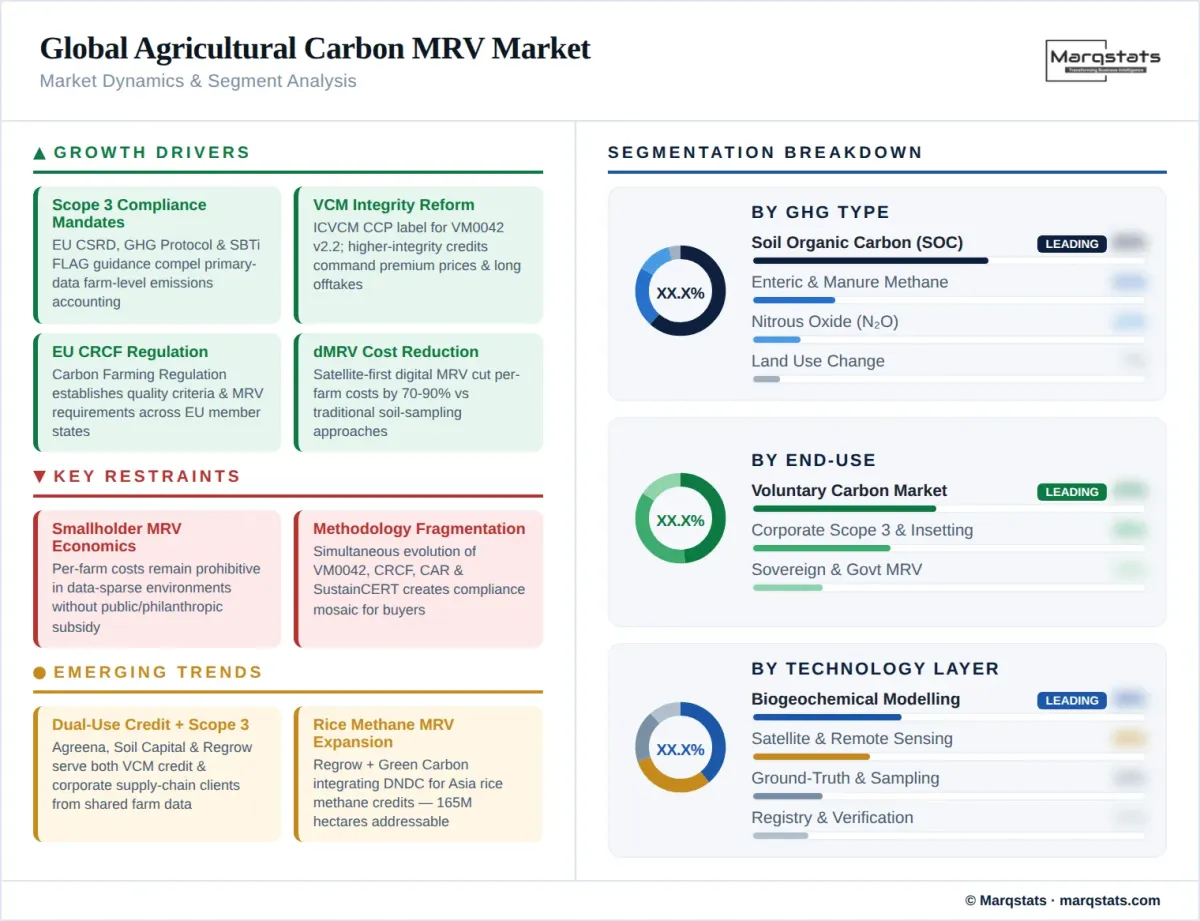
- Corporate Scope 3 and supply-chain decarbonisation mandates: The EU Corporate Sustainability Reporting Directive (CSRD), mandatory for large EU companies from 2024 onwards, requires primary-data-based emissions accounting across supply chains — including agricultural raw material sourcing. Combined with GHG Protocol Scope 3 guidance and the Science Based Targets initiative's (SBTi) FLAG (Forest, Land and Agriculture) sector guidance requiring absolute land-sector emission reductions, corporate food and beverage companies now face hard obligations to demonstrate farm-level emissions data. This is creating a durable, non-discretionary demand base for agricultural MRV services that is structurally distinct from and more resilient than voluntary offset demand. PepsiCo's 2025 partnership with Soil Capital across 35,000+ acres in the UK, France, and Belgium exemplifies this supply-chain-driven demand pattern.
- Voluntary carbon market reform and integrity standards raising the bar: The ICVCM's CCP label approval for VM0042 v2.2 in 2025, Verra's ongoing development of VM0042 v3.0 (consultation launched February 2026), and the establishment of SustainCERT validation as a commercial differentiator for insetting claims are collectively restoring buyer confidence in agricultural carbon credits after the credibility crisis of 2022–2023. Higher-integrity credits command price premiums and longer offtake contracts — illustrated by Microsoft's 12-year, 2.85-million-credit deal with Indigo Carbon PBC, structured under ICVCM CCP-approved protocols. This integrity premium is a direct economic incentive for MRV platform investment.
- EU Carbon Removal and Carbon Farming Regulation (CRCF): The CRCF regulation establishes quality criteria and MRV process requirements for carbon farming across EU member states, creating a regulatory demand signal for standardised, auditable farm-level carbon accounting across European arable, permanent crop, and grassland systems. The MRV4SOC project's work to standardise soil organic carbon MRV across 15 demonstration sites reflects the magnitude of public investment flowing into EU-aligned MRV infrastructure.
- Satellite and AI-enabled dMRV cost reduction: The convergence of high-resolution satellite imagery, machine learning-based change detection, and validated biogeochemical models has reduced the cost of per-farm MRV by 70–90% compared to traditional soil-sampling-intensive approaches over the 2018–2025 period. Indigo Carbon's fifth issuance announcement cited an 85% reduction in administrative burden for farmer data collection and new remote-sensing algorithms improving field and land management validation accuracy — directly enabling the company to operate at 8+ million enrolled acres across 28 U.S. states. This cost trajectory is the single most important driver of market scalability.
- Emerging-market sovereign carbon finance and Article 6.2 demand: Singapore's competitive government tender awarding Boomitra a 625,000 soil carbon credit contract under Article 6.2 of the Paris Agreement (2026–2031) signals that nationally determined contributions (NDCs) and bilateral carbon-trading arrangements are opening a new, government-grade demand category for agricultural MRV — distinct from corporate voluntary markets and potentially larger in aggregate volume.
Key Restraints
- MRV cost and scalability constraints in smallholder and data-poor environments: Despite significant dMRV cost reductions in well-mapped, data-rich agricultural environments (North America, Western Europe, Australia), per-farm MRV in data-sparse smallholder contexts — where farm boundaries are informal, input records are absent, and connectivity is limited — remains prohibitively expensive for widespread deployment without significant public or philanthropic subsidy. India's policy community has explicitly highlighted the need for low-cost, high-integrity MRV using remote sensing and probabilistic modelling; Boomitra's AI-first architecture is designed to address this, but the commercial model at smallholder scale remains fragile.
- Methodology fragmentation and evolving standards creating compliance uncertainty: The simultaneous evolution of Verra's VM0042 (v2.2 approved, v3.0 in consultation), the EU CRCF regulation, SustainCERT insetting framework, Climate Action Reserve's Soil Enrichment Protocol, and national MRV frameworks creates a compliance mosaic that buyers find difficult to navigate and platforms must invest heavily to satisfy. Registry clarification cycles (VM0042 received operational clarifications in October 2025) can delay credit issuance and create retrospective compliance obligations for enrolled projects.
- Carbon market credibility and price volatility: The voluntary carbon market is still recovering from a credibility crisis rooted in over-credited projects across multiple methodologies. Agricultural soil carbon credits — characterised by permanence challenges, measurement uncertainty, and additionality debates — remain under disproportionate scrutiny. Price volatility in the voluntary carbon market (VCM) directly affects the bankability of long-dated MRV service contracts for both platform operators and farmers.
- Biogeochemical model uncertainty and permanence risk: Even the most rigorously calibrated biogeochemical models (DNDC, DayCent-CR, RothC) carry structural uncertainty in soil carbon flux estimation that can only be partially addressed by sampling. The 40-year durability commitment required by Indigo's Microsoft deal, and the 100-year monitoring obligations embedded in the Climate Action Reserve's Soil Enrichment Protocol, reflect the market's recognition of permanence risk — a factor that creates significant liability and risk-management complexity for platform operators.
Key Trends
- Dual-use MRV platforms for credits and Scope 3 reporting: The strongest commercial positioning in 2025–2026 belongs to platforms that can serve both voluntary carbon project clients and corporate supply-chain clients from a single underlying farm data asset. Agreena's combination of Verra-verified credits and SustainCERT-validated supply-chain decarbonisation claims, Soil Capital's explicit positioning around insetting rather than offsetting, and Regrow's integration of farm-level MRV with Scope 3 hotspot analysis all reflect this convergence. Platforms that cannot serve both use cases are losing ground to those that can.
- Model-based, satellite-first MRV architectures becoming the competitive standard: Regrow's DNDC-based enterprise MRV, Boomitra's AI and satellite-first soil carbon quantification, Perennial's digital soil mapping plus minimal-sampling MMRV, and Indigo's DayCent-CR approach with remote-sensing validation all signal that model-based MRV is the cost-effective standard — with ground-based soil sampling increasingly treated as a validation input rather than the primary measurement instrument.
- Emergence of blockchain and distributed ledger registry infrastructure: Blockchain-based carbon registries — used for transparent credit provenance, retirement tracking, and double-counting prevention — are gaining traction in agricultural carbon programmes aligned with Article 6.2 sovereign transactions and high-integrity corporate procurement. The integrity of credit traceability from farm practice to registry issuance to buyer retirement is becoming a non-negotiable feature for enterprise-grade offtakers.
- Rice methane MRV entering the commercial mainstream: Regrow's 2025 partnership with Green Carbon to integrate DNDC into the Agreen platform for rice methane-reduction credits in Asia signals that enteric and soil-associated methane MRV is following soil carbon into the commercial market — opening significant volume in Asia's 165 million hectares of rice cultivation.
Market Segmentation
Soil organic carbon sequestration is the dominant GHG type in agricultural MRV by revenue, estimated at 58–62% of 2025 market value. The segment encompasses MRV for no-till, cover cropping, reduced tillage, and organic matter management practices verified under protocols including Verra's VM0042, the Climate Action Reserve's Soil Enrichment Protocol, and emerging CRCF-aligned frameworks. Indigo Carbon's 2.1 million metric tonne cumulative impact, Agreena's 2.3 million VCUs, and Boomitra's multi-continent smallholder programmes all sit within this segment. The segment faces the highest methodology scrutiny but commands premium credit prices under ICVCM CCP-approved protocols.
Methane MRV from livestock enteric fermentation and manure management is the second-largest GHG segment and the fastest growing, estimated at 20–22% of 2025 revenue. Demand is being driven by food and beverage companies with cattle and dairy in their Scope 3 footprint — particularly in Latin America, Europe, and Australia — and by the Global Methane Pledge's sectoral emission reduction commitments. Regrow's enterprise MRV capabilities and its rice methane programme reflect the methodological expansion into non-SOC GHG types. Monitoring approaches combine livestock census data, feed-intake models, enteric fermentation emissions factors (IPCC Tier 2/3), and manure management system tracking.
Nitrous oxide emissions from synthetic and organic nitrogen fertiliser application are a structurally important but methodologically challenging MRV category, accounting for approximately 15% of agricultural GHG emissions but carrying high measurement uncertainty due to spatial and temporal variability in soil N2O flux. MRV approaches range from IPCC Tier 1 emissions factors to field-level process modelling (DayCent-CR, DNDC). Indigo's DayCent-CR model explicitly includes N2O flux quantification, and its CAR protocol's third expert-reviewed validation incorporated enhanced N2O sensitivity. Corporate food companies reducing Scope 3 fertiliser-intensive crop sourcing emissions are the primary demand driver for N2O MRV.
Land use change MRV — covering deforestation, afforestation/reforestation, and conversion of native grasslands — is the fourth segment, driven primarily by the EU Deforestation Regulation (EUDR), which requires due-diligence supply-chain verification for cattle, soy, palm oil, cocoa, coffee, wood, and rubber entering the EU market. While distinct from soil carbon and methane MRV, land use change monitoring uses overlapping satellite analytics and farm-level geospatial data infrastructure, making it a natural adjacency for farm carbon MRV platforms expanding into supply-chain compliance services.
Voluntary carbon market projects — where MRV enables the issuance and sale of verified carbon credits to corporate and institutional buyers — represent the historical core of the agricultural carbon MRV market and still account for an estimated 45–50% of 2025 revenue. The segment is characterised by registry-dependent revenue (Verra, Climate Action Reserve, Gold Standard, American Carbon Registry) and is undergoing a quality upgrade cycle as ICVCM CCP requirements filter out lower-integrity methodologies. Long-dated offtake agreements — illustrated by the 12-year Microsoft–Indigo deal and Singapore's 2026–2031 Boomitra contract — are becoming the commercial norm for creditworthy programmes.
Corporate Scope 3 and supply-chain insetting programmes — where food, beverage, and retail companies pay for MRV services that quantify and reduce agricultural emissions within their own supply chains, without generating tradeable carbon credits — are the fastest-growing end-use segment, forecast to overtake VCM projects in revenue by 2028. SustainCERT validations, SBTi FLAG alignment, and CSRD primary-data requirements are the structural demand drivers. PepsiCo's Soil Capital partnership, Agreena's dual-use positioning, and Regrow's enterprise MRV software licensing model all serve this segment.
Sovereign and government-commissioned MRV — including national MRV systems for Paris Agreement Nationally Determined Contributions (NDCs), Article 6.2 bilateral carbon trading, and publicly funded carbon farming schemes — is the emerging third end-use segment. Boomitra's Singapore Article 6.2 contract, India's government-linked agricultural carbon MRV policy work, and the EU MRV4SOC project all sit in this segment. While currently the smallest segment by private-sector revenue, it represents the largest potential volume as NDC implementation scales through the late 2020s.
By Geography
North America
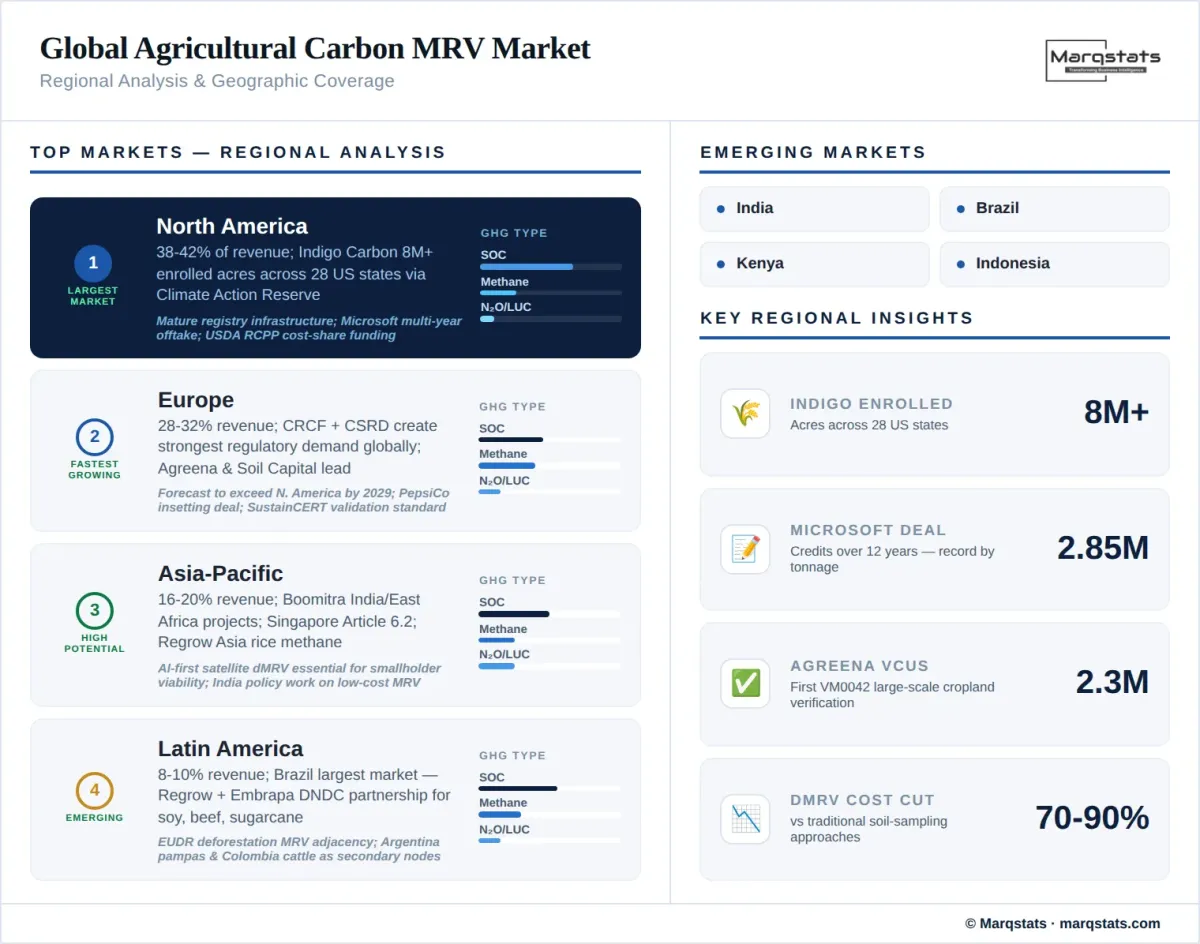
North America is the largest regional market, estimated at 38–42% of 2025 global revenue, anchored by the United States' mature voluntary carbon market infrastructure. Indigo Carbon PBC's 8+ million enrolled acres across 28 states, verified through the Climate Action Reserve under the Soil Enrichment Protocol, represents the world's largest operational soil carbon programme by enrolled acreage. The U.S. market benefits from established registry infrastructure (Climate Action Reserve, American Carbon Registry, Verra), a well-documented agronomic research base for biogeochemical model calibration, and sophisticated corporate buyers — led by Microsoft's multi-year, multi-gigatonne commitment — who have demonstrated willingness to sign long-dated offtake agreements for ICVCM CCP-aligned credits. Canada contributes significant agricultural acreage in prairie cereal and canola systems. The U.S. regulatory environment under USDA's Regional Conservation Partnership Program (RCPP) and the Inflation Reduction Act's climate-smart agriculture provisions provides cost-share funding that de-risks farmer MRV adoption.
Europe
Europe is the fastest-growing regional market, estimated at 28–32% of 2025 revenue and forecast to exceed North America in absolute revenue terms by 2029. The CRCF regulation, CSRD, and EU Farm to Fork Strategy collectively create the strongest regulatory demand signal for agricultural carbon MRV of any jurisdiction globally. Agreena's European cropland programme — operating across Denmark, Germany, France, the United Kingdom, Poland, and Romania — is the most commercially visible EU-headquartered MRV platform. Soil Capital's insetting-oriented arable farming programme, validated by SustainCERT and partnered with PepsiCo across the UK, France, and Belgium, reflects the dominance of supply-chain insetting over pure offset demand in European markets. The Netherlands-based Wageningen University, INRAE France, and Rothamsted Research UK provide a dense academic ecosystem supporting model development and third-party validation.
Asia-Pacific
Asia-Pacific accounts for approximately 16–20% of 2025 revenue and is characterised by high heterogeneity: Japan and Australia are commercially developed markets with institutional-grade MRV demand; India, Southeast Asia, and China represent large-scale smallholder agricultural systems where AI-first, satellite-led dMRV is essential for commercial viability. Boomitra's Verra-registered projects in India and East Africa, Singapore's Article 6.2 sovereign contract, and Regrow's partnerships with Embrapa (Brazil, primarily a Latin America overlap) and Green Carbon (Asia rice methane) represent the principal commercial activity. India's government-level policy work on agricultural carbon MRV signals significant future public investment in national MRV infrastructure, with particular emphasis on low-cost remote-sensing and probabilistic modelling approaches compatible with smallholder realities.
Latin America
Latin America accounts for approximately 8–10% of 2025 revenue, with Brazil and Colombia as the primary markets. Brazil's agricultural sector — the world's largest exporter of soybeans, beef, and sugarcane — generates significant Scope 3 emissions for global food companies and correspondingly large MRV demand. Regrow's July 2025 partnership with Embrapa to adapt DNDC-based MRV for Brazil explicitly recognises the scale of the Brazilian agricultural MRV opportunity. Argentina's pampas grasslands and Colombia's cattle sector are secondary demand nodes. Deforestation-linked MRV under the EUDR is creating an additional compliance demand layer for Brazilian and Colombian commodity exporters.
Middle East, Africa and Rest of World
Sub-Saharan Africa represents the most underserved agricultural carbon MRV market relative to its land area and smallholder population, accounting for an estimated 3–5% of 2025 revenue but growing rapidly via Boomitra's East Africa croplands project (Verra-registered, May 2025) and Downforce Technologies' Kenya digital MRV integrity work. Africa's 600+ million smallholders represent the largest potential agricultural carbon credit source in the world, but unit economics and data infrastructure remain the binding constraints. Middle Eastern agricultural MRV demand is nascent but growing, driven by GCC food security programmes and government-led precision agriculture investment.
How Competition Is Evolving
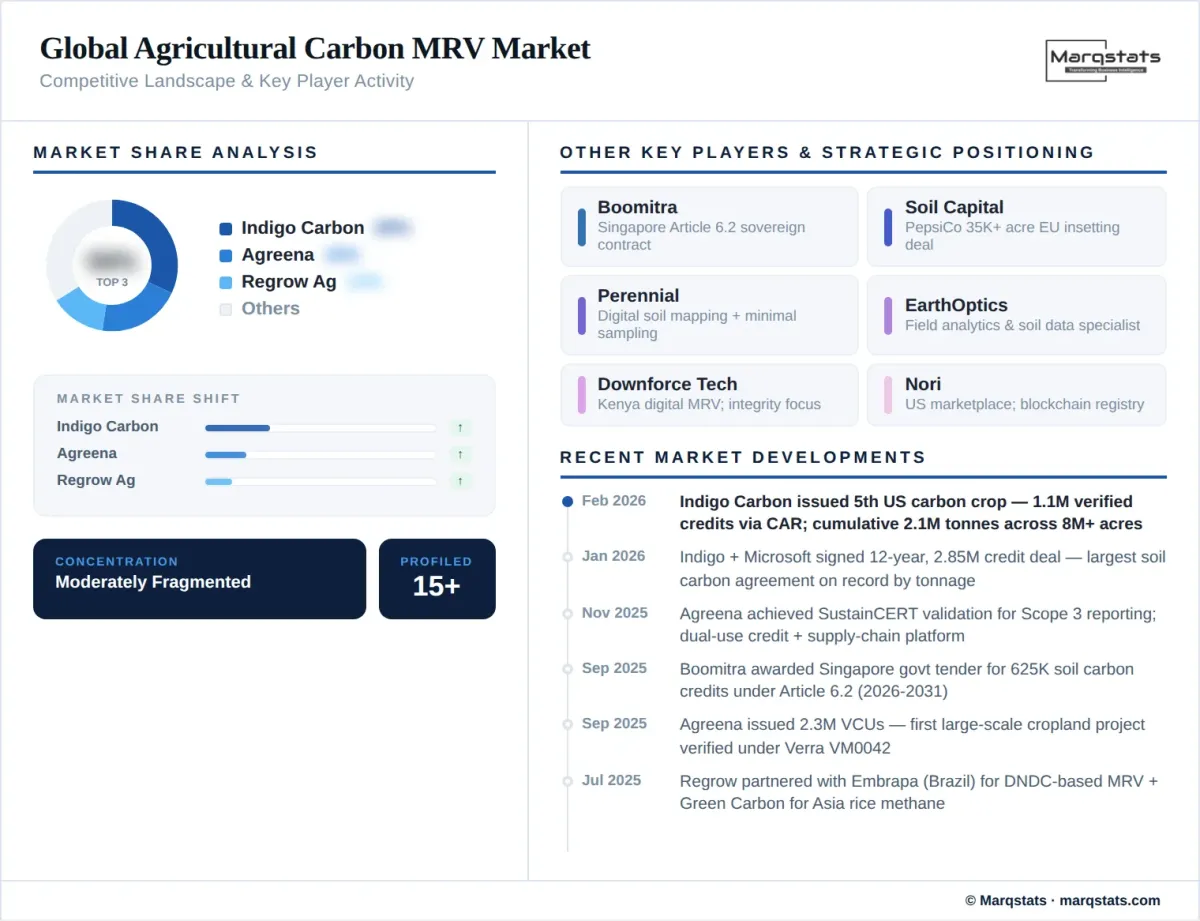
The global agricultural carbon MRV market is moderately fragmented, with a small number of full-stack platform leaders operating at significant commercial scale and a larger ecosystem of specialist measurement and data enablers. Competition is occurring on four fronts simultaneously: methodology credibility (registry approvals, ICVCM CCP alignment, SustainCERT validation, ISO compliance); MRV architecture (model-led versus measurement-led versus hybrid remote-sensing approaches); dual-use output capability (the ability to serve both VCM credit and corporate Scope 3 clients from a shared farm data asset); and geographic operating model (the specific crop systems, farm structures, and regulatory frameworks each platform has calibrated its MRV to).
Indigo Carbon PBC commands the strongest commercial position in North American soil carbon, with an 8+ million acre enrolled programme, five consecutive Climate Action Reserve credit issuances totalling 2.1 million metric tonnes, ICVCM CCP-label credentials, and the record-setting 12-year Microsoft offtake agreement executed in January 2026 for 2.85 million credits. Indigo's fifth issuance (February 2026, 1.1 million independently verified credits) and its investment in remote-sensing algorithmic upgrades and AI-powered buyer portals signal continued platform maturation. Agreena leads the European full-stack competitive set: first large-scale agricultural cropland project under Verra's VM0042, 2.3 million VCUs issued in September 2025, SustainCERT validation added in November 2025, and corporate customer base doubled in 2025.
Boomitra has established the most credible emerging-market soil carbon MRV presence, with five Verra-registered projects across India and East Africa, a 6,000-smallholder first issuance from the URVARA Project, and a sovereign-grade Article 6.2 contract with Singapore's government — the first of its kind for soil carbon at government-tender scale. Regrow holds the strongest enterprise MRV software positioning: its DNDC-based platform serves supply-chain programmes across 15+ crops and 5 continents, with formal partnerships with Embrapa (Brazil), Green Carbon (Asia rice methane), and investment backing from SE Ventures. Soil Capital is positioning itself as the European insetting specialist — SustainCERT-validated, GHG Protocol-aligned, primary-data-based — and its PepsiCo partnership across 35,000+ UK/France/Belgium acres gives it a credible corporate reference at FMCG scale. Perennial, EarthOptics, and Downforce Technologies operate as measurement and data infrastructure specialists whose outputs feed into full-stack platforms and corporate MRV programmes.
Companies Covered
Companies covered in the report include:
Recent Market Activity
Table of Contents
Coverage & Segmentation
This report provides a comprehensive analysis of the global agricultural carbon MRV market covering the historical period 2021–2025 and the forecast period 2026–2030, with 2025 as the base year. The study examines market size and revenue forecasts in USD billion, segmented by GHG type (soil organic carbon sequestration, methane, nitrous oxide, land use change), end-use (voluntary carbon market projects, corporate Scope 3 and insetting, sovereign and government MRV), and geography (North America, Europe, Asia-Pacific, Latin America, Middle East/Africa). The scope covers platform software, biogeochemical modelling services, remote-sensing analytics, field measurement and soil sampling logistics, verification services, and registry interface and credit management — all components of the MRV service stack when deployed for agricultural greenhouse gas quantification.
Primary research incorporated analysis of company press releases, registry project databases (Verra, Climate Action Reserve), government procurement announcements, corporate sustainability reports and Scope 3 disclosures, investor filings, and vendor technical documentation published through Q1 2026. Secondary research drew from IPCC Sixth Assessment Report agriculture chapters, EU CRCF legislative texts, ICVCM CCP technical documents, GHG Protocol Scope 3 standard guidance, Verra VM0042 versions 2.2 and v3.0 consultation documentation, MRV4SOC project publications, and peer-reviewed agronomy and soil science literature. The competitive assessment is grounded in publicly verifiable commercial milestones — registered projects, issued credit volumes, corporate partnerships, and validation certificates — rather than company self-reported claims.