Market Snapshot
Middle bar: base-year value × (1 + CAGR), rounded to two decimals. This is a calculated illustration, not a separately researched annual estimate.
The global agricultural nanobubble market is emerging as one of the most consequential precision-agri innovations of this decade, with the technology moving decisively from laboratory demonstration to commercial deployment across irrigation, greenhouse horticulture, hydroponics, and aquaculture. Nanobubbles — ultrafine gas bubbles with diameters below 200 nanometres, conforming to ISO 20480 definitions for ultrafine bubbles — remain stable in solution far longer than conventional microbubbles, enabling sustained dissolved oxygen enrichment of root zones, irrigation lines, and water bodies at concentrations previously unachievable through mechanical aeration. The global agricultural nanobubble market was valued at approximately USD 0.42 billion in 2025 and is projected to reach USD 1.18 billion by 2030, expanding at a CAGR of 22.88% during the 2026–2030 forecast period — driven by mounting pressure on water efficiency, documented crop-yield improvements of 25–53% in independent field and greenhouse trials, and the growing body of peer-reviewed research validating agronomic returns.
The market encompasses hardware (nanobubble generators and ozone-nanobubble systems), associated consumables, and service/maintenance contracts deployed across irrigated agriculture, protected cultivation (greenhouses, growth chambers), aquaculture tanks and ponds, and soilless systems such as hydroponics and aeroponics. Demand is firmly anchored in the Asia-Pacific region, which accounts for the largest revenue share owing to Japan's engineering leadership, China's large-scale greenhouse sector, India's rapidly professionalising hydroponics industry, and government-led programmes to raise irrigation efficiency. North America represents the second-largest market, led by commercial greenhouse operators, berry and leafy-vegetable growers, and early adopters integrating nanobubble systems with precision-irrigation stacks.
Key growth catalysts include tightening water-use regulations in California, the EU, and Gulf Cooperation Council (GCC) countries; declining total cost of ownership as generator hardware matures; the expanding scientific evidence base linking dissolved oxygen enrichment with pathogen suppression, biofilm reduction, and nutrient uptake efficiency; and the entry of well-capitalised distribution platforms — most notably Xylem Inc.'s 2025 strategic investment and global distribution agreement with Moleaer Inc. — that accelerate market reach beyond specialist channels. Restraints include high upfront capital costs relative to conventional aeration, the need for grower education on system integration, and competition from cheaper but shorter-acting microbubble and diffuser technologies.
Key Takeaways
Market Overview & Analysis
Report Summary
Agricultural nanobubble technology centres on the generation and delivery of sub-200-nanometre gas bubbles — primarily oxygen, ozone, or carbon dioxide — directly into irrigation water, nutrient solution, or water bodies. Unlike conventional aeration, nanobubbles carry a slight negative surface charge that prevents coalescence, giving them residence times measured in weeks rather than seconds and enabling oxygen transfer efficiencies up to ten times higher than diffuser-based systems. The technology is governed by the ISO 20480-1:2017 standard for fine and ultrafine bubbles, which provides a consistent framework for equipment specification and efficacy benchmarking — a prerequisite for institutional adoption in precision agriculture.
Commercial deployment spans six primary use cases: (1) root-zone dissolved-oxygen enrichment for field crops and permanent plantings; (2) irrigation-line biofilm elimination and chemical usage reduction; (3) controlled-environment agriculture (greenhouse, vertical farm, growth chamber) water treatment; (4) hydroponic and aeroponic nutrient-solution oxygenation; (5) aquaculture tank and pond dissolved-oxygen management; and (6) saline and water-stressed crop systems where ozone-nanobubble combinations target soil pathogens and salinity stress. The 2025–2026 scientific literature has substantively strengthened the evidence base: independent studies have reported cotton yield gains of 33.8–52.3% under saline-alkali conditions, rice yield improvements under nitrogen deficiency, and water savings in precision nanobubble irrigation for lettuce. A 2025 systematic review specifically highlighted oxygenated nanobubbles as promising for root-zone disease management in controlled-environment agriculture.
The broader bubble-generation equipment market — which encompasses nanobubble, microbubble, and fine-bubble generators across all end-uses — is projected to expand from USD 1.3 billion in 2024 to USD 1.8 billion by 2029, with agriculture and aquaculture explicitly cited as primary demand drivers by multiple independent market analyses. The agricultural nanobubble sub-market is a premium, high-growth segment within this broader category. Market structure is currently asymmetric: Moleaer, Inc. has built a meaningful scale advantage through aggressive product expansion, award recognition, and strategic capital, while the rest of the competitive field remains fragmented across regional and application-specific specialists.
Market Dynamics
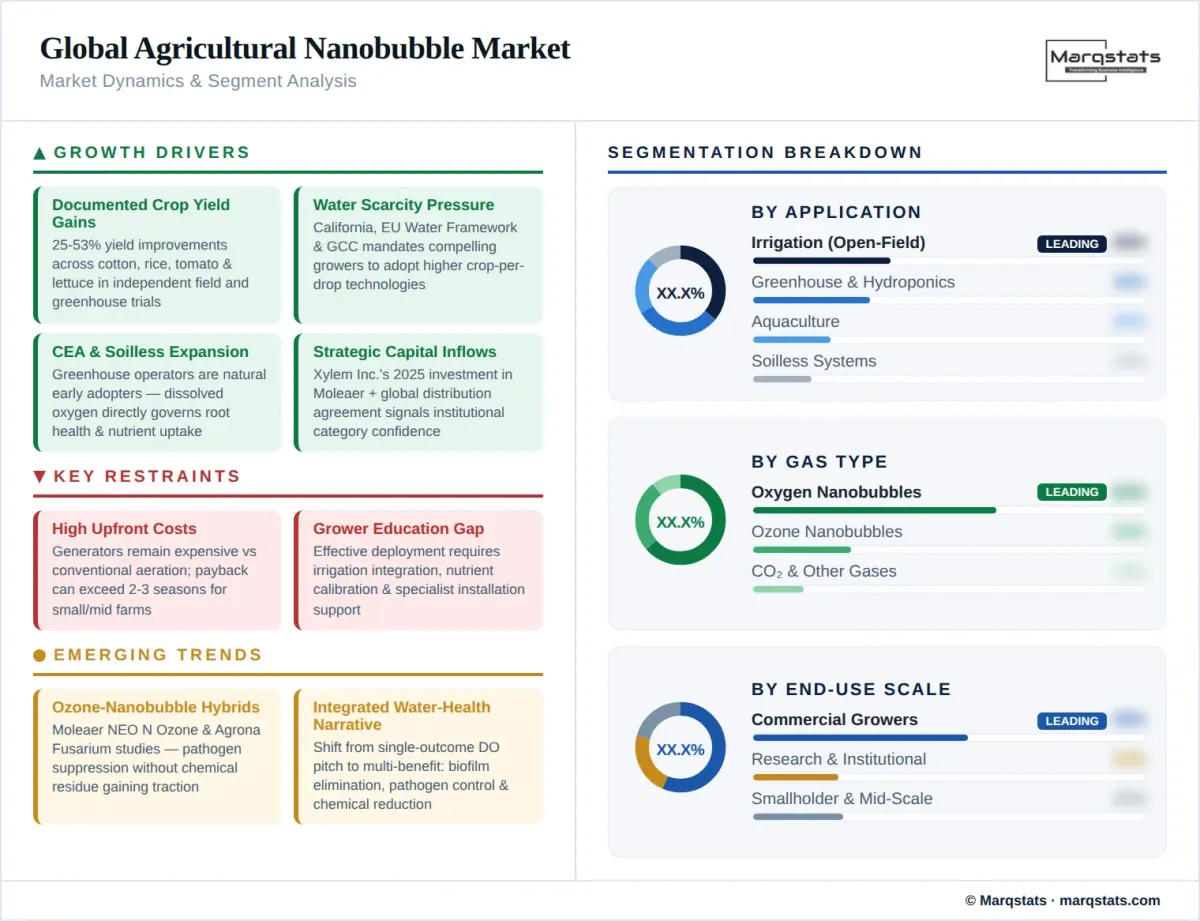
Key Drivers
- Documented crop-yield improvements commanding agronomic ROI: Field trials and peer-reviewed research published in 2024–2025 have moved beyond proof-of-concept. Cotton trials under saline-alkali conditions reported 33.8–52.3% yield gains, hydroponic lettuce trials at IIT Ropar demonstrated stronger root growth and biomass accumulation, and aeroponic tomato deployments with Eeki Foods claimed a 25% yield boost. These results are now being used by vendors as primary commercial arguments, raising adoption confidence among commercial growers with high-value, water-intensive crops.
- Rising water scarcity and regulatory pressure on irrigation efficiency: Tightening water-use regulations in California, the EU Water Framework Directive, and GCC food security mandates are compelling commercial growers to adopt technologies that deliver more crop per drop. Nanobubble irrigation reduces water consumption through higher oxygen transfer efficiency — eliminating the need for excessive flushing and nutrient replenishment in recirculating systems — while reducing reliance on chemical treatments for biofilm and pathogen management.
- Expansion of controlled-environment agriculture (CEA) and soilless systems: The global greenhouse market is expanding rapidly, with Asia-Pacific and the Middle East leading construction pipelines. CEA operators — who already invest in precision environmental controls — represent natural early adopters of nanobubble oxygenation systems, particularly for hydroponic nutrient solutions where dissolved oxygen directly governs root health and nutrient uptake rates.
- Strategic capital inflows and distribution scale-up: Xylem Inc.'s 2025 strategic investment in Moleaer and subsequent global distribution agreement significantly expands market reach beyond direct sales into Xylem's established water-treatment channel network. This transaction signals institutional confidence in the category and is expected to catalyse follow-on investment and distribution partnerships across the competitive set.
- Declining total cost of ownership as hardware matures: Generator unit prices are declining as manufacturing volumes increase and competition intensifies. Acniti's agricultural systems now offer optional oxygen-concentrator pairing to reduce operating costs, while Moleaer's expanded product family (Lotus PLUS, NEO B, NEO N Ozone, Trinity) targets growers across different scales and cultivation methods — broadening addressable demand beyond large commercial operations.
Key Restraints
- High upfront capital costs limiting small-farm penetration: Commercial nanobubble generators remain expensive relative to conventional aeration equipment. For small and mid-size farming operations — particularly in emerging markets — payback periods can extend beyond two to three growing seasons, creating a significant adoption barrier without access to agri-finance schemes or lease/pay-per-use commercial models.
- Grower education and system integration complexity: Effective nanobubble deployment requires integration with existing irrigation infrastructure, nutrient dosing systems, and (in greenhouse settings) climate computers. Acniti's PLC-compatible systems address this in part, but the category as a whole still requires skilled installation and agronomic calibration, limiting rapid independent adoption by growers without specialist support.
- Competition from established conventional aeration technologies: Diffusers, surface aerators, and venturi-based systems have well-established supply chains, familiarity among growers and agronomists, and lower capital entry points. Vendors must overcome buyer inertia and demonstrate clear, measurable superiority in agronomic outcomes before procurement decisions shift.
- Limited standardisation in performance benchmarking: While ISO 20480 provides a bubble-size framework, there is no universally accepted agronomic performance standard for nanobubble systems. This creates scepticism among technically sophisticated buyers — research institutions, large corporate farm operators — who demand reproducible, independently validated efficacy data before capital commitment.
Key Trends
- Shift from dissolved-oxygen pitch to integrated water-health narrative: Leading vendors are repositioning nanobubble technology as a complete water-health management solution covering oxygenation, biofilm elimination, pathogen suppression (via ozone-nanobubble variants), and irrigation infrastructure protection. This broadens the value proposition beyond crop yield alone and aligns with growing grower focus on chemical reduction and integrated pest management.
- Ozone-nanobubble hybrids targeting pathogen control: Ozone-infused nanobubble systems (notably Moleaer's NEO N Ozone product, launched February 2025) are gaining traction in high-value horticulture and hydroponic settings where waterborne pathogens — Fusarium, Pythium, Phytophthora — represent major crop-loss risks. Agrona's February 2026 publication on Fusarium stress in peppers using nanobubble technology reflects the same strategic focus.
- PLC and climate-computer integration enabling smart greenhouse compatibility: Acniti's agriGaLF product line features PLC integration with greenhouse climate-control computers, positioning nanobubble generators as components of intelligent farming systems rather than standalone equipment. This integration trend aligns with broader digital agriculture and precision farming movements.
- Emerging market localisation: NanoKriti (India) and Nanobubble Agritech (New Zealand) represent a broader trend of regional players commercialising nanobubble technology in domestically relevant crop systems and farm scales — moving the market beyond its initial dependence on North American and Japanese suppliers.
Market Segmentation
Irrigation represents the largest volume deployment channel for agricultural nanobubble systems, encompassing drip, subsurface drip, and sprinkler systems across field crops, orchards, and viticulture. Systems are installed inline to deliver dissolved oxygen and — in ozone-nanobubble configurations — antimicrobial treatment passively through existing irrigation infrastructure. Commercial growers report benefits including biofilm elimination from drip emitters (reducing maintenance costs), improved soil-microbial activity, and documented yield improvements in moisture-stressed and saline-soil conditions. This segment accounts for an estimated 35% of 2025 revenue and is expected to maintain leadership through 2030 as water-efficiency regulations tighten globally.
Controlled-environment agriculture — encompassing glass and poly greenhouses, vertical farms, and hydroponic growth chambers — is the fastest-growing application segment, projected to expand at a CAGR of over 26% through 2030. Growers in this segment operate at high capital intensity and demand precision-input management; nanobubble oxygenation systems directly address root-zone dissolved-oxygen requirements, which are critical to nutrient uptake, root health, and resistance to waterborne pathogens. Moleaer, Acniti, and Agrona all have targeted product lines for this segment. Hydroponic and aeroponic operators in India, the Netherlands, and Japan are adopting nanobubble systems as part of water-recirculation and nutrient-solution management protocols.
Aquaculture represents a structurally distinct but commercially adjacent application, with nanobubble dissolved-oxygen systems used in intensive fish and crustacean farming to maintain water quality without mechanical aeration noise and the mechanical fish-stress risks associated with conventional diffusers. Demand is concentrated in high-value species — salmon, trout, prawn, and sea bass — where dissolved oxygen management directly governs growth rates and feed conversion ratios. Asia-Pacific dominates aquaculture demand, with Japan and Norway representing the most sophisticated markets for precision dissolved-oxygen management in recirculating aquaculture systems (RAS). This segment contributes approximately 20% of 2025 market revenue.
Aeroponic and nutrient-film technique (NFT) systems, which suspend root systems in a nutrient mist or thin film rather than a growing medium, are highly sensitive to dissolved-oxygen levels in the root zone. Nanobubble systems used in these settings can deliver oxygen concentrations significantly above ambient saturation, supporting faster vegetative cycles and higher plant densities. NanoKriti's IIT Ropar hydroponic trials and its Eeki Foods aeroponic tomato deployment illustrate the commercial opportunity in India's fast-professionalising soilless-farming sector. This segment remains nascent in revenue terms but is growing rapidly as vertical farming scales.
Oxygen nanobubble systems constitute the dominant gas-type segment — estimated at 60%+ of 2025 market revenue — due to their direct agronomic mechanism: root-zone dissolved-oxygen enrichment improves aerobic microbial activity, accelerates nutrient mineralisation, and reduces anaerobic-stress conditions that favour root-rot pathogens. Systems range from standalone generator units (Moleaer NEO B, Acniti agriGaLF) to integrated systems pairing the generator with on-site oxygen concentrators for cost-efficient, high-concentration operation.
Ozone-nanobubble systems are the fastest-growing gas-type segment, targeting pathogens, biofilm, and oxidative soil conditioning in addition to dissolved-oxygen delivery. The combination of ozone's antimicrobial potency with nanobubble stability enables pathogen suppression without chemical residue — a compelling value proposition as regulatory pressure on fungicide and disinfectant use increases in the EU and select US states. Moleaer's NEO N Ozone product, launched in February 2025 as part of its expanded irrigation line, is the most commercially visible offering in this segment.
Carbon dioxide nanobubbles are used in niche applications — notably pH management in alkaline water sources and selective stimulation of root-zone CO₂ respiration. Other gases, including air-nanobubble systems used for cost-sensitive applications, round out the segment. This gas-type category remains small in revenue terms but may expand as customised gas-blend systems gain traction in precision horticulture settings.
By Geography
Asia-Pacific
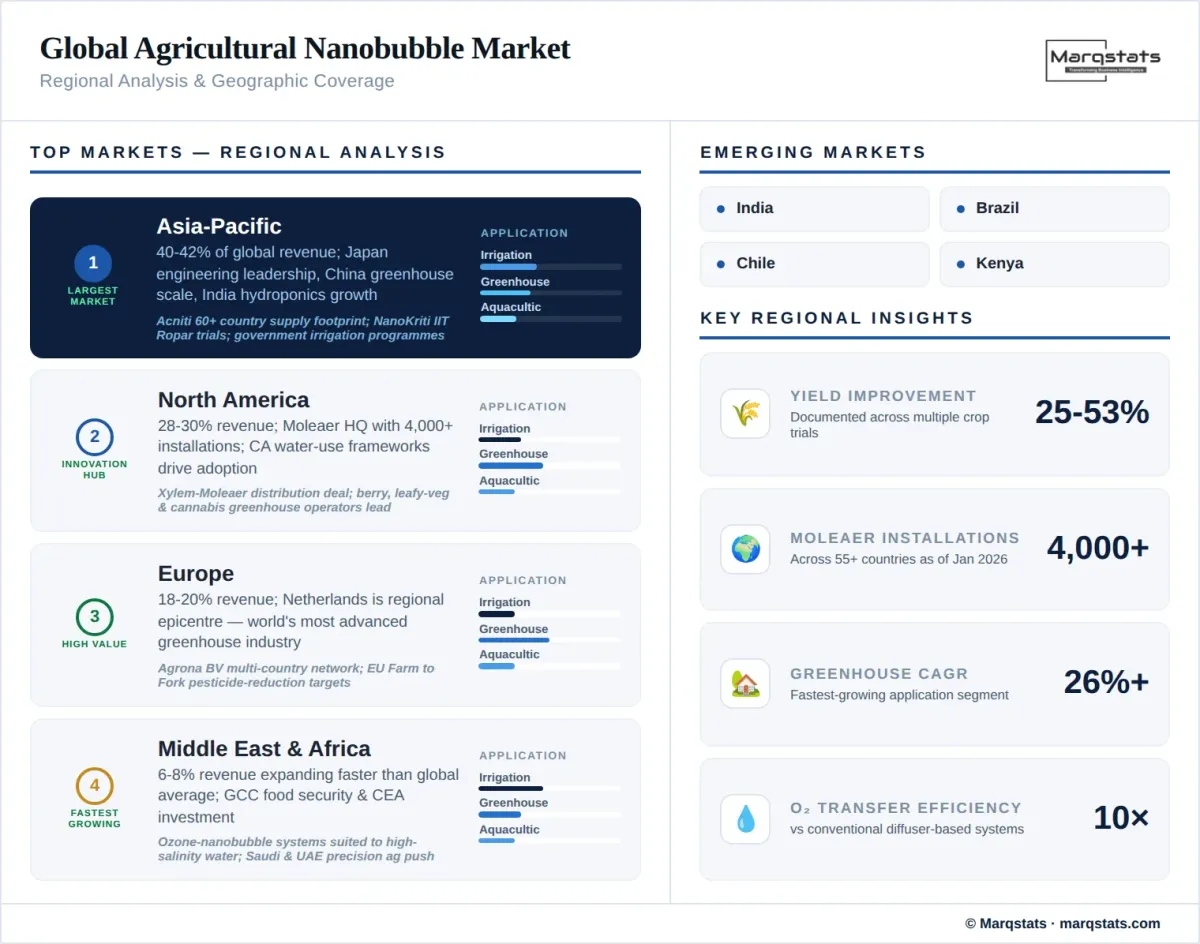
Asia-Pacific is the largest regional market for agricultural nanobubbles, accounting for an estimated 40–42% of 2025 global revenue. Japan anchors the region as an engineering and early-deployment leader: Acniti, headquartered in Japan, has supplied agricultural nanobubble systems in 60+ countries, and Japanese academic institutions have collaborated with vendors to produce peer-reviewed agronomic validation data. China's extensive greenhouse sector — the world's largest by covered area — represents the largest volume opportunity, as CEA operators seek precise water and oxygen management tools. India is the fastest-growing national sub-market in the region, driven by the rapid professionalisation of its hydroponics, vertical farming, and precision irrigation sectors. NanoKriti's India-based commercialisation activities — including IIT Ropar hydroponic trials and aeroponic deployments — are emblematic of this domestic market development. Australia and New Zealand contribute premium aquaculture and irrigated-horticulture demand, with Nanobubble Agritech actively deploying across New Zealand's dairy, pastoral, and horticultural systems.
North America
North America represents the second-largest regional market, estimated at 28–30% of 2025 global revenue, and is home to Moleaer, Inc. — the category's most visible and well-capitalised participant. The United States is the primary demand centre: commercial berry, leafy-vegetable, cannabis, and ornamental greenhouse operators have been early adopters, motivated by California's stringent water-use frameworks, rising input costs, and the documented ability of nanobubble systems to reduce fertiliser and crop-protection chemical usage. Canada contributes meaningful greenhouse-horticulture demand, particularly in British Columbia and Ontario. The Xylem–Moleaer strategic investment and global distribution agreement, announced in September 2025, is expected to significantly accelerate North American channel reach beyond Moleaer's existing direct-sales network.
Europe
Europe accounts for approximately 18–20% of 2025 market revenue, with the Netherlands, Spain, France, and the United Kingdom representing the most commercially active markets. The Netherlands — home to Agrona and the world's most technologically advanced greenhouse industry — is the regional epicentre of nanobubble adoption in horticulture. Dutch growers operate at scale with high-technology growing systems and are accustomed to evaluating novel input technologies against measurable yield and quality metrics. EU regulatory drivers — including the Farm to Fork Strategy's pesticide-reduction targets and the Water Framework Directive's water-quality obligations — create structural incentives for nanobubble adoption as a chemical-reduction and water-efficiency tool. Germany, Italy, and Poland are secondary markets at earlier adoption stages.
Middle East and Africa
The Middle East and Africa region represents a high-growth opportunity, estimated at 6–8% of 2025 revenue but expanding faster than the global average. GCC countries — particularly Saudi Arabia, UAE, and Qatar — are investing heavily in food security through controlled-environment agriculture and precision irrigation, given severe water scarcity and a national agenda to reduce food import dependence. Ozone-nanobubble systems are well-suited to high-salinity water sources prevalent in arid environments. Sub-Saharan Africa remains nascent but presents a long-term opportunity as irrigated export horticulture (floriculture, tropical fruits, vegetables) scales in Kenya, Ethiopia, and South Africa.
Latin America
Latin America accounts for approximately 5–7% of 2025 market revenue, with Brazil, Mexico, and Chile representing the primary demand centres. Brazil's large-scale irrigated agriculture — particularly soybeans, citrus, and high-value fruits — and Mexico's export-oriented greenhouse vegetable sector present meaningful addressable markets. Agrona has established commercial presence in Mexico. Chile's intensive aquaculture sector (salmon farming) represents a distinct demand driver in the region. Adoption is constrained by limited grower awareness, agri-finance access challenges, and the region's historically price-sensitive equipment procurement culture.
How Competition Is Evolving
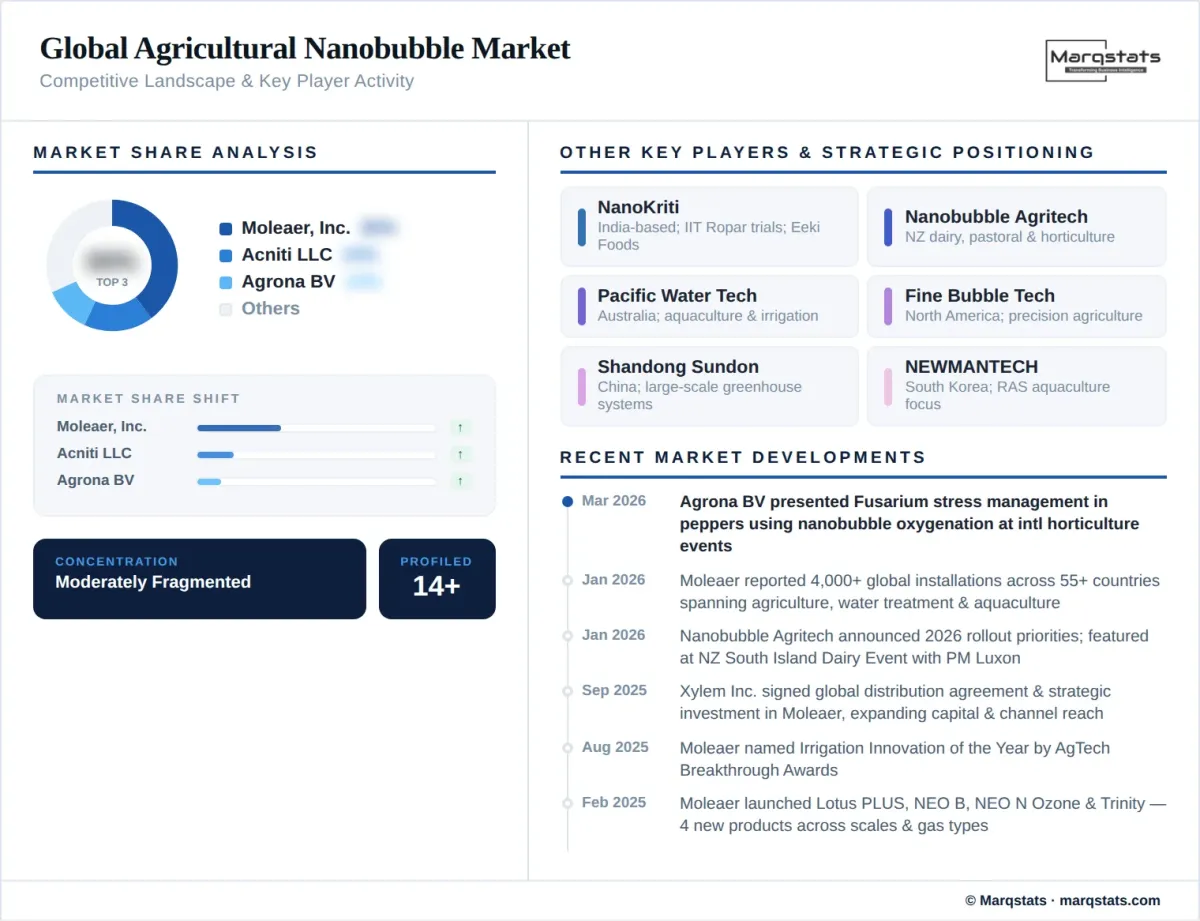
The global agricultural nanobubble market is currently fragmented, with one clear scale leader and a field of regionally and application-focused challengers at meaningfully earlier commercial stages. Moleaer, Inc. holds the strongest competitive position by a significant margin: as of January 2026, the company reported 4,000+ installations across 55+ countries spanning agriculture, water treatment, and aquaculture. Its February 2025 product line expansion — introducing the Lotus PLUS, NEO B, NEO N Ozone, and Trinity generators — explicitly targeted broader accessibility across grower scales and cultivation methods. The September 2025 Xylem strategic investment and global distribution agreement materially strengthens its capital position, distribution credibility, and institutional reach. Recognition as AgTech Breakthrough's Irrigation Innovation of the Year in August 2025 further validates its commercial and technical leadership.
Competition is occurring along four distinct fronts. The first is agronomic proof-of-concept: vendors are increasingly differentiating on the depth and crop-specificity of their results library — field trials, grower case studies, and peer-reviewed publications. The second is system integration: Acniti's PLC and climate-computer integration capabilities represent a genuine technical differentiator in greenhouse settings, positioning its systems as smart-farm components rather than standalone devices. The third is service and channel footprint: Moleaer's scale advantage, Agrona's multi-country subsidiary network (Netherlands, France, Spain, Canada, Mexico, USA, Italy), and Acniti's 60-country supply footprint reflect a recognition that nanobubble adoption depends heavily on local installation expertise and after-sales agronomic support. The fourth front is value-proposition breadth: the market is shifting from single-outcome selling (dissolved oxygen) toward multi-outcome integrated water-health narratives covering pathogen control, biofilm elimination, chemical-use reduction, and measurable crop ROI.
The competitive landscape is expected to consolidate modestly through 2030 as hardware costs decline and channel partnerships concentrate market share around vendors with strong agronomic validation and service infrastructure. Mergers and acquisitions activity is likely, particularly as agricultural technology platforms and irrigation-equipment majors seek differentiated product lines for precision water management. The Xylem–Moleaer transaction may be the precursor to a broader wave of strategic investment and distribution-partnership activity across the competitive set.
Companies Covered
Companies covered in the report include:
Recent Market Activity
Table of Contents
Coverage & Segmentation
This report provides a comprehensive analysis of the global agricultural nanobubble market covering the historical period 2021–2025 and the forecast period 2026–2030, with 2025 as the base year. The study examines market size and revenue forecasts in USD billion, segmented by application (irrigation, greenhouse horticulture/hydroponics, aquaculture, soilless systems), gas type (oxygen, ozone, CO₂, other), and geography (Asia-Pacific, North America, Europe, Middle East and Africa, Latin America). The scope covers ultrafine bubble generators and ozone-nanobubble systems deployed in agricultural settings, along with associated service and maintenance contracts. Equipment used exclusively in industrial water treatment, municipal water management, or non-agricultural aquatic applications is excluded from scope.
The research methodology combines primary and secondary research. Secondary research drew from peer-reviewed journals (including publications on nanobubble effects on cotton, rice, lettuce, tomato, and other crops from 2024–2026), government agricultural databases (USDA, India Ministry of Agriculture, EU FADN, Japan MAFF), trade publications, equipment vendor technical documentation, company press releases, award citations, and partnership announcements. Primary research incorporated analysis of company deployment data, product launch timelines, and case study portfolios published by leading vendors. The competitive assessment is grounded in publicly verifiable evidence of commercial scale, geographic reach, product breadth, and institutional validation — including the ISO 20480 standards framework for ultrafine bubble classification.