Market Snapshot
Key Takeaways
Market Overview & Analysis
Report Summary
Greenhouse management software encompasses the full stack of digital tools used to monitor, control, and optimise the production environment in glass and poly greenhouses, vertical farms, indoor growing facilities, and other controlled-environment agriculture (CEA) settings. The functional architecture spans four layers. The control layer — historically the core of the market — includes climate computers and process controllers that regulate temperature, humidity, CO2 concentration, ventilation, heating, shading, and irrigation in real time. The data layer aggregates sensor readings, equipment states, weather data, and crop observations into unified dashboards and historical archives. The intelligence layer applies machine learning, computer vision, and bioprocess modelling to translate data into setpoint recommendations, yield forecasts, disease-risk alerts, and autonomous crop-steering decisions. The workflow layer manages labour scheduling, task assignment, harvest planning, traceability, and ERP-adjacent functions. The most commercially advanced vendors — particularly Priva, Source.ag, and IUNU — are building toward full integration across all four layers.
The strategic inflection point currently reshaping the market is the emergence of AI-native autonomous growing platforms that move beyond passive monitoring and manual setpoint management toward closed-loop, self-adjusting production systems. Hoogendoorn's IIVO, positioned as supporting the transition to autonomous growing, and Blue Radix's Crop Controller, marketed as operating autonomously across climate and irrigation in 100+ commercial vegetable production sites and 20+ countries, both represent this direction from the incumbent and challenger sides respectively. Source.ag's September 2025 Plant Balance Metrics — a virtual sensor layer for crop balance that calculates optimal irrigation strategies without requiring physical sensors — and its March 2026 tomato-forecasting model improvements exemplify the AI-driven product roadmap that is setting the competitive pace in 2025–2026.
The competitive dynamics are being shaped by a critical structural question: will growers adopt a single integrated operating system, or will they assemble best-of-breed tools from different vendors? The evidence from 2025–2026 strongly suggests the latter model is prevailing in the near term: Priva's Open Platform with 60+ integration partners, Ridder's API-based integrations with Blue Radix and Source.ag, Koidra's explicit design to work alongside existing Priva or Hoogendoorn controllers, and Source.ag's integration with Priva PIM and Priva Connext all reflect an ecosystem architecture where incumbents provide execution infrastructure and AI challengers provide the intelligence overlay. This modularity is commercially advantageous for both sides — incumbents maintain installation base stickiness while AI vendors access large existing fleets without requiring hardware replacement.
Market Dynamics
Key Drivers
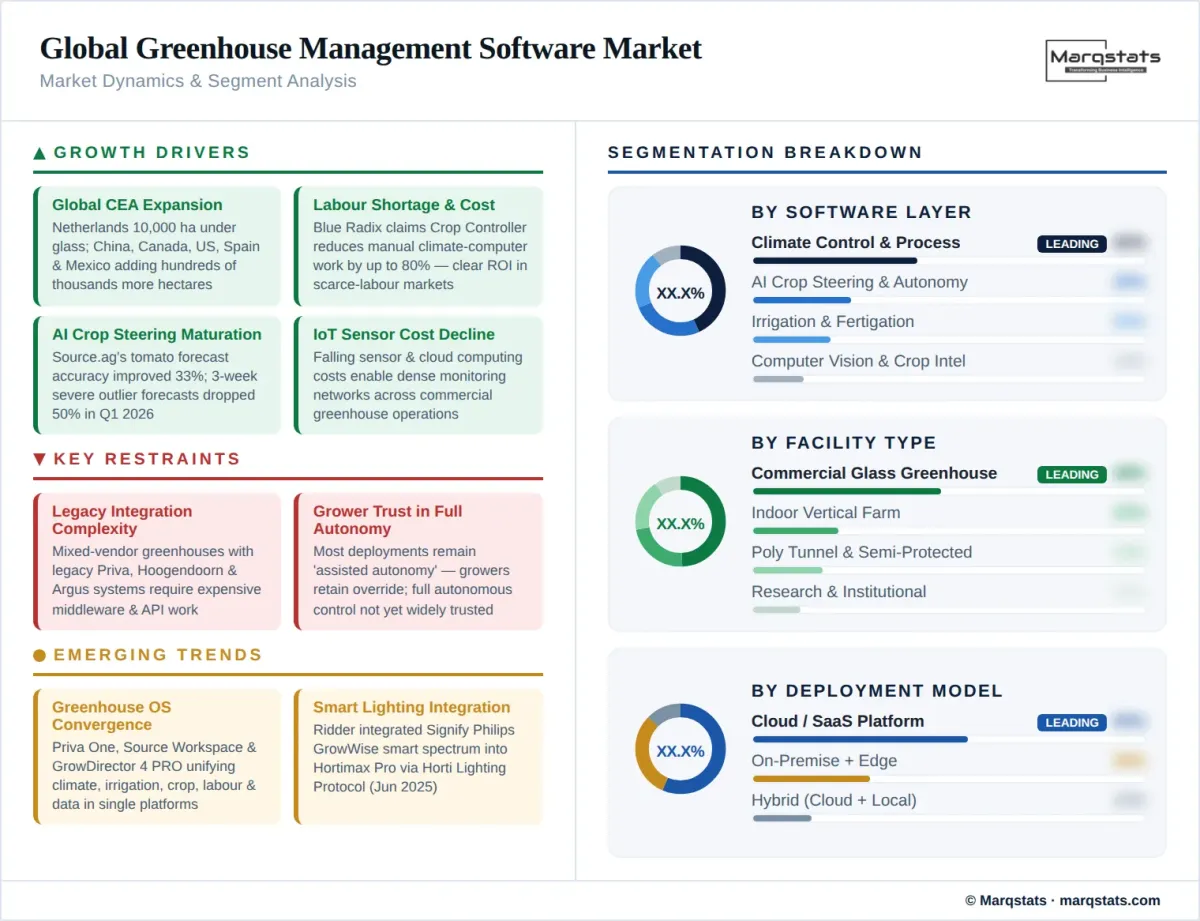
- Global controlled environment agriculture expansion driving software platform demand: The global CEA market — encompassing commercial glass greenhouses, poly tunnels, vertical farms, and hybrid indoor facilities — is expanding rapidly in response to food security pressures, urbanisation, climate change impacts on outdoor production, and consumer demand for local, year-round produce. Each new greenhouse hectare and every indoor farm retrofit requires climate control, irrigation management, data logging, and increasingly AI-driven crop optimisation — directly driving software platform demand. The Dutch greenhouse industry alone covers approximately 10,000 hectares under glass, while China, Canada, the U.S., Spain, Morocco, Turkey, and Mexico collectively represent hundreds of thousands of additional commercial hectares in active expansion.
- Labour shortage and cost inflation in commercial horticulture driving automation ROI: Commercial greenhouse horticulture is highly labour-intensive, with manual monitoring, irrigation scheduling, harvest timing, and climate adjustment historically consuming significant operational hours. Blue Radix's company-reported claim that Crop Controller reduces manual climate-computer work by up to 80% reflects the economic driver: in markets where skilled greenhouse labour is scarce and expensive (Netherlands, UK, Canada, U.S.), software that measurably reduces operator time per hectare commands a clear ROI case. GrowDirector's core commercial message — managing any-sized greenhouse with the smallest workforce possible — targets the same driver for mid-scale operations globally.
- AI and IoT sensor maturation enabling predictive and autonomous crop steering: The convergence of affordable, accurate IoT sensors (climate, substrate moisture, EC, pH, light, CO2), cloud computing, and machine learning models trained on large commercial greenhouse datasets has crossed a practical viability threshold for autonomous setpoint management and yield forecasting. Source.ag's Plant Balance Metrics virtual sensor layer, IUNU's per-plant computer vision inference, and Koidra's KoPilot autonomous control — which achieved 6.8% yield improvement with 4.84% less steam energy in a company-reported 2025 case study — demonstrate that AI-native crop steering is delivering quantifiable results in commercial operations, accelerating broader adoption.
- Open platform and interoperability strategies unlocking ecosystem network effects: Priva's announcement that its Open Platform has more than 60 integration partners, Ridder's June 2025 integration of Signify's Philips GrowWise smart spectrum lighting into Hortimax Pro, and the Source.ag–Priva joint integration (Source calculates optimal irrigation strategies, Priva executes them inside the greenhouse) all reflect a deliberate market structure where control incumbents commoditise connectivity and AI challengers build value on top. This ecosystem approach lowers switching costs for growers, accelerates adoption of new AI features, and creates network effects that benefit both incumbent platforms and compliant AI partners.
- Food company sustainability commitments and traceability requirements creating data platform demand: Major food retailers and food service companies are requiring suppliers to demonstrate resource efficiency, pesticide reduction, water use documentation, and carbon footprint data from their greenhouse supply chains. This creates demand for software platforms that not only control growing conditions but also log, aggregate, and report operational data in formats suitable for third-party audit and ESG disclosure — elevating 30MHz and the data-unification layer of Priva One and Source Workspace from operational conveniences to compliance necessities.
Key Restraints
- Integration complexity across legacy hardware and mixed-vendor greenhouse environments: Most commercial greenhouses operate mixed hardware environments — legacy climate computers from one vendor, irrigation controllers from another, sensors from multiple suppliers, and ERP or crop-planning tools from a third — making seamless software integration technically challenging and commercially expensive. Retrofitting AI overlay software on top of legacy Priva, Hoogendoorn, or Argus installations requires middleware, API access, and often hardware upgrades, creating friction for adoption particularly at older operations with heterogeneous control infrastructure.
- Grower trust in AI-driven autonomous control limiting full automation adoption: Despite significant advances in autonomous climate and irrigation algorithms, most commercial deployments remain in an 'assisted autonomy' mode where AI provides recommendations or executes pre-approved setpoint ranges but growers retain override capability and final responsibility. Blue Radix, Koidra, and IUNU all explicitly frame their products as reducing manual work while keeping growers in control — acknowledging that full autonomous operation remains a trust threshold that most commercial operations have not yet crossed.
- High upfront implementation cost and complexity for large-scale greenhouse operations: Enterprise-grade greenhouse operating platforms — particularly full Priva One or Ridder Hortimax Pro installations at large commercial facilities — involve significant capital expenditure in hardware, software licensing, installation, commissioning, and grower training. For mid-scale and smaller operations in price-sensitive markets (Eastern Europe, Southeast Asia, LATAM), this cost barrier limits adoption to the upper tier of commercial operators, constraining total addressable market in the near term.
- Fragmented and immature market for vertical farming and indoor-specific software: While the greenhouse software market is relatively mature in European commercial horticulture, the rapidly growing vertical farming and indoor CEA segment requires fundamentally different software architecture — managing multi-tier rack systems, artificial lighting recipes, hydroponic or aeroponic root-zone management, and tightly controlled airflow — for which purpose-built platforms are still emerging. Generic greenhouse climate-control software is often poorly suited to vertical farm operations, creating a gap that is not yet fully addressed by any dominant platform.
Key Trends
- Greenhouse operating system convergence: climate, irrigation, crop, labour, and data in one platform: The dominant product architecture trend is the convergence of previously separate software modules into unified greenhouse operating platforms. Priva One explicitly frames this as an operating system for greenhouse management. Source Workspace combines forecasting, irrigation intelligence, crop-balance metrics, and grower workflows. GrowDirector 4 PRO unifies climate, lighting, irrigation, fertigation, AI alerts, and AgriNotes crop CRM in one platform. This convergence is raising switching costs and rewarding vendors that can deliver a credible end-to-end stack.
- Lighting intelligence integrating into greenhouse automation platforms: Ridder's June 2025 integration of Signify's Philips GrowWise smart spectrum control into Hortimax Pro via the Horti Lighting Protocol — enabling dynamic spectral management as part of the core automation stack rather than a separate system — signals that adaptive lighting control is becoming a standard module in greenhouse operating platforms. This trend is particularly relevant for supplementary lighting management in northern European greenhouse production and for full-spectrum recipe management in indoor vertical farms.
- Computer vision enabling per-plant prescriptive intelligence: IUNU's LUNA platform, which images every plant throughout its lifecycle to build a predictive and prescriptive growing model, represents the leading commercial expression of computer vision-based crop intelligence. IUNU's April 2025 USD 20 million raise and 330% vine-crop segment growth signal that plant-level visual intelligence is achieving commercial scale, closing the loop between individual plant response and environmental control in a way that aggregate climate sensors cannot.
- Mid-market and modular automation platforms accelerating global CEA adoption: GrowDirector's 2025 launch of GrowDirector 4 PRO — a fully wireless, modular, plug-and-play AI-driven system designed for easy retrofit into existing operations — and its presence at Cultivate '25 and GreenTech Amsterdam 2025 reflect a deliberate strategy to serve the large global segment of commercial greenhouses that cannot afford enterprise-scale Priva or Argus implementations. This mid-market segment — covering smaller commercial vegetable and cannabis operations in North America, Israel, Eastern Europe, and Southeast Asia — represents a significant volume opportunity that is being increasingly addressed by modular hardware-plus-software platforms.
Market Segmentation
Climate control and process computer software is the largest and most established segment, estimated at 40–44% of 2025 market revenue. This segment encompasses the core software that monitors and controls greenhouse climate parameters — temperature, humidity, CO2, ventilation, heating, shading, and basic irrigation — in real time. The primary commercial vendors are Priva (Priva One platform), Hoogendoorn (IIVO, replacing legacy iSii from January 2026), Ridder (Hortimax Pro), and Argus Controls (TITAN 900 and the new Axia platform for commercial and research CEA). These vendors serve the world's largest and most technically sophisticated commercial greenhouse fleets, primarily in the Netherlands, Belgium, the U.K., Canada, and the U.S. Argus Controls' TITAN system — which manages climate, fertigation, irrigation, lighting, and physical plant operations from a central command centre — serves institutional research facilities (including University of Guelph, BASF seed trials) as well as commercial operations.
AI crop steering and autonomous growing software is the fastest-growing segment, forecast to expand at over 30% CAGR through 2030, driven by Source.ag, Blue Radix, Koidra, and IUNU. Source.ag's platform combines harvest forecasting, irrigation intelligence, and Plant Balance Metrics virtual sensing — launched September 2025 — to deliver crop-steering decisions without requiring additional physical sensors. Blue Radix's Crop Controller operates autonomously across climate and irrigation in 100+ commercial sites across 20+ countries, with company-reported reduction of manual climate-computer work by up to 80%. Koidra's KoPilot produced 6.8% yield improvement with 4.84% less steam energy in a company-reported 2025 case study and is designed to work alongside existing Priva or Hoogendoorn controllers as an AI overlay. This segment's growth reflects the shift from operator-driven setpoint management to machine-learning-driven autonomous optimisation.
Data aggregation and decision-support platforms form the horizontal intelligence layer of the greenhouse software stack, consolidating sensor, climate, crop, equipment, and operational data from multiple sources into unified dashboards and analytical tools. 30MHz is the most visible specialist in this segment, operating as a platform that integrates greenhouse, climate, crop, and sensor data across multi-vendor environments. In June 2025, 30MHz launched a smart AI assistant beta that builds dashboards from a grower's own data, positioning the platform as an AI-enhanced analytics layer on top of raw data streams. This segment also includes the data and reporting capabilities embedded within Priva One and Source Workspace, where unified data visibility is a core commercial argument.
Irrigation and fertigation management is the most commercially critical application within greenhouse software, as water and nutrient delivery precision directly governs yield, quality, crop uniformity, and substrate health. Automated irrigation and fertigation systems — managing drip irrigation schedules, nutrient dosing (EC, pH, macro and micronutrient ratios), water recirculation, and leachate monitoring — are standard in high-technology Dutch-style greenhouse operations and increasingly expected in North American and APAC commercial facilities. Source.ag's irrigation intelligence (integrated with Priva PIM and Priva Connext) and GrowDirector 4 PRO's precision fertigation and pH/EC management capabilities both represent state-of-the-art commercial offerings in this application.
Crop monitoring, pest and disease detection, and yield forecasting are the fastest-growing application functions, driven by the economic value of early problem identification and production planning accuracy. IUNU's LUNA platform delivers plant-level imaging for disease, growth-stage, and yield-potential monitoring at scale. Source.ag's March 2026 next-generation tomato harvest-forecasting model — reducing severe outlier forecasts by 50% and improving three-week accuracy by 33% in company-reported results — directly addresses the production planning and supply-chain reliability needs of large tomato growers and their retail customers. GrowDirector's AI provides early warnings of fungal outbreak risk and weather-based predictive adjustments, targeting the same application for mid-scale operations.
Energy management is a critical application segment given that greenhouse heating, cooling, supplementary lighting, and CO2 enrichment represent 25–40% of total production costs in northern European and North American commercial greenhouse operations. Software platforms that optimise energy use — through predictive heating setpoint management, algorithmic supplementary lighting control, smart shading, and heat buffer management — deliver direct and measurable cost reductions. Argus Controls' TITAN algorithmic prediction of natural light as the basis for supplementary lighting and its evapotranspiration model for irrigation scheduling both target energy optimisation directly. Koidra's 4.84% steam energy reduction in its 2025 case study demonstrates the measurable energy efficiency gains that AI-driven crop steering can deliver.
By Geography
Europe
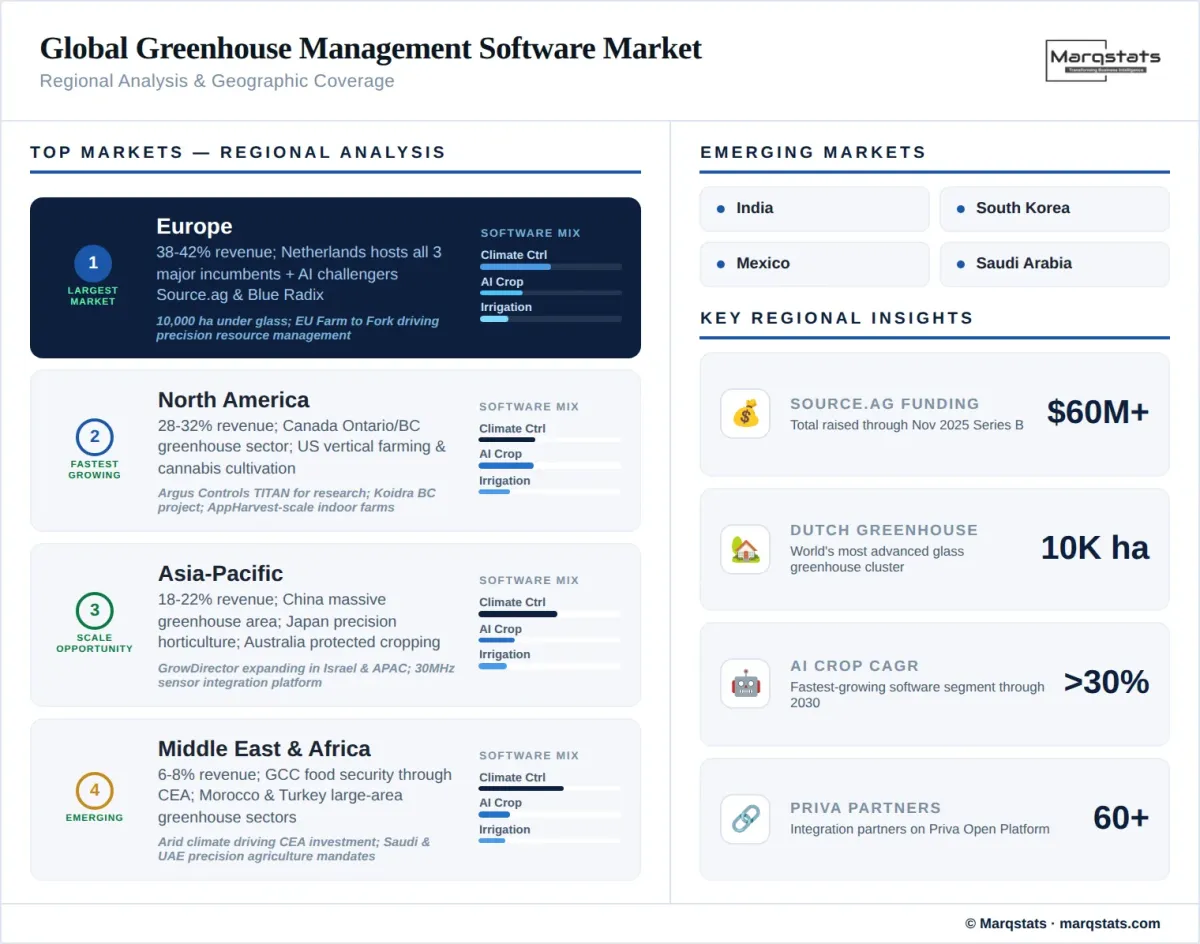
Europe is the largest regional market, estimated at 38–42% of 2025 global revenue, dominated by the Netherlands' world-leading commercial horticulture sector alongside Belgium, Germany, the United Kingdom, Spain, Poland, and Scandinavia. The Netherlands alone hosts approximately 10,000 hectares under glass — the world's most technologically advanced greenhouse cluster — and is home to all three major incumbent control vendors (Priva, Hoogendoorn, Ridder) as well as leading AI challengers Source.ag and Blue Radix. Ridder's April 2025 Hortimax Pro Dutch Interactive Award win and June 2025 Signify integration reflect continuing product innovation from Dutch-domiciled vendors. The EU Farm to Fork Strategy's emphasis on pesticide reduction, water efficiency, and resource optimisation creates additional regulatory incentive for software-enabled precision management. The UK's commercial tomato, cucumber, pepper, and ornamental sectors are a major market for Priva and Argus systems.
North America
North America is the second-largest and fastest-growing major regional market, estimated at 28–32% of 2025 revenue, driven by the rapid expansion of large-scale indoor and greenhouse vegetable production, cannabis cultivation, and vertical farming. Canada — with its established large-scale tomato, pepper, and cucumber greenhouse sector in Ontario and British Columbia — is the primary Canadian market. The U.S. is dominated by large indoor vertical farming operations (Plenty, AppHarvest legacy, AeroFarms successors), large-scale tomato and leafy-green greenhouse complexes, and cannabis cultivation facilities. Argus Controls (Canada-headquartered) commands significant North American share in institutional and research greenhouse segments. Koidra's February 2026 participation in a BCCAI-supported smart-greenhouse project in British Columbia, IUNU's April 2025 USD 20 million raise targeting North America and Europe, and Source.ag's integration with Climate FieldView and major CEA operators reflect the region's strong AI-adoption momentum.
Asia-Pacific
Asia-Pacific accounts for approximately 18–22% of 2025 revenue and is the fastest-growing regional market long-term. China is the largest APAC market by greenhouse area — with massive expansion in smart greenhouse infrastructure under national food security and rural modernisation programmes — and represents a major opportunity for both domestic software providers and international vendors with localisation strategies. Japan's precision horticulture sector (high-technology strawberry, tomato, and leafy-green production) and South Korea's smart greenhouse programmes are secondary markets with high technology adoption rates. Australia's commercial greenhouse horticulture sector and GCC food security-driven CEA investments in Saudi Arabia and UAE are additional growth nodes. GrowDirector's commercial activity in Israel — its home market — and Middle East deployments reflect this region's emerging growth.
Latin America and Rest of World
Latin America and rest of world account for approximately 6–10% of 2025 revenue. Mexico's large-scale export tomato and pepper greenhouse sector — supplying major U.S. retail chains — is the primary LATAM market, with increasing adoption of climate control and irrigation software in Sonora and Sinaloa growing regions. Morocco and Turkey have significant export-oriented greenhouse vegetable sectors with growing software adoption. Sub-Saharan Africa's export horticulture sector (Kenya floriculture, Ethiopian roses) represents an emerging frontier for basic greenhouse automation and monitoring software.
How Competition Is Evolving
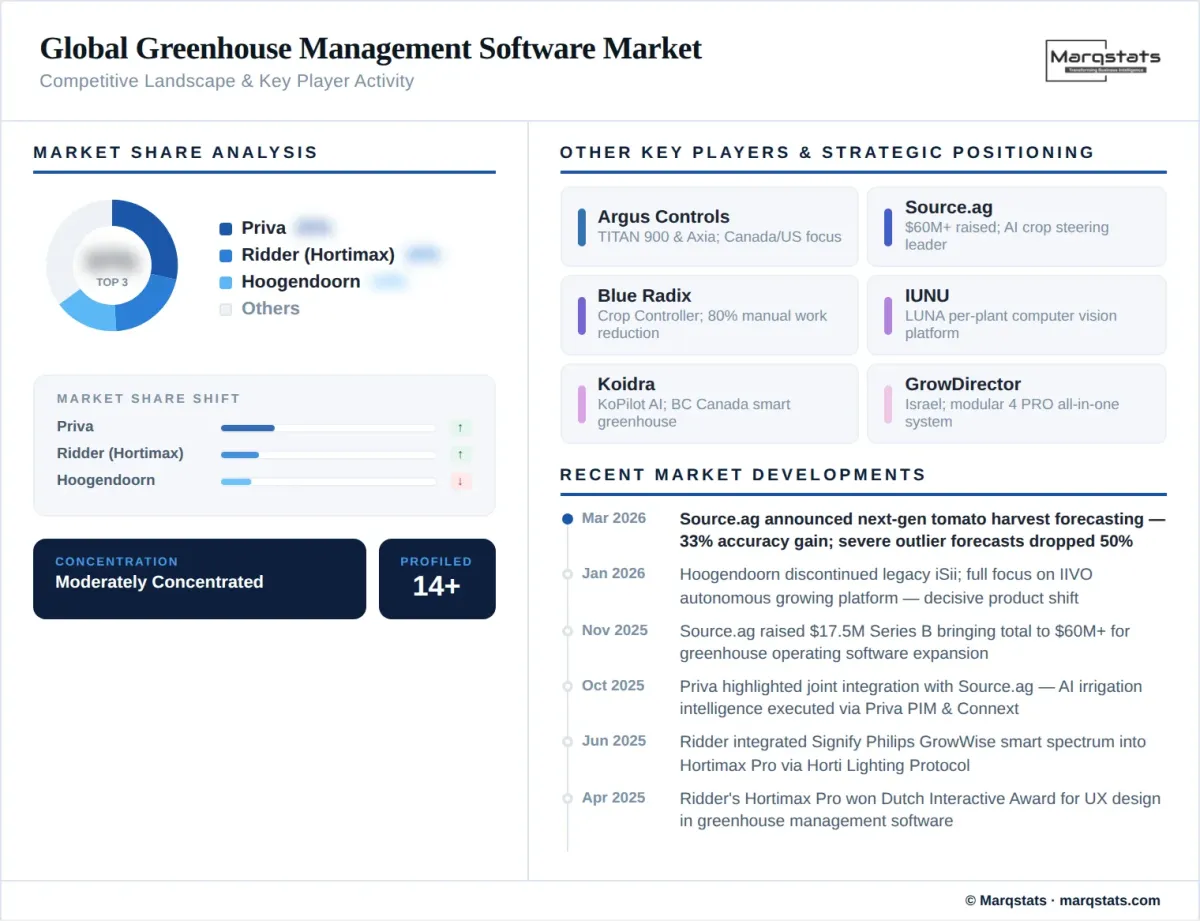
The global greenhouse management software market is moderately fragmented, with three clearly dominant incumbent control-platform vendors, a cohort of well-capitalised AI-native challengers, and a longer tail of specialist and regional players. Competition is occurring simultaneously on four battlegrounds: control-stack ownership (incumbents' advantage in physical execution and installation base), AI overlay versus full operating system (challengers' advantage in intelligence and product velocity), interoperability (the decisive near-term battleground where open APIs and ecosystem partnerships are winning), and proof of operational ROI (where increasingly specific vendor-reported performance metrics are shifting from feature comparisons to outcome evidence).
Priva is the strongest incumbent by breadth and scale. Priva One — its integrated operating system for climate, irrigation, crop performance, energy, and processes — combined with the Priva Connext data platform, the Priva Open Platform with 60+ integration partners, and the October 2025 joint integration with Source.ag positions Priva as both a control-layer provider and an ecosystem orchestrator. Ridder holds a comparable position in the open-control-backbone lane: Hortimax Pro's April 2025 Dutch Interactive Award, its June 2025 Signify Philips GrowWise lighting integration, and its API partnerships with Blue Radix and Source.ag make it the most connectivity-focused incumbent. Hoogendoorn's January 2026 discontinuation of legacy iSii sales and full pivot to IIVO — explicitly positioned for autonomous growing — signals a strategic bet on next-generation platform software over legacy hardware maintenance.
Among AI challengers, Source.ag has the strongest visible momentum: USD 60+ million total funding, the Plant Balance Metrics launch (September 2025), the tomato-forecasting model improvement (March 2026), and deep ecosystem integrations with Priva, making it the most commercially credible pure-play greenhouse operating software challenger. Blue Radix holds the strongest autonomous-control positioning, with Crop Controller deployed across 20+ countries and 100+ commercial sites (company-reported), an AgTech Breakthrough Award for Crop Controller in 2025, and up to 80% reduction in manual climate work (company claim). IUNU's USD 20 million April 2025 raise, 330% vine-crop segment growth, and plant-level vision intelligence make it the leader in computer-vision-based crop intelligence. Argus Controls — with TITAN 900 installed in major institutional and commercial CEA operations in North America and its new Axia platform — holds a differentiated position as the highest-configurability, research-grade control system provider. GrowDirector's 2025 GrowDirector 4 PRO launch represents the clearest mid-market challenger, targeting the large global segment of commercial operations that need wireless, modular, AI-capable automation without enterprise-scale complexity.
Companies Covered
The report profiles 14++ companies with full strategy and financials analysis, including:
Recent Market Activity
Table of Contents
Coverage & Segmentation
This report provides a comprehensive analysis of the global greenhouse management software market covering the historical period 2021–2025 and the forecast period 2026–2030, with 2025 as the base year. The study examines market size and revenue forecasts in USD billion, segmented by software layer (climate control and process computer software, AI crop steering and autonomous growing software, data aggregation and decision-support platforms), application (greenhouse fertigation and irrigation management, crop monitoring and yield forecasting, energy management and resource optimisation), and geography (Europe, North America, Asia-Pacific, Latin America and Rest of World). Scope covers commercial software licences, SaaS subscriptions, hardware-integrated software platforms, and AI analytics services deployed in glass greenhouses, poly tunnels, vertical farms, and other controlled-environment agriculture facilities. Basic standalone sensors, greenhouse construction, and non-software automation hardware are excluded from scope.
Research drew from company press releases and product announcements, venture capital funding disclosures, award recognitions (AgTech Breakthrough 2025, Dutch Interactive Award 2025), partnership announcements, product documentation from Priva, Ridder, Hoogendoorn, Argus Controls, Source.ag, Blue Radix, IUNU, Koidra, GrowDirector, and 30MHz, company-reported performance metrics and deployment data, and trade press coverage of GreenTech Amsterdam 2025 and Cultivate '25. The competitive assessment is grounded in verified commercial milestones, funding events, and product launch disclosures through March 2026.