Market Snapshot
Key Takeaways
Market Overview & Analysis
Report Summary
Enteric fermentation in cattle produces methane through the activity of methanogenic archaea in the rumen — microorganisms that reduce CO2 using hydrogen generated during microbial fermentation of feed carbohydrates. The resulting methane is exhaled primarily through belching (eructation), with a smaller fraction passed as flatus. A single dairy cow produces approximately 220 pounds (100 kg) of methane per year; scaled across the world's approximately 1 billion cattle, enteric fermentation represents roughly 2 billion metric tonnes of CO2-equivalent annually — given methane's global warming potential of 27–28 times that of CO2 over a 100-year horizon. Reducing enteric methane is therefore one of the highest-leverage single interventions available for near-term agricultural emissions reduction, and the target of an increasingly competitive commercial and policy ecosystem.
The commercial opportunity is structured by four overlapping demand sources. First, corporate food companies — dairy processors, meat companies, and food retailers — with Scope 3 supply-chain decarbonisation commitments require measurable, auditable farm-level methane reductions from their suppliers. Arla Foods' December 2024 announcement incorporating Bovaer in its carbon footprint reduction programme, following its November 2024 retailer trial with Morrisons, Tesco, and Aldi in the UK, exemplifies this corporate-procurement demand pattern. Second, national government programmes — including the USDA RCPP grants in the U.S. and Denmark's government-financed farmer support — are de-risking adoption costs and accelerating the commercial pipeline. Third, voluntary carbon markets — through platforms including Athian (U.S. livestock carbon inset marketplace), Truterra, and emerging sovereign carbon programmes — are creating a per-tonne income stream that supplements product economics for farmers. Fourth, national emissions reduction mandates — such as Denmark's sector-level cattle methane target — are beginning to create compliance-driven demand rather than purely voluntary adoption.
The competitive landscape is defined by a stark asymmetry between the regulatory maturity, deployment scale, and economic infrastructure surrounding Bovaer/3-NOP and the still-developing commercial readiness of all challengers. That said, the challenger field is technically credible: Rumin8's synthetic bromoform formulation has produced trial methane reductions above 90% — substantially higher than Bovaer's 30–45% range — and CH4 Global's Asparagopsis EcoPark build-out is addressing the supply scalability challenge that has historically constrained natural bromoform-based products. The market is therefore best understood as an early-commercial category with one deployed scale leader and a credible next wave that is 2–4 years behind on regulatory clearance and production scale.
Market Dynamics
Key Drivers
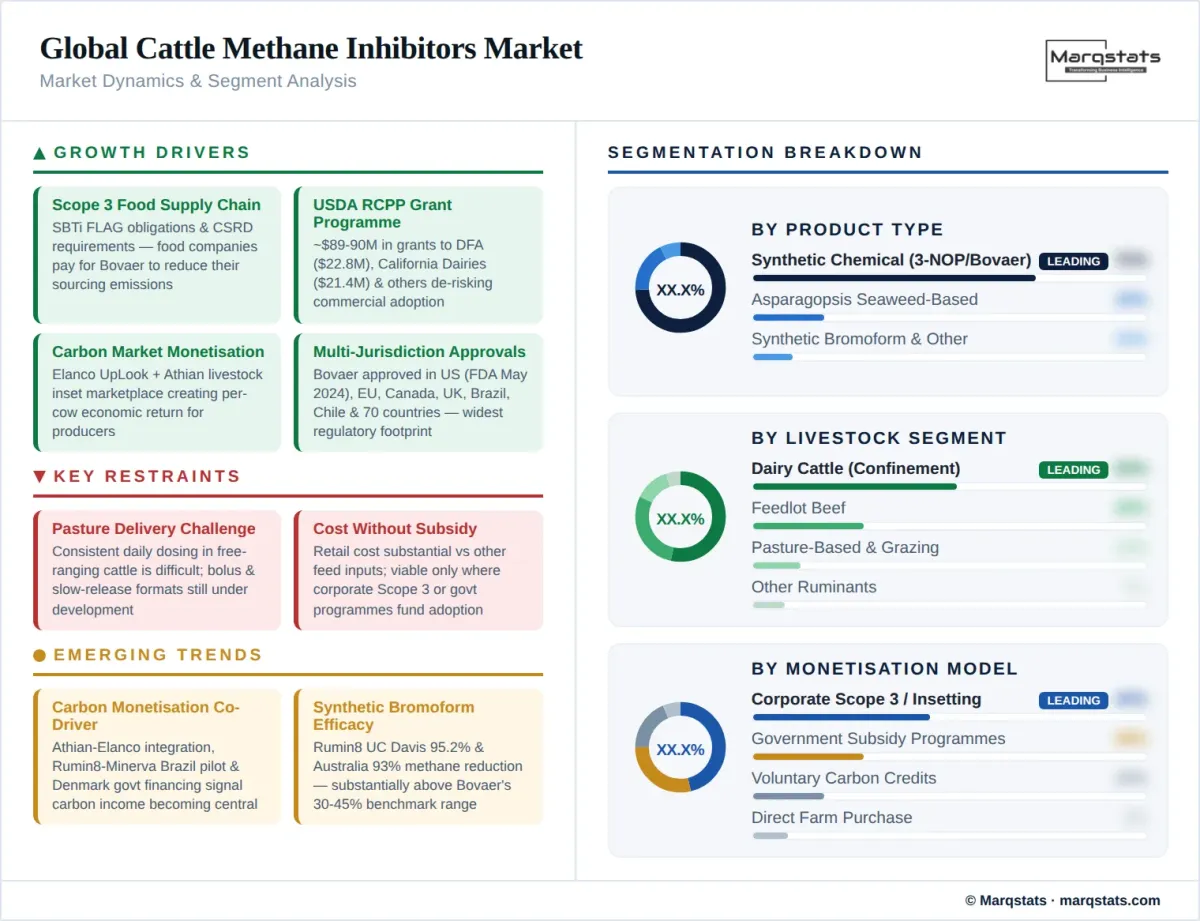
- Corporate Scope 3 food supply-chain decarbonisation mandates creating structured demand: Major food companies and dairy processors face hard Science Based Targets initiative (SBTi) FLAG sector obligations and CSRD primary-data requirements that include enteric methane from livestock sourcing as a material emission source. The commercial value proposition for Bovaer is explicitly structured around this — dsm-firmenich states that in the majority of commercial deployments, the food companies benefiting from Scope 3 reductions pay for the Bovaer cost rather than the farmer. This demand model — where food company procurement creates the pull for farm-level adoption — is the primary commercial engine of the market and makes enteric methane inhibitors functionally part of the broader agricultural carbon MRV market.
- USDA RCPP grants and national government financing de-risking farm adoption: The USDA's approximately USD 89–90 million RCPP grant programme (FY2023) to dairy companies, cooperatives, and trade groups — including USD 22.8 million to Dairy Farmers of America's Climate-Smart Dairies Partnership and USD 21.4 million to California Dairies Inc. — has created the first tranche of public financial infrastructure for commercial Bovaer adoption in the U.S. Denmark's government agreement to finance farmer costs of methane-reducing feed additives is the European equivalent — converting voluntary adoption into a state-supported transition and providing a template that other EU member states may follow under CRCF and Farm to Fork implementation.
- Voluntary carbon market monetisation creating per-cow economic return for producers: Elanco's UpLook quantification tool and its integration with Athian — the first livestock carbon inset marketplace in the U.S. — create a credible per-cow economic return of approximately USD 20 per lactating cow annually for U.S. dairy producers feeding Bovaer. Rumin8's December 2025 Brazil pilot with Minerva Foods is explicitly structured to generate carbon credits tied to Rumin8 additive use, demonstrating that the carbon monetisation model is being replicated beyond the Bovaer ecosystem. As the voluntary carbon market matures and livestock-specific MRV protocols gain registry approval, this monetisation layer is expected to become increasingly important to the commercial economics of the category.
- Global Methane Pledge and UNFCCC livestock methane commitments creating policy tailwinds: The Global Methane Pledge, signed by 150+ countries, commits signatories to a collective 30% reduction in methane emissions from all sectors by 2030 relative to 2020 levels. Agriculture — including enteric fermentation from livestock — is explicitly included, creating a policy framework that is translating into national programmes, farm subsidy design, and food company sustainability commitments. The EU's forthcoming agricultural methane monitoring requirements under the CRCF and the EU Methane Regulation create additional regulatory demand signals for deployable enteric methane reduction technologies.
- Growing evidence base and regulatory clearances reducing buyer risk: The FDA approval of Bovaer in May 2024 — following the European Union's 2022 authorization, Canada's early 2024 approval, and earlier clearances in Brazil, Chile, and other markets — has progressively reduced the regulatory risk that previously deterred large-scale food company adoption. The UK Food Standards Agency's December 2024 statement that milk from cows fed Bovaer is safe and that the additive does not pass into milk provided additional consumer-safety confidence. Combined with the expanding academic literature — including a 150-farm Netherlands study demonstrating Bovaer efficacy across 20,000+ cows — the evidence base is now sufficient to support large food company procurement commitments.
Key Restraints
- Delivery challenge in pasture-based and grazing cattle systems: The first commercial wave of methane inhibitors is structurally concentrated in confinement systems — dairy herds on total mixed rations and feedlot beef — where daily dosing can be controlled reliably. Pasture-based beef and grazing dairy systems, which account for the majority of global cattle production by head count, present a fundamental delivery logistics challenge: consistent daily dosing in free-ranging cattle is difficult, bolus and slow-release delivery formats are still under development, and the peer-reviewed literature confirms that methane inhibitors are difficult to deliver consistently in grazing systems. This structural constraint limits the near-term addressable market significantly.
- Cost burden and economic viability without corporate or government subsidy: The retail cost of Bovaer is substantial relative to other feed inputs, and WRI explicitly notes that cost is one of the key barriers to feed additive adoption at scale. The current commercial model — where food companies pay for the additive as part of Scope 3 commitments, or government programmes subsidise adoption — is effective in markets with strong corporate sustainability programmes but fragile in markets where neither driver is present. In price-sensitive cattle markets (Latin America, Sub-Saharan Africa, South/Southeast Asia), economic viability without external subsidy remains a major constraint.
- Public acceptance and consumer backlash risk in some markets: The UK experience with Arla Foods' Bovaer trial in 2024 — which triggered social media boycott campaigns based on unfounded conspiracy theories linking the product to a supposed depopulation agenda — illustrates a reputational risk that is distinct from regulatory or scientific risk. While expert bodies including the UK FSA and EFSA have affirmed Bovaer's safety, the backlash episode demonstrates that consumer communication and transparency are material commercial risks in certain markets, particularly where food system trust is already fragile.
- Ongoing evidence requirements and regulatory scrutiny for challenger products: EFSA's February 2026 call for additional farm-use data on 3-NOP in ruminants (post-market evidence) — while not indicative of safety concerns — illustrates that even approved products face ongoing regulatory engagement. Challenger products including Asparagopsis-based additives and Rumin8's bromoform formulation still face substantial safety dossier, efficacy validation, and registration pathway requirements across major jurisdictions that will take 2–5 years to complete.
Key Trends
- Carbon monetisation becoming a co-equal commercial driver alongside feed economics: The integration of Athian livestock carbon inset marketplace with Elanco's UpLook tool, Rumin8's Brazil Minerva Foods pilot structured for carbon credit generation, and Denmark's government financing of feed additive adoption under an explicit emissions-reduction framework all signal that carbon market income — not just feed cost economics — is increasingly central to the commercial case for methane inhibitor adoption. As MRV protocols for livestock methane improve and more carbon registries approve livestock-specific methodologies, this trend is expected to accelerate.
- Seaweed production scale-up industrialising the Asparagopsis supply chain: CH4 Global's January 2025 opening of Phase 1 of its Asparagopsis EcoPark in South Australia — 80 metric tonnes annual initial capacity, targeting 45,000 cattle per day at full build-out — represents the most significant attempt to industrialise the Asparagopsis supply chain and address the primary commercial constraint on natural bromoform-based methane reduction: reliable, large-scale supply of stabilised, shelf-stable product. FutureFeed's licensing model is creating a multi-vendor ecosystem for Asparagopsis commercialisation across geographies.
- Synthetic bromoform formulations achieving trial efficacy significantly above 3-NOP benchmarks: Rumin8's March 2025 UC Davis trial (95.2% total methane reduction) and June 2025 Australian trial (93% reduction) represent methane reduction efficacy substantially higher than Bovaer's 30–45% range. If Rumin8 can translate this trial performance through safety registration and scalable production into a commercial product, it would represent a step-change in per-cow emissions reduction potential that could redefine the competitive landscape in the late 2020s.
- Methane vaccine and rumen microbiome modulation as next-wave technologies: Beyond chemical inhibitors and natural additives, research into vaccines targeting methanogenic archaea in the rumen (notably work from AgResearch New Zealand) and microbiome-editing approaches represent the most scientifically ambitious next-wave technologies. These approaches aim for durable, self-sustaining methane reduction rather than daily dosing — addressing the fundamental delivery challenge in grazing systems — but remain at early research stages with no near-term commercial timeline.
Market Segmentation
Synthetic chemical inhibitors — led by 3-nitrooxypropanol (3-NOP), commercialised as Bovaer by dsm-firmenich — are the dominant product segment, estimated at 70–75% of 2025 market revenue. 3-NOP works by binding to and oxidising the methyl-coenzyme M reductase (MCR) enzyme, blocking the final step in methanogenesis in the rumen. It is metabolised quickly into natural rumen compounds and does not pass into milk or meat. A tablespoon (approximately 80 mg) per lactating cow per day achieves approximately 30% methane reduction; higher doses and lower-fibre diets improve efficacy. The segment benefits from Bovaer's multi-jurisdiction regulatory clearances (U.S. FDA May 2024, EU 2022, Canada early 2024, UK, Brazil, Chile, and 70 countries total), its established commercial infrastructure through Elanco in North America and direct sales in other markets, and the carbon-monetisation ecosystem built around UpLook and Athian.
Asparagopsis seaweed-based additives contain naturally occurring bromoform (CHBr3), which inhibits the same MCR enzyme pathway as 3-NOP. Studies have reported methane reductions of 70–90%+ at low inclusion rates (0.1–1% of dry matter intake), with CH4 Global citing guaranteed minimum 70% methane reduction over product shelf life for its Methane Tamer product. The primary commercial challenge has been producing sufficient quantities of stabilised, shelf-stable Asparagopsis at viable cost — a challenge that CH4 Global's January 2025 South Australia EcoPark Phase 1 build-out (80 metric tonnes annually, targeting 45,000 cattle per day at scale) directly addresses. FutureFeed's IP licensing model creates a framework for multiple regional producers to enter the market under licence. This segment remains pre-commercial at meaningful scale, constrained by production infrastructure and regulatory registration requirements.
Synthetic bromoform formulations — led by Rumin8's investigational veterinary product — replicate the active methane-inhibiting mechanism of natural Asparagopsis bromoform through a pharmaceutical-style synthetic manufacturing approach, enabling consistent potency, scalable production, and multiple delivery formats (supplement, premix, intraruminal bolus) without the supply chain variability of seaweed cultivation. Rumin8's trial results are the most dramatic published in the category: 95.2% total methane reduction in a March 2025 UC Davis trial and 93% reduction in a June 2025 Australian trial. The company's December 2025 acquisition of ROAM Agricultural is expanding its delivery format portfolio. Rumin8 is still working through the registration pathway required for commercial launch in major markets, and production scale-up is ongoing.
Dairy cattle in confinement systems fed total mixed rations (TMR) represent the primary commercial deployment segment, estimated at 55–60% of 2025 market revenue. Consistent daily dosing through TMR incorporation is straightforward, making dairy the natural first market for 3-NOP and the segment where Bovaer has achieved the most commercial traction globally. The food company Scope 3 demand driver is particularly strong in dairy, as major dairy processors (Arla, Dairy Farmers of America, FrieslandCampina, Fonterra) have measurable Scope 3 Category 11 livestock emissions accounting obligations. Bovaer reports average 30% methane reduction in lactating dairy cows in commercial settings, equivalent to approximately 1.2 metric tonnes CO2e per cow annually.
Feedlot beef — cattle in confinement finishing operations fed high-concentrate diets — is the second-largest and fastest-growing production system segment. Bovaer reports up to 45% methane reduction in beef cattle, materially higher than the dairy rate, making the feedlot channel commercially attractive. The primary demand driver in feedlot beef is corporate retailer and food service Scope 3 commitments, particularly in Australia, the United States, and Brazil, where large-scale feedlot operations serve premium beef export markets with demanding sustainability requirements. Rumin8's Brazil pilot with Minerva Foods explicitly targets the feedlot beef carbon credit opportunity.
Pasture-based and grazing cattle systems — which encompass the majority of global cattle by head count, particularly in Latin America, Sub-Saharan Africa, Australia, New Zealand, and Ireland — represent the largest long-term market opportunity but the most technically challenging near-term delivery context. Consistent daily dosing in free-ranging cattle requires alternative delivery technologies including slow-release intraruminal boluses, mineral lick formulations, and water-based delivery systems. Rumin8's multi-format development strategy (including intraruminal bolus) and the methane vaccine research pipeline are both partly directed at this segment. Peer-reviewed literature confirms that methane inhibitors are difficult to deliver consistently in grazing systems, making this segment a 2028–2030+ commercial opportunity rather than a near-term revenue driver.
By Geography
North America
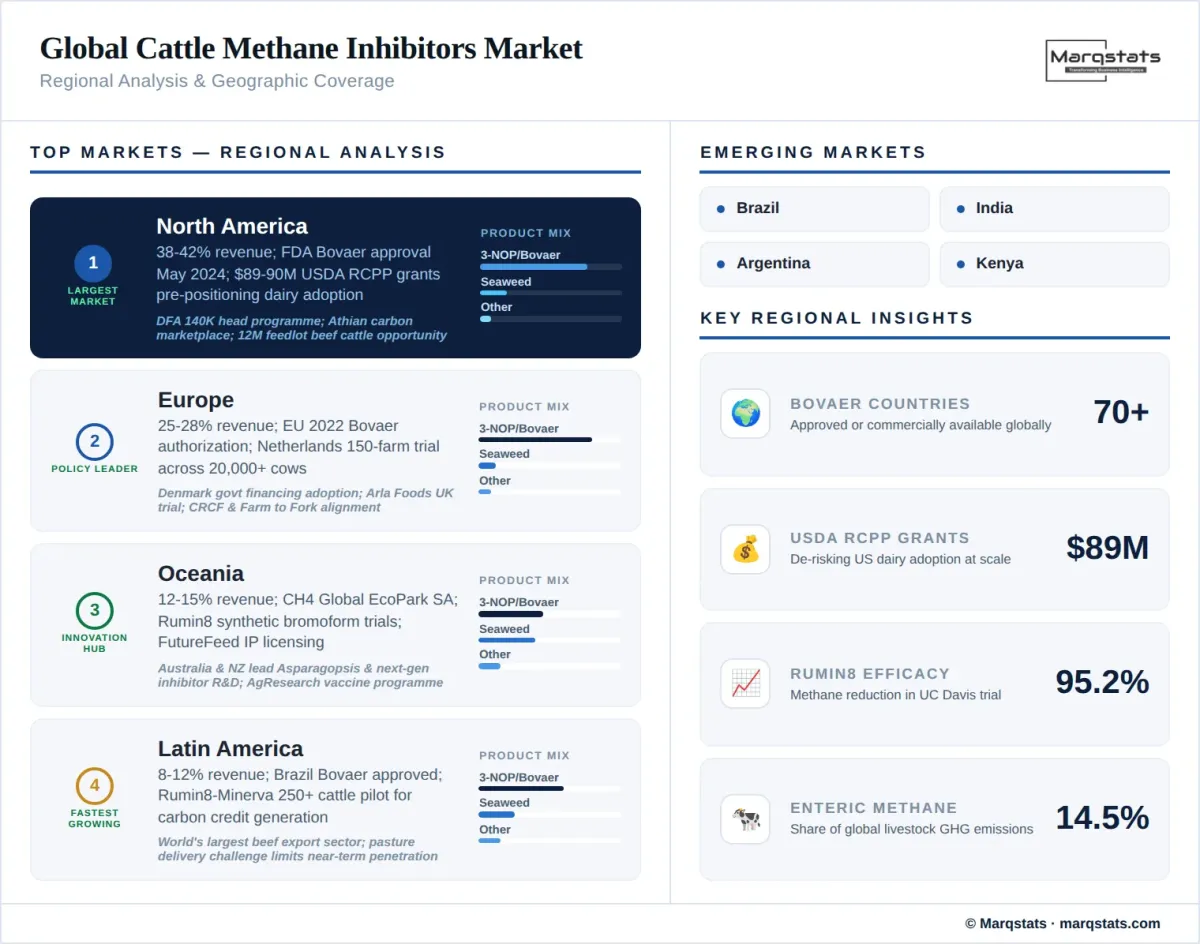
North America is the largest regional market, estimated at 38–42% of 2025 revenue, driven by the United States' May 2024 FDA approval of Bovaer and the USD 89–90 million USDA RCPP grant programme that pre-positioned dairy companies, cooperatives, and trade groups to adopt the product at scale. Major programme recipients include Dairy Farmers of America (USD 22.8 million, Climate-Smart Dairies Partnership covering up to 50 operations with 140,000 head) and California Dairies Inc. (USD 21.4 million, targeting 35% GHG footprint reduction in California dairy). Canada approved Bovaer in early 2024, and Elanco's distribution agreement with dsm-firmenich covers North America including Mexico. The Athian livestock carbon inset marketplace, partnered with Elanco's UpLook tool, provides the commercial carbon-credit infrastructure for the U.S. market. Elanco also works with Truterra as a secondary carbon platform. The U.S. feedlot beef sector — with approximately 12 million cattle in feedlots at any given time — represents the major growth opportunity beyond the initial dairy focus.
Europe
Europe is the second-largest market, estimated at 25–28% of 2025 revenue, with the EU 2022 authorization for Bovaer in dairy cattle as the regulatory foundation. The Netherlands — home to the world's most intensive dairy sector and a 150-farm Bovaer efficacy trial across 20,000+ cows — and Denmark are the most commercially active markets. Arla Foods' UK retailer trial with Morrisons, Tesco, and Aldi (November 2024) and its December 2024 public commitment to using Bovaer as part of its carbon footprint reduction programme represent the clearest European food company adoption signal. Denmark's government agreement to finance farmer adoption costs is the most advanced national policy deployment support in Europe and a potential template for other EU member states. EFSA's February 2026 call for additional farm-use data on 3-NOP does not affect approval status but signals continued post-market regulatory engagement. Ireland's pasture-based dairy sector and Germany's large dairy industry are significant secondary markets.
Asia-Pacific
Asia-Pacific accounts for approximately 15–18% of 2025 revenue, with Australia as the most commercially active market. Australia's combination of a large feedlot sector, world-leading methane research ecosystem (including Rumin8's trial partnerships and CH4 Global's South Australia EcoPark), and ambitious national agricultural emissions reduction targets creates the strongest challenger-market dynamics outside of North America and Europe. Rumin8's June 2025 Australian feedlot trial (93% methane reduction) and CH4 Global's EcoPark build-out are both based in Australia. New Zealand — the most pastoral-dairy-intensive economy in the world — represents a critical test market for grazing-system delivery innovations, with AgResearch New Zealand's methane vaccine programme being the most advanced vaccine-track research programme globally. Japan, South Korea, and China are secondary markets with growing dairy and beef modernisation programmes.
Latin America
Latin America accounts for approximately 8–10% of 2025 revenue and is the market where Bovaer has its longest commercial history — Brazil and Chile were the first countries to approve 3-NOP in 2021. Brazil's large-scale feedlot beef sector, combined with active corporate sustainability programmes from Minerva Foods and JBS and Brazil's developing Article 6.2 carbon trading framework, creates a meaningful commercial opportunity. Rumin8's December 2025 Brazil pilot with Minerva Foods — designed to generate carbon credits tied to Rumin8 additive use — reflects growing investor and corporate interest in the region. Argentina's large beef sector, despite its predominantly pasture-based production model, represents a long-term opportunity as grazing-system delivery solutions develop.
Middle East, Africa and Rest of World
The Middle East, Africa, and rest of world account for approximately 5–8% of 2025 revenue, concentrated in South Africa, Kenya, and GCC countries with intensive dairy operations. Sub-Saharan Africa's large cattle population is predominantly pasture-based smallholder stock where delivery constraints and cost barriers currently preclude meaningful commercial adoption. However, the region's massive methane reduction potential — combined with CGIAR-led research on low-cost enteric methane reduction approaches suitable for smallholder systems — represents an important long-term development agenda. India's large buffalo and cattle dairy sector is an emerging market that has not yet been materially penetrated by commercial methane inhibitor products.
How Competition Is Evolving
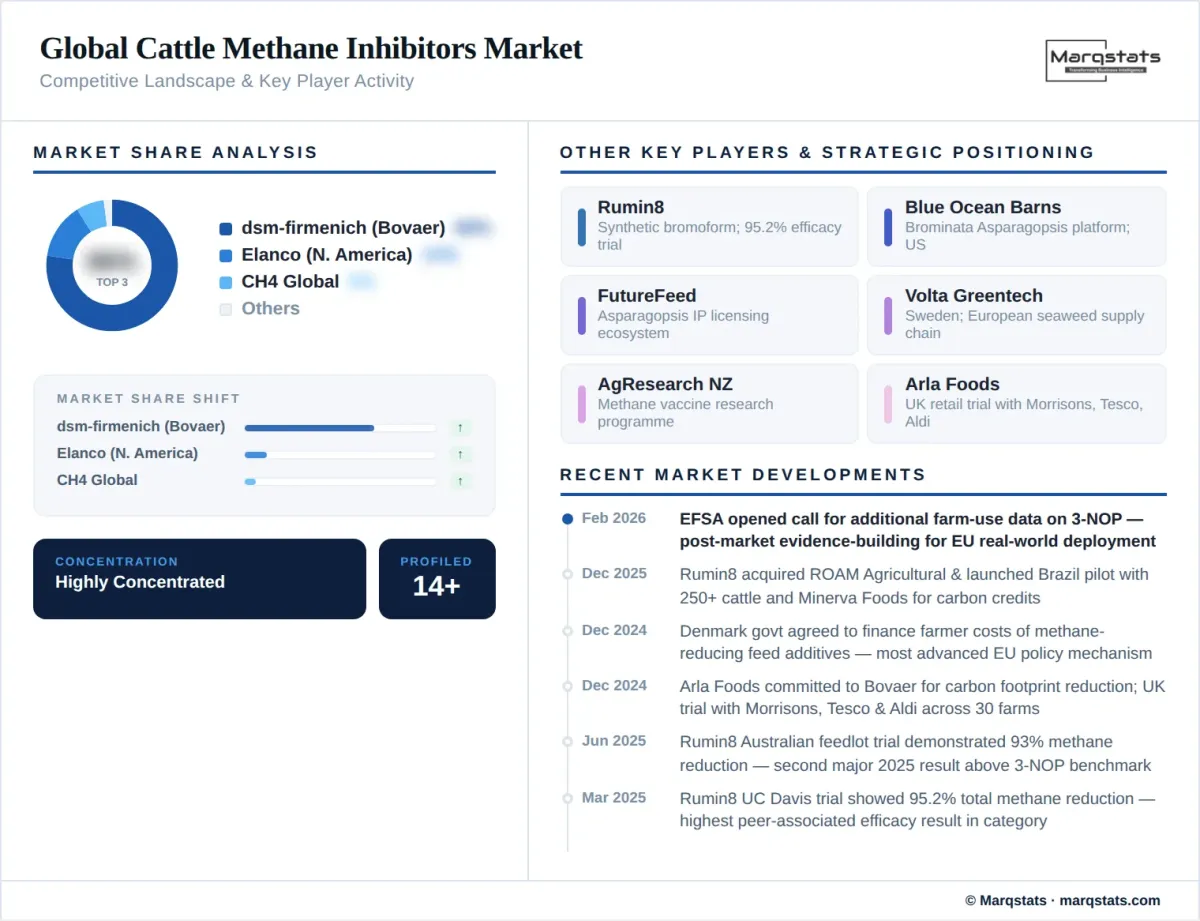
The global cattle methane inhibitors market is highly concentrated at the top and fragmented below it. dsm-firmenich's Bovaer is the clear market leader by every commercial metric — regulatory approvals, deployed scale, country coverage, food company partnerships, and carbon-market integration — with no comparable competitor in terms of current commercial deployment. The competitive field beneath Bovaer is technically credible but commercially pre-scale: CH4 Global and Blue Ocean Barns are the leading Asparagopsis seaweed platforms; Rumin8 is the leading synthetic bromoform challenger; and FutureFeed functions as an IP and licensing backbone for the Asparagopsis ecosystem. Competition is occurring on four battlegrounds: regulatory access and approval timing; efficacy versus delivery scalability trade-offs; production system fit (confinement vs grazing); and carbon monetisation architecture.
dsm-firmenich holds the regulatory, scale, and ecosystem moat. Its multi-year investment in regulatory dossiers across the U.S., EU, Canada, UK, and 70 global markets is a competitive advantage that will take challengers years to replicate. The Elanco commercialisation partnership in North America provides pharmaceutical-grade sales infrastructure, medical-representative farm outreach, and the UpLook-Athian carbon marketplace integration. Bovaer's 500,000+ cow commercial deployment daily — compared to the pilot and trial stages of all challengers — provides the farm-reference base that food company procurement teams require before committing to supply-chain-wide adoption programmes. The 150-farm Netherlands study (20,000+ cows) and the UC Davis meta-analysis (Journal of Dairy Science, 2023) provide the peer-reviewed evidence backbone.
Among challengers, Rumin8 is the most commercially differentiated on trial efficacy: 95.2% and 93% methane reduction in 2025 trials represent a 2–3x improvement on Bovaer's benchmark, and if achievable in commercial conditions, would represent a step-change product. Its December 2025 ROAM Agricultural acquisition expands delivery format development, and its Brazil Minerva Foods pilot creates a carbon credit proof-of-concept. CH4 Global is the most advanced on physical production infrastructure: its January 2025 EcoPark Phase 1 opening addresses the primary supply constraint on Asparagopsis commercialisation. FutureFeed's licensing ecosystem is creating the multi-vendor supply and commercialisation framework that could prevent any single Asparagopsis producer from bottlenecking the category. Blue Ocean Barns occupies a more focused niche in the dairy-facing Asparagopsis lane with a science-heavy evidence-building strategy. The emerging methane vaccine pipeline — led by AgResearch New Zealand — remains the most scientifically ambitious challenger to chemical inhibitors but is 5–10 years from commercial relevance.
Companies Covered
The report profiles 14+ companies with full strategy and financials analysis, including:
Recent Market Activity
Table of Contents
Coverage & Segmentation
This report provides a comprehensive analysis of the global cattle methane inhibitors market covering the historical period 2021–2025 and the forecast period 2026–2030, with 2025 as the base year. The study examines market size and revenue forecasts in USD billion, segmented by product type (synthetic chemical inhibitors / 3-NOP, Asparagopsis seaweed-based additives, synthetic bromoform formulations), production system (dairy confinement, feedlot beef, pasture-based and grazing), and geography (North America, Europe, Asia-Pacific, Latin America, Middle East/Africa). Scope covers commercial feed additives and supplements targeting enteric methane reduction in cattle through direct chemical or biological inhibition of rumen methanogenesis; adjacent approaches including dietary manipulation, phytogenic additives, and manure management are excluded unless explicitly formulated as enteric methane inhibitors. The report does not cover emissions from non-cattle ruminants (sheep, goats, buffalo) as primary scope, though relevant cross-reference data is included.
Research drew from company press releases and product documentation, regulatory authority announcements (FDA May 2024, EU 2022, Canada 2024, UK FSA December 2024, EFSA February 2026), peer-reviewed scientific literature including the UC Davis meta-analysis of 3-NOP efficacy (Journal of Dairy Science, 2023) and the 2025 Journal of Dairy Science paper on regulatory requirements for antimethanogenic feed additives, WRI enteric methane solution assessments, USDA RCPP grant award documentation, Reuters reporting on Denmark government finance programme, and commercial announcements from dsm-firmenich, Elanco, CH4 Global, Rumin8, Blue Ocean Barns, Arla Foods, and Minerva Foods through March 2026.