Market Snapshot
Key Takeaways
Market Overview & Analysis
Report Summary
Agriculture Drone-as-a-Service (DaaS) represents a structural evolution in agricultural input delivery and field intelligence collection, where growers access drone-enabled services on a per-acre, per-hectare, subscription, or cooperative basis rather than purchasing and operating aircraft themselves. The DaaS model addresses three fundamental barriers to direct drone ownership among commercial farmers: the capital cost of multi-drone fleets, the training and certification burden of maintaining qualified pilots, and the logistics of coordinating aircraft, parts, and maintenance schedules with narrow crop-window service timing. By aggregating drone capacity across many farm clients and deploying it through professional operator networks, DaaS providers achieve asset utilisation rates and service consistency that individual farm ownership cannot replicate.
The market has passed through three phases. In the proof-of-concept phase (2016–2019), agricultural drones were primarily used in Japan and China for small-plot rice and orchard spraying through cooperatives, with DJI and Yamaha Motor as the dominant platforms. In the regulatory unlock phase (2019–2022), Brazil's 2021 regulatory framework, India's liberalised drone rules and subsidy architecture, and Southeast Asian government-supported pilot programmes created the regulatory conditions for commercial service scaling. In the current commercial scale-up phase (2022–2026), professional operator networks have reached operational density in China, India, Japan, Brazil, and Southeast Asia, while the United States has transitioned from regulatory dialogue to rapid acreage growth through custom application networks — with the American Spray Drone Coalition reporting 16.4 million treated acres in 2025.
The technical differentiation between service operators is not primarily in aircraft specifications — most commercial service drones in the 10–30 kg payload range share similar flight endurance, GPS-guided coverage, and application system architectures. Instead, competitive advantage concentrates in service network density (pilot availability, maintenance infrastructure, route planning capability), regulatory compliance and localisation (DGCA certification in India, ANAC authorisation in Brazil, TKDN local content in Indonesia), agronomic protocol quality (application rate calibration, nozzle selection, swath management, overlap control), and data product capability (multispectral NDVI mapping, variable-rate prescription generation, yield correlation analytics). The market is therefore best understood as an operator-services business with aircraft as infrastructure — not an equipment category.
Market Dynamics
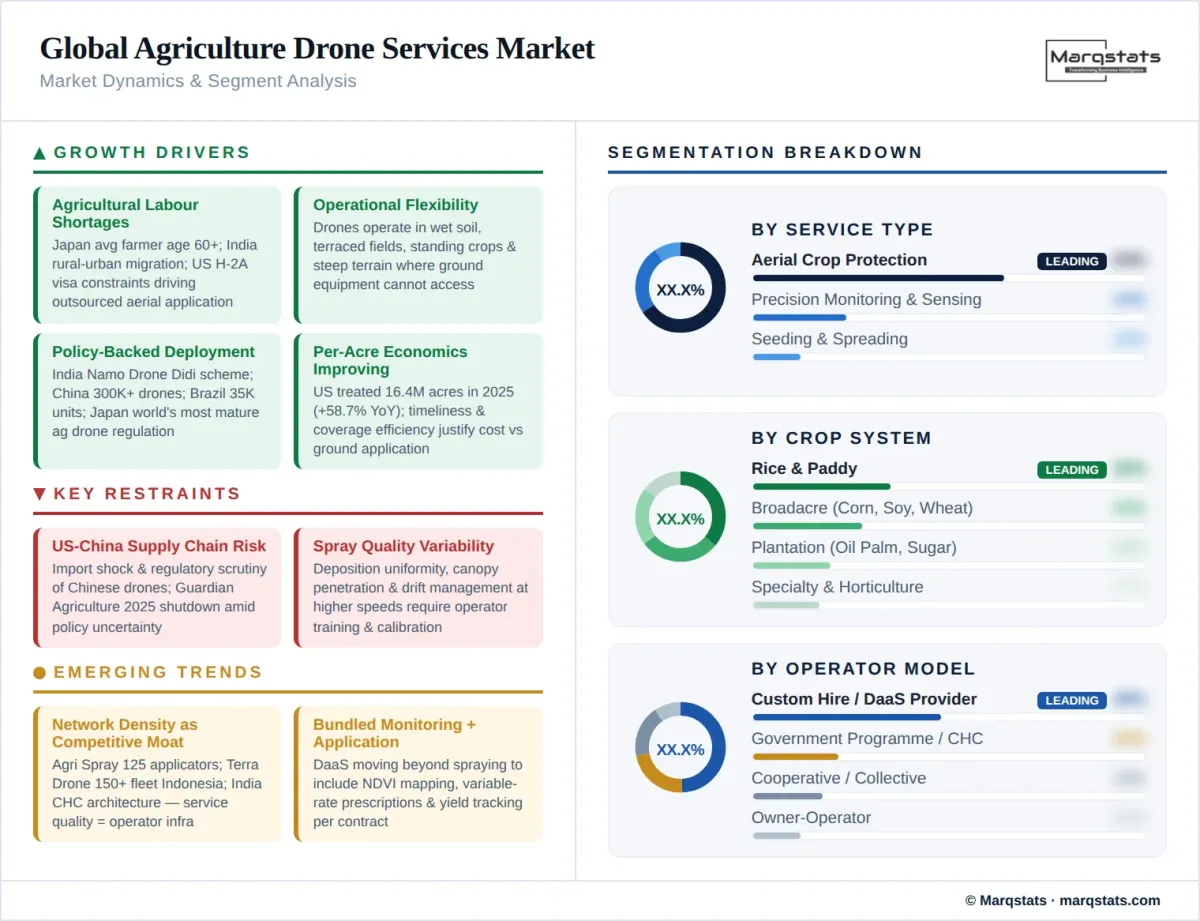
Key Drivers
- Agricultural labour shortages and rising field labour costs in major markets: The most consistent structural driver across all major drone services markets is the declining availability and rising cost of agricultural field labour. In Japan, where Yamaha Motor pioneered agricultural drone spraying in the 1990s for paddy rice, the average farmer age exceeds 60 and rural labour availability has been declining for two decades. In India, migration from agricultural to urban labour markets is a long-standing trend that Namo Drone Didi and the Custom Hiring Centre architecture are explicitly designed to address. In Brazil, the high cost of labour in large-scale soybean, sugarcane, and corn operations makes per-acre drone application economics compelling when adjusted for timeliness and coverage efficiency. In the United States, H-2A agricultural worker visa constraints, immigration policy uncertainty, and rising hourly labour rates in specialty and broadacre crop systems are making outsourced aerial application attractive.
- Operational flexibility and hard-to-reach field accessibility: Peer-reviewed work on spray drone adoption consistently cites operational flexibility — the ability to deploy aircraft quickly when weather and crop phenology windows align, without the setup time, soil compaction, and access constraints of ground-based equipment — as a primary driver. Drones can operate in wet soil conditions where tractors are prohibited, in contoured or terraced fields where ground equipment is impractical, in standing crops where boom sprayers cannot enter, and in strip-intercropped systems requiring selective application. This physical accessibility advantage is particularly important in markets with fragmented smallholder land parcels, hilly terrain, and plantation-scale tree crops.
- Government subsidy and policy frameworks de-risking service adoption: India's Drone Shakti initiative, Namo Drone Didi programme, Custom Hiring Centre support, ICAR/SAU/KVK demonstration network (41,010 hectares, 452,291 farmers through November 2025), and Garuda Aerospace's June 2025 DGCA-approved Train-the-Trainer programme collectively represent the most comprehensively state-supported drone services agriculture framework of any country globally. Brazil's post-2021 ANAC regulatory framework enabled rapid commercial adoption (approximately 35,000 units by mid-2025). The USDA's Inflation Reduction Act climate-smart agriculture provisions and NRCS conservation programme funding are beginning to create parallel U.S. subsidy structures. Japan's METI and MAFF long-standing support for agricultural UAV programmes provides model-programme precedent.
- Input precision and environmental compliance requirements driving quality-seeking demand: As agricultural input cost inflation, pesticide resistance management, and environmental regulations tighten across major markets, growers and agronomists are seeking application precision that drone services — with GPS-guided coverage, variable-rate capability, and application audit trails — provide more cost-effectively than traditional broadcast methods in many contexts. Multispectral NDVI-based variable-rate application prescriptions, where drone-mapped crop stress zones drive differential input rates within a single field, represent the premium service tier that agrochemical manufacturers and retailer networks are actively incorporating into their service-model offerings — as demonstrated by Agri Spray Drones' January 2026 co-marketing agreement with WinField United.
- Platform ecosystem buildout enabling service network scaling: XAG's explicitly stated strategy of building 'pay-per-mu' service provider networks across 60+ countries and regions — training and equipping independent operators rather than operating services directly — reflects a hardware-plus-ecosystem model that has proven commercially scalable in China and is being replicated in Latin America (XAG P150 and P60 launched with CNH at Agrishow 2025 in Brazil) and Southeast Asia (XAG–Chia Tai partnership in Thailand). Terra Drone's Malaysia pilot-training MOU (March 2025), its Yanmar Diesel Indonesia 120-drone sales partnership (August 2025), and its 200,000+ hectare Indonesia flight record (October 2025) demonstrate that ecosystem partnerships with agricultural equipment distributors, input companies, and cooperatives are the primary channel for service network scaling.
Key Restraints
- Regulatory uncertainty and Chinese drone supply-chain scrutiny in the U.S.: AgFunder reported in 2025 that U.S. drone acreage was soaring even as equipment sales slumped amid import shock and legal and regulatory battles over Chinese drone access. Guardian Agriculture's 2025 shutdown — attributed by its former executive to slow regulatory processes and competition from lower-cost Chinese platforms — illustrates the structural tension between agricultural operators who depend on affordable Chinese-manufactured drones and a U.S. policy environment increasingly scrutinising Chinese-manufactured UAVs on national security grounds. This creates commercial uncertainty for U.S. DaaS operators whose aircraft costs and parts availability depend on supply chains now under regulatory pressure.
- Agronomic performance variability: deposition, drift, and speed trade-offs: Recent peer-reviewed technical studies on spray drone application quality note that while drones offer significant operational advantages, deposition uniformity, canopy penetration, and drift management at higher operational speeds remain areas where performance variability affects application efficacy. Studies note trade-offs between application speed (which determines per-acre economics) and deposition quality (which determines agronomic efficacy and regulatory compliance). This variability requires that DaaS operators invest in agronomic protocols, nozzle calibration, and operator training to deliver consistent results across crop systems and weather conditions.
- Human-capital bottleneck: certified pilot and maintenance technician supply: Agricultural drone services are as much a labour market as a technology market. India's DGCA training infrastructure, Malaysia's pilot employment pipeline MOU (Terra Drone, March 2025), the U.S. Part 107 certification process, and Brazil's ANAC pilot licensing requirements all create structural constraints on service network growth that aircraft availability alone cannot resolve. Organisations can have large drone fleets grounded by pilot shortages during peak crop windows — a bottleneck that Garuda Aerospace's 300 Centres of Excellence and Train-the-Trainer programme, India's Drone Didi structure, and Terra Drone's employment-focused MOU are all explicitly designed to address.
- Market fragmentation and DaaS business model scalability: The agriculture drone services market is highly fragmented across geographies, crop systems, regulatory frameworks, and customer types. The unit economics that work in dense smallholder markets (India, Southeast Asia) — where per-acre service fees are low but volume is high — are structurally different from the economics in the Brazilian cerrado or U.S. corn belt, where larger field sizes, longer seasons, and more complex agronomic requirements shift service pricing and operational architecture significantly. Building a scalable DaaS business model across multiple geographies requires localisation of pricing, aircraft configuration, agronomic protocols, and regulatory compliance that significantly raises operational complexity.
Key Trends
- Service provider network density becoming the primary competitive moat: The market is converging on the insight that drone service quality is determined more by operator network infrastructure — trained pilots, maintenance capacity, route planning, agronomic expertise, and dispatch logistics — than by aircraft specifications. Agri Spray Drones' custom-applicator map connecting 125 applicators with growers, Terra Drone Agri's 150+ drone Indonesia fleet with 4,000 daily flights, and India's Custom Hiring Centre architecture all reflect this network-density competitive model. The strongest DaaS operators are those that can aggregate demand across many farms and dispatch reliable services within the crop-window timing that agronomic performance requires.
- Bundling: crop monitoring and data analytics integrating with application services: The most commercially advanced DaaS operators are moving beyond single-service spraying contracts toward bundled offerings that combine aerial crop protection application with multispectral NDVI mapping, variable-rate prescription generation, and yield tracking. Agri Spray Drones' partnership with WinField United (January 2026) — covering training, field demonstrations, research, and customer engagement — signals that agronomy channel partnerships are the mechanism through which precision data services are being integrated into drone application businesses. ZenaTech's DaaS platform explicitly includes multispectral scanning for crop health optimisation, pest detection, and soil moisture management alongside its surveying and inspection services.
- Domestic manufacturing and localisation as regulatory and commercial imperative: India's push for domestically manufactured drones — Garuda Aerospace's Chennai indigenisation facility, Optiemus Unmanned Systems' 65–75% local component target, and the DGCA's domestic-production certification requirements — reflects a global trend toward localised drone supply chains driven by national security, local employment, and supply-chain resilience considerations. Brazil's regulatory framework, Indonesia's TKDN local content requirements, and the U.S. market's scrutiny of Chinese drone access all point toward the same commercial implication: DaaS operators in key markets must increasingly source or manufacture aircraft domestically or through locally compliant supply chains.
- AI-powered variable-rate application and prescription integration as premium tier: Precision drone services that incorporate AI-driven multispectral analysis to generate variable-rate application prescriptions — applying different rates of pesticide, fertiliser, or growth regulator across zones within a field based on real-time crop health indices — represent the highest-value service tier in the agriculture drone services market. DJI Agriculture's smart agriculture ecosystem, XAG's AI Farm platform, and the integration of platforms like Agritask (acquired by Walmart-backed supply chains for drone remote sensing) into corporate food supply chain management systems reflect the convergence of drone data and AI-agronomic decision support.
Market Segmentation
Aerial crop protection — drone application of pesticides, fungicides, foliar fertilisers, and plant growth regulators — is the dominant service segment, estimated at 62–66% of 2025 market revenue. This segment is anchored by Asia's massive operating base: DJI Agriculture's Agras T series and XAG's P series have collectively enabled hundreds of thousands of commercial service operators across China, Japan, South Korea, Southeast Asia, and increasingly India and Latin America. The U.S. market's 16.4 million treated acres in 2025 (up 58.7% year-over-year) reflects the rapid commercial scaling of custom spray-drone operators across the corn belt, soybean belt, and specialty crop regions. Hylio's 2025 announcement of a new Texas facility targeting 5,000 annual drone units by 2028 addresses the U.S. domestic hardware capacity constraint that has historically limited operator network growth.
Precision crop monitoring — deploying multispectral (NDVI, NDRE, chlorophyll index), thermal, and RGB imaging sensors to generate crop health maps, stress zone identification, weed pressure maps, and insurance damage assessments — is the second-largest and fastest-growing service segment, estimated at 22–26% of 2025 revenue. Multispectral imaging services are sold both as standalone scouting and mapping contracts and as bundled add-ons to aerial application programmes. ZenaTech's DaaS platform includes LiDAR, GPS tracking, multispectral sensors, and high-definition cameras for crop health optimisation, pest detection, and soil moisture management. Optiemus Unmanned Systems' Vajra QC P20 precision agriculture and mapping drone — 2 kg, 30-minute flight duration, 0.5–1 sq. km survey area — targets insurance damage assessment alongside crop health monitoring. Corporate supply chain applications, such as Walmart-backed Agritask's drone remote sensing for supplier field quality management, represent an emerging premium tier within this segment.
Aerial seeding — drone broadcast sowing of rice, cover crops, pasture restoration species, and oilseeds — is the third service segment, estimated at 8–12% of 2025 revenue. Commercial adoption is most advanced in paddy rice systems (China, Japan, Southeast Asia), where drone seeding of pre-germinated rice seed reduces transplanting labour and accelerates planting scheduling flexibility. Cover crop aerial seeding in U.S. corn and soybean rotations — deploying drone seeding ahead of harvest to establish winter cover crops into standing corn — is the most commercially active North American segment, supported by NRCS conservation payment programmes and food company sustainability sourcing requirements.
GPS-guided autonomous spraying — where mission-planned flight paths enable consistent swath management, automatic obstacle avoidance, and application rate control without continuous manual input — is the dominant technology in commercial drone services. DJI Agras T50 and T25, XAG P150 and P60, Hylio AG-272 and AG-530, and Garuda Aerospace's agricultural drone platforms all operate on this architecture. Advanced implementations incorporate terrain-following radar for slope compensation, real-time wind speed adjustment for spray drift management, and auto-resume after battery swap — enabling continuous-operation service delivery at commercially viable coverage rates.
Multispectral and thermal imaging systems capture crop reflectance across multiple wavelength bands — including near-infrared (NIR), red-edge, and thermal — to compute vegetation indices such as NDVI (Normalised Difference Vegetation Index), NDRE (Normalised Difference Red-Edge), and CWSI (Crop Water Stress Index) that translate into actionable crop health maps and variable-rate application prescriptions. The commercial value of these imaging services is highest when integrated with agronomic decision support platforms that translate index maps into zone-specific input recommendations — the integration model being pioneered by Agri Spray Drones' WinField United partnership, DJI's smart farming ecosystem, and XAG's AI Farm platform.
By Geography
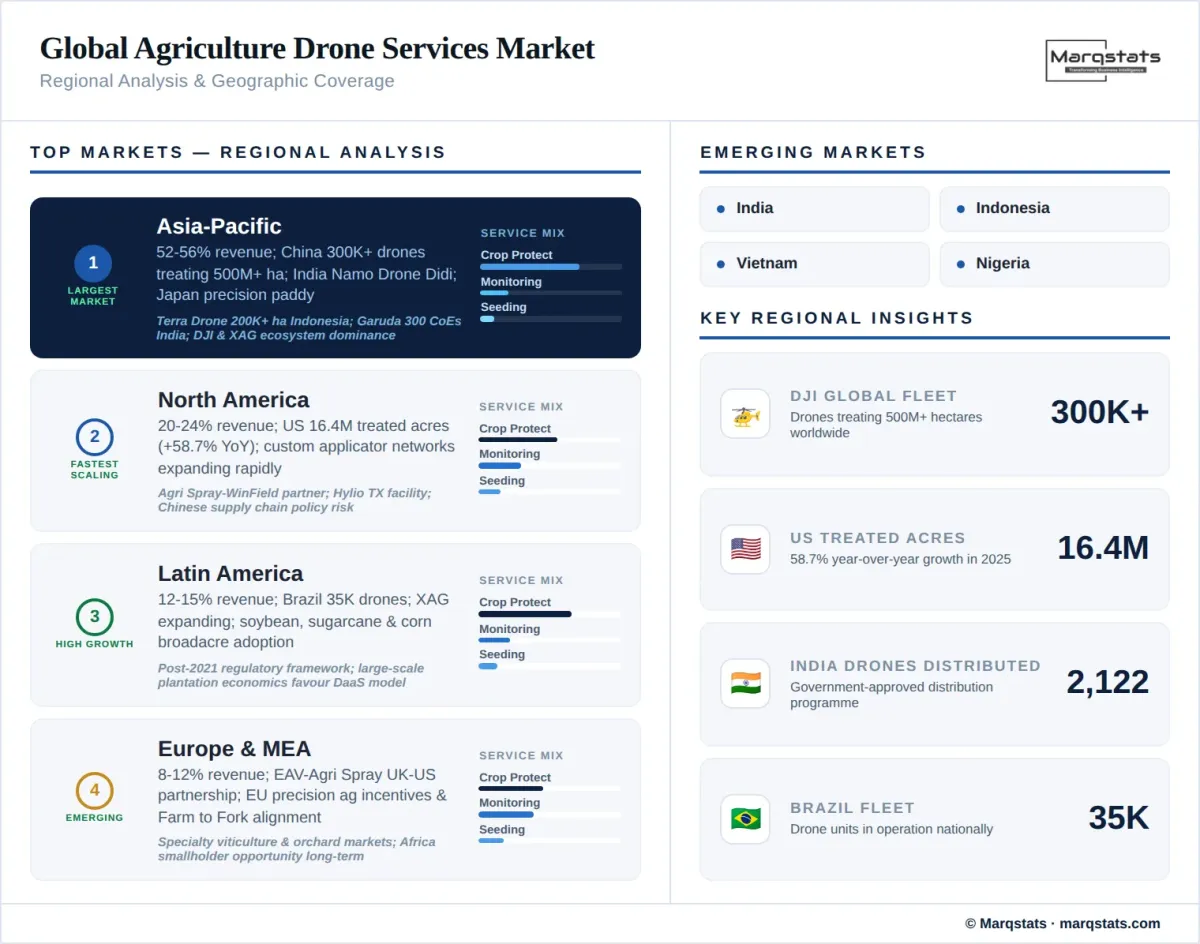
Asia-Pacific
Asia-Pacific is the largest regional market, estimated at 52–56% of 2025 global revenue, anchored by China's dominant drone services ecosystem and reinforced by rapidly growing markets in India, Japan, South Korea, Southeast Asia, and Australia. China is the world's largest agricultural drone services market by installed base — DJI Agriculture states that 300,000+ drones globally are treating 500 million+ hectares, with China representing the overwhelming majority. India is the most policy-driven market: the government's approval of 2,122 drone distributions, the Namo Drone Didi scheme (500 drones to women SHGs), and Garuda Aerospace's June 2025 Chennai indigenisation facility and Train-the-Trainer programme represent the most comprehensively state-supported DaaS agriculture programme of any country. Optiemus Unmanned Systems announced at the 5th Drone International Expo in July 2024 a Rs 140 crore DaaS investment targeting 5,000 drones and 6,000 pilots. Japan's precision rice and orchard spraying sector — served by Yamaha Motor's RMAX and DJI's Agras platforms — is the world's most mature agricultural drone service market in terms of regulatory framework and operator professionalisation. Southeast Asia's most advanced commercial service operator is Terra Drone Agri: its Indonesia unit completed flights over 200,000+ hectares with 150+ drones and 4,000 daily flights as of October 2025, and its January 2025 oil palm pest management project across 2,158 hectares in Indonesia and Malaysia with Behn Meyer is the region's most visible commercial case study.
Latin America
Latin America is the second-largest and fastest-growing major regional market, estimated at 22–26% of 2025 revenue, with Brazil as the primary market. Brazil's 2021 regulatory framework (ANAC Regulation ICA 100-40) enabled rapid commercial adoption, with Brazil's Ministry of Agriculture estimating approximately 35,000 units in operation by mid-2025 and anticipating additional regulatory updates. XAG's Agrishow 2025 launch of its P150 and P60 with CNH explicitly targets Brazilian smart-farming operations, reflecting international player investment in the market. Agrishow 2025 was the region's largest agri-technology showcase and a major commercial event for drone services sector launches. Argentina, Colombia, and Chile are secondary Latin American markets at earlier adoption stages, while Ecuador's large banana and cut flower export sectors represent premium precision agriculture drone service opportunities.
North America
North America accounts for approximately 14–18% of 2025 revenue, almost entirely in the United States, and is growing through custom application operator networks rather than state subsidy programmes. The American Spray Drone Coalition's 2025 industry survey figure of 16.4 million treated acres — a 58.7% year-over-year increase — is the clearest available metric for the U.S. market's scale and growth rate. Agri Spray Drones is the most visible U.S. ecosystem builder, with 125 custom applicators mapped to growers, a January 2026 WinField United co-marketing agreement, and a 2025 industry-advancement initiative with EAV covering coordinated operator and university deployments. Hylio's new Texas facility targeting 5,000 drones annually by 2028 addresses the U.S. domestic manufacturing capacity constraint. ZenaTech (Nasdaq: ZENA) demonstrated the DaaS revenue model with USD 3.57 million in DaaS revenue in Q3 2025 (82% of total, 1,225% year-over-year growth, with 12 U.S. acquisitions), with precision agriculture as one of its multi-vertical DaaS service lines. The U.S. market faces structural tension between Chinese drone supply-chain dependency and national security policy scrutiny — Guardian Agriculture's 2025 shutdown being the most visible casualty of this tension.
Europe, Middle East and Africa
Europe, Middle East and Africa account for approximately 6–10% of 2025 revenue, with Europe leading commercial development. The EU's relaxation of drone regulations under the EU Drone Strategy and EASA U-Space framework is enabling commercial drone services expansion in major agricultural economies including France, Germany, Spain, Poland, Italy, and the Netherlands. The EU drone services market is growing most rapidly in precision mapping and crop monitoring, where NDVI-based variable rate prescriptions are being incorporated into agronomy advisory services. South Africa is the most commercially advanced African drone services market, particularly in commercial row crop and deciduous fruit applications. The GCC's investment in precision agriculture in controlled and irrigated crop systems represents a growing Middle Eastern market node.
How Competition Is Evolving
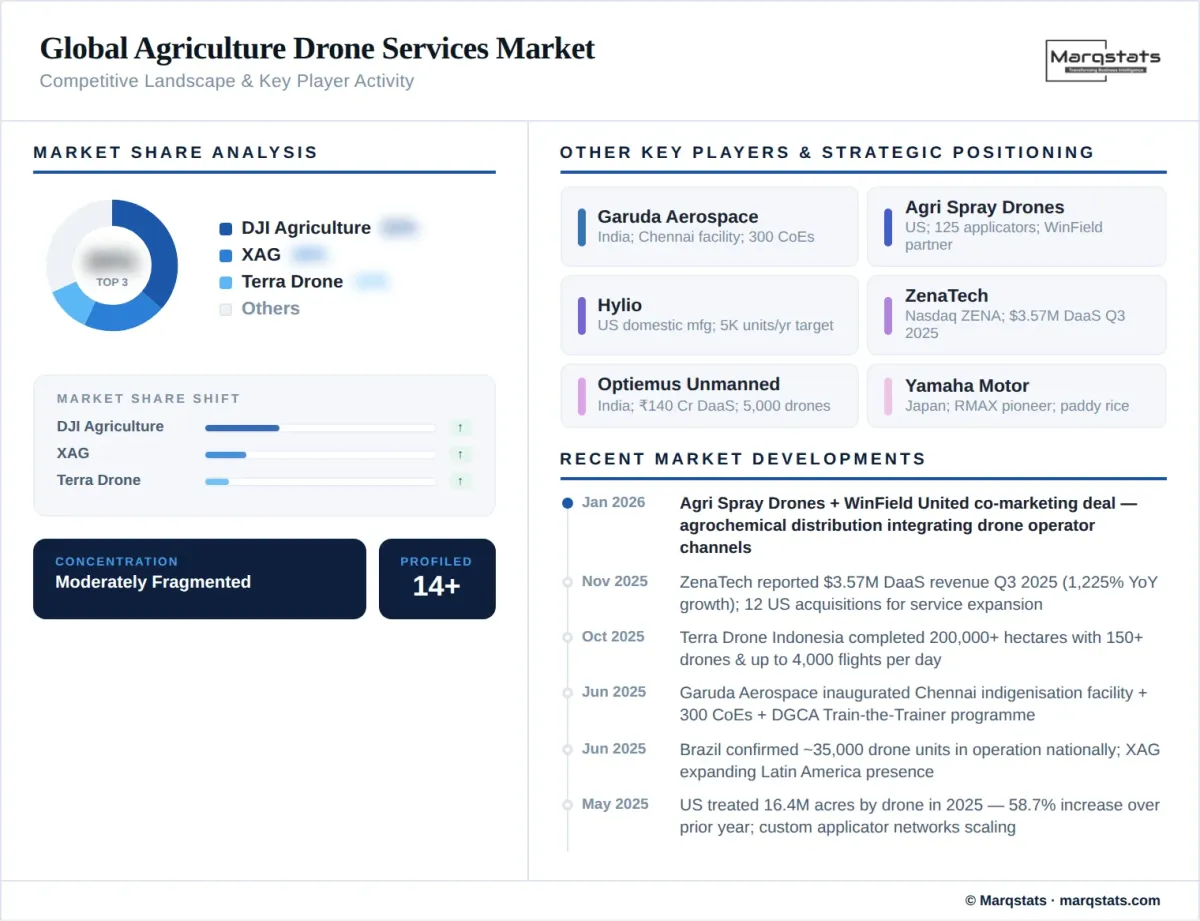
The global agriculture drone services market is highly fragmented, with no single player holding cross-geography commercial leadership. Competition is occurring on four battlegrounds simultaneously: service-network density (the ability to recruit, train, and maintain pilots at the scale required for crop-window service delivery); local regulation and localization (aircraft certification, pilot licensing, and domestic manufacturing compliance); channel partnerships with input distributors, equipment companies, cooperatives, and agronomy networks; and proof of operational and agronomic ROI backed by field research and independent validation.
XAG is the strongest international ecosystem player, combining a documented 60+ country reach, a 'pay-per-mu' service provider network-building strategy, the P150 and P60 platform launches at Agrishow 2025 in Brazil, and an XAG–Chia Tai agricultural partnership in Thailand. XAG's competitive model is to enable independent service providers through hardware, software (AI Farm platform), and training — an asset-light approach to global DaaS market participation that parallels the franchise model in traditional service industries. DJI Agriculture remains the foundational installed-base platform for most agricultural drone service agencies globally, with the Agras T50 (40 kg payload, 16 L/min flow rate, 9 m effective spray width) and Agras T25 representing the dominant hardware standard across Asia and increasingly Latin America. DJI's commercial position is under pressure in the U.S. from national security legislation, but its global agricultural installed base is not easily displaced.
Terra Drone/Terra Agri is the most commercially explicit multi-country service operator in Southeast Asia, with its 200,000+ hectare Indonesia flight record, oil palm Behn Meyer programme, Yanmar Diesel Indonesia 120-drone partnership (August 2025), and Malaysia pilot recruitment MOU (March 2025) representing the most transparent service-scale metrics disclosed by any regional operator. Garuda Aerospace is India's most visible integrated challenger — combining manufacturing (4,000 drones delivered, Chennai indigenisation facility), training (300 Centres of Excellence, DGCA-approved Train-the-Trainer programme), and agricultural service operations. Optiemus Unmanned Systems' July 2024 announcement of Rs 140 crore DaaS investment with a target fleet of 5,000 drones, 6,000 pilots, and projected service revenues of Rs 600–900 crore by end-2025 represents the most ambitious single-company India DaaS commitment announced publicly. Agri Spray Drones and Hylio anchor the U.S. commercial ecosystem as operator-network builder and domestic manufacturer respectively. ZenaTech provides the clearest publicly traded DaaS revenue data point in North America with its Q3 2025 financials.
Companies Covered
The report profiles 14+ companies with full strategy and financials analysis, including:
Recent Market Activity
Table of Contents
Coverage & Segmentation
This report provides a comprehensive analysis of the global agriculture drone services market covering the historical period 2021–2025 and the forecast period 2026–2030, with 2025 as the base year. The study examines market size and revenue forecasts in USD billion, segmented by service type (aerial crop protection spraying and spreading, precision crop monitoring and remote sensing, aerial seeding and direct application), application technology (GPS-guided autonomous spraying, multispectral and thermal imaging, AI-enabled variable-rate application), and geography (Asia-Pacific, Latin America, North America, Europe/Middle East/Africa). Scope covers revenue from drone service delivery contracts charged on per-acre, per-hectare, per-flight, or subscription bases to agricultural end-users; revenue from drone service platform licensing and operator training programmes when directly associated with agricultural service delivery; and bundled agronomic data service fees included in DaaS contracts. Hardware sales, drone manufacturing, and non-agricultural DaaS services (construction, inspection, utility surveying) are excluded from scope unless explicitly bundled with agricultural service delivery.
Research drew from the American Spray Drone Coalition's 2025 Industry Survey (16.4 million treated U.S. acres), Government of India PIB press releases and ICAR demonstration data, Brazil Ministry of Agriculture drone fleet estimates, Terra Drone commercial operation and partnership disclosures, Garuda Aerospace manufacturing and training programme announcements, ZenaTech financial disclosures (Nasdaq: ZENA, Q3 2025 10-F/6-K), XAG corporate materials and Agrishow 2025 launch documentation, Optiemus Unmanned Systems 5th Drone International Expo announcement (July 2024), DJI Agriculture platform specifications and global deployment data, peer-reviewed reviews of agricultural drone adoption (2026 Agriculture 5.0 review, 2026 global diffusion paper), and trade press coverage through March 2026.