Market Snapshot
Key Takeaways
Market Overview & Analysis
Report Summary
The electric truck market encompasses battery-electric trucks (BEV), fuel cell electric trucks (FCEV), and plug-in hybrid trucks across light commercial, medium-duty, and heavy-duty weight classes deployed in urban delivery, regional distribution, long-haul freight, drayage, port logistics, refuse collection, construction, mining, and municipal services globally. The market covers the full system: vehicles, depot charging infrastructure (150–350 kW DC and emerging megawatt-class), corridor charging networks, grid interconnection and energy management, fleet telematics and route optimisation software, and the regulatory and financing structures that underpin fleet transition at scale.
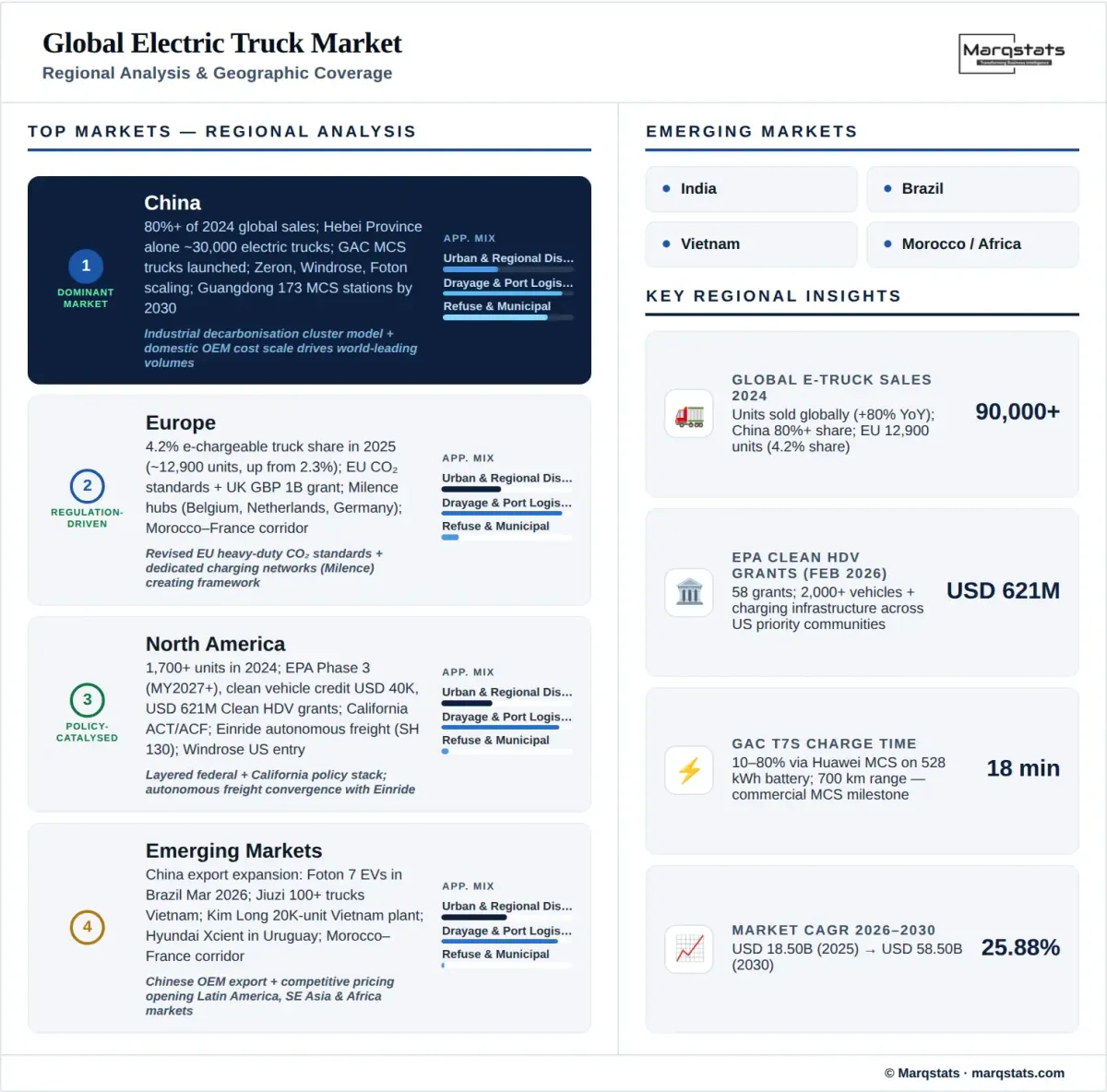
The electric truck transition is shifting from individual vehicle pilots to fleet-scale deployment decisions, but the pace varies dramatically by application and geography. In China, heavy-industry provinces such as Hebei have scaled electric truck fleets to approximately 30,000 vehicles through a cluster adoption model driven by industrial decarbonisation pressure and localised operations. In Europe, dedicated heavy-duty charging networks are emerging—Milence is building charging hubs and expanding across Belgium, Netherlands, and Germany—indicating a shift from pilots to early commercial networks. In the United States, adoption is strongly shaped by a layered policy stack: the EPA Phase 3 rule, the commercial clean vehicle credit (up to USD 40,000 for vehicles above 14,000 lbs GVWR), EPA Clean Heavy-Duty Vehicles grants (58 grants totalling approximately USD 621 million for replacement of 2,000+ vehicles plus infrastructure), and California’s state-level Advanced Clean Trucks and Advanced Clean Fleets mandates.
The economically “first to electrify” truck niches are those where electricity is cheaper per kilometre and where charging can be accomplished without expensive downtime or corridor dependence. If electricity tariffs are stable or hedged and trucks can charge mainly off-peak, energy operating expenditure is structurally favourable versus diesel. However, if demand charges and interconnection upgrades are large and utilisation is low, the economics can reverse even when per-kilometre energy cost favours electric. This tariff sensitivity, combined with multi-MW interconnection requirements for large depots and the 6–18 month timelines for utility approvals, makes depot power readiness—not vehicle technology—the critical-path constraint for fleet-scale deployment in most markets.
Market Dynamics
Key Drivers
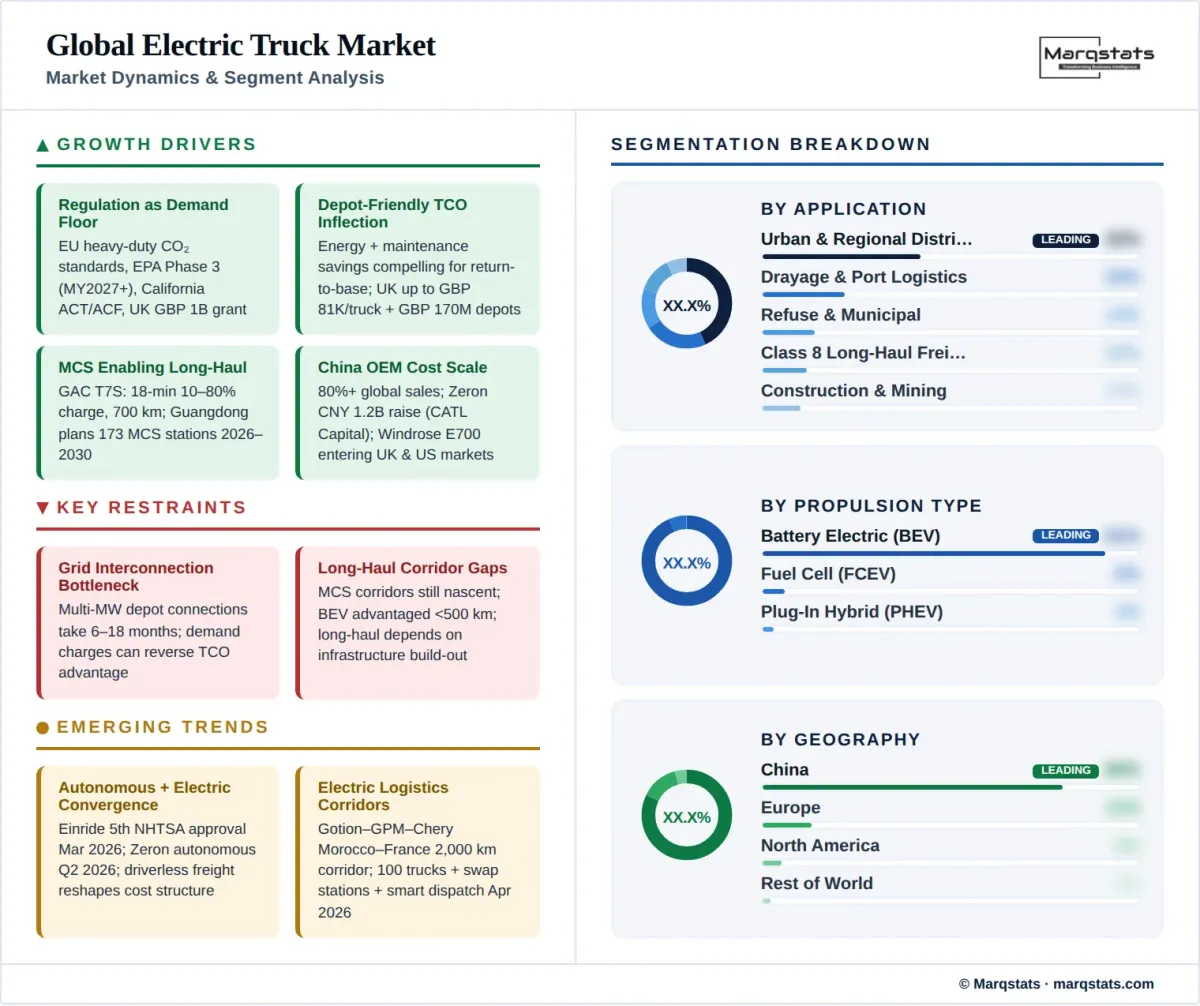
- Regulation as the demand floor across major markets: The EU’s revised heavy-duty CO₂ standards reshape OEM compliance planning and accelerate zero-emission truck offerings, with the EU Council adopting a targeted flexibility amendment for 2030 compliance in March 2026. The US EPA Phase 3 rule sets stronger GHG standards beginning MY2027, supported by the commercial clean vehicle credit and EPA grant programmes. California’s Advanced Clean Trucks (manufacturer sales requirement) and Advanced Clean Fleets (fleet requirements including public fleets and drayage) are key demand shapers. India’s March 2026 Gazette notification tightened localisation norms for N2/N3 electric truck powertrains under PM E-DRIVE, phasing in domestic manufacturing of traction motors and controllers.
- Fleet economics reaching inflection in depot-friendly applications: Total cost of ownership is increasingly competitive in return-to-base, drayage, and short-haul applications where trucks charge overnight at depot rates. Energy cost advantages compound with lower maintenance requirements, reduced brake wear through regenerative braking, and absence of diesel particulate filter servicing. The UK’s March 2026 announcement of GBP 1 billion for zero-emission truck and van grants—covering up to 40% of cost and up to GBP 81,000 off the heaviest trucks—plus GBP 170 million for depot charging directly addresses the capex gap.
- Megawatt charging enabling long-haul viability: MCS is the critical infrastructure enabler for Class 8 and long-haul truck electrification, allowing practical charging within driver rest windows. GAC Commercial Vehicle launched megawatt charging trucks in March 2026: the T7S tractor with 528 kWh battery achieving 18-minute 10–80% charge and 700 km range, and the C7S truck with 310 kWh battery and 15-minute charge. Guangdong Province plans 173 heavy-duty megawatt charging stations between 2026 and 2030. CharIN continues to advance MCS standardisation, including ruggedised variants for harsh environments (mining, ports).
- Chinese manufacturing scale driving cost competitiveness: China’s dominance (80%+ of global electric truck sales) reflects both policy pressure and manufacturing cost advantages. Zeron, an emerging Chinese electric commercial vehicle manufacturer, closed a CNY 1.2 billion financing round led by CATL Capital, Momenta, and NIO Capital in March 2026, with nearly 1,600 cumulative vehicle sales and autonomous driving capabilities. Windrose launched the E700 electric truck in the UK (705 kWh LFP, 670 km range, MCS and CCS2 compatible) and is entering the US market at approximately USD 300,000, challenging the Tesla Semi.
- Corporate Scope 3 pressure and sustainability commitments: Major logistics companies and shippers are setting fleet decarbonisation targets driven by Scope 3 emissions reporting requirements, ESG investor pressure, and customer sustainability demands. This creates top-down demand for zero-emission trucks independent of pure TCO calculations, particularly in European and North American markets where corporate sustainability commitments are binding.
Key Restraints
- Grid interconnection and depot power as critical-path constraints: Large truck depots requiring multi-MW connections face demand charges and power quality as material operating expense variables. Interconnection timelines can exceed vehicle lead times, delaying fleet utilisation. The practical constraint is not energy (kWh/day) but peak power (kW/MW) and the 6–18 month process for utility approvals, transformer installation, and service upgrades.
- Long-haul corridor charging infrastructure still nascent: While depot charging is established technology, long-haul truck electrification depends on corridor-scale megawatt charging that is still in early deployment. Only approximately 30 hydrogen stations exist on or near China’s highway service areas. In Europe, Milence and similar networks are building hub-by-hub but coverage is far from comprehensive. MCS standardisation is progressing but not yet commercially deployed at scale.
- Payload penalty and range trade-offs for heavy-duty applications: Battery packs for Class 8 tractors weigh 3,000–5,000 kg, directly reducing payload capacity versus diesel equivalents. For weight-sensitive freight (e.g., tanker, bulk), this payload reduction can offset energy cost savings. Range remains limited to 300–500 km for most available heavy-duty BEV models, though megawatt charging and larger packs (500–700+ kWh) are extending this.
- Financing and fleet transition barriers: Due diligence for electric truck financing lacks historical performance data, and financing rates have risen 20–30% in some markets. Subsidy collection cycles can exceed two years (as noted in China’s hydrogen fuel cell truck sector), shaping credit terms across the value chain. Smaller fleet operators face disproportionate barriers in navigating incentive applications, depot upgrades, and workforce training for high-voltage diagnostics.
Key Trends
- Autonomous electric trucks converging with electrification: Einride received its fifth US NHTSA approval to operate autonomous vehicles on public roads in March 2026 and is preparing for a US public listing via a USD 113 million capital raise. The company partnered with Texas highway operator SH 130 to create an autonomous freight testbed. Zeron achieved in-vehicle autonomous driving based on end-to-end multimodal large models, with regular autonomous operation scheduled for Q2 2026. This convergence of autonomy and electrification reshapes freight economics by eliminating driver costs alongside fuel costs.
- Electric logistics corridors as a new market architecture: Gotion, GPM, and Chery signed an agreement in April 2026 to develop a 2,000 km heavy-duty electric logistics corridor between Morocco and France, deploying 100 initial electric trucks with battery-swapping stations and smart dispatching. This corridor model—combining vehicles, infrastructure, energy management, and fleet orchestration—represents the emerging architecture for cross-border electric freight.
- Hydrogen combustion engines emerging as long-haul complement: Volvo Trucks began road testing hydrogen combustion engine trucks in April 2026 using High Pressure Direct Injection (HPDI) technology, targeting launch by 2030. Hyundai deployed eight Xcient Fuel Cell Class 8 trucks in Uruguay for timber logistics with a 720 km range. Daimler Truck unveiled the eCitaro fuel cell bus with range extender in March 2026. These developments signal that long-haul zero-emission freight will be served by multiple propulsion technologies, not BEV alone.
- Dedicated heavy-duty charging networks emerging in Europe: Milence is building dedicated heavy-duty charging hubs across Europe, including a Belgium hub at a Volvo factory site announced in March 2026. These hubs are positioned at logistics nodes and industrial sites rather than passenger-car charging stations, reflecting the distinct infrastructure requirements of commercial vehicles: higher power, larger parking footprints, and integration with fleet scheduling systems.
Market Segmentation
Medium-duty rigid trucks (Class 4–6, typically 6–16 tonnes GVW) are the earliest and most mature segment for electrification. These vehicles operate on predictable urban and regional routes with daily distances of 100–250 km, returning to base nightly for depot charging. Workhorse (merged with Motiv Electric Trucks in December 2025) produces W56 electric step vans from its 436,000 sq ft Indiana facility with 5,200-unit annual capacity, and received a 100-unit order from Purolator in March 2026. Foton launched seven electric commercial vehicles in Brazil in March 2026, including the eAumark truck line in 6T, 9T, and 12T versions. The segment benefits from favourable TCO in last-mile delivery, parcel distribution, and food/beverage logistics.
Heavy-duty rigid trucks for construction, refuse collection, and municipal services represent the second adoption tier. These applications feature high idle time, operation in urban emissions zones, and access to municipal funding and sustainability mandates. Refuse trucks are particularly suited for electrification due to frequent stop-start cycles that maximise regenerative braking benefits and predictable depot-based routes. The India government tightened localisation norms for N2/N3 electric truck powertrains in March 2026, phasing in domestic manufacturing of traction motors and controllers, which will shape the competitive landscape for heavy-duty electric trucks in one of the world’s largest commercial vehicle markets.
Class 8 tractor electrification is emerging but remains highly dependent on megawatt charging corridor infrastructure. GAC Commercial Vehicle’s T7S megawatt charging tractor (528 kWh Sunwoda battery, Huawei MCS, 18-minute 10–80% charge, 700 km range) demonstrates that the technology is becoming commercially available, at least in China. Windrose is entering the US market with a Class 8 electric truck at approximately USD 300,000, targeting California and Texas. However, long-haul economics depend on corridor charging availability, and the gap between vehicle readiness and infrastructure deployment remains the primary constraint. Expert opinion positions BEV trucks as advantaged within approximately 500 km, with hydrogen trucks more suited beyond 500–1,000 km.
Drayage and port operations are consistently among the first heavy-duty electrification niches due to fixed short-haul routes, high utilisation, and concentrated air-quality regulations around ports. California’s Advanced Clean Fleets framework includes specific drayage provisions. The Gotion-GPM-Chery Morocco-France corridor agreement demonstrates the extension of this model to intercontinental logistics. EKA Mobility in India sold 1,143 electric commercial vehicles in FY 2025–26 and deployed a hydrogen fuel cell bus at Cochin International Airport, illustrating the convergence of port, airport, and logistics electrification.
Battery-electric trucks dominate the current electric truck market with over 90% of sales globally. BEV economics are strongest in depot-based, return-to-base applications where overnight charging at commercial electricity rates eliminates fuel cost and reduces maintenance expenditure. Battery capacities range from 100–200 kWh for medium-duty to 300–700+ kWh for heavy-duty tractors. LFP chemistry dominates for its safety, cycle life, and cost advantages, though NMC variants are used where energy density and weight are critical.
Fuel cell trucks remain a targeted solution for specific long-range, high-utilisation corridors where battery weight penalty and charging time constraints are binding. Hyundai deployed eight Xcient Fuel Cell Class 8 trucks in Uruguay (180 kW fuel cell, 350 kW motor, 68 kg hydrogen storage, 720 km range). Volvo is testing hydrogen combustion engine trucks as an alternative to fuel cells for long-haul. The competitive dynamics between BEV and FCEV trucks will be determined by corridor charging infrastructure deployment speed: where MCS corridors build out, BEV will dominate; where they lag, hydrogen retains relevance.
By Geography
China
China dominates the global electric truck market with over 80% of sales in 2024, driven by emissions policy tightening, industrial decarbonisation mandates, and domestic OEM cost competitiveness. Hebei Province alone scaled electric truck fleets to approximately 30,000 vehicles through a cluster adoption model centred on steel, coking, and mining logistics. Zeron closed a CNY 1.2 billion financing round led by CATL Capital in March 2026 with nearly 1,600 cumulative vehicle sales and autonomous driving capabilities. GAC Commercial Vehicle launched megawatt charging trucks with Huawei MCS systems, and Guangdong Province plans 173 heavy-duty MCS stations by 2030. Windrose is exporting the E700 electric truck (705 kWh, 670 km range) to the UK and US markets.
Europe
Europe is the second-largest electric truck market and the most regulation-driven. EU electrically-chargeable truck registrations reached 4.2% share in 2025 (approximately 12,900 units), up from 2.3% in 2024. The revised EU heavy-duty CO₂ standards set reduction targets directly shaping OEM compliance, with the EU Council adopting a targeted flexibility amendment in March 2026. Milence is building dedicated heavy-duty charging hubs across Belgium, Netherlands, and Germany. MAN began electric Lion’s City E bus production at its Ankara plant and is preparing electric eTGL light-duty truck production at its Krakow plant. The UK announced GBP 1 billion for zero-emission truck grants (up to GBP 81,000 per truck) and depot charging (GBP 170 million). The Gotion-GPM-Chery Morocco-France electric logistics corridor (2,000 km, 100 initial trucks) represents cross-border freight electrification.
North America
North America’s electric truck market is driven by a layered policy stack: EPA Phase 3 standards (MY2027+), the commercial clean vehicle credit (up to USD 40,000), EPA Clean Heavy-Duty Vehicles grants (USD 621 million for 2,000+ vehicles plus infrastructure), and California’s ACT/ACF frameworks. The US sold over 1,700 electric trucks in 2024. Windrose entered the US market at approximately USD 300,000, challenging the Tesla Semi. Workhorse (merged with Motiv) received a 100-unit Purolator order. Einride received its fifth NHTSA approval for autonomous operations and signed an MOU with Texas SH 130 for an autonomous freight corridor. Hero MotoCorp acquired 36.67% of Euler Motors (electric commercial vehicles) in India, and Scout Motors is developing electric trucks under the VW Group umbrella.
Emerging Markets
Emerging markets are opening as Chinese OEMs expand export operations. Foton launched seven electric commercial vehicles in Brazil in March 2026. Jiuzi secured agreements for 100+ electric trucks in Vietnam. Hyundai deployed Xcient Fuel Cell trucks in Uruguay. Kim Long Motor opened a 20,000-unit truck manufacturing plant in Vietnam with EV capability. These markets are characterised by growing logistics demand, urbanisation-driven air quality concerns, and increasing availability of Chinese electric truck platforms at competitive price points.
How Competition Is Evolving
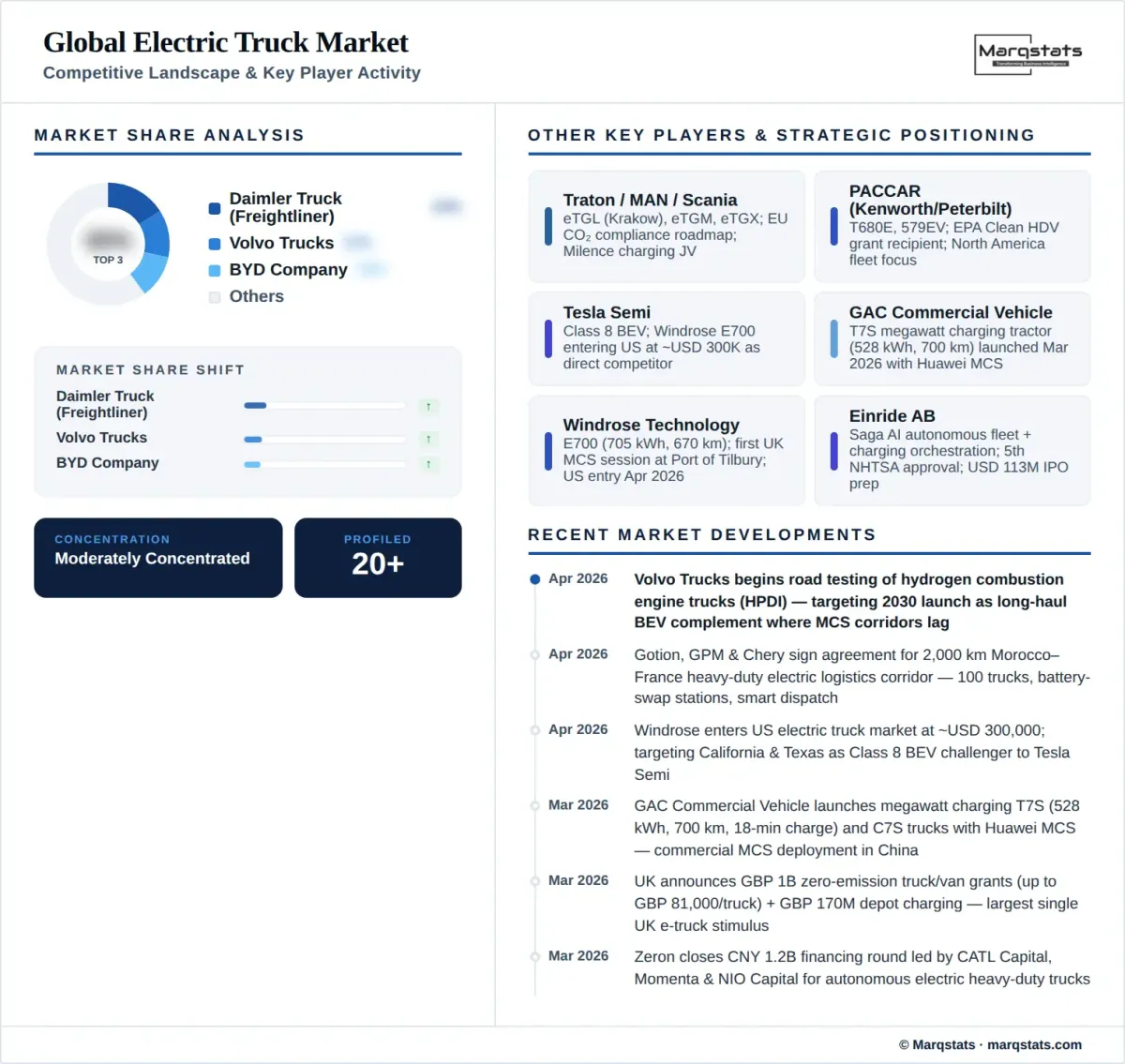
The electric truck competitive landscape operates across three interacting layers: vehicle OEMs, charging and energy providers, and software and fleet management companies. Among global OEMs, Daimler Truck (Freightliner eCascadia, eActros, eCitaro fuel cell), Volvo Trucks (FH Electric, FM Electric, hydrogen ICE testing), MAN/Traton (eTGL, eTGM, eTGX), PACCAR (Kenworth T680E, Peterbilt 579EV), and BYD (electric trucks across weight classes) are scaling medium- and heavy-duty platforms. Chinese challengers including Windrose, Zeron, Foton, and GAC Commercial Vehicle are competing on cost, range, and MCS integration.
In charging infrastructure, Milence is emerging as Europe’s dedicated heavy-duty charging network, while CharIN drives MCS standardisation. Huawei’s megawatt charging technology is deployed with GAC in China. In fleet software, Einride’s Saga AI combines autonomous driving, route optimisation, and charging orchestration. Zenobē acquired Revolv in March 2026 to scale North American commercial electric truck fleet electrification, adding 100+ trucks across 13 sites.
The competitive dynamics are increasingly defined by the ability to deliver integrated freight solutions—vehicle, charging, energy management, and uptime guarantees—rather than standalone trucks. OEMs that partner with charging operators, energy companies, and software providers to reduce fleet adoption friction will capture disproportionate market share. The convergence of electrification with autonomous driving (Einride, Zeron) introduces a new competitive dimension where driverless electric freight could fundamentally reshape the cost structure of road logistics.
Companies Covered
The report profiles 20++ companies with full strategy and financials analysis, including:
Recent Market Activity
Table of Contents
Coverage & Segmentation
This report provides a comprehensive analysis of the global electric truck market covering the historical period 2021–2025 and forecast period 2026–2030, with 2025 as the base year. The study examines market size in value (USD billion) and volume (units), segmented by truck class (medium-duty, heavy-duty, Class 8 tractor), application (urban delivery, regional distribution, long-haul, drayage/port, refuse/municipal, construction/mining), propulsion (BEV, FCEV, PHEV), charging infrastructure (depot DC, megawatt corridor, opportunity), and geography (China, Europe, North America, emerging markets). The competitive landscape profiles 20 leading OEMs, charging network operators, and technology providers.
Primary research includes structured interviews with 40+ industry stakeholders spanning truck OEMs, fleet operators, logistics companies, charging infrastructure providers, energy management platforms, battery suppliers, and government policy teams. Secondary research draws from IEA Global EV Outlook 2025, ACEA registration data, EPA standards and grant programmes, CAAM statistics, CharIN MCS documentation, and company disclosures. All market estimates represent Marqstats Intelligence proprietary calculations.