Market Snapshot
Key Takeaways
Market Overview & Analysis
Report Summary
The India telematics and fleet safety systems market encompasses the end-to-end stack of hardware, software, connectivity, and services that enable vehicles to communicate, be tracked, diagnosed, and managed in real time. The scope of this report covers four overlapping layers: regulatory telematics (AIS-140-compliant vehicle location tracking devices and emergency alerts), fleet-operations telematics (trip management, fuel monitoring, geofencing, driver scoring), fleet safety systems (dashcams, AI video telematics, drowsiness and distraction detection, ADAS-linked alerts), and OEM-embedded telematics platforms deployed at the factory across passenger and light commercial vehicle segments. The study examines the market across the 2021–2025 historical period and forecasts demand through 2030.
India's telematics ecosystem is at an inflection point. AIS-140, introduced as a compliance framework for public service vehicles with mandatory VLTD fitment and IS 16833 standards covering real-time location, emergency alerts, OTA updates, and back-end communications, created the foundation. The next phase is being driven by AI-powered fleet intelligence, OEM-embedded connectivity, and a new generation of MoRTH safety mandates targeting heavy vehicles from 2027. Fleet operators, logistics companies, passenger vehicle owners, and public transport authorities are all transitioning from basic GPS to richer analytics and safety systems. India's passenger car market sold approximately 4.3 million units in FY 2024–25 (SIAM), with connected features now standard across the INR 8–12 lakh and above segments—accelerating the passenger vehicle telematics installed base meaningfully.
The competitive landscape features four distinct archetypes: full-stack domestic platforms (MapmyIndia, JioThings), scale-up SaaS fleet intelligence players (Fleetx, LocoNav/Sensorise), AI video safety specialists (Netradyne, LightMetrics, drivebuddyAI), and global Tier-1 TCU suppliers entering India directly (HARMAN, Continental, ZF). OEM-embedded platforms from Tata Motors Fleet Edge, Ashok Leyland i-Alert, My Eicher, and Mahindra iMAXX are increasingly the base layer, with third-party safety providers integrating on top. The market additionally benefits from India's growing role as a manufacturing and R&D hub for telematics hardware, evidenced by Pioneer's new Bengaluru R&D centre and HARMAN's expanded Pune plant.
Market Dynamics
Key Drivers
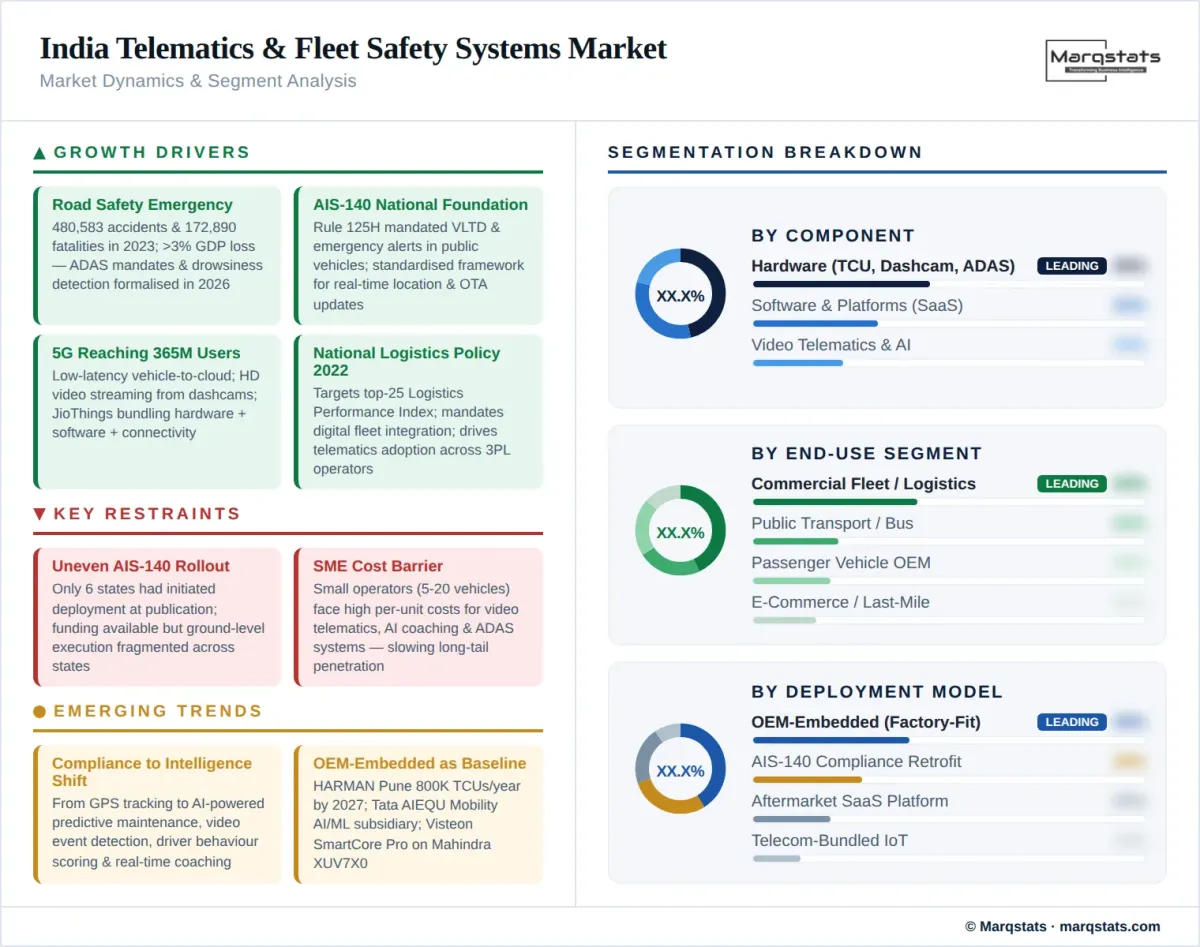
- Road safety emergency demanding intelligent intervention: India's 480,583 road accidents and 172,890 fatalities in 2023 (MoRTH) represent an annual economic loss estimated at over 3% of GDP. Telematics and driver safety systems are increasingly positioned as the primary policy and commercial response, with ADAS mandates and drowsiness detection requirements formalizing this linkage in 2026.
- AIS-140 creating the national telematics foundation: MoRTH's Rule 125H mandated VLTD and emergency alert systems in public service vehicles, with AIS-140-compliant devices required for applicable vehicles registered from January 2019. This created a standardised, interoperable framework covering real-time location, OTA updates, SIM/connectivity management, and back-end communications—establishing a reusable base for next-generation services.
- 5G network expansion unlocking new connected vehicle use cases: India's 5G user base reached 365 million as of July 2025 (Department of Telecommunications), enabling low-latency vehicle-to-cloud communication, high-definition video streaming from dashcams, and V2X communication. Telecom-OEM revenue-sharing models (JioThings bundling hardware, software, and connectivity) are lowering total cost of ownership for fleet operators.
- National Logistics Policy 2022 mandating digital fleet integration: The NLP explicitly targets a top-25 Logistics Performance Index ranking by 2030, with digital integration of logistics infrastructure as a core pillar. The 2025 LEADS framework added digital logistics and sustainability metrics, creating policy tailwinds for fleet telematics adoption beyond compliance into operational productivity.
- OEM-driven connectivity democratisation across price segments: Tata Motors IRA, Hyundai BlueLink, Suzuki Connect, Mahindra AdrenoX, MG Astor's AI assistant, and Kia Connect have collectively made factory-fitted telematics a buying criterion from INR 8 lakh upwards, expanding the addressable market beyond fleet operators to individual vehicle owners.
Key Restraints
- Uneven state-level AIS-140 implementation: The ACMA–Grant Thornton industry white paper noted that only six states had initiated rollout at the time of publication, with funding and guidelines available in many others but ground-level deployment lagging. This execution fragmentation limits the size and quality of the compliance-driven installed base.
- Cybersecurity and data governance gaps: As telematics systems move from tracking to safety-critical functions—diagnostics, ESC integration, emergency calls—weak device quality or poor data governance becomes a structural risk. India's automotive cybersecurity standards (aligned with ISO/SAE 21434 and ISO 26262) were still being finalised as of 2025, creating uncertainty for OEMs and fleet operators on compliance obligations.
- High upfront costs constraining SME and owner-operator adoption: While large fleet operators and OEM customers benefit from economies of scale, small operators running five to twenty vehicles face relatively high per-unit costs for video telematics, AI driver coaching, and ADAS-linked safety systems—slowing penetration in the long tail of India's fragmented transport sector.
- Fragmented ecosystem creating integration complexity: The coexistence of OEM embedded platforms, AIS-140 compliance vendors, telecom IoT stacks, SaaS fleet tools, and video telematics specialists means that many fleets end up with disconnected tools that do not share data—limiting the analytics value that makes premium telematics financially justified.
Key Trends
- Shift from compliance-led to intelligence-led telematics: The first-generation AIS-140 market was about location and emergency alerts. The second-generation market is about AI-powered predictive maintenance, video event detection, driver behaviour scoring, and real-time coaching—repositioning telematics as an operational and safety intelligence platform rather than a regulatory checkbox.
- OEM-embedded connectivity as the new baseline: HARMAN's expansion of its Pune plant to produce 800,000 telematics control units annually by 2027, Tata Motors' incorporation of AIEQU Mobility Limited (January 2026) as a dedicated AI/ML and telematics subsidiary, and Visteon's SmartCore Pro deployment on Mahindra's XUV7X0 all signal that embedded telematics is transitioning from a differentiator to a standard hardware line item.
- EV fleet telematics as the next growth wave: The integration of telematics with battery management systems is becoming essential in electric vehicles—enabling remote state-of-charge monitoring, charging optimisation, battery degradation analytics, and range prediction. Netradyne's deployments with BillionE Mobility and the ACMA–Grant Thornton industry analysis both frame EV telematics as the next structural demand driver for India's fleet safety market.
- Usage-based insurance (UBI) and vehicle digital passports gaining traction: Hyundai Motor India's launch of the Vehicle Digital Passport (May 2025) at INR 399 per quarter—consolidating service records, accident history, malfunction indicators, and driving behaviour from BlueLink telematics—points to a monetisation model where OEM telematics data becomes a revenue stream via subscription services, including UBI linkages.
Market Segmentation
The hardware segment—comprising telematics control units (TCUs), onboard diagnostics dongles, dashcams, radar sensors, and ADAS modules—accounts for the largest share of the India telematics market by revenue, driven by AIS-140 device fitments, OEM TCU procurement, and growing demand for AI-enabled dashcams. Key hardware suppliers include HARMAN International, Continental AG, Robert Bosch GmbH, Denso Corporation, and domestic manufacturers aligned with the AIS-140 IS 16833 standard. HARMAN's Pune plant, which manufactures TCUs for Tata Motors and Maruti Suzuki including the Ready Connect unit with OTA, cybersecurity, and remote diagnostics, targets 800,000 telematics control units annually by 2027. Shriram Pistons & Rings' March 2026 MoA expansion to include radars, lidars, ADAS components, and telematics boxes underscores the deepening localisation of telematics hardware manufacturing.
Fleet management software and AI analytics platforms represent the fastest-growing segment within the India telematics market, as fleet operators transition from hardware-led GPS tracking to SaaS-delivered intelligence. Leading platforms—Fleetx, LocoNav (now under Sensorise's Eagle.ai brand), MapmyIndia, and JioThings—offer unified views of trip management, fuel analytics, driver behaviour, predictive maintenance, and video event detection. Fleetx's AI platform serves 3.5 lakh vehicles with 300+ integrations; its March 2026 partnership with AbhiBus to deploy AI-powered video telematics across bus operators illustrates the platform-upsell model that is driving revenue per vehicle meaningfully above pure-GPS pricing. ZF's January 2025 launch of its SCALAR digital fleet management platform in India reflects the entry of global Tier-1 suppliers into this software layer.
Connectivity services—encompassing SIM management, IoT data plans, cloud infrastructure, and OTA update pipelines—are a critical and increasingly monetised layer. JioThings' Smart Connected Vehicle solution, which bundles hardware, software, and Jio connectivity into a single stack for enterprises, represents the telecom-led model. Tessolve's October 2025 membership in the eSync Alliance to standardise OTA and data management for automotive electronics reflects growing OEM attention to reliable, interoperable OTA pipelines as the number of software-defined vehicle functions grows. India's 5G rollout to 365 million users (DoT, July 2025) is making V2C and V2X connectivity practical at scale.
Fleet and logistics management is the dominant application segment, accounting for approximately 42% of market revenues, driven by commercial fleet operators, logistics companies, and ride-hailing aggregators demanding real-time vehicle tracking, route optimisation, fuel management, and driver performance analytics. The logistics sector's digital transformation under the National Logistics Policy 2022 is formalising telematics as a procurement requirement for government-contracted logistics providers. Mahindra's June 2025 launch of the Bolero MaXX Pik-Up HD 1.9 CNG—the brand's first CNG pickup with iMAXX connected vehicle technology offering real-time operational data—extends OEM-embedded fleet telematics to light commercial vehicle segments.
Passenger vehicle connected services—covering remote diagnostics, emergency assistance, OTA updates, navigation, vehicle health monitoring, and usage-based insurance—are the fastest-growing application segment, historically underrepresented relative to CV telematics but now scaling rapidly through OEM-embedded platforms. Hyundai Motor India's Vehicle Digital Passport, launched in May 2025 at INR 399 per quarter, uses telematics-derived service and behaviour data to provide a seven-page health and usage report for BlueLink-enabled vehicles. HARMAN's supply of the Ready Connect TCU and advanced infotainment for the Tata Sierra—featuring emergency call, stolen vehicle tracking, OTA updates, and cybersecurity—illustrates the feature richness now standard on upper-mass passenger vehicles.
Driver safety systems—video telematics, drowsiness detection (DDDAS), driver monitoring systems (DMS), lane departure warning (LDW), and ADAS alerts—represent the highest-growth emerging segment, with the February 2026 MoRTH mandate for heavy-vehicle safety technology creating a compliance pull that is accelerating OEM and fleet operator investment. Netradyne's full-drive-time video analysis, drivebuddyAI's integration with Volvo Eicher's MyEicher platform (March 2026) for real-time safety data alongside GPS and fuel, and LightMetrics' hardware-agnostic RideView platform for fleet safety coaching all operate in this space. The segment also benefits from the growing maturity of connected EV safety analytics, as evidenced by Netradyne's deployments with BillionE Mobility for EV fleet driver performance monitoring.
OEMs and Tier-1 electronics suppliers are the primary demand anchors for the hardware and embedded software layers. Tata Motors, Maruti Suzuki, Hyundai, Mahindra, Kia, and MG Motor are all active with factory-fitted connected platforms; HARMAN, Continental, Bosch, Denso, and Visteon supply the underlying TCUs and cockpit systems. Tata Motors' February 2026 incorporation of AIEQU Mobility Limited as a dedicated AI/ML and telematics subsidiary signals that the group is building proprietary software capability alongside its hardware partnerships.
Fleet operators and logistics companies represent the broadest customer base for aftermarket and SaaS telematics solutions. India's logistics sector accounts for approximately 14% of GDP, and the combination of the National Logistics Policy's digital mandate, commercial vehicle sales of 10.3 lakh units in 2025 (SIAM), and rising fuel costs is driving fleet operators to adopt analytics platforms beyond basic compliance tracking. Sensorise's October 2025 acquisition of LocoNav's India fleet management business—bringing 10,000+ customers and 150,000 active device subscriptions—consolidated a significant slice of the aftermarket fleet telematics base.
By Geography
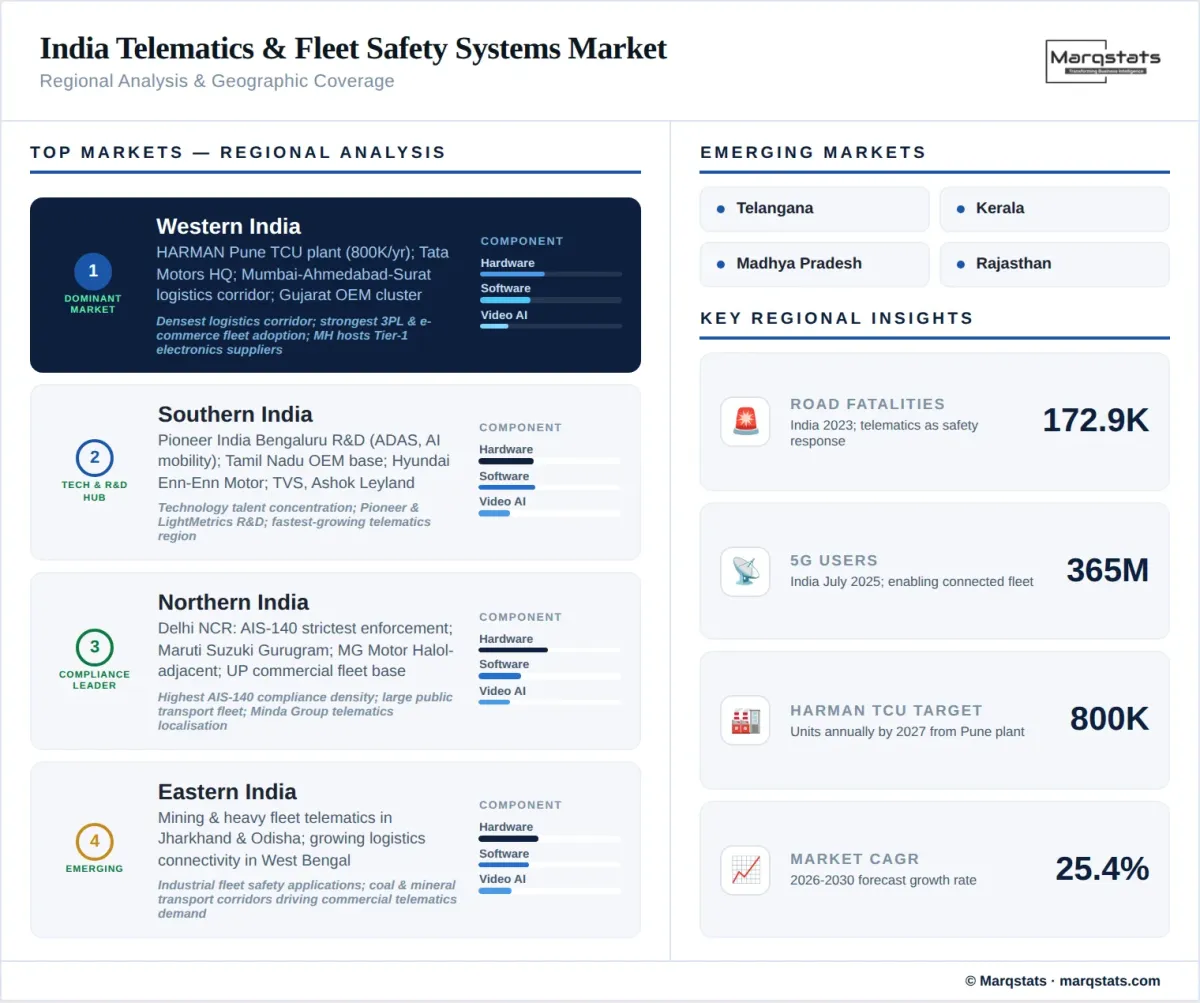
Western India
Western India—anchored by Maharashtra, Gujarat, and Rajasthan—is the dominant regional market for automotive telematics, accounting for the largest revenue share by installed base and OEM manufacturing activity. Maharashtra hosts HARMAN's Pune TCU manufacturing plant (targeted 800,000 units annually by 2027), Tata Motors' passenger vehicle headquarters, and a dense cluster of Tier-1 automotive electronics suppliers. Gujarat's expanding automotive manufacturing corridor (Suzuki, Tata, MG Motor) is accelerating factory-fitted telematics volumes. The region also benefits from India's strongest logistics density along the Mumbai-Ahmedabad-Surat corridor, driving fleet telematics adoption by 3PL operators and e-commerce logistics providers.
Southern India
Southern India—particularly Karnataka, Tamil Nadu, and Telangana—is the fastest-growing telematics region, driven by its concentration of technology talent, R&D investment, and OEM assembly. Pioneer India's May 2025 inauguration of its Bengaluru R&D centre for automotive vision, ADAS, digital cockpits, AI mobility data platforms, and two-wheeler connected solutions reflects the region's emergence as a telematics technology development hub. Tamil Nadu's OEM base (Hyundai Enn-Enn Motor, TVS, Ashok Leyland, Ford's former plant now serving as a manufacturing centre) is a significant telematics hardware demand node. Bangalore-headquartered technology startups are disproportionately shaping India's fleet SaaS and AI safety platform market.
Northern India
Northern India—Delhi-NCR, Haryana, Uttar Pradesh, and Punjab—is the largest fleet telematics demand region by fleet density, driven by its role as India's primary logistics corridor connecting manufacturing hubs to consumption centres. The Delhi-Mumbai Industrial Corridor and the Western Dedicated Freight Corridor are both driving structured fleet management adoption by large logistics operators. Gurugram hosts several fleet management SaaS companies and serves as the sales and operations hub for global telematics suppliers entering India. UP and Punjab's large truck and bus fleets are primary targets for AIS-140 compliance device upgrades and video telematics upsells.
Eastern India
Eastern India—West Bengal, Odisha, Bihar, and Jharkhand—represents an emerging telematics market with significant headroom, currently constrained by lower fleet formalisation, weaker 4G/5G network density outside major urban centres, and smaller OEM volumes. Bihar's implementation of the state VLT and EAS portal aligned with the national AIS-140 framework points to a compliance-led entry pathway for telematics vendors in the region. With the East Dedicated Freight Corridor and rising e-commerce penetration in tier-2 cities, eastern India is expected to log above-average growth in fleet telematics adoption through 2030.
Rest of India (Central and Northeastern States)
Central India (Madhya Pradesh, Chhattisgarh) and Northeastern states are nascent telematics markets, with adoption largely concentrated in state transport undertakings (STUs), government fleet compliance, and intercity logistics operators. Madhya Pradesh and Chhattisgarh's mining and heavy industry sectors create demand for asset-tracking and predictive maintenance telematics. As 5G networks expand to second- and third-tier cities, and as OEM-embedded telematics reaches sub-INR 10 lakh vehicles, these regions will become meaningful contributors to overall market growth in the latter half of the forecast period.
How Competition Is Evolving
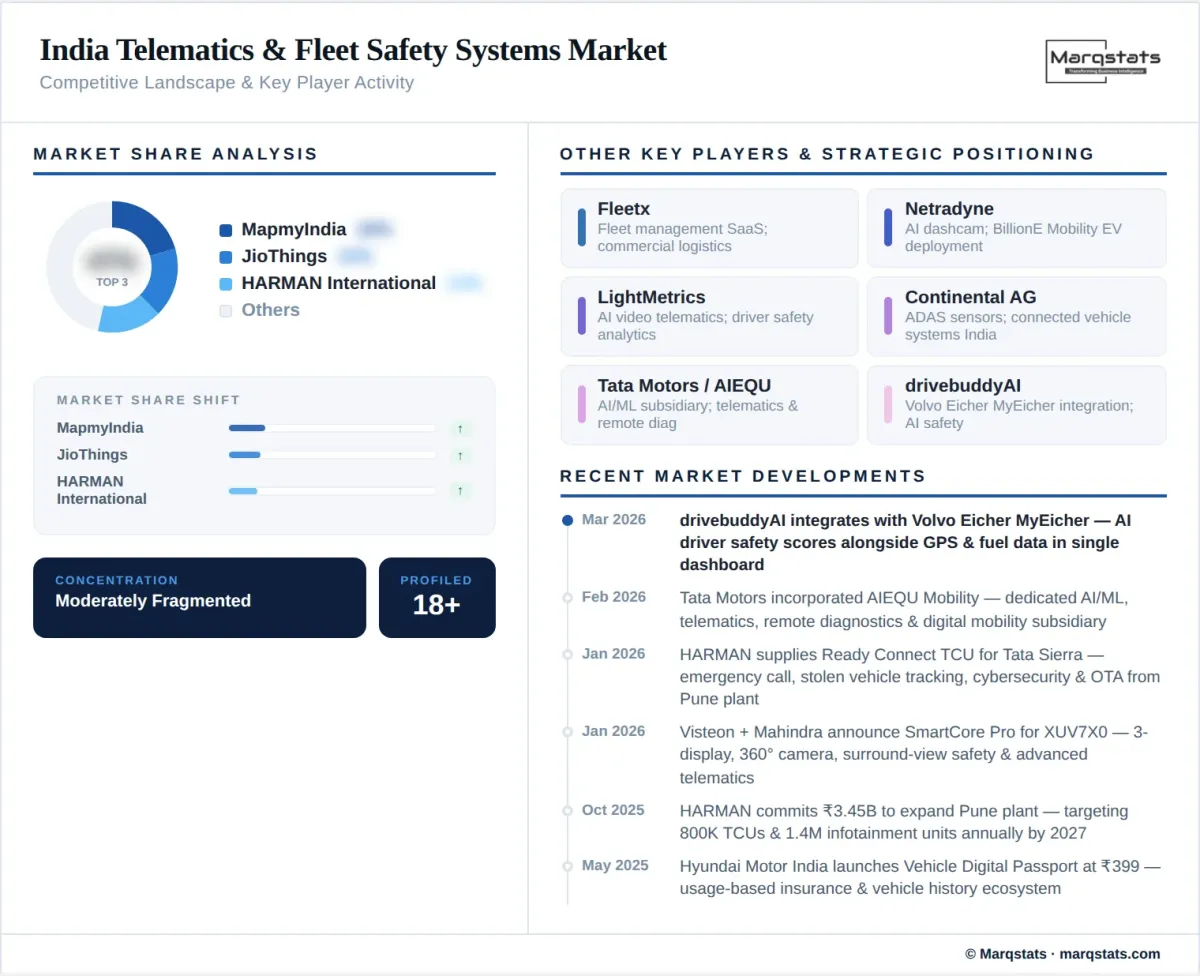
India's telematics and fleet safety systems market is moderately fragmented, with no single player holding more than 15–20% share across all layers. Competition is structured across four archetypes: domestic full-stack platforms, global Tier-1 hardware suppliers, scale-up SaaS fleet platforms, and AI-first safety specialists. The primary battleground is moving from hardware commoditisation to platform stickiness—vendors that can combine device reliability, connectivity management, fleet analytics, video safety, and workflow automation into a unified SaaS model are capturing the highest revenue-per-vehicle economics.
OEM-embedded telematics is reshaping competitive dynamics by extending factory-fitted platforms into aftermarket services. Tata Motors Fleet Edge, My Eicher, Ashok Leyland i-Alert, and Mahindra iMAXX are creating proprietary data ecosystems that reduce aftermarket vendors' access to vehicle diagnostics data. The February 2026 incorporation of Tata Motors' AIEQU Mobility Limited—purpose-built for AI/ML, telematics, and digital mobility solutions—signals that large OEMs are internalising what was previously a third-party services opportunity. In response, aftermarket platforms are differentiating on video telematics, AI coaching, multi-brand aggregation, and integration with logistics management systems.
Recent consolidation activity signals market maturation in the aftermarket layer. Sensorise's October 2025 acquisition of LocoNav's India fleet management business—the third-largest aftermarket fleet telematics player—to form the Eagle.ai platform, and Fleetx's ₹113 crore Series C fundraise in May 2025 underline two distinct strategies: roll-up consolidation versus organic platform expansion. Global entrants including ZF (SCALAR platform, launched India January 2025) and Netradyne (Indian enterprise deployments from late 2025) are raising the competitive bar on AI analytics and video safety, particularly for large enterprise fleet operators.
Companies Covered
The report profiles 18+ companies with full strategy and financials analysis, including:
Recent Market Activity
Table of Contents
Coverage & Segmentation
This report provides a comprehensive analysis of the India telematics and fleet safety systems market covering the 2021–2030 period, with 2025 as the base year, 2021–2025 as the historical window, and 2026–2030 as the forecast horizon. The study examines the full telematics value stack: regulatory and compliance tracking hardware (AIS-140 / IS 16833), fleet management software and AI analytics platforms, video telematics and driver safety systems (DDDAS, LDW, ADAS-linked), telematics control units and connectivity hardware, and OEM-embedded connected vehicle services across passenger car and mixed-fleet segments. Commercial vehicle-specific deep-dives—including heavy CV ADAS mandates, intercity bus telematics, and dedicated CV fleet management platforms—are covered in a companion report (Marqstats RD on India Commercial Vehicle Telematics and Safety Systems).
Primary research for this study included 40+ interviews with fleet telematics procurement managers, OEM connected-vehicle product leads, telematics hardware manufacturers, AI safety platform founders, and logistics sector CXOs across Delhi-NCR, Pune, Bengaluru, and Chennai. Secondary research drew from MoRTH annual accident reports, SIAM vehicle registration and sales data, ACMA–Grant Thornton telematics white papers, PIB policy notifications, company press releases and annual reports, stock exchange filings, and Department of Telecommunications 5G coverage data. Market sizing used a bottom-up approach validated against top-down signals from device registration data, OEM telematics subscription disclosures, and public fund-raise and M&A transaction values.