Market Snapshot
Key Takeaways
Market Overview & Analysis
Report Summary
The India electric two-wheeler battery market encompasses complete lithium-ion battery systems for electric scooters and electric motorcycles—integrating battery cells (NMC cylindrical 21700, LFP prismatic, and emerging LMFP), modules, battery management systems (BMS), thermal management systems, and structural enclosures designed for two-wheeler form factors. The market scope covers batteries for battery electric two-wheelers only; lead-acid low-speed variants and pedal-assist e-bikes (which use a distinct ‘e-bike’ classification globally) are excluded. The India electric scooter battery segment accounts for 95%+ of market value, while the India electric motorcycle battery segment (Revolt RV400, Ultraviolette F77, Tork Kratos, Bajaj Pulsar Electric) represents an emerging but fast-growing sub-segment at under 5% current share.
India’s electric two-wheeler industry delivered a record 14,01,663 retails in FY2025–26, a 22% increase over FY2024–25’s 12,09,772 units. Electric two-wheelers accounted for 59.4% of all EV sales in India and 6.54% of total two-wheeler sales—up from 6.2% the prior year. The top 10 OEMs account for 93.8% of high-speed e-2W sales, reflecting a concentrated but competitive market. With mainstream battery capacities spanning 2.2–5.3 kWh (TVS iQube at 2.2–5.3 kWh, Bajaj Chetak 35 at 3.5 kWh, Vida V2 Pro at 3.9 kWh, Ola variants at 3–5.2 kWh, Ather 450 range at 2.9–3.7 kWh), the battery pack represents the single most expensive component in every electric scooter, making battery pack price per kWh, energy density, thermal safety, and lifecycle performance the defining factors for product competitiveness.
The transition from subsidy-driven to demand-driven growth is structurally significant for battery suppliers. PM E-DRIVE provides INR 5,000/kWh capped at INR 10,000 per vehicle (FY2024–25), declining to INR 2,500/kWh capped at INR 5,000 (April 2025 to July 2026)—meaning the effective subsidy stops scaling beyond approximately 2 kWh, well below mainstream pack sizes. Real competitiveness now comes from battery cost, range, safety, warranty, and serviceability rather than subsidy optimization. India’s e-2W battery market contributed approximately 24.9% of India’s total EV battery demand of 13 GWh in 2024, implying roughly 3.2 GWh of dedicated two-wheeler battery consumption.
Market Dynamics
Key Drivers
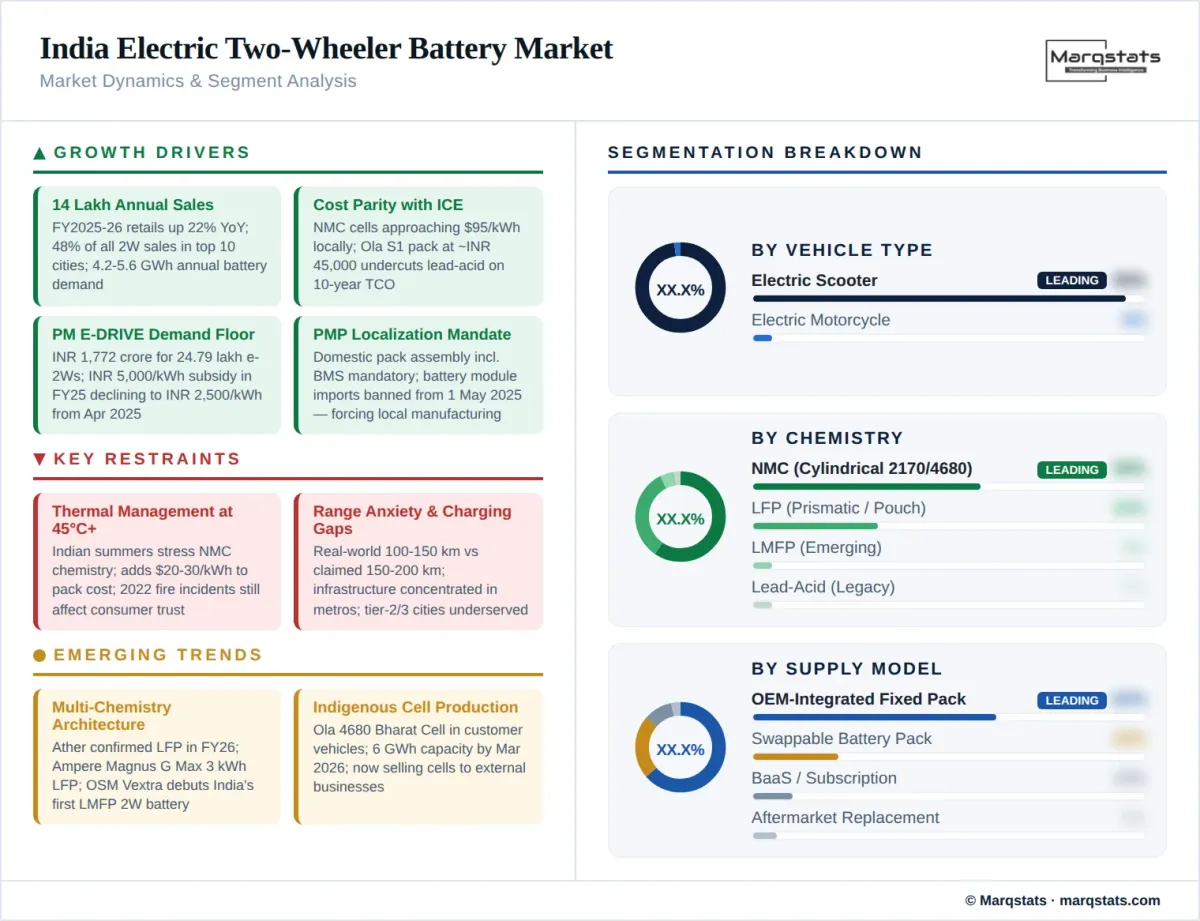
- Record two-wheeler EV volumes driving 4.2–5.6 GWh annual battery demand: FY2025–26 retails of 14.02 lakh units, with a mainstream battery capacity band of 3–4 kWh per vehicle, translate to approximately 4.2–5.6 GWh of annual pack demand—making the electric two-wheeler battery segment the largest single-application battery market in India by unit volume. This demand is structurally recurring and growing: EV penetration reached 48% of all two-wheeler sales in the top 10 Indian cities in 2025, and industry analyses project continued double-digit volume growth through 2030.
- Cost competitiveness versus ICE achieving tipping point: NMC cylindrical cells are approaching USD 95/kWh for locally produced units by early 2026, and Ola Electric’s S1 battery pack at approximately INR 45,000 already undercuts lead-acid on 10-year total cost of ownership. The lead-acid to lithium-ion transition is accelerating across the two-wheeler segment as lithium-ion offers 3–5x longer cycle life, 40% lower lifetime costs, and significantly better energy density. Global battery pack prices are trending toward USD 80/kWh by 2026, further improving electric scooter economics relative to INR 70,000–80,000 ICE scooters.
- PM E-DRIVE sustaining demand floor with INR 1,772 crore for 24.79 lakh e-2Ws: While subsidies are declining (from INR 5,000/kWh to INR 2,500/kWh), the scheme’s extension to 31 March 2028 (with e-2W support through July 2026) preserves near-term demand visibility. As of January 2026, approximately 16.56 lakh EVs had been incentivised under PM E-DRIVE (58.6% of the revised 28.27 lakh target). The Rajya Sabha Standing Committee on Industry recommended in March 2026 extending e-2W incentives to March 2028, which would provide additional demand support if implemented. PM E-DRIVE also targets 48,400 fast chargers for e-2Ws and e-3Ws.
- Phased Manufacturing Programme creating captive demand for domestic battery packs: The revised PMP effective 1 May 2025 mandates that traction battery packs for L1/L2 vehicles must be domestically manufactured—including cell-to-cell connections, bus bars, sensors, wiring/crimping, safety devices, BMS integration, thermal management integration, pressure-release valves, and enclosure fitment. Battery module imports are prohibited. Domestic BMS manufacture is also required. This creates captive demand for India-based pack assembly operations including Amara Raja (1.5 GWh plant operational), Exide Energy Solutions (modules and packs active, 12 GWh cell plant under construction), Tata AutoComp Gotion, and Endurance Technologies (started production January 2026 for a leading 2W OEM with INR 3 billion order).
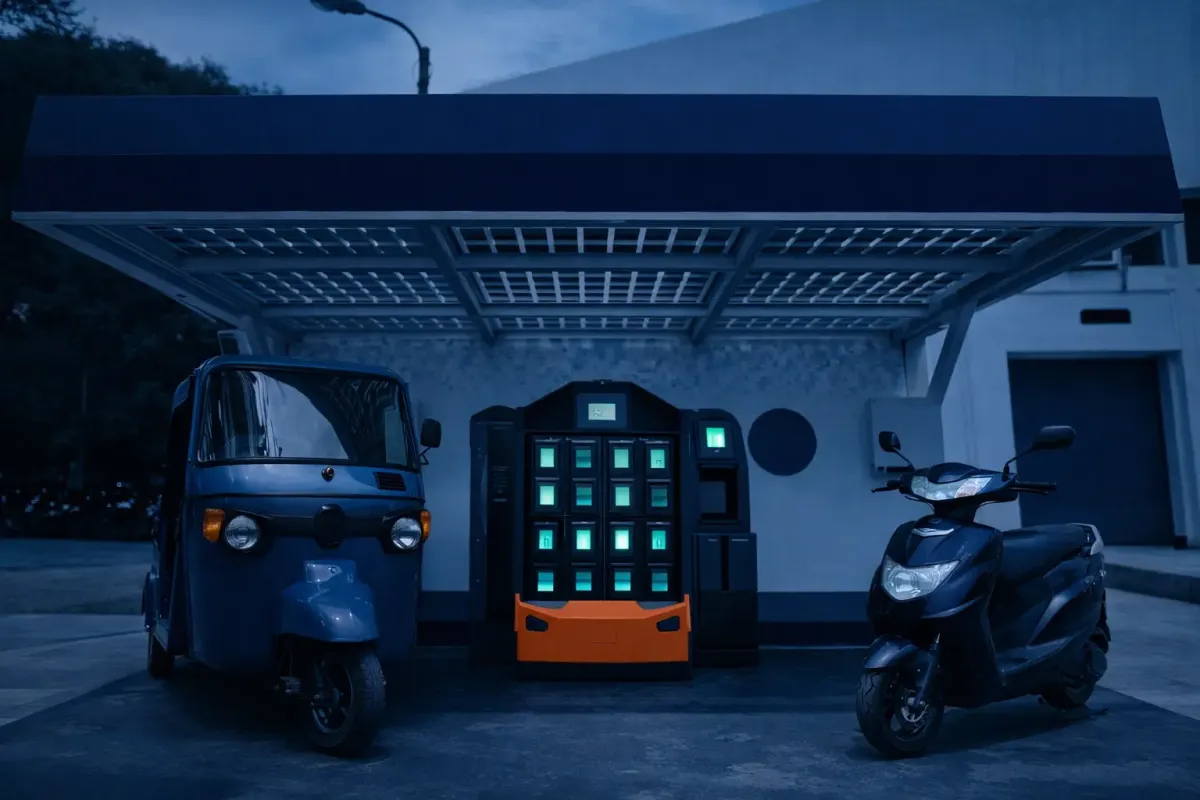
- Battery swapping and BaaS expanding addressable market beyond fixed-pack sales: Battery swapping networks are creating parallel demand for standardized, high-cycle-life battery packs. Ather Energy processes approximately 8,000 swap transactions daily across its network, targeting 200 stations by 2026. Indofast Energy partnered with e-Sprinto to deploy 20,000 electric two-wheelers with battery swapping, targeting 2,750 swap stations and 150,000 vehicles by March 2026. Vida’s Battery-as-a-Service model lowers upfront vehicle cost while creating a recurring commercial relationship around the battery. Flowatt Battery Science raised INR 22 million for its BaaS pay-per-use model targeting commercial mobility fleets.
Key Restraints
- Battery thermal management challenges in Indian climate exceeding 45°C: India’s extreme summer temperatures (45°C+) create significant thermal management challenges for two-wheeler battery packs, particularly NMC chemistry which is more heat-sensitive than LFP. Thermal management adds USD 20–30/kWh to pack costs for pouch configurations. The 2022 fire incidents that triggered AIS 156 safety standard amendments remain a consumer confidence concern. Battery degradation accelerates in hot climates, reducing typical lithium-ion pack life to 3–5 years in Indian conditions, making BMS quality and thermal design critical differentiators.
- Range anxiety and charging infrastructure gaps in tier-2/3 cities: Real-world range of 100–150 km versus claimed 150–200 km creates consumer anxiety, particularly for inter-city use. Public charging infrastructure remains concentrated in metropolitan areas, limiting adoption in tier-2 and tier-3 cities where two-wheeler demand is strongest. While PM E-DRIVE supports 48,400 fast chargers for e-2Ws/e-3Ws and the Ministry of Power issued new charging guidelines in September 2024 and battery swapping guidelines in January 2025, actual deployment lags targets.
- Fragmented aftermarket and unorganized battery replacement market: With 600+ players registered on VAHAN in the electric two-wheeler space, the gap between organized OEM-backed battery packs and unorganized aftermarket replacements creates safety and quality concerns. The electric two-wheeler aftermarket battery pack segment in India is largely untargeted by established pack manufacturers, despite representing high commercial potential as the FAME-I and FAME-II era fleet approaches battery end-of-life by 2028–2030. Battery lifecycle management including degradation monitoring and safe replacement remains an underdeveloped commercial layer.
- PLI-ACC cell manufacturing ramp-up lagging targets: The INR 18,100 crore PLI-ACC scheme has 40 GWh awarded but only 1 GWh commissioned as of early 2026, with no incentives paid. Ola Electric is the sole beneficiary to have operationalized cell manufacturing (~6 GWh capacity by March 2026). The Rajya Sabha panel called for a beneficiary-wise review, conditional timeline extensions, and possible reallocation of non-performing capacity. Until domestic cell supply scales, India’s two-wheeler battery market remains dependent on imported cells from China, Japan, and South Korea.
Key Trends
- Chemistry diversification from NMC-only to multi-chemistry architecture: The Indian electric two-wheeler battery market is shifting from NMC dominance to a mixed chemistry structure. Ather Energy—traditionally NMC-only—confirmed LFP packs went live in FY2026. Amara Raja’s agreement with Ather explicitly covers both NMC and LFP cells. Ampere launched the Magnus G Max with a 3 kWh LFP battery at INR 94,999 (January 2026). Most notably, Omega Seiki Mobility debuted the OSM Vextra with a 3.45 kWh LMFP (lithium-manganese-iron-phosphate) battery at INR 99,900—potentially the first LMFP-powered electric two-wheeler in India. LFP’s thermal stability advantage (250–270°C vs NMC’s 210°C) and 18–22% lower bill-of-materials cost are driving adoption, while NMC retains advantages in energy density (150–220 Wh/kg vs LFP’s 120–160 Wh/kg) for premium, range-focused products.
- Indigenous cell manufacturing entering commercialization: Ola Electric is commercially deploying its in-house NMC 4680 Bharat Cell in customer vehicles, with the Roadster X+ 9.1 kWh motorcycle offering 500 km range on a single charge. Ola has also started selling 4680 Bharat Cells and 1.5 kWh packs directly to businesses and startups for applications across automotive, humanoids, drones, and medical equipment. Its installed capacity reached approximately 6 GWh by March 2026, capable of supporting approximately 1.2 million products at 3.5–4 kWh per pack. Management indicated no further gigafactory expansion is planned beyond the current 6 GWh, as the focus shifts to scaling into this existing base.
- Warranty and battery health becoming the new competitive battleground: As the market matures beyond pure price competition, battery warranty and State of Health (SoH) guarantees are emerging as key purchase differentiators. Ather’s Eight70 programme offers 8 years / 80,000 km with battery replacement if health drops below 70%—far exceeding PM E-DRIVE’s minimum floor of 3 years / 20,000 km. Vida’s battery plan extends to 5 years / 60,000 km. Matter Energy partnered with US-based Iontra in March 2026 to integrate real-time battery sensing and adaptive charging technology that dynamically adjusts charging to cell condition and manages thermal stress without hardware changes. This trend signals that battery degradation performance is becoming a commercial battleground, not just a technical specification.
- AI-defined battery intelligence and connected platforms emerging: Matter Motor unveiled its AI-Defined Vehicles (AIDV) platform in January 2026, treating batteries as ‘intelligent, self-aware systems’ that sense their state, adapt to usage, and optimize over the vehicle lifecycle. Greaves/Ampere partnered with US-based Sibros in December 2025 to integrate its Deep Connected Platform for real-time battery health analytics, OTA updates, and predictive maintenance. India Nippon Electricals is developing BMS and motor controller systems for two-wheelers. These developments signal battery intelligence becoming a software-defined differentiator alongside hardware chemistry.
- Pouch cells gaining share alongside dominant cylindrical 21700 format: Cylindrical 21700 cells remain the dominant form factor for electric two-wheelers, offering 35% more energy than 18650 cells and 8–10% lower per-kWh pack cost. Ola Electric and Ather Energy use 21700 format. However, pouch cells are growing at approximately 24.3% CAGR, capturing 16.2% share in 2025, offering 12–18% weight savings. LG Energy Solution’s Pune 5 GWh plant (targeted 2026) will supply 250 Wh/kg NMC pouch cells, potentially disrupting the cylindrical-dominant market structure.
Market Segmentation
Electric scooters account for 95%+ of India’s electric two-wheeler battery market, making it the dominant application segment. Key models and their battery specifications span a wide range: TVS iQube (2.2–5.3 kWh variants across multiple trims), Bajaj Chetak 35 (3.5 kWh, IP54-rated), Ola S1 family (3–5.2 kWh NMC variants with in-house 4680 Bharat Cell integration), Ather 450X/450S (2.9–3.7 kWh, 21700 cylindrical), Hero Vida V2 Pro (3.9 kWh), and Ampere Magnus G Max (3 kWh LFP). The electric scooter battery price in India ranges from approximately INR 45,000 to INR 80,000 depending on capacity and chemistry. Mass-market scooters in the INR 80,000–1.5 lakh ex-factory price band (PM E-DRIVE ceiling) drive the bulk of battery pack demand.
Electric motorcycles represent an emerging sub-segment at under 5% market share but are growing rapidly. Revolt RV400 offers a swappable battery architecture capturing motorcycle-specific consumer searches. Ultraviolette F77 targets the premium performance segment and raised USD 45 million in Series E funding (December 2025) for F77/X-47 lineup expansion and battery technology advancement. Tork Kratos competes in the mid-range electric motorcycle space. Ola Electric’s Roadster X+ with 9.1 kWh 4680 Bharat Cell pack and 500 km claimed range represents the highest-capacity two-wheeler battery in India. Bajaj Pulsar Electric is anticipated. Motorcycle battery packs are typically 3–9 kWh with higher energy density requirements than scooters, favouring NMC chemistry.
NMC cylindrical 21700 cells remain the prevailing chemistry for Indian electric two-wheelers, deployed by Ola Electric, Ather Energy, and TVS among others. NMC offers energy density of 150–220 Wh/kg, enabling 100–150 km real-world range within compact 2.5–4 kWh packs suited to two-wheeler form factors. Ola Electric’s indigenous NMC 2170 cell production at its Tamil Nadu gigafactory—India’s first domestically manufactured lithium-ion cell—represents a landmark for supply chain localization, with the 4680 Bharat Cell format achieving higher capacity per cell. NMC cells are currently at approximately USD 95/kWh for locally produced units by early 2026. However, NMC’s higher thermal sensitivity (210°C runaway onset) versus LFP creates design constraints for India’s 45°C+ climate, adding USD 20–30/kWh for thermal management in certain pack configurations.
LFP is rapidly gaining share in the India electric two-wheeler battery market, driven by superior thermal stability (250–270°C runaway onset critical for Indian summers), 18–22% lower bill-of-materials cost versus NMC, and 3,000–5,000 cycle life versus NMC’s 1,500–2,000. LFP represented approximately 22% of India’s lithium-ion demand in 2025. Ather’s confirmation that LFP packs went live in FY2026 is particularly significant given its premium positioning. Ampere’s Magnus G Max (3 kWh LFP, INR 94,999) demonstrates LFP’s viability at mass-market price points. Tata AutoComp Gotion positions LFP-based pack capability for the two-wheeler ecosystem. LFP’s lower energy density (120–160 Wh/kg) means slightly larger/heavier packs for equivalent range, but the safety, cost, and localization advantages (LFP patent expiry in 2022 enabling domestic cathode production) are driving rapid adoption.
Omega Seiki Mobility’s launch of the OSM Vextra in February 2026 with a 3.45 kWh LMFP (lithium-manganese-iron-phosphate) battery at INR 99,900 potentially represents the first LMFP-powered electric two-wheeler in India. LMFP offers 15–20% higher energy density than standard LFP while preserving thermal stability and extended cycle life. Solid-state batteries for electric two-wheelers remain at early R&D stage, with a projected 33.5% CAGR to 2031 in India’s broader battery market but no near-term commercial deployment in two-wheelers.
The 21700 cylindrical cell is the dominant form factor for Indian electric two-wheelers, offering 35% more energy than legacy 18650 cells and 8–10% lower per-kWh pack cost. Ola Electric and Ather Energy are primary users. Ola’s evolution to 4680 format (larger cylindrical cell with higher capacity per unit) represents the next step in cylindrical form factor development for two-wheelers. Endurance Technologies started production of cylindrical cell assembly lines (imported from China) in January 2026 for a leading two-wheeler OEM with an INR 3 billion order.
Pouch cells hold approximately 16.2% share in India’s 2025 lithium-ion market and are growing at 24.3% CAGR, offering 12–18% weight savings versus cylindrical cells. LG Energy Solution’s planned 5 GWh Pune plant (2026) will supply 250 Wh/kg NMC pouch cells, potentially expanding pouch adoption in premium two-wheeler applications where weight and energy density are critical.
Prismatic cells serve the emerging LFP two-wheeler segment, offering better packing efficiency in rectangular form factors. Tata AutoComp Gotion provides prismatic LFP-based pack solutions. As LFP adoption grows in two-wheelers, prismatic cell share is expected to increase correspondingly.
By Geography
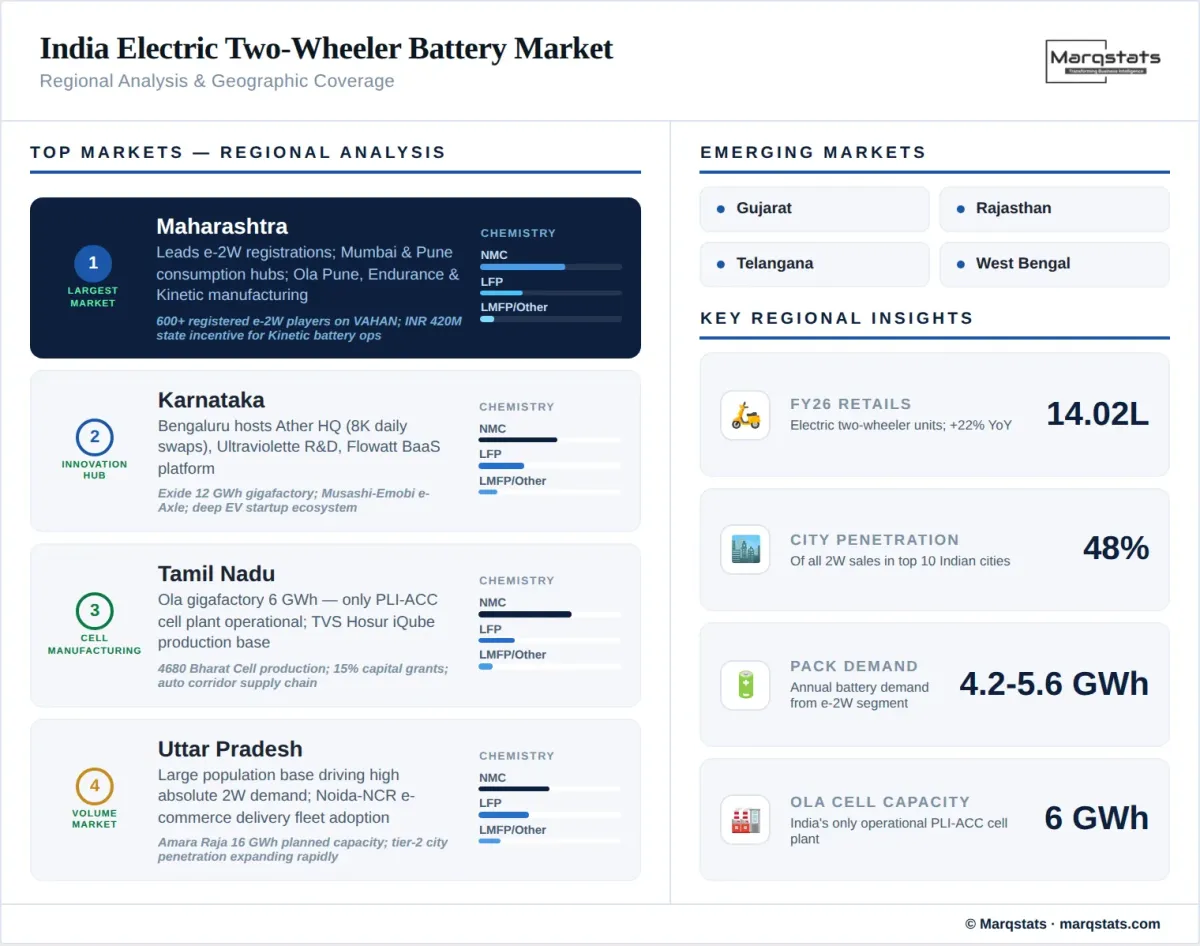
Maharashtra
Maharashtra leads India in electric two-wheeler registrations, anchored by Mumbai and Pune as major consumption centres. Ola Electric’s presence in Pune, Endurance Technologies’ battery pack facility near Pune (operational January 2026), and Kinetic Watts & Volts’ INR 700 million investment in DX EV production with Range-X battery assembly in Ahilyanagar create a manufacturing cluster. Maharashtra’s EV policy approved INR 420 million in benefits for Kinetic’s operations over 10 years. The state’s 600+ registered e-2W players on VAHAN reflect both organized OEMs and a fragmented aftermarket.
Karnataka
Karnataka’s Bengaluru serves as India’s two-wheeler EV innovation hub, hosting Ather Energy’s headquarters and swapping network (~8,000 daily transactions), Ultraviolette’s R&D centre (USD 45M Series E funding for battery technology advancement), and Flowatt Battery Science’s BaaS platform. Musashi Seimitsu launched its e-Axle-powered two-wheeler EV with Bangalore-based Emobi in November 2025, compatible with Honda’s BaaS platform. Exide’s 12 GWh Bengaluru gigafactory serves as an upstream cell supply anchor.
Tamil Nadu
Tamil Nadu hosts Ola Electric’s gigafactory (6 GWh capacity by March 2026)—the only operational PLI-ACC cell manufacturing facility in India, producing NMC 2170 and 4680 Bharat Cell formats. TVS Motor’s Hosur manufacturing base produces the iQube lineup. Bajaj’s supply chain reaches into Tamil Nadu’s automotive corridor. The state’s electricity-duty exemptions and capital grants attract continued battery manufacturing investment.
Telangana and Andhra Pradesh
Amara Raja Energy & Mobility’s giga corridor in Mahbubnagar (Telangana) targets 16 GWh cell and 5 GWh pack capacity, with its 1.5 GWh battery pack assembly plant inaugurated in August 2024. Amara Raja’s agreement with Ather for NMC and LFP two-wheeler cells strengthens the Telangana supply ecosystem. Cygni Energy’s Hyderabad gigafactory adds pack assembly capacity.
Delhi-NCR and Northern India
Delhi-NCR and northern India represent a major consumption hub for electric two-wheelers, supported by state-level incentives and e-commerce last-mile delivery demand. Omega Seiki Mobility’s Faridabad facility (25,000 annual OSM Vextra capacity) and Minda Corporation’s EV connector and battery pack component production serve the Delhi-NCR manufacturing base. Indofast Energy operates over 1,000 battery swap stations across 10 states and 22 cities, with highest concentration in northern India.
Rest of India
Tier-2 and tier-3 cities represent the growth frontier for electric two-wheeler battery demand, driven by rising fuel costs and expanding dealer networks. TVS iQube and Bajaj Chetak’s tier-2/3 expansion strategies are particularly significant for battery pack demand growth. Gujarat hosts Exide’s Prantij lithium-ion pack plant. Hero Vida leverages Hero MotoCorp’s 8,000+ dealer network for national distribution. Greaves/Ampere targets affordable electrification in semi-urban and rural markets with the LFP-based Magnus G Max positioned at INR 94,999.
How Competition Is Evolving
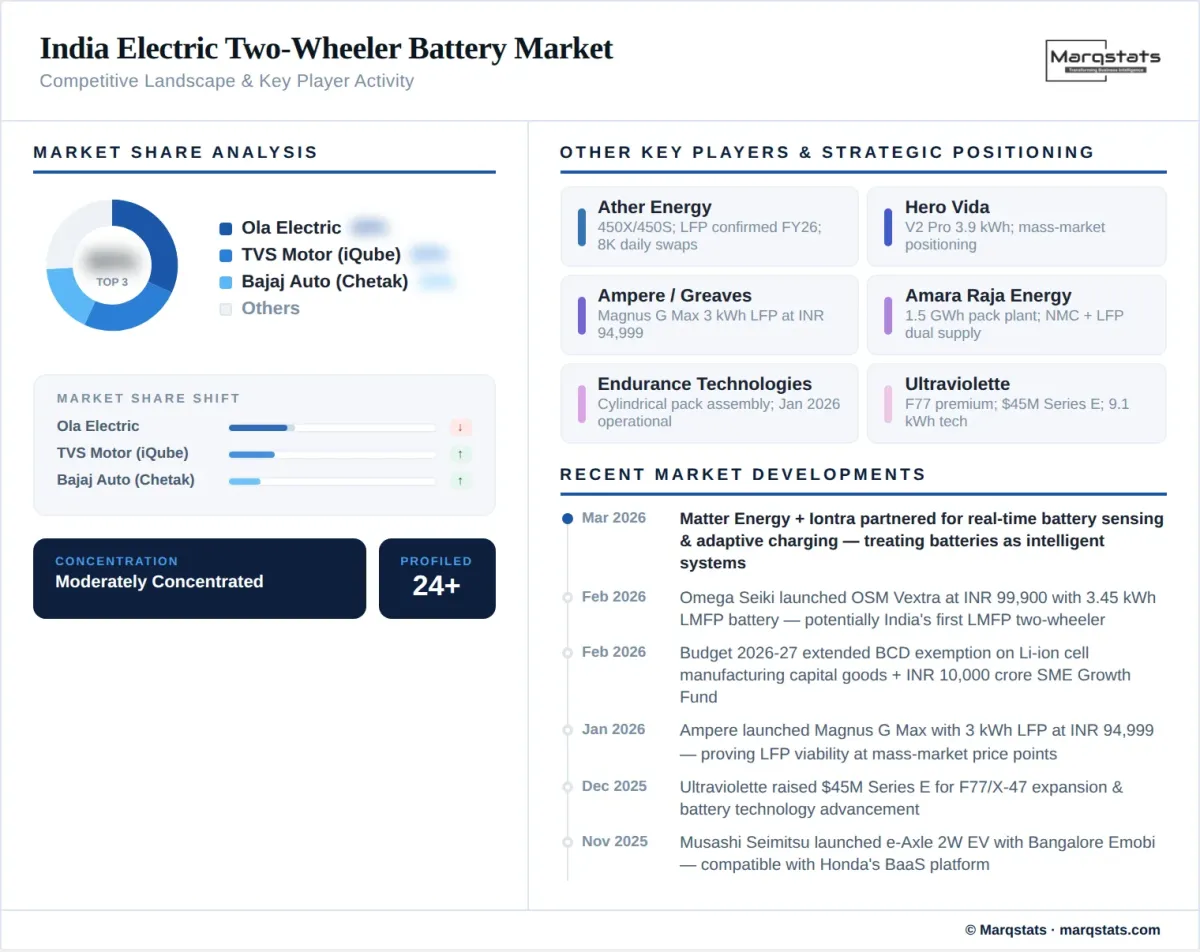
The India electric two-wheeler battery market features a two-tier competitive structure: vehicle OEMs that drive battery demand through product design, chemistry selection, and warranty commitments; and dedicated battery pack suppliers, cell manufacturers, and component providers that constitute the upstream supply chain.
On the OEM side, FY2025–26 saw a decisive shift toward legacy ICE two-wheeler manufacturers. TVS Motor led at 24.3% market share (up from lower positions in prior years), followed by Bajaj Auto at 20.6% and Ather Energy at 17.0%. Ola Electric, once the undisputed volume leader, declined to 11.7% as it focused on in-house cell manufacturing and motorcycle launches. Hero Vida (10.3%) and Greaves/Ampere (4.4%) round out the top tier. The top 10 OEMs command 93.8% of high-speed e-2W sales. This concentration means battery pack procurement decisions by six companies essentially determine the chemistry mix, cell format, capacity range, and supplier selection for the majority of India’s two-wheeler battery market.
On the supply side, Ola Electric’s vertical integration from cell to pack to vehicle (6 GWh capacity, NMC 4680 Bharat Cell) makes it India’s only two-wheeler OEM with in-house cell manufacturing. Amara Raja Energy & Mobility operates a 1.5 GWh battery pack plant and has technology licensing from Gotion-InoBat for LFP and NMC cells, with a specific supply agreement with Ather covering both chemistries. Exide Energy Solutions is building 12 GWh cell capacity while already active in module and pack production (INR 42 billion total investment in EESL). Tata AutoComp Gotion provides LFP-based pack, BMS, and thermal management solutions. Endurance Technologies started cylindrical pack assembly in January 2026 for a leading two-wheeler OEM (INR 3 billion order). Kinetic Engineering’s Range-X battery unit targets 60,000 units/year. Neuron Energy raised INR 310 million to scale to 3 GWh capacity. On the international side, CATL and LG Energy Solution remain key cell suppliers, with LG’s planned 5 GWh Pune pouch cell plant potentially reshaping the supply landscape.
Companies Covered
The report profiles 24++ companies with full strategy and financials analysis, including:
Recent Market Activity
Table of Contents
Coverage & Segmentation
This report provides a comprehensive analysis of the India electric two-wheeler battery market covering the historical period (2021–2025) and forecast period (2026–2030), with 2025 as the base year. The study examines market size in USD, unit volume forecasts, battery pack GWh demand, growth trends, competitive dynamics, and segment-level analysis across vehicle type (electric scooters, electric motorcycles), battery chemistry (NMC, LFP, LMFP, emerging), cell form factor (cylindrical 21700/4680, pouch, prismatic), battery pack capacity bands (sub-2 kWh, 2–4 kWh, 4+ kWh), ownership model (fixed pack, BaaS, swappable), and state-level geographic analysis. Company profiling covers 24+ players across vehicle OEMs, battery pack assemblers, and cell manufacturers.
Research methodology combines bottom-up battery demand modelling from VAHAN registration data and published pack capacities, validated against SIAM industry figures, FADA retail data, and company annual reports. Primary research encompasses interactions with two-wheeler OEMs, battery pack suppliers, cell manufacturers, charging/swapping network operators, and policy stakeholders. Companion Marqstats reports on the India EV battery pack market, India EV battery swapping market, India EV charging infrastructure market, and India EV battery recycling market provide integrated ecosystem intelligence.