Market Snapshot
Key Takeaways
Market Overview & Analysis
Report Summary
Pollination automation encompasses the full range of mechanical, robotic, and UAV-based technologies designed to perform or supplement the transfer of pollen between flowers in agricultural crop systems — replacing or reducing dependence on managed honey bee colonies, wild pollinator populations, and manual human pollination labour. The technology category spans five principal delivery architectures, each suited to different crop systems and commercial contexts. Air-pulse pollination — used by Arugga's Polly+ — generates directed airflow that vibrates tomato and other solanaceous crop flowers to release and disperse pollen in the controlled environment of a greenhouse row, mimicking the sonic vibration of bumble bee wing beats. Contact-based pollination — used by WVU's StickBug and various handheld devices — applies a physical probe or brush to transfer pollen directly to the flower's stigma. Pollen collection and targeted application — the model used by Edete and PowerPollen — harvests pollen from male flowers or donor plants, stores and preserves it, and applies it precisely to female flowers or hybrid seed production plants. UAV-based aerial delivery — used by Polybee and Dropcopter — deploys small drones to distribute pollen over or near flowers through downwash, spray, or electrostatic transfer. Micro-aerial insect-scale robotics — the MIT and Harvard RoboBee research programmes — represent the furthest-forward R&D frontier.
The commercial market has evolved through three phases. In the research and demonstration phase (2010–2018), academic programmes at WVU, Harvard (RoboBee/Wyss Institute), Delft University, and various Japanese institutions established the technical feasibility of robotic pollination across multiple architectures. In the early commercial phase (2018–2023), companies including Arugga, BloomX, Edete, Polybee, and PowerPollen moved from demonstration to initial farm deployments, primarily in greenhouse tomatoes, specialty orchards, and corn seed production. In the current commercial scale-up phase (2023–2026), the market has crossed a commercial viability threshold in greenhouse tomatoes (Arugga's 60 deployments, Polybee's multi-crop commercial operation) and specialty tree crops (Edete's 3,000+ California pistachio acres, BloomX's multi-country adoption) — with PowerPollen and Oxbo's January 2026 announcement marking the emergence of mechanised row-crop pollination as a distinct third commercial lane.
The competitive dynamics are shaped by a structural market fragmentation that is unlikely to resolve into a single platform leader. Different crop systems require fundamentally different pollination architectures: greenhouse tomatoes respond to air-pulse vibration (Arugga) or small drone airflow (Polybee); avocados and blueberries require cross-pollination with pollen from compatible varieties (BloomX's biomimetic approach); pistachios require precision pollen collection and targeted application at canopy scale (Edete); and hybrid corn seed production requires controlled pollen movement between inbred lines at field scale (PowerPollen/Oxbo). This crop-biology fragmentation means the market will likely remain segmented across crop-specific specialists for the foreseeable future, with consolidation happening within lanes rather than across them.
Market Dynamics
Key Drivers
- Pollinator decline and colony collapse disorder (CCD) creating structural demand for pollination alternatives: Wild bee population declines, honey bee colony collapse disorder, and the broader pollinator biodiversity crisis are creating a systemic vulnerability in global food production that has been extensively documented by IPBES, FAO, and national governments. Approximately 75% of the world's food crops — including fruits, vegetables, nuts, and oilseeds — depend on animal pollination to varying degrees, representing a total contribution to global food production estimated at USD 235–577 billion annually. North American honey bee colony losses have exceeded 30–40% per year for over a decade, and managed colony transport costs have risen sharply as beekeeper capacity fails to keep pace with commercial demand. In greenhouse environments where domesticated bees struggle to navigate under artificial light or in filtered-air environments, commercial bumblebee colony costs represent a meaningful operating expense that robotic alternatives can justify replacing.
- Labour shortage and cost inflation in commercial greenhouse and orchard horticulture: Manual pollination using electric vibrators or handheld blowers is a daily labour-intensive task in high-value greenhouse crops such as tomatoes, peppers, and strawberries. In labour-constrained markets — particularly the Netherlands, UK, Canada, Australia, and the U.S. — the cost and availability of skilled greenhouse labour makes automation ROI compelling. Arugga's commercial positioning explicitly addresses the labour dimension: the Polly+ system navigates greenhouse rows autonomously and performs the daily pollination cycle without manual intervention, with company-reported yield performance that ranges from parity to 20% above manual pollination and up to 5% above bumblebees.
- Specialty crop yield variability and food company supply-chain quality requirements: In high-value tree crops — pistachios, almonds, avocados, blueberries — inter-annual yield variability driven by insufficient or poorly timed pollination represents a significant commercial risk for growers and food companies. Edete's Pollination-as-a-Service model in California pistachios — reporting 15–30% yield improvement with 24% average uplift in a company case study — addresses this directly: by collecting, storing, and precisely applying pollen at the optimal phenological window regardless of weather conditions or wild bee activity, precision pollination services reduce yield variability and improve crop uniformity at commercially meaningful scale.
- Hybrid seed production requiring controlled pollination creates distinct industrial demand: The commercial production of hybrid corn, sunflower, and other field crop seeds requires precise cross-pollination between inbred parental lines under controlled conditions — a process where the timing, spatial precision, and pollen viability of the transfer directly determines seed set and hybrid seed lot quality. PowerPollen's platform, which has applied its technology across thousands of commercial acres in prior seasons and is scaling through the Oxbo partnership for 2026, addresses a distinct industrial demand for controlled pollination in a USD 10+ billion global hybrid seed production market that conventional mechanisation has not previously addressed.
- Indoor vertical farming and CEA expansion creating new pollination addressable markets: The global expansion of controlled-environment agriculture (CEA) — including indoor vertical farms, large-scale glass greenhouses, and high-tunnel protected cropping — is creating growing demand for pollination solutions that work in environments where natural bees are impractical. Polybee's founding premise, as described by its founder Siddharth Jadhav to Scientific American, was explicitly to address this indoor-farm pollination gap. MIT's robotic insect programme, as described by Prof. Kevin Chen in January 2025, specifically identifies indoor farming and vertical farms as the primary commercial target for near-term robotic insect pollination deployment.
Key Restraints
- Technical robustness challenges at commercial scale: A 2025 review of autonomous pollination technologies identifies bottlenecks in flower detection and pose estimation, specialised end-effector design for delicate flower contact, decision-making robustness in variable real-world greenhouse and orchard conditions, and motion control precision at operational speeds. WVU's StickBug, while a significant design advance achieving 1.5 pollinations per minute, reported a 50% success rate in initial validation — well below the reliability threshold required for commercial deployment as a standalone system. These fundamental robotics challenges explain why commercial deployment is currently led by simpler air-pulse and drone-airflow systems rather than contact-based robotic manipulators.
- Pollen logistics: the chicken-and-egg problem in pollen-supply-dependent systems: A 2023 review of artificial pollination technologies identifies a structural constraint in pollen-supply-dependent systems: many orchard and UAV-based pollination systems require pre-collected, preserved, and accurately timed pollen supply — but pollen collection, storage, and viability maintenance at commercial scale is itself a complex and costly operation. PowerPollen's May 2025 foundational patent for pollen storage methodology, and Edete's integrated pollen collection and application service model, are both directly addressing this constraint — which explains why pollen handling and preservation IP is commercially significant in this market.
- Market fragmentation by crop biology limiting platform scalability: Because different crops require fundamentally different pollination mechanics (vibration for tomatoes, cross-pollen application for avocados and blueberries, wind-assisted for corn, contact-stigma application for brambles), no single pollination automation architecture can serve the full addressable market. This fragmentation limits the scalability of individual platforms and means that most commercial players are currently confined to one or two crop systems, constraining revenue growth compared to more universal agricultural automation categories.
- Grower adoption friction and ROI demonstration requirements: Commercial growers considering investment in pollination automation — particularly capital-intensive robotic systems — require credible yield improvement evidence, reliable operational performance data, and clear payback period calculations. Company-reported yield figures (Arugga's 20% improvement, Edete's 24% pistachio uplift, Polybee's 15% greenhouse yield gain) are commercially useful but require third-party corroboration for broader grower confidence. The Delphy Improvement Centre trial of Polly+ in the Netherlands (October 2025) reflects the need for independent validation that the market is beginning to supply.
Key Trends
- From pollination device to pollination operating system: Business model evolution: The market is shifting from selling pollination hardware to selling pollination workflows — combining robotic or UAV delivery with yield forecasting, crop data capture, grower-facing dashboards, and service models. Arugga combines robot deployment with data capture and performance analytics; Edete operates a full Pollination-as-a-Service model that includes pollen collection, preservation, and application without requiring growers to operate any equipment; Polybee blends autonomous pollination with yield forecasting and field intelligence; and PowerPollen operates through its Oxbo partnership as a mechanised equipment-and-pollen-platform provider. This operating-system framing is consistent with the broader trend in agricultural automation toward workflow ownership over device sales.
- Multi-crop platform development expanding beyond early adopter crops: Early commercial deployments are concentrated in greenhouse tomatoes (Arugga, Polybee), California pistachios (Edete), avocados and blueberries (BloomX), and hybrid corn seed (PowerPollen). The R&D pipeline is extending into apples, strawberries, kiwifruit, date palms, peppers, brambles, and indoor leafy crops — reflecting both academic activity (WVU StickBug targeting blackberries and tomatoes, Georgia Tech indoor flower prototype) and commercial platform expansion (Polybee's multi-crop open-field and greenhouse deployments, BloomX's YAHAV2400 robotic platform for tree crops).
- UAV pollen delivery maturing from orchard trials to commercial service: Dropcopter's service operations across almond, apple, cherry, and pistachio orchards from California to Brazil represent the most geographically extensive UAV pollination service offering currently deployed. The intersection of UAV pollen delivery with precision flight planning, variable-rate pollen application, and post-season yield verification is creating a service infrastructure for orchard pollination that parallels aerial crop protection. Polybee's drone-based approach in open fields and greenhouses represents a distinct indoor/protected-cropping application of the same UAV platform architecture.
- Micro-aerial robotic insects entering the credible near-term research-to-commercial pipeline: MIT's January 2025 Science Robotics publication of a sub-paperclip robotic insect achieving 1,000-second hover — 100x the previous record — and Prof. Kevin Chen's explicit identification of indoor-farm assisted pollination as the target application within 3–5 years, combined with a December 2025 follow-up publication on bumblebee-speed aerobatics, represents the most significant single advance in insect-scale robotic pollinators in the category's history. While still requiring external power and lab-only deployment, the research trajectory suggests that autonomous micro-aerial pollinators capable of operating in vertical farms and controlled-environment facilities may be commercially viable in the late 2020s.
Market Segmentation
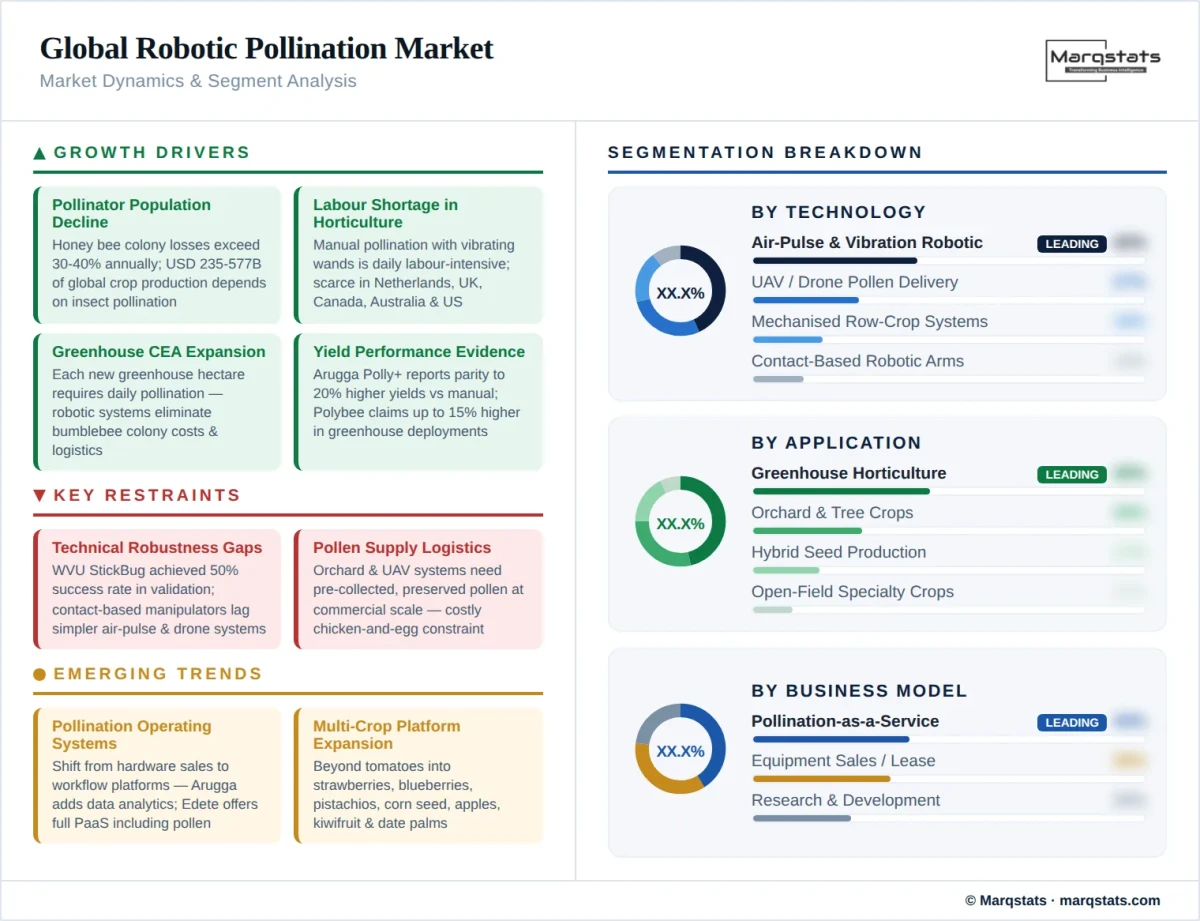
Air-pulse and vibration systems are the dominant commercial technology segment, estimated at 40–44% of 2025 market revenue, anchored by Arugga AI Farming's Polly+ system which uses directed air pulses to vibrate tomato flower clusters — mimicking the sonic vibration of bumblebee wing beats that releases pollen from poricidal anthers. This architecture requires no external pollen supply, is non-contact (reducing flower damage risk), and is well-suited to the controlled row environment of glass and poly greenhouses. Arugga reports 60 commercial deployments across Australia, Europe, and North America as of September 2025, with yields ranging from parity to 20% higher than manual pollination and up to 5% higher than bumblebees in company-reported results. The October 2025 Delphy Improvement Centre trial in the Netherlands — comparing Polly+ against bumblebees under an energy-saving screen setup — represents the first major independent validation trial of this architecture at commercial scale.
UAV and drone-based pollen delivery is the second-largest technology segment and the most architecturally versatile, estimated at 25–28% of 2025 revenue. Polybee's platform — commercially deployed in open-field spinach and broccoli as well as greenhouse tomatoes, strawberries, and blueberries — uses AI-powered small drones with colour camera sensors to fly near plants and distribute pollen through downwash or proximity. Dropcopter's aerial application service uses larger UAVs to distribute pre-collected pollen at canopy scale across almond, apple, cherry, and pistachio orchards from California to Brazil. The UAV architecture is particularly well-suited to large-scale orchard systems where ground-based robots cannot efficiently cover the spatial footprint of production trees. Polybee's February 2026 USD 4.3 million raise and multi-crop commercial operations confirm this segment's commercial momentum.
Precision pollen collection, storage, and application represents the third major technology architecture and the model best suited to cross-pollination-dependent crops (avocados, pistachios, almonds, blueberries) and hybrid seed production. Edete's integrated Pollination-as-a-Service model — which collects pollen from donor trees, preserves viability through specialised storage, and applies it precisely to female flowers at the optimal phenological moment — has expanded to 3,000+ California pistachio acres in 2024 and reports 15–30% yield improvements. PowerPollen's platform, which received a foundational pollen storage methodology patent in May 2025 and is scaling corn-seed production through the Oxbo partnership, operates in the hybrid seed production sub-segment of this architecture. BloomX's biomimetic device approach — designed to simulate biological cross-pollination for crops like avocados and blueberries — represents a variation that integrates pollen collection with a device-based targeted application model.
Insect-scale micro-aerial robots and multi-armed contact pollination robots represent the R&D frontier of the market with no current commercial deployment. MIT's robotic insect (Science Robotics, January 2025) — weighing less than a paperclip, hovering for 1,000+ seconds — is targeting indoor-farm assisted pollination as the primary application within 3–5 years. WVU's StickBug six-armed precision robot — USDA NIFA-funded, presented at IROS 2024 — achieves 1.5 pollinations per minute at 50% success in greenhouse brambles. Harvard's RoboBee programme at the Wyss Institute and Georgia Tech's indoor flower pollination robot prototype (February 2026) round out the academic pipeline. These programmes collectively indicate that insect-scale autonomous robotic pollination for vertical farms and indoor CEA may achieve commercial relevance in the late 2020s, though battery autonomy, sensor miniaturisation, and cost-per-unit remain major barriers.
Greenhouse and protected-cropping vegetables — led by tomatoes, peppers, cucumbers, and strawberries — are the dominant crop-system segment, estimated at 45–50% of 2025 market revenue. The combination of controlled environment, predictable row structure, high crop value, daily pollination requirement, and bumblebee replacement economics makes this the natural first commercial market for pollination automation. Arugga's Polly+ and Polybee's drone systems both compete directly in this segment, which is concentrated in the Netherlands, Belgium, Spain, UK, Canada, Australia, and increasingly the U.S.
Specialty orchards — encompassing pistachios, almonds, avocados, blueberries, apples, and cherries — represent the second-largest crop system segment, estimated at 28–32% of 2025 revenue, and the primary commercial territory for Edete, BloomX, and Dropcopter. The fundamental commercial value proposition in orchards is yield improvement and variability reduction through reliable cross-pollination rather than bee replacement — a distinction that makes the economics of precision pollination services compelling even when bee colonies are available, because natural pollination quality in these crops is highly weather-sensitive and inter-annual variability is commercially costly.
Row-crop and hybrid seed production pollination automation is the newest and fastest-growing crop-system segment, estimated at 15–18% of 2025 revenue but growing rapidly as PowerPollen's Oxbo partnership scales mechanised corn-seed pollination from thousands of acres of prior seasons to broader commercial deployment in 2026. The segment addresses a fundamentally different commercial problem from greenhouse or orchard pollination: not natural pollinator replacement, but precision control of pollen movement between inbred parental lines in hybrid seed production — a USD 10+ billion global market where seed set quality and hybrid lot purity directly determine product value.
By Geography
Europe
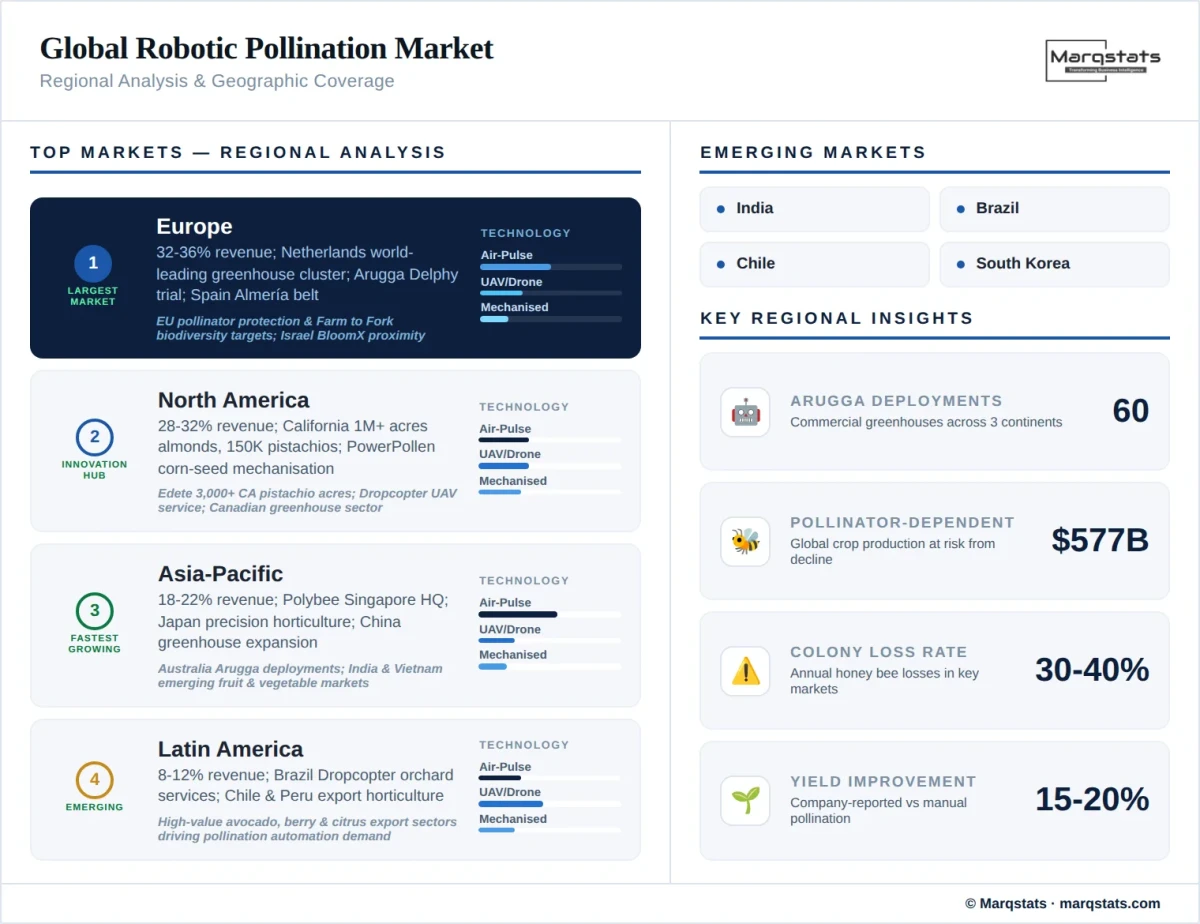
Europe is the largest regional market, estimated at 32–36% of 2025 global revenue, anchored by the Netherlands' world-leading commercial greenhouse horticulture sector. The Netherlands hosts Arugga's most visible European deployments, the October 2025 Delphy Improvement Centre Polly+ trial, and a dense commercial greenhouse cluster where daily pollination of tomatoes, cucumbers, and peppers represents a significant operational challenge. Belgium, Spain (Almería greenhouse belt), Germany, France, the UK, and Italy are secondary greenhouse markets with meaningful pollination automation addressable area. Israel — home to BloomX and the broader BloomX adoption base — is geographically proximate to Europe's specialty fruit export supply chains and relevant to orchard automation demand in Mediterranean fruit crops. The EU's pollinator protection initiatives and Farm to Fork biodiversity targets create policy tailwinds for investment in pollinator-independent crop production technologies.
North America
North America is the second-largest market, estimated at 28–32% of 2025 revenue, driven by the United States' world-leading specialty nut, fruit, and vegetable production sectors and the Canadian greenhouse vegetable industry. California — home to over 1 million acres of almonds (90% of global supply), 150,000 acres of pistachios, and the world's largest commercial greenhouse and orchard automation investment environment — is the most important single U.S. state market. Edete's 3,000+ California pistachio acres and the California Rice Commission's 2025 first-in-state gene-edited rice field research approval (covering adjacent precision crop management) reflect California's early-adopter commercial culture. PowerPollen's corn-seed production mechanisation is concentrated in the U.S. Midwest corn belt and is scaling for the 2026 season through Oxbo. Canada's Ontario and British Columbia greenhouse sectors are also active Arugga and Polybee deployment markets.
Asia-Pacific
Asia-Pacific accounts for approximately 20–24% of 2025 revenue, with Australia as the most commercially active market. Arugga reports commercial deployments in Australia alongside Europe and the Americas. Australia's large-scale almond and pistachio sectors, commercial tomato and strawberry greenhouse industry, and well-developed precision agriculture technology adoption environment make it a natural early adopter market. Japan has a world-leading precision horticulture sector where robotic pollination for strawberries, tomatoes, and other greenhouse crops has been the subject of significant academic and commercial investment (multiple Japanese university and government-funded programmes target tomato and strawberry robotic pollination). China's massive greenhouse area and large-scale kiwifruit and orchard sectors represent the largest long-term APAC opportunity. Singapore's vertical farming sector — where Polybee was founded — is a niche but symbolically important early-adoption market for drone-based indoor pollination.
Latin America and Rest of World
Latin America and rest of world account for approximately 10–14% of 2025 revenue, with Israel, Brazil, Chile, and South Africa as the primary markets. BloomX's commercial adoption base in avocados and blueberries spans Latin America, Israel, and South Africa — making it the most geographically distributed commercial operator in the specialty-fruit orchard lane. Dropcopter has also operated commercially in Brazil alongside California. Israel's combination of world-leading agricultural technology and high-value specialty crop exports makes it both a product development and commercial deployment hub for BloomX and adjacent pollination automation companies. Brazil's large-scale fruit export sector (mangoes, avocados, blueberries) and growing commercial greenhouse vegetable industry represent significant near-term addressable markets.
How Competition Is Evolving
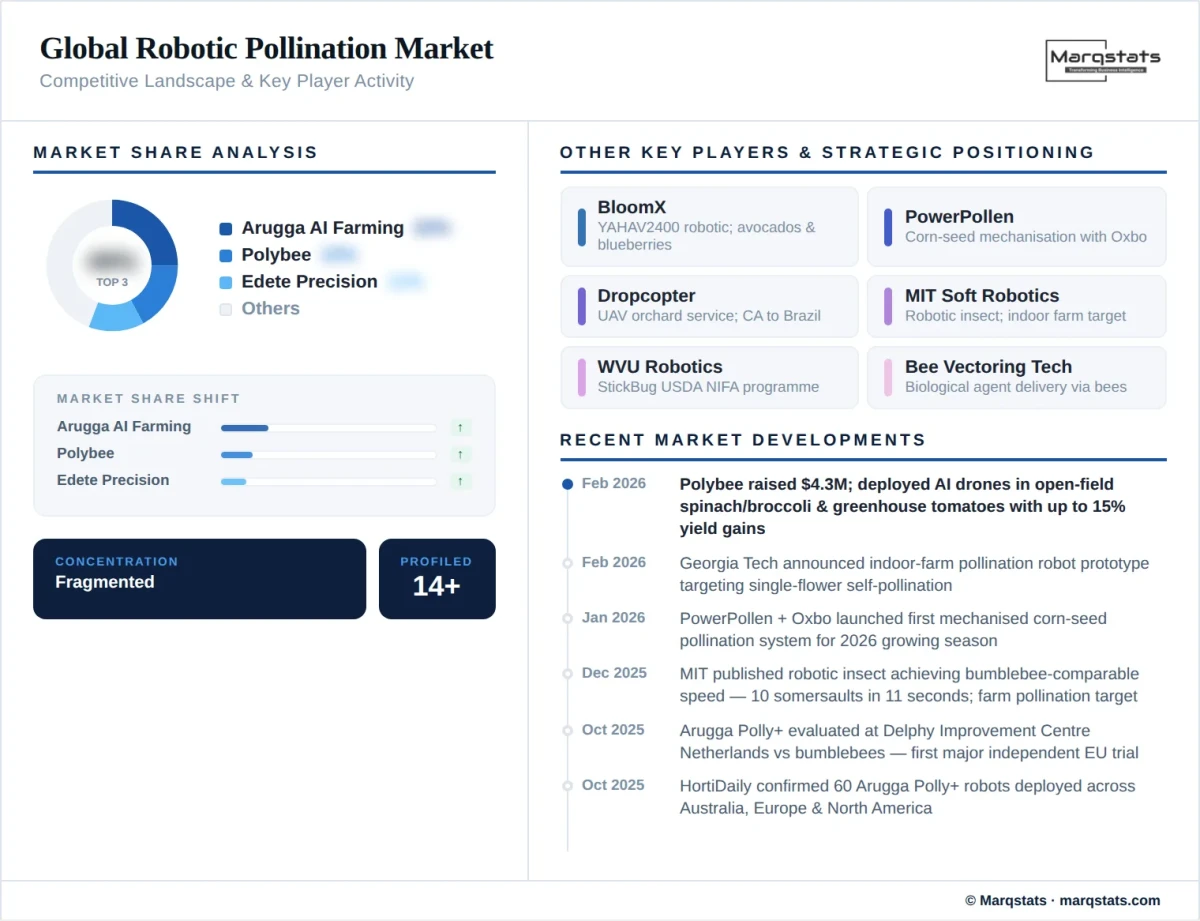
The global pollination automation market has no single overall leader across all crop systems and architectures. Competition is occurring within three structurally distinct lanes — greenhouse robotic pollination, orchard and specialty-crop precision pollination, and row-crop mechanised pollination — with limited direct competition across lanes. Within greenhouse robotic pollination, Arugga holds the clearest commercial lead based on deployment scale and product evolution (Polly+ through multiple generations, 60 commercial sites by September 2025). Polybee is the most credible near-term challenger, with its February 2026 raise, multi-crop commercial deployments, and greenhouse-to-open-field flexibility. The WVU StickBug and MIT robotic insect programmes represent the next-wave R&D frontier but are 3–7 years from commercial relevance at scale.
Within orchard and specialty-crop pollination, Edete holds the strongest service-model commercial position with 3,000+ California pistachio acres in 2024 and a 24% company-reported average yield improvement. BloomX is the most strategically interesting challenger: having built adoption in avocados and blueberries across Latin America, Israel, and South Africa through its biomimetic device, it is now preparing to launch its first robotic tree-crop platform (YAHAV2400) in 2026 — the most significant new product entry in the orchard automation lane. Dropcopter occupies a focused UAV-orchard lane with commercial operations across almonds, apples, cherries, and pistachios from California to Brazil. Within row-crop pollination, PowerPollen and Oxbo's January 2026 announcement establishes them as the only company with a deployed mechanised corn-seed pollination system for the 2026 commercial season — with no comparable direct competitor currently visible.
Business model competition is at least as important as technology competition in this market. Edete's Pollination-as-a-Service model — where the grower pays for a service outcome rather than operating equipment — lowers adoption barriers dramatically compared to capital equipment purchase. PowerPollen's shift from pure service toward an equipment-and-platform model through Oxbo creates a more scalable go-to-market architecture. Arugga's robot-plus-data model is creating recurring revenue streams beyond equipment sales. These business model differences will significantly influence which players achieve durable market positions as the commercial landscape matures through 2030.
Companies Covered
The report profiles 14+ companies with full strategy and financials analysis, including:
Recent Market Activity
Table of Contents
Coverage & Segmentation
This report provides a comprehensive analysis of the global pollination automation market covering the historical period 2021–2025 and the forecast period 2026–2030, with 2025 as the base year. The study examines market size and revenue forecasts in USD billion, segmented by technology (air-pulse and vibration robotic systems, UAV and drone-based pollen delivery, precision pollen collection/storage/application, insect-scale micro-aerial robotics), crop system (greenhouse and protected-cropping vegetables, specialty orchards and tree crops, row crops and hybrid seed production), and geography (Europe, North America, Asia-Pacific, Latin America and Rest of World). Scope covers commercial robotic and autonomous pollination systems, UAV-based pollen delivery services, precision pollination service contracts, and mechanised pollen collection and application equipment when deployed for agricultural crop pollination. Managed bee colony transport, conventional handheld manual pollination tools, and plant breeding programmes are excluded from scope.
Research drew from company press releases and product announcements, HortiDaily commercial deployment coverage, AgFunderNews funding disclosures, peer-reviewed reviews of autonomous pollination technologies (2023 and 2025), MIT Science Robotics publications (January 2025, December 2025), WVU StickBug USDA NIFA programme reports and IEEE/RSJ IROS 2024 presentation, PowerPollen and Oxbo commercialisation announcements, Polybee February 2026 funding and deployment disclosure, Edete commercial service data and case study reporting, BloomX roadmap coverage, Dropcopter orchard service documentation, and Delphy Improvement Centre trial reporting through March 2026.