Market Snapshot
Key Takeaways
Market Overview & Analysis
Report Summary
The electric vehicle bearings market covers all bearing types engineered for battery electric vehicles and plug-in hybrid electric vehicles: wheel-end hub unit bearings (low-friction, sensor-integrated, heavier-load-rated for battery weight), e-axle and drive motor bearings (high-speed, electrically insulated, compact), reduction gearset bearings, and supporting positions including steering column, suspension, and auxiliary motor bearings. The market encompasses ball bearings (approximately 62% share in 2024), roller bearings (tapered, cylindrical, needle), and ceramic hybrid bearings designed specifically for EV electrical insulation. The scope covers OEM fitment (new vehicle production) and the emerging EV-specific aftermarket repair segment. ICE-only automotive bearings are excluded, though dual-use bearings serving hybrid architectures are included. Materials covered span chrome steel, stainless steel, silicon nitride (Si₃N₄) ceramic elements, resin-mould insulation, and advanced surface treatments.
This market is more qualification-driven than regulation-driven. Unlike batteries or charging hardware, EV bearings are not shaped by one headline EV-specific regulation. The real gatekeepers are automotive quality systems: IATF 16949 defines quality-management requirements across the global automotive industry, and PPAP (Production Part Approval Process) demonstrates that engineering and specification requirements are consistently met in serial production. Multiple leading bearing plants maintain IATF 16949 certification. The commercial filters for EV bearings are therefore: performance, electrical-erosion mitigation, NVH, compactness, cost, and automotive qualification readiness—not regulatory compliance alone.
Market Dynamics
Key Drivers
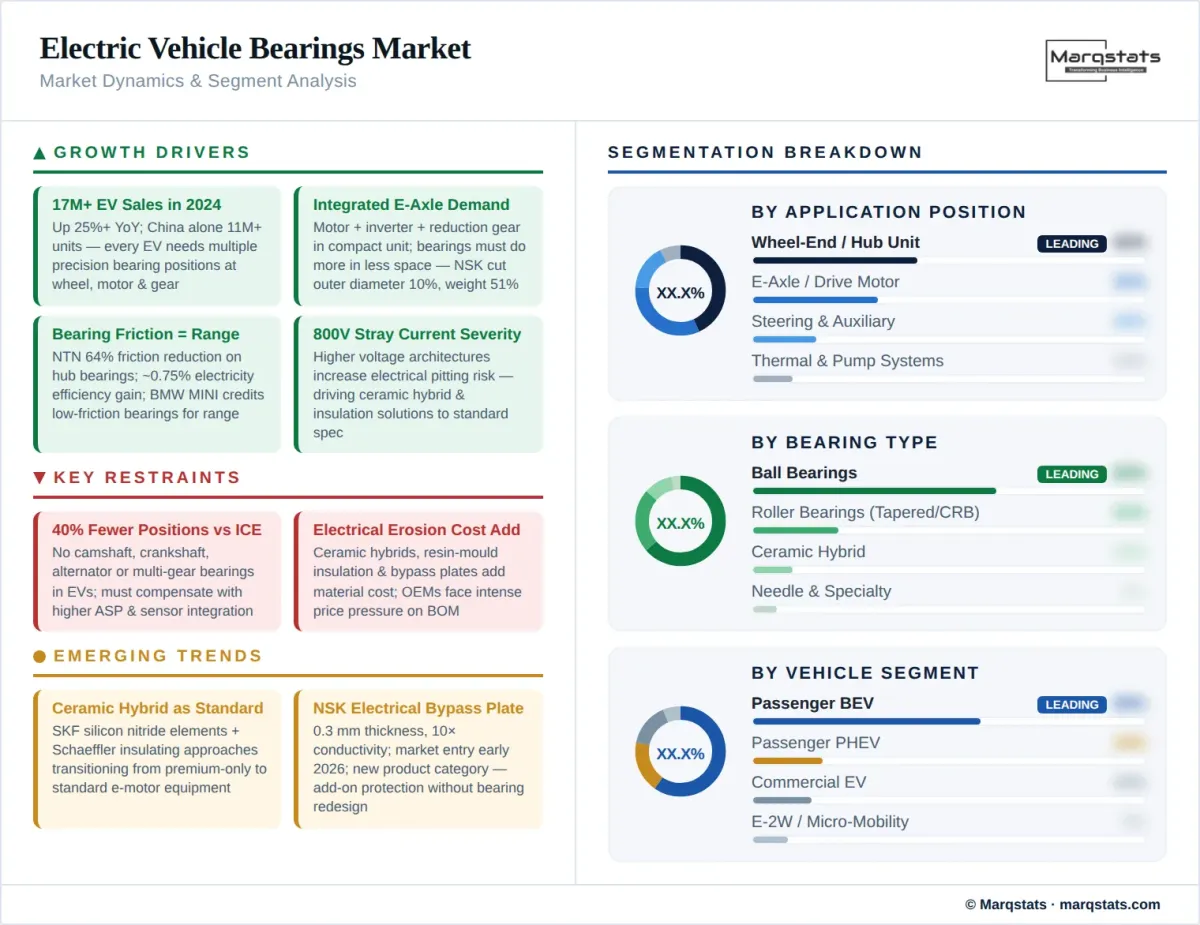
- EV production growth mechanically expanding bearing demand: Global electric car sales topped 17 million in 2024, up 25%+ year-over-year, with China alone above 11 million. EV battery demand is expected to exceed 3 TWh by 2030. Every EV produced requires multiple precision bearing positions—wheel hubs, e-motor, reduction gear, steering, and auxiliaries. While EV drivelines use approximately 40% fewer bearing positions than ICE equivalents, the total addressable market grows because EV unit volumes are scaling rapidly and the value per bearing position is higher due to tighter specifications.
- Integrated e-axle architectures demanding more from fewer bearing positions: As OEMs consolidate motor, inverter, and reduction gear into compact e-axle units, bearings must do more in less space while staying quieter and more efficient. NSK’s March 2025 compact deep-groove ball bearing for EV drive units cuts outer diameter by 10% and weight by 51%. JTEKT’s Ultra Compact Bearing targets BEV e-axle downsizing. NTN developed a high-accuracy torque calculation method specifically for e-axle bearings operating at high rotational speeds. This integration trend means bearing suppliers compete on watts lost, not only life hours.
- Bearing friction becoming a measurable contributor to EV range: Range optimisation is now a bearing-level specification. NTN’s low-friction hub bearings reduce rotational friction by up to 64%, improve electricity efficiency by approximately 0.75%, and extend single-charge cruising distance by about 3 km. NSK’s low-friction hub units generate up to 30% less friction while maintaining conventional reliability. BMW’s electric MINI Countryman E (January 2026) explicitly lists low-friction front wheel bearings alongside SiC inverter and aerodynamic design as contributors to its 501 km WLTC range. This makes bearings part of the vehicle’s efficiency strategy, not just durability infrastructure.
- 800V architectures increasing electrical-erosion severity: Higher-voltage EV powertrains (800V systems from Porsche, Hyundai/Kia, Renault) increase the magnitude of stray currents passing through bearing raceways. This amplifies electrical pitting damage, vibration, noise, and premature failure. NSK’s electrical bypass plate (announced October 2025, market entry early 2026) offers 10x conductivity in 0.3 mm thickness to address this escalating problem. The 800V transition creates a product-cycle upgrade opportunity for bearing suppliers with electrical-erosion solutions.
- SKF India investing INR 3–3.5 billion in Pune for unitised wheel-end EV bearings: SKF India’s announced capacity expansion targets wheel-end bearings for both ICE and EV across passenger and commercial vehicles. The Haridwar and Bangalore plants focus on two-wheeler and EV powertrain bearings (INR 1–1.5 billion by 2029). These investments confirm that global bearing majors are committing capital specifically to EV bearing production capacity, not just adapting legacy ICE lines.
Key Restraints
- 40% fewer bearing positions per EV driveline versus ICE: EV powertrains are mechanically simpler than ICE: no camshaft bearings, crankshaft bearings, alternator bearings, or multi-gear transmission bearings. This means the volume opportunity per vehicle is structurally lower, even though value per bearing is higher. Bearing suppliers must compensate through higher ASP, broader content per vehicle (sensor integration, insulation, smart hub units), and new application wins in e-axle and auxiliary positions.
- Electrolytic corrosion requiring specialised solutions that add cost: Electrical pitting from stray EV motor currents is a problem that has no ICE equivalent. Solutions—ceramic hybrid elements, resin-mould insulation, conductive brush rings, electrical bypass plates—add material and engineering cost to each bearing. In a market where EV OEMs face intense cost pressure, bearing suppliers must demonstrate that electrical-erosion solutions save total system cost (by preventing premature failure) rather than simply adding BOM.
- NVH characteristics at electric motor frequencies requiring different design approaches: ICE NVH is dominated by combustion and exhaust frequencies; EV NVH is dominated by high-frequency motor whine, gear mesh, and inverter switching noise. Bearings that perform acceptably in ICE applications may generate unacceptable noise patterns in EV applications. Redesigning bearing geometry, cage materials, lubrication, and surface finish for EV NVH profiles requires significant engineering investment and OEM-specific validation.
Key Trends
- Ceramic hybrid bearings becoming standard for e-motor electrical insulation: SKF’s EV portfolio centres on hybrid bearings (silicon nitride ceramic rolling elements in steel races) that offer higher speed capability, longer service life, and electrical insulation against current leakage. Schaeffler emphasises insulating approaches for current management. The ceramic hybrid bearing is transitioning from premium-only specification to standard EV e-motor equipment as 800V architectures increase stray current severity.
- NSK electrical bypass plate as next-generation erosion mitigation: Announced October 2025 with early 2026 market entry, NSK’s electrical bypass plate is inserted between bearing and housing to prevent current flow to rolling elements. At 0.3 mm thickness and 10x conductivity versus conventional products, it targets JPY 1 billion in sales by 2027. This represents a new product category within EV bearings—an add-on component rather than a bearing redesign—potentially enabling electrical protection on existing bearing designs.
- Schaeffler EV aftermarket repair solutions emerging: Schaeffler used Automechanika (September 2024) to launch repair solutions for Hyundai Ioniq e-axles and electric motors. This signals the EV bearing market is beginning to move from OEM-only fitment into specialised aftermarket repair—a significant commercial milestone because it means the EV parc is now large enough to generate bearing replacement demand.
- Chinese precision bearing manufacturers investing in Southeast Asian production: Thailand BOI investment talks (December 2025) included Zhejiang Jinwo (precision EV bearing rings) and Zhejiang XCC (bearings and precision components for EVs and robotics), both planning Thai manufacturing bases with combined first-phase investments exceeding THB 7 billion. This signals that China’s EV bearing supply chain is beginning to internationalise, following the same pattern as Chinese cell and component manufacturers.
- Advanced surface treatments reducing friction and extending bearing life: Sweden’s Tribonex raised SEK 15.7 million (October 2025) to accelerate rollout of its Triboconditioning patented surface treatment that significantly reduces friction and wear in EV bearings, driveline components, and hydraulic systems. Sumitomo Bakelite expanded its high-sliding phenolic resin moulding materials lineup for electric pump bearings (July 2025). These developments show the EV bearing value chain extending beyond the bearing itself into materials science and surface engineering.
Market Segmentation
The highest-volume bearing position in every EV. The EV-specific value-add is lower rotational friction (NTN: 64% reduction, NSK: 30% reduction), better sealing against road contaminants, higher load ratings for heavier battery-equipped vehicles, and sensor integration for wheel-speed, temperature, and load monitoring. BMW MINI Countryman E explicitly credits low-friction front wheel bearings for range contribution. EV wheel hub bearing sensor integration creates smart hub units that provide real-time data to ADAS, stability control, and energy management systems. SKF India’s INR 3–3.5 billion Pune expansion specifically targets unitised wheel-end bearings for EV and ICE passenger and commercial vehicles. JTEKT India developed newly designed hub bearings engineered to withstand higher loads for heavier EV platforms.
The fastest-growing and most strategically important application segment. E-powertrain bearings face the most acute EV-specific challenges: shaft speeds exceeding 20,000 rpm, tighter packaging within integrated e-axle housings, electrical pitting from motor/inverter stray currents, and thermal stress from inverter proximity. NSK’s compact deep-groove ball bearing (March 2025) cuts outer diameter by 10% and weight by 51% for EV drive units. NTN started mass production of resin-mould insulated bearings for e-axles (May 2025). NSK’s electrical bypass plate (0.3 mm, 10x conductivity) specifically targets e-axle bearing protection. JTEKT’s Ultra Compact Bearing positions BEV e-axle downsizing as the core value proposition. NTN developed a high-accuracy torque calculation method that reduces the discrepancy between calculated and measured torque by up to 50%, enabling development of lower-torque e-axle bearings.
The highest-ASP bearing category in the EV market. SKF’s hybrid bearings (silicon nitride ceramic elements in steel races) offer higher speed capability, longer service life, and electrical insulation. Schaeffler emphasises efficiency-optimised bearings with patented centrifugal discs to reduce oil splash losses. NTN’s resin-mould insulated bearings provide an alternative insulation approach. This segment’s growth is driven by the escalating electrical-erosion problem as 800V architectures increase stray current severity—making ceramic hybrid and insulated bearings less of a premium option and more of a functional necessity.
Approximately 62% of the EV bearing market in 2024. Deep-groove ball bearings are the dominant type for e-motor, reduction gear, and auxiliary positions. NSK’s compact lightweight deep-groove ball bearing is purpose-designed for EV drive units. Ball bearings benefit from lower friction coefficients at high rotational speeds, making them the natural choice for EV motor applications operating above 15,000–20,000 rpm.
Tapered roller bearings serve wheel-end and differential positions where combined radial and axial loads are high. Cylindrical roller bearings address high-radial-load e-motor positions. NRB Bearings (India) developed a lightweight cylindrical roller bearing with special heat treatment for balancer shaft applications and needle thrust cages for transmission systems. Roller bearings are less common in e-motor positions but remain essential for wheel hubs, steering, and heavier commercial EV applications.
Silicon nitride (Si₃N₄) ceramic rolling elements in steel races provide electrical insulation, higher speed capability, and longer service life under identical operating conditions versus all-steel bearings. The ceramic hybrid bearing is the premium solution for e-motor current-leakage protection and is becoming a standard specification as 800V architectures proliferate.
By Geography
China
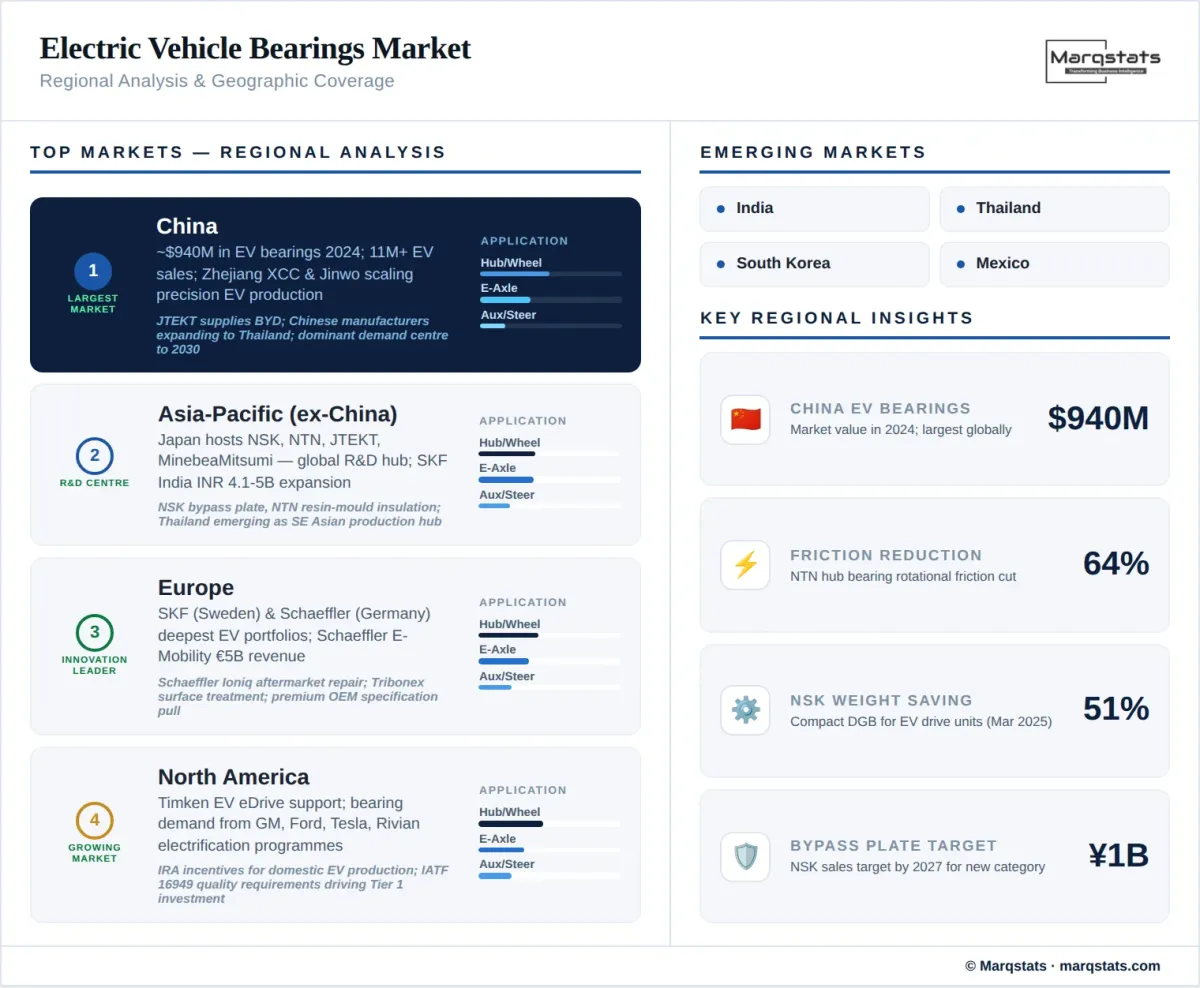
The undisputed demand centre: approximately USD 940 million in EV bearings in 2024, driven by 11+ million EV sales. China’s domestic precision bearing manufacturers are scaling EV-specific production, with Zhejiang XCC and Zhejiang Jinwo investing in Thai manufacturing (THB 7B+ combined). JTEKT supplies bearings to BYD and steering to Guangzhou Automobile. China’s dominance in EV production ensures it remains the largest single-country market through 2030.
Asia-Pacific (Excluding China)
Japan hosts four of the six global bearing majors (NSK, NTN, JTEKT, MinebeaMitsumi) and remains the R&D centre for EV bearing innovation. NTN is reorganising global production and targeting JPY 300 billion sales by FY2034, with ball screws for EV brake systems as a third pillar alongside bearings. NSK’s electrical bypass plate targets early 2026 market entry. JTEKT India developed hub bearings for higher EV loads. SKF India is investing INR 4.1–5 billion across Pune, Haridwar, and Bangalore for EV and ICE bearing capacity. NRB Bearings (India) launched lightweight EV-applicable cylindrical roller bearings. Thailand is emerging as a Southeast Asian production hub with Chinese EV bearing manufacturers establishing bases through BOI investment.
Europe
Home to SKF (Sweden) and Schaeffler (Germany), the two Western bearing majors with the deepest EV portfolios. Schaeffler’s E-Mobility division generated €5.015 billion in 2025 revenue (broader than bearings alone) and projects €8.25–9 billion by 2028. SKF’s hybrid bearings and conductive brush ring are core EV products. Schaeffler launched Hyundai Ioniq e-axle repair solutions at Automechanika (September 2024), signalling EV aftermarket emergence. Tribonex (Sweden) raised capital for EV-applicable surface treatment. Bosch is repositioning its Tilburg site toward gas foil bearings and thin metal technologies. European demand is driven by EU EV mandates and premium OEM electrification programmes.
North America
Timken is the principal US-headquartered bearing major with EV eDrive positioning and multiple IATF 16949-certified bearing plants. North American EV production expansion (GM, Ford, Rivian, Tesla) creates local bearing demand. US industrial policy (IRA, DOE manufacturing grants) supports domestic component supply chains including bearings. Canada and Mexico serve as integrated North American automotive production bases.
Rest of World
South Korea hosts Schaeffler and SKF operations serving Hyundai/Kia EV platforms. Russia’s Kursk Bearing Plant launched import-substituting production for domestic commercial vehicles (March 2026), though EV-specific bearing production remains limited. India’s SKF, JTEKT India, and NRB Bearings are all investing in EV bearing capability. Southeast Asia (Thailand, Indonesia) is emerging as an EV bearing production base driven by Chinese manufacturer investment.
How Competition Is Evolving
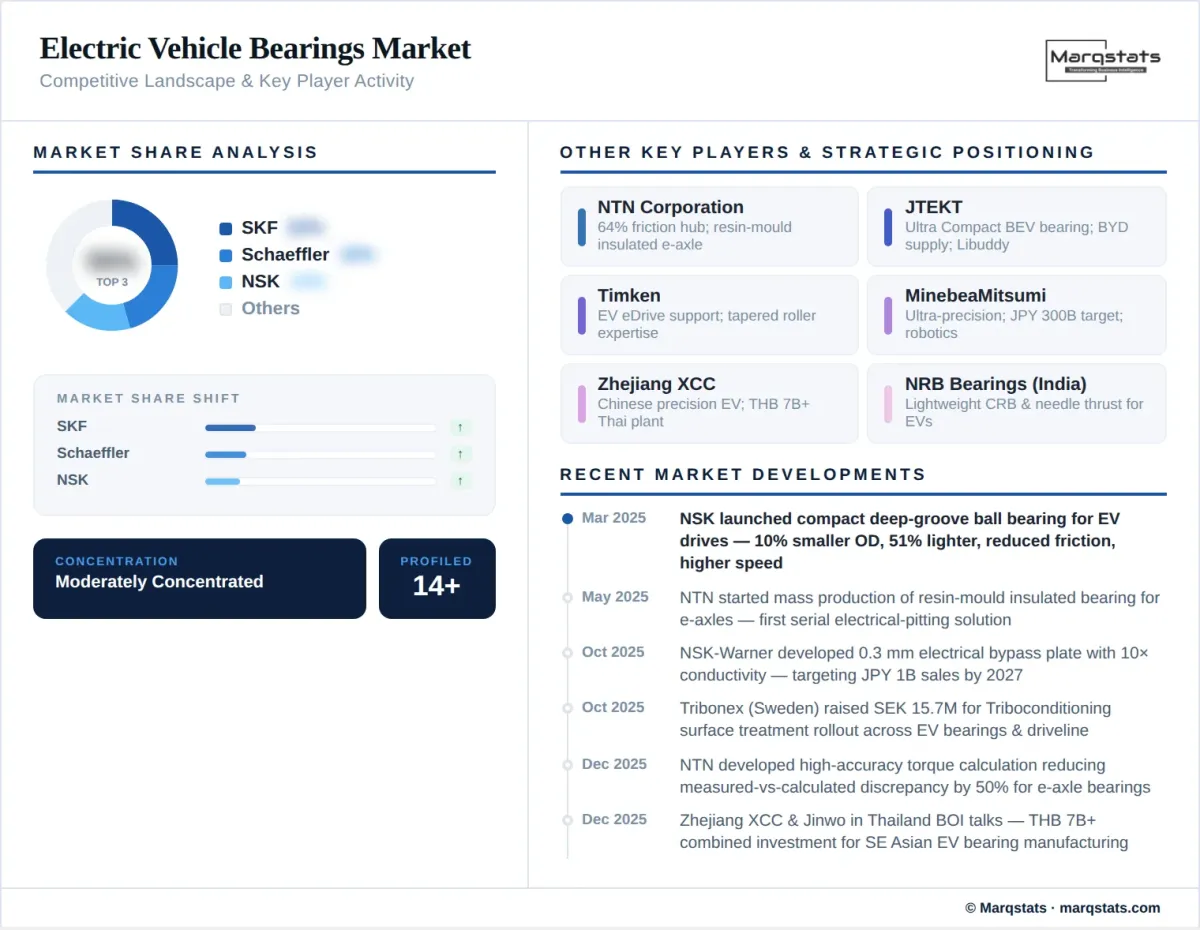
The electric vehicle bearings market is dominated by six global bearing majors, each with distinct EV positioning. SKF (Sweden) centres its EV strategy on hybrid ceramic bearings for e-motor electrical insulation and a conductive brush ring for current leakage management, with INR 3–3.5 billion India investment for unitised wheel-end EV bearings. Schaeffler (Germany) spans bearings and full electrified driveline systems, with its E-Mobility division at €5 billion revenue (2025) and aftermarket EV repair solutions launched at Automechanika. NSK (Japan) leads in EV-specific problem solving: compact lightweight drive-unit bearings (10% smaller, 51% lighter), low-friction hub units (30% friction reduction), electrical-erosion-resistant e-axle bearings, and the electrical bypass plate (0.3 mm, 10x conductivity, JPY 1B target by 2027).
NTN (Japan) delivers both wheel-end and e-axle solutions: low-friction hub bearings (64% friction reduction, 0.75% efficiency gain, 3 km range extension) and resin-mould insulated e-axle bearings moved to mass production in May 2025, plus a high-accuracy torque calculation method improving calculation precision by 50%. JTEKT (Japan) targets BEV e-axle compactness with its Ultra Compact Bearing and supplies bearings to BYD. Timken (US) positions around EV eDrive support with tapered roller bearing expertise and multiple IATF 16949-certified operations. MinebeaMitsumi (Japan) targets autonomous driving and humanoid robot applications alongside traditional bearing miniaturisation, with JPY 300 billion total sales target by FY2034.
Emerging competitive layers include Chinese EV bearing specialists (Zhejiang XCC, Zhejiang Jinwo) investing in Thai manufacturing bases, Indian players (NRB Bearings, JTEKT India, SKF India) developing EV-specific products, materials innovators (Tribonex surface treatment, Sumitomo Bakelite resin materials for EV pump bearings), and NSK-Warner’s electrical bypass plate as a new add-on product category. The EV aftermarket is beginning to emerge as a competitive dimension, with Schaeffler’s Hyundai Ioniq repair solutions being the clearest signal.
Companies Covered
The report profiles 15+ companies with full strategy and financials analysis, including:
Recent Market Activity
Table of Contents
Coverage & Segmentation
This report provides a comprehensive analysis of the global electric vehicle bearings market covering the historical period (2021–2025) and forecast period (2026–2030), with 2025 as the base year. The study examines market size in USD, unit volume, and value per vehicle across application position (wheel-end/hub, e-axle/drive motor, gearset, auxiliary), bearing type (ball, roller, ceramic hybrid), vehicle type (BEV, PHEV, by segment), and geography covering 20 countries across China, Asia-Pacific, Europe, North America, and Rest of World. Company profiling covers 15+ players across global bearing majors, emerging EV specialists, and materials/surface treatment innovators. Technical analysis covers electrical erosion mitigation, NVH design, friction reduction, 800V architecture implications, and sensor-integrated smart hub units.
Research methodology combines bottom-up modelling from EV production volumes, bearing positions per vehicle architecture (BEV vs ICE comparison), ASP per bearing position by application, and supplier production capacity disclosures. Primary research encompasses 40+ interactions with bearing OEM application engineers, e-axle system integrators, EV platform teams, surface treatment specialists, and aftermarket distributors across China, Japan, Europe, and North America. Automotive quality data (IATF 16949 certifications, PPAP approval processes) used for qualification readiness assessment.