Market Snapshot
Key Takeaways
Market Overview & Analysis
Report Summary
The RFID tire tag market covers passive UHF RFID tags embedded in or attached to tires for unique digital identification and lifecycle traceability. Scope includes embedded tags (vulcanised into tire), patch tags (inner liner), sticker tags (sidewall), RFID reader infrastructure, cloud/data platforms for tire lifecycle management, and standards/regulatory framework (ISO 20909, ISO 20910, GS1 SGTIN-96, RAIN UHF, GDSO, ESPR/DPP). Active tire sensors and TPMS are excluded but referenced—RFID provides the durable identity layer while sensors add telemetry.
The market is a digital identification and lifecycle-traceability layer inside the tire value chain. RFID enables cradle-to-grave tire tracking across manufacturers, OEMs, fleets, service workshops, retreaders, and recyclers. The RAIN RFID Alliance guideline was written because tire data needs span so many stakeholders across a fragmented lifecycle.
Market Dynamics
Key Drivers
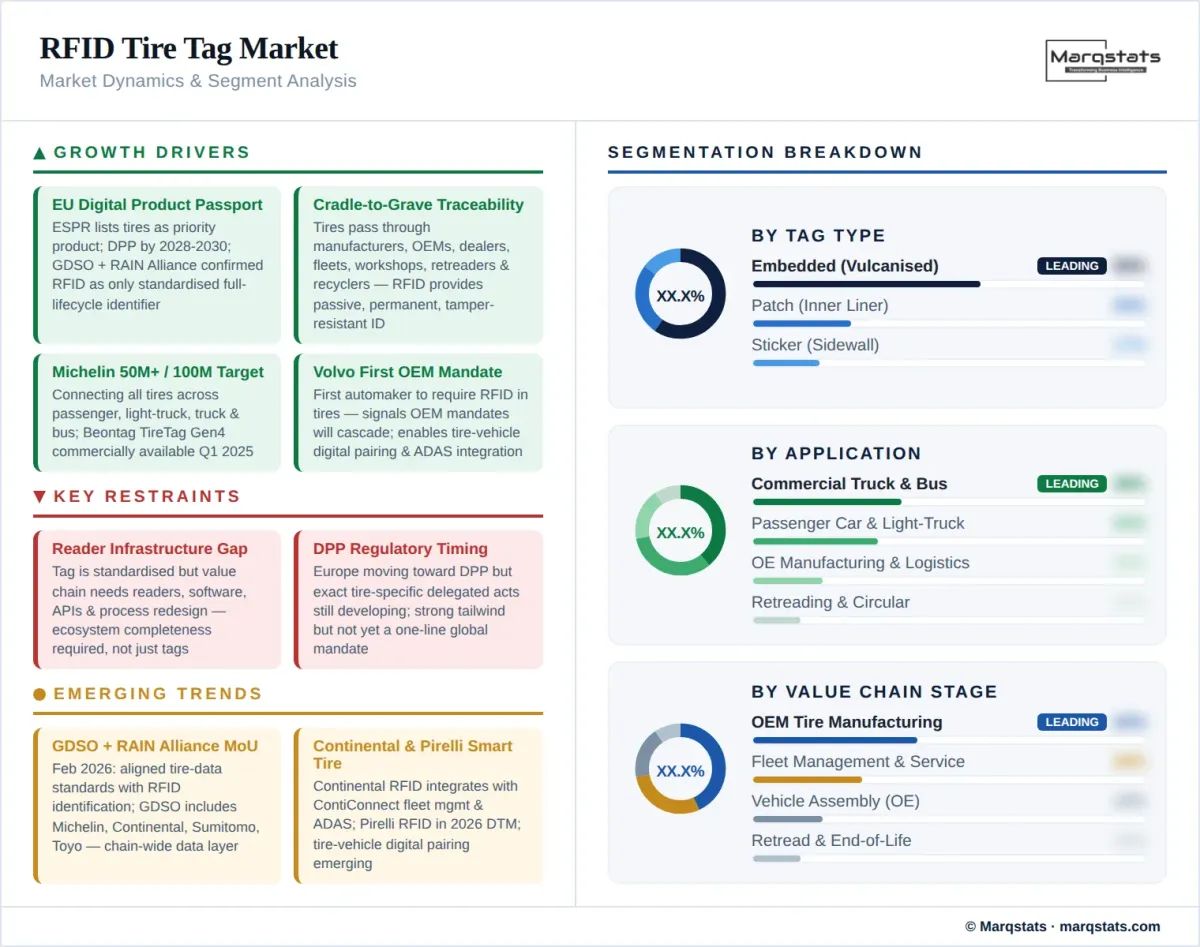
- EU DPP creating mandatory traceability demand: ESPR lists tires as priority. DPP requires sustainability/durability data. GDSO and RAIN Alliance confirmed RFID as only standardised full-lifecycle identifier. DPP expected by 2028–2030. Transforms RFID from efficiency tool to compliance requirement.
- Individual tire traceability across multi-stakeholder lifecycle: Tires pass through manufacturers, OEMs, dealers, fleets, workshops, retreaders, recyclers. RFID provides passive, permanent, tamper-resistant identity without battery or line-of-sight. Michelin and Continental position RFID as cradle-to-grave. GDSO mission is cradle-to-grave tire data services.
- Operational efficiency in manufacturing, logistics, fleet management: RAIN RFID supports high-read-rate inventory without line of sight. Reduces manual capture, improves accuracy. Avery Dennison positions for maintenance recording, inventory tracking, fleet management. Continental integrates with ContiConnect digital fleet stack.
- Retreading, circularity, and end-of-life management: ISO 20909 preserves original UII through retreading. Beontag emphasises 1-million-km durability including retreading. Michelin says RFID improves end-of-life sorting. Strongest differentiator vs ordinary industrial RFID.
- Volvo OEM mandate and anti-counterfeit: First OEM to require RFID in tires. Michelin describes RFID as unique and unforgeable. Sumitomo says RFID supports quality assurance, warranty, counterfeit elimination. OEM mandates will cascade.
Key Restraints
- Reader infrastructure and data-system investment needed: Tag is standardised but value chain needs readers, software, APIs, process redesign. Ecosystem completeness required, not just tags.
- Tag durability and manufacturing integration: Must survive vulcanisation (150–200°C), pressure, flexing, 100K+ km. ISO 20909 exists because these are non-trivial. Avery AD Maxdura, Beontag TireTag Gen4, Murata all emphasise ruggedisation.
- DPP regulatory timing uncertainty: Europe moving toward DPP but exact tire-specific delegated acts still developing. RFID has strong tailwind but not yet a one-line global mandate.
Key Trends
- Michelin scaling RFID across all tire categories with multi-supplier strategy: Beontag: millions of tires. Murata: Gen 4 mass production after Jan 2025. Hana: Link Less Rev4. TireTag Gen4 commercially available Q1 2025.
- GDSO + RAIN Alliance alignment creating shared data infrastructure (February 2026): MoU aligns tire-data standards with RFID identification. GDSO includes Michelin, Continental, Sumitomo, Toyo Tire. Creates chain-wide data layer.
- Continental and Pirelli integrating RFID with smart tire and ADAS: Continental RFID integrates with ContiConnect fleet management and ADAS tire-awareness. Pirelli RFID in 2026 DTM. Tire-vehicle digital pairing for connected platforms.
- Sumitomo and Toyo Tire broadening adoption beyond Western majors: Sumitomo RFID taxi/EV-bus tires Japan (2023), GDSO member. Toyo joined GDSO Nov 2025, building RFID tire database. Industry-wide adoption.
Market Segmentation
Vulcanised into tire during manufacturing. Most durable—survives full lifecycle including retreading. Michelin Gen 4/TireTag Gen4, Continental Gen 5, Avery AD Maxdura. Dominant for OE and commercial fleet.
Affixed to inner liner post-manufacturing. ISO 20909 recognised format. Used for aftermarket retrofit. Replacement patches must carry original UII per ISO 20909.
Applied to sidewall. Easiest deployment on existing inventory. Less durable but suitable for logistics, warehousing, short-lifecycle tracking.
First scaled segment. Continental all Gen 5 RFID. Sumitomo taxi/EV-bus Japan. Multi-life applications where retreading, maintenance, and recycling data are most valuable.
Largest volume. Michelin targeting 100M passenger tires. Beontag/Michelin covers both. Volvo OEM mandate. DPP will make RFID standard for European passenger tires.
Automated tire ID in manufacturing, warehouse, shipping, OEM assembly. Volvo mandate means RFID before assembly plant. Reduces manual scanning, enables JIT logistics.
ISO 20909 preserves UII through retreading. Gives retreaders full manufacturing and usage history. Beontag 1M-km durability. Connects to ESPR circularity objectives.
Pirelli 2026 DTM RFID integration (October 2025). Small volume but technology proving ground for extreme conditions. Showcases RFID to OEMs and premium buyers.
By Geography
Europe
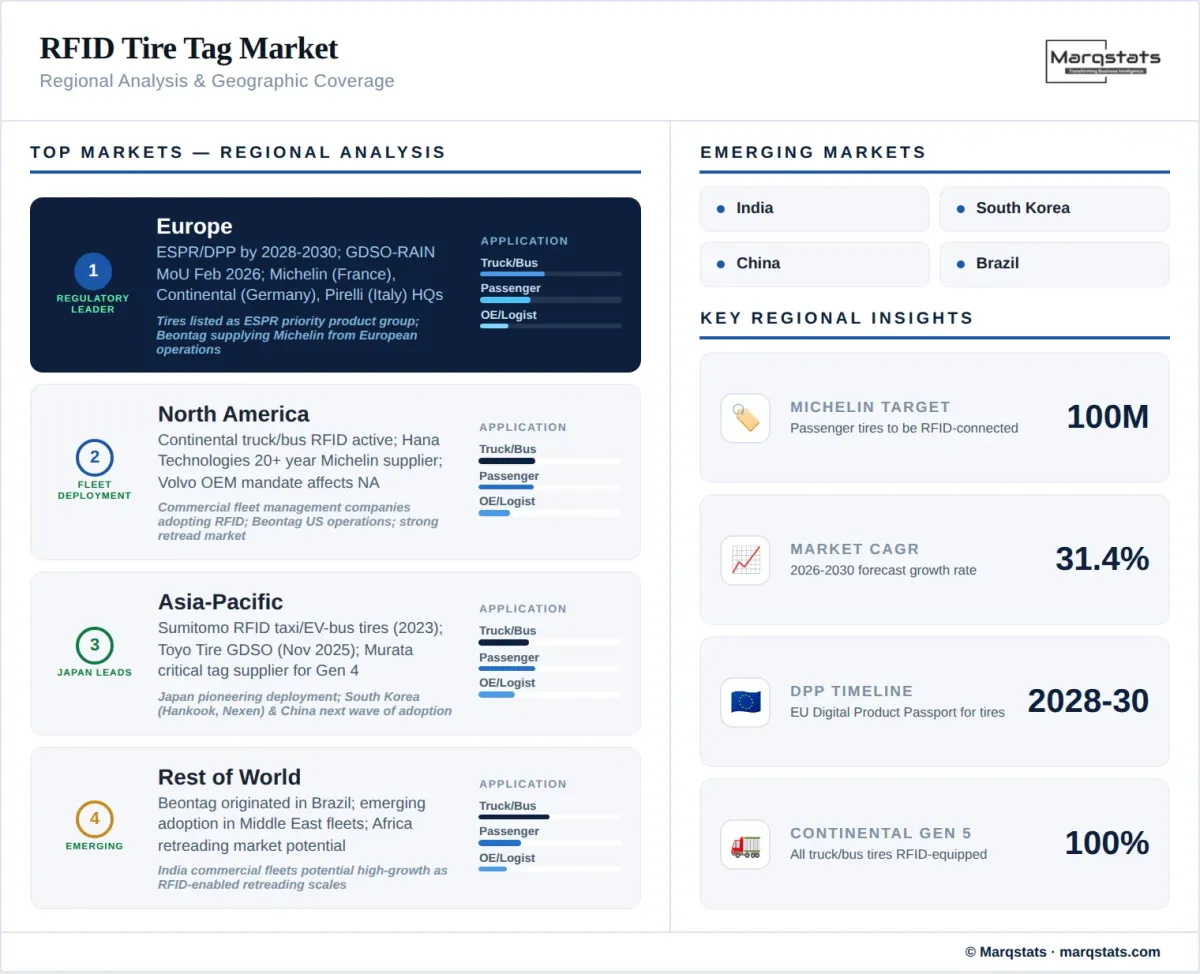
Global leader via ESPR/DPP regulatory pull. Tires priority under ESPR 2025–2030. DPP by 2028–2030. GDSO/RAIN MoU February 2026. Michelin (France), Continental (Germany) headquartered here. Pirelli (Italy) DTM RFID. Beontag supplying Michelin from European operations.
North America
Strong commercial fleet deployment. Continental truck/bus RFID active. Beontag US operations. Hana Technologies (US) 20+ year Michelin supplier. Volvo OEM mandate affects NA production. Fleet management companies adopting RFID.
Asia-Pacific
Japan leads: Sumitomo RFID taxi/EV-bus (2023), Toyo Tire GDSO (Nov 2025), Murata critical tag supplier. South Korea (Hankook, Nexen) and China next wave.
Rest of World
Beontag originated in Brazil. Emerging adoption in Middle East fleets and African retreading. India commercial fleets potential high-growth as RFID-enabled retreading scales.
How Competition Is Evolving
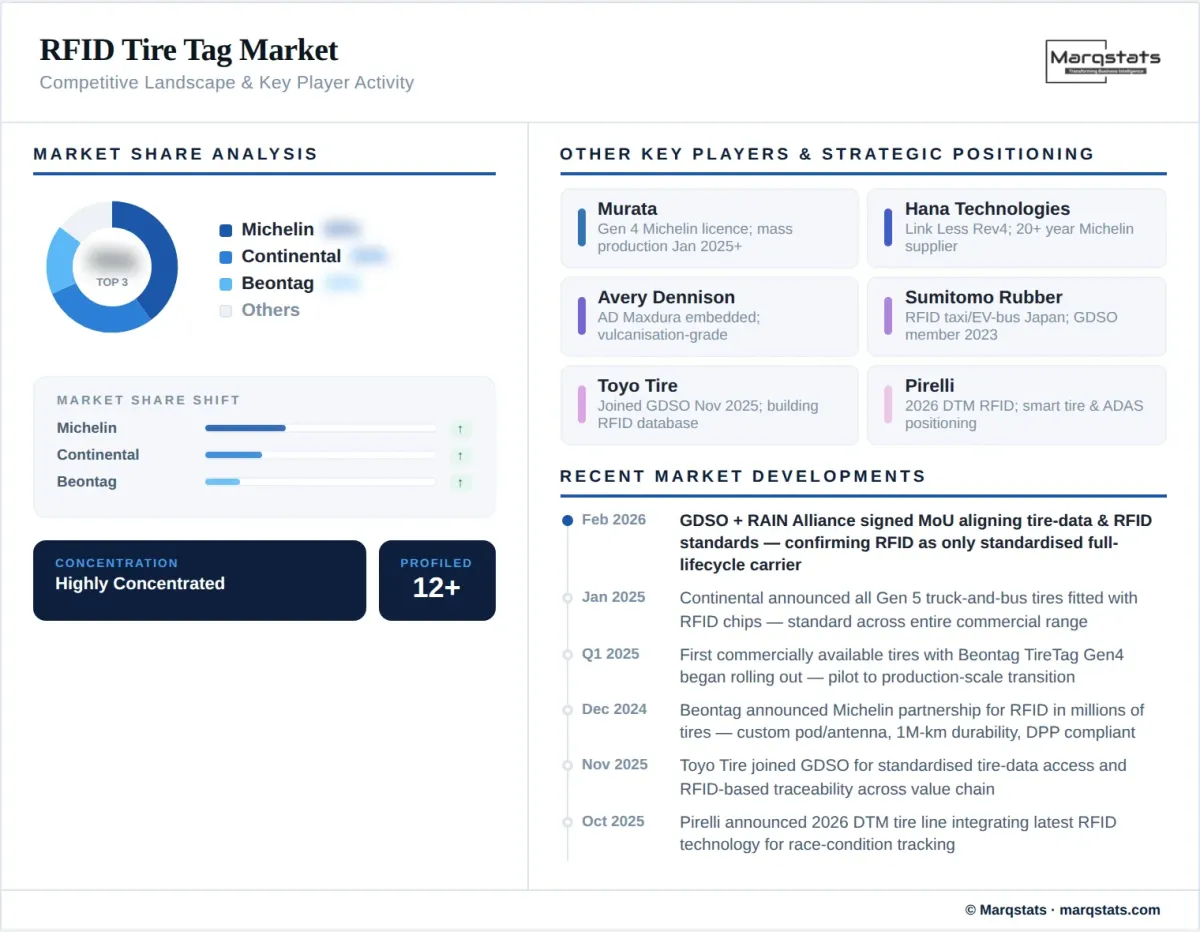
Four ecosystem layers. Tire OEMs: Michelin (connecting all tires, Gen 4, Beontag/Murata/Hana multi-supplier), Continental (all Gen 5 truck/bus RFID, ContiConnect integration), Sumitomo (RFID taxi/EV-bus, GDSO 2023), Toyo Tire (GDSO Nov 2025), Pirelli (DTM RFID, ADAS positioning).
Tag suppliers: Beontag (TireTag Gen4, Michelin millions of tires, 1M-km durability, DPP-ready), Murata (Gen 4 Michelin licence, mass production Jan 2025+, id-Bridge), Hana Technologies (Link Less Rev4, Michelin Mar 2024, 20+ year supplier), Avery Dennison (AD Maxdura, vulcanisation-grade, fleet lifecycle).
Standards/data: GDSO (tire data standardisation, RAIN MoU Feb 2026), RAIN Alliance (UHF standards), GS1 (SGTIN-96), ISO (20909/20910). OEM adopters: Volvo (first RFID tire mandate).
Companies Covered
The report profiles 15+ companies with full strategy and financials analysis, including:
Recent Market Activity
Table of Contents
Coverage & Segmentation
This report covers the global RFID tire tag market 2021–2025 (historical) and 2026–2030 (forecast), base year 2025. Market size in USD and volume across tag type (embedded, patch, sticker), application (truck/bus, passenger, OE logistics, retread/circular, motorsport), and geography (15 countries). 15+ company profiles. Regulatory analysis of ESPR, DPP, ISO 20909/20910, GS1, RAIN.
Bottom-up from Michelin volume targets (50M+, 100M passenger), Continental Gen 5, Beontag/Murata/Hana production, tag pricing, GDSO membership, Volvo mandate, DPP timelines. Primary research: 40+ interactions with tire RFID directors, tag suppliers, GDSO participants, fleet software, retreaders, and OEM procurement across Europe, North America, Japan.