Market Snapshot
Key Takeaways
Market Overview & Analysis
Report Summary
The India EV battery recycling and circular economy market encompasses the full lifecycle value chain beyond first use: formal collection and reverse logistics of end-of-life EV batteries, battery diagnostics and State of Health (SoH) assessment, second-life repurposing for stationary energy storage applications, hydrometallurgical and pyrometallurgical recycling processes, black mass production and processing, and refining of battery-grade critical minerals (lithium, cobalt, nickel, manganese, graphite, copper). The market scope covers lithium-ion batteries from electric vehicles (two-wheelers, three-wheelers, passenger vehicles, commercial vehicles, and buses)—distinguishing this from the broader lithium-ion battery recycling market that includes consumer electronics and industrial batteries. Lead-acid battery recycling, which represents a mature segment with 670+ CPCB-registered recyclers and over 90% recycling rates, is excluded from market sizing but covered as a contextual reference point.
This market is best understood in two layers. In the near term (2025–2028), it is fundamentally a collection, compliance, and channelization market—because EV battery waste volumes are still small (1.08 kT of 36 kT total LIB end-of-life in 2025), informal handling remains dominant (18 kT via informal channels versus 5.04 kT formal), and the capacity-feedstock mismatch means utilization rates will remain low. In the medium to long term (2028–2035+), it transforms into a critical-minerals and circular-manufacturing market, driven by BWMR recovery/recycled-content mandates, CPCB digital traceability, the INR 1,500 crore critical mineral recycling scheme, and the massive wave of FAME-era EV batteries reaching end-of-life. Independent estimates suggest lithium-ion battery waste in India could rise 6x by 2030 and 50x by 2035 versus 2025 levels.
The value pool is deliberately broader than metal recovery alone. Cumulative battery reuse potential through 2050 is estimated at 220 GWh, with annual repurposing potential reaching approximately 600 GWh by 2050. India’s circular economy for EV batteries will be built on second-life diagnostics, refurbishment, repurposing into stationary storage, and then final recycling—making this a multi-stage value chain rather than a single end-of-life processing step. Government policy now explicitly favours integrated players that can perform actual mineral extraction, not just black mass production. The Mines Ministry’s critical mineral recycling scheme specifies that incentives target “the value chain involved in the actual extraction of critical minerals,” pushing the market toward deeper refining capabilities.
Market Dynamics
Key Drivers
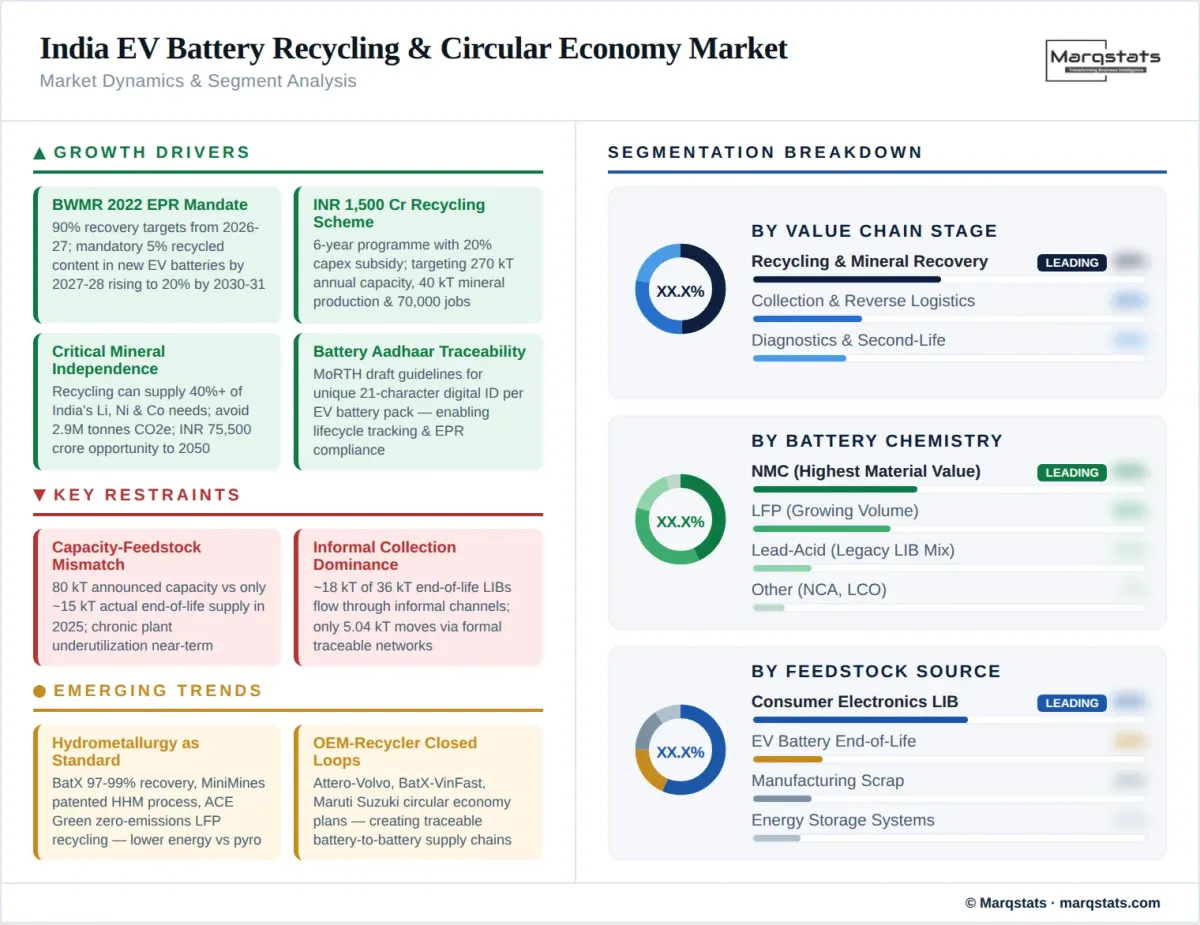
- Battery Waste Management Rules 2022 creating mandatory EPR framework: The BWMR 2022 covers all waste batteries including EV batteries, requiring collection and recycling/refurbishment under Extended Producer Responsibility (EPR). Disposal in landfills and incineration is prohibited. The rules have been progressively tightened: the 2023 amendment strengthened CPCB oversight and enabled EPR trading platforms with price bands; the 2024 amendment linked EPR certificate price bands to environmental compensation and allowed 60% carry-forward of excess EPR obligations; and the 2025 amendment introduced QR/barcode-based labelling carrying the EPR registration number. Recovery targets for EV batteries are 70% in 2024–25, 80% in 2025–26, and 90% from 2026–27 onward. Mandatory recycled content in new EV batteries rises from 5% in 2027–28 to 20% from 2030–31.
- INR 1,500 crore Critical Mineral Recycling Scheme accelerating capacity investment: Approved by the Union Cabinet in September 2025, this 6-year programme (FY2025–26 to FY2030–31) accepts lithium-ion battery scrap as eligible feedstock. It offers 20% capex subsidy on plant, machinery, and utilities (capped at INR 500 million for large entities, INR 250 million for small), with one-third of the outlay reserved for small recyclers and startups. Expected outcomes: 270 kT annual recycling capacity, 40 kT critical mineral production, INR 8,000 crore investment, and 70,000 jobs. By November 2025, the Mines Ministry confirmed a significant number of entities had already registered, signalling strong industry interest.
- India’s critical mineral import dependence making recycling a strategic imperative: India imports approximately 80% of lithium-ion cells from China, Japan, and South Korea, with INR 20,000 crore of battery storage equipment imported annually. Recycling is now explicitly positioned in government policy as a pathway to reduce import dependence and strengthen domestic supply of lithium, nickel, cobalt, and other critical materials. The Rajya Sabha Standing Committee in March 2026 urged faster offtake deals and JVs with resource-rich nations alongside accelerated domestic recycling. Budget 2026–27 exempted customs duties on critical mineral processing equipment and announced rare earth corridors across four states. This framing shifts the sector from compliance-driven waste disposal to resource security and industrial policy.
- Massive EV installed base creating future feedstock wave: India recorded over 2.3 million EV sales in 2025, with cumulative lithium-ion battery demand projected to rise from 29 GWh in 2025 to 248 GWh by 2035. As FAME-I era EVs (2019–2022) and early FAME-II vehicles approach battery end-of-life from 2028–2030, the EV-specific recycling feedstock will surge dramatically. LIB waste is estimated to rise 6x by 2030 and 50x by 2035 versus 2025 levels. This creates a multi-year visibility window for recycling capacity investments being made today.
- Digital traceability moving from optional to mandatory: The 2025 BWMR amendment introduced QR/barcode-based labelling with EPR registration numbers. The Battery Pack Aadhaar system (draft guidelines released January 2026) assigns unique 21-character alphanumeric codes to each battery pack for lifecycle traceability. Tata Elxsi presented the Battery Aadhaar technology demonstrator at Battery Summit 2025, built on its MOBIUS+ platform with blockchain-backed traceability. This consortium includes Tata Motors, Tata AutoComp, IIT Kharagpur, WRI, LOHUM, NUNAM Technologies, and Oorja Energy. Digital traceability enables SoH assessment for second-life decisions, provenance tracking for recycled-content compliance, and formal channelization of end-of-life batteries.
Key Restraints
- Capacity-feedstock mismatch constraining near-term utilization: India has over 80 kT of announced recycling capacity versus only approximately 15 kT of end-of-life lithium-ion supply in 2025. By 2030, announced capacity could reach 115 kT against estimated 60 kT actual supply. This means recycling plants face chronic underutilization in the near term. The commercial risk is not “who can build plants” but “who can secure feedstock and run facilities at economically viable utilization rates.” This drives consolidation pressure and favours players with OEM partnerships, fleet operator agreements, and formal collection networks.
- Informal collection dominating over formal channels: Of approximately 36 kT lithium-ion batteries reaching end-of-life in 2025, roughly 18 kT flows through informal collection, 12.6 kT remains uncollected, and only 5.04 kT moves through formal channels. Informal handlers lack safety protocols, traceability, and environmental compliance. Converting this informal flow into formal, traceable channels is the single largest commercial opportunity and operational challenge simultaneously. The CPCB centralized battery EPR portal (requiring producer, recycler, and refurbisher registration) is intended to improve accountability, but enforcement remains nascent.
- EV battery waste still marginal within total LIB end-of-life volumes: Only 1.08 kT of the 36 kT lithium-ion batteries reaching end-of-life in 2025 comes from EVs, versus 33.12 kT from consumer electronics and 1.8 kT from energy storage systems. This means the “India EV battery recycling market” is strategically important but near-term volumes are dominated by non-EV lithium-ion waste. The true EV battery recycling wave will arrive from 2028–2030 as the FAME-era fleet approaches battery end-of-life.
- Technology gaps in moving beyond black mass to battery-grade refining: Many Indian recyclers currently perform mechanical processing to produce black mass (mixed metal powder), but the higher-value step is hydrometallurgical refining to produce battery-grade lithium carbonate, nickel sulphate, cobalt sulphate, and manganese. The Mines Ministry’s recycling scheme explicitly excludes incentives for black-mass-only producers, pushing the market toward actual mineral extraction. LOHUM’s March 2025 launch of India’s first battery-grade lithium refinery (1,000 MT annual capacity) demonstrates this transition is possible but still early.
Key Trends
- Hydrometallurgical processing emerging as India’s preferred recycling technology: Hydrometallurgical methods achieve over 95% material recovery with lower energy consumption and emissions compared to pyrometallurgical (smelting) approaches. BatX Energies’ proprietary process operates at low temperature and pressure with 97–99% recovery rates across all lithium-ion chemistries. MiniMines’ patented Hybrid-Hydrometallurgy (HHM) process targets 15,000 MTPA capacity at its INR 3.5 billion Bengaluru refining complex. ACE Green’s Mundra facility (10,000 tonnes annual capacity) uses zero-emissions hydrometallurgy for LFP-specific recycling. India’s lead-acid recycling infrastructure (670+ CPCB-authorized units, 3.5+ MT annual capacity, 90%+ recycling rate) provides an existing logistics and processing framework, but LIB recycling requires fundamentally different chemistry and safety protocols.
- OEM-recycler partnerships creating closed-loop supply chains: Attero partnered with Volvo Cars India in June 2025 for EV battery recycling using its proprietary technology recovering 98%+ of critical minerals. VinFast India signed with BatX Energies in July 2025 for battery recycling, repurposing, and rare metal recovery across factory and after-sales operations. Maruti Suzuki outlined circular economy plans for end-of-life vehicles and battery recycling in March 2026. Ashok Leyland announced INR 50 billion investment including a Global Centre of Excellence for battery recycling R&D. These OEM partnerships are critical because they secure traceable feedstock supply for recyclers while enabling OEMs to meet recycled-content mandates.
- Second-life battery applications extending economic value before final recycling: EV batteries retaining 70–80% capacity after vehicle end-of-life can serve 10–15 additional years in stationary storage applications including grid backup, telecom towers, solar streetlights, and portable devices. Cumulative battery reuse potential is estimated at 220 GWh through 2050. MaxVolt Energy’s repurposing programme collects used batteries from nearly 30% of India’s pin codes, repurposing them for routers, streetlights, and CCTV devices. PeakAmp’s full-stack circularity platform covers collection, second-life repurposing, and then final mineral recovery. This multi-stage value chain means the “circular economy” is significantly larger than recycling alone.
- Rare earth element recycling emerging as adjacent opportunity: BatX Energies and Germany-based Rocklink GmbH signed an MoU in July 2025 to build India’s first fully integrated rare earth refining facility, deploying Rocklink’s Magcycle reverse logistics for end-of-life permanent magnets (NdFeB, SmCo, AlNiCo) from electric motors. The pilot facility in Sikandrabad, Uttar Pradesh is expected operational within 12 months. Budget 2026–27 announced rare earth corridors in Odisha, Kerala, Andhra Pradesh, and Tamil Nadu. Rare earth recycling from EV motors complements battery mineral recovery, positioning integrated players for broader circular economy participation.
Market Segmentation
Formal collection is the most critical bottleneck: only 5.04 kT of 36 kT end-of-life LIBs in 2025 flows through formal channels. The CPCB centralized EPR portal requires producer, recycler, and refurbisher registration. QR/barcode labelling (2025 BWMR amendment) and Battery Aadhaar traceability are designed to expand formal channel share. MaxVolt Energy’s collection network covers approximately 30% of India’s pin codes. Indofast Energy operates 1,000+ battery swap stations that double as collection points. Companies building traceable, nationwide collection infrastructure will command strategic advantage as EV feedstock volumes surge post-2028.
Battery diagnostics and SoH assessment determine whether an end-of-life EV battery enters second-life repurposing (70–80% residual capacity, 10–15 year additional life in stationary storage) or proceeds directly to recycling. Annual repurposing potential is estimated at 600 GWh by 2050. LOHUM operates 300 MWh repurposing capacity per year. PeakAmp’s platform spans collection, second-life, and mineral recovery. Luminous Power Technologies’ Baddi facility integrates end-to-end digital traceability aligned with Battery Aadhaar for lifecycle tracking. Second-life applications include grid backup, telecom tower batteries, solar streetlights, data centre UPS, and portable devices.
Hydrometallurgical processing is the dominant technology path in India, achieving 95–99% recovery of lithium, cobalt, nickel, manganese, copper, and graphite. LOHUM operates 2 GWh recycling/refining capacity with plans to scale to 25–30 GWh by 2027. Attero targets 1 million tonnes of LIB recycling by 2030 and announced INR 2,000 crore expansion. Exigo’s integrated facility handles 10,000 tonnes with up to 96% recovery. BatX Energies achieved government support from TDB/DST for commercial-scale facility with seven patents filed. NavPrakriti started operations in eastern India in October 2025 with 12,000 TPA capacity targeting 24,000 TPA by 2027. The recovery mandate escalation (70% → 80% → 90% by 2026–27) and recycled-content mandates (5% → 20% by 2030–31) create compliance-driven demand growth.
The highest-value stage: refining black mass into battery-grade lithium carbonate, nickel sulphate, and cobalt sulphate suitable for re-integration into new battery manufacturing. LOHUM launched India’s first battery-grade lithium refinery in March 2025 with 1,000 MT annual capacity. MiniMines signed an MoU with Karnataka for an INR 3.5 billion giga critical minerals refining complex in Bengaluru with 15,000 MTPA Phase 1 capacity, producing high-purity lithium, nickel, cobalt, copper, graphite, and rare earth elements. The Mines Ministry’s recycling scheme explicitly targets actual mineral extraction over black-mass-only processing.
NMC (nickel manganese cobalt) and NCA batteries offer the highest per-tonne recovery value due to cobalt and nickel content, making them economically attractive for recyclers. Most current EV battery recycling in India focuses on NMC cells from two-wheelers (Ola Electric, Ather Energy) and passenger vehicles. Recovery of cobalt, nickel, and lithium from NMC batteries commands premium pricing in the critical minerals market.
LFP (lithium iron phosphate) recycling presents different economics: lower per-tonne metal value (no cobalt or nickel) but massive volume growth as LFP dominates India’s EV bus, three-wheeler, and mass-market scooter segments. ACE Green’s 10,000 tonne Mundra facility is India’s largest LFP-specific recycling plant. LFP recycling yields lithium and iron phosphate for re-use, with the lithium recovery value increasingly significant as domestic battery manufacturing scales.
Near-term recycling volumes are dominated by consumer electronics LIBs (33.12 kT of 36 kT total in 2025), providing feedstock for recyclers building capacity ahead of the EV wave. These batteries use diverse chemistries (LCO, NMC, LFP) in smaller form factors, requiring different processing approaches than large-format EV packs.
By Geography
Maharashtra and Western India
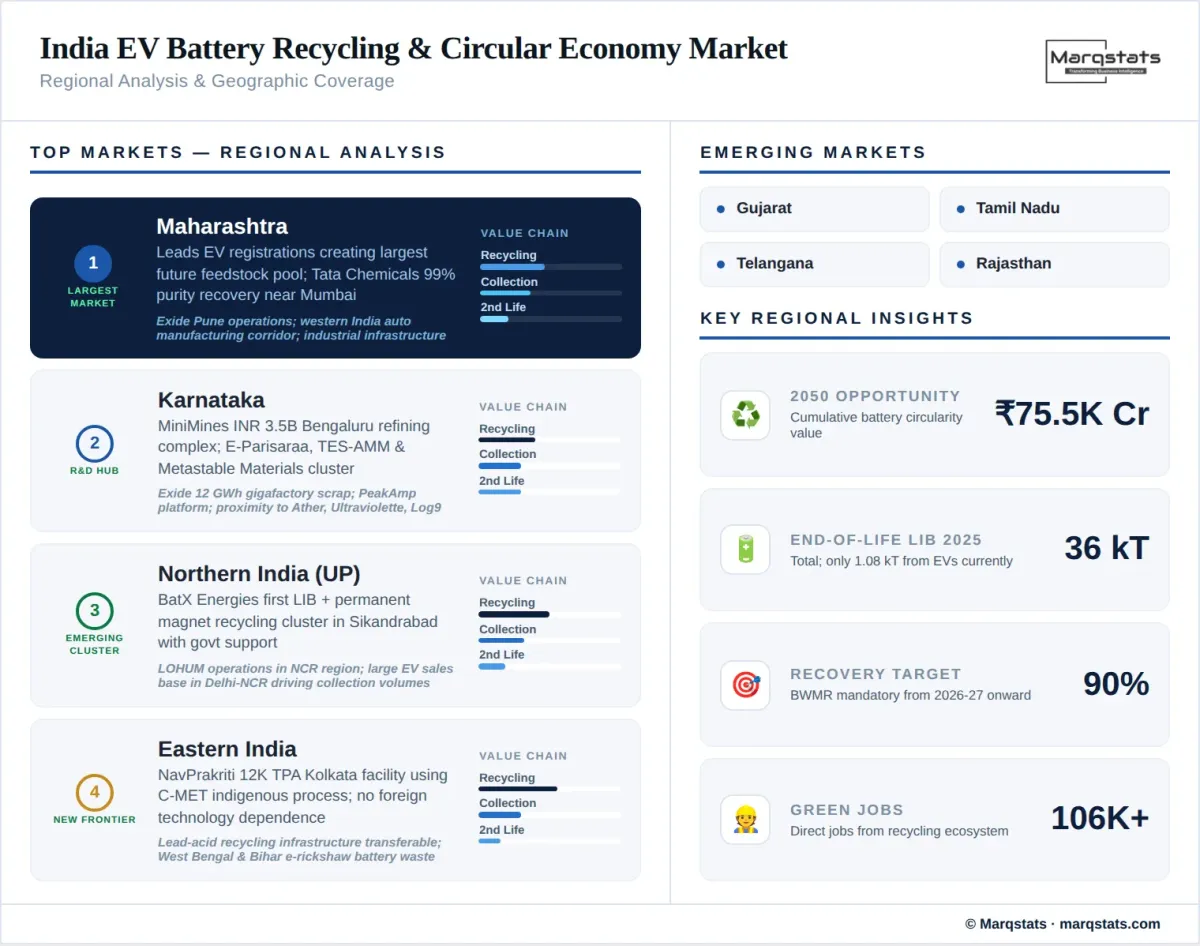
Maharashtra leads India in EV registrations (~4,038 cumulative e-bus registrations alone), creating the largest future EV battery end-of-life feedstock pool. Tata Chemicals operates recycling operations near Mumbai with 99% purity metal recovery for re-integration into battery manufacturing. Exide’s Pune operations include module/pack production that will eventually generate manufacturing scrap feedstock. Attero’s expansion centres partly serve western India’s automotive manufacturing corridor. Maharashtra’s concentration of EV sales, manufacturing, and industrial infrastructure makes it the primary market for both collection and recycling.
Karnataka and Bengaluru
Bengaluru is emerging as India’s recycling technology and R&D hub. MiniMines signed an MoU with Karnataka for an INR 3.5 billion giga critical minerals refining complex. E-Parisaraa, TES-AMM, and Metastable Materials operate recycling facilities in the Bengaluru cluster. Exide’s 12 GWh gigafactory in Bengaluru will generate significant manufacturing scrap. PeakAmp’s circularity platform is Bengaluru-based. Karnataka’s technology talent pool, proximity to EV OEM R&D centres (Ather, Ultraviolette, Log9), and state government support drive its positioning as the fastest-growing recycling hub.
Northern India and Uttar Pradesh
BatX Energies initiated India’s first lithium-ion battery and permanent magnet recycling cluster in Sikandrabad, Uttar Pradesh, with government support from TDB/DST. MaxVolt Energy acquired 23,524 sq. m. in Aligarh for a 5,200 MT Phase 1 lithium battery recycling facility. The Delhi-NCR and UP industrial corridor hosts significant e-rickshaw, e-scooter, and EV fleet concentrations generating near-term end-of-life battery volumes.
Eastern India
NavPrakriti started operations of a lithium-ion battery recycling facility in eastern India (near Kolkata) in October 2025 with 12,000 TPA mechanical pre-treatment capacity (scalable to 24,000 TPA by 2027), developed by C-MET without reliance on foreign processes. West Bengal’s Exide legacy operations and growing e-rickshaw/e-bus fleets create regional feedstock supply. Eastern India’s recycling development addresses the geographic concentration risk of having capacity only in western and southern hubs.
Rest of India
ACE Green’s Mundra, Gujarat facility (10,000 tonnes, LFP-specific, zero-emissions hydrometallurgy) serves the western manufacturing corridor. Amara Raja’s Telangana operations include battery breaking at its new recycling plant (Q4 FY2026 operational go-live). LOHUM operates from its Noida/Greater Noida base with India’s largest EV LIB recycling market share. Recyclekaro’s 24,000 tonne capacity expansion serves multiple regions. As the BWMR EPR framework tightens and the critical mineral recycling scheme distributes incentives, recycling capacity is expected to broaden geographically toward tier-2 industrial centres closer to EV fleet concentrations.
How Competition Is Evolving
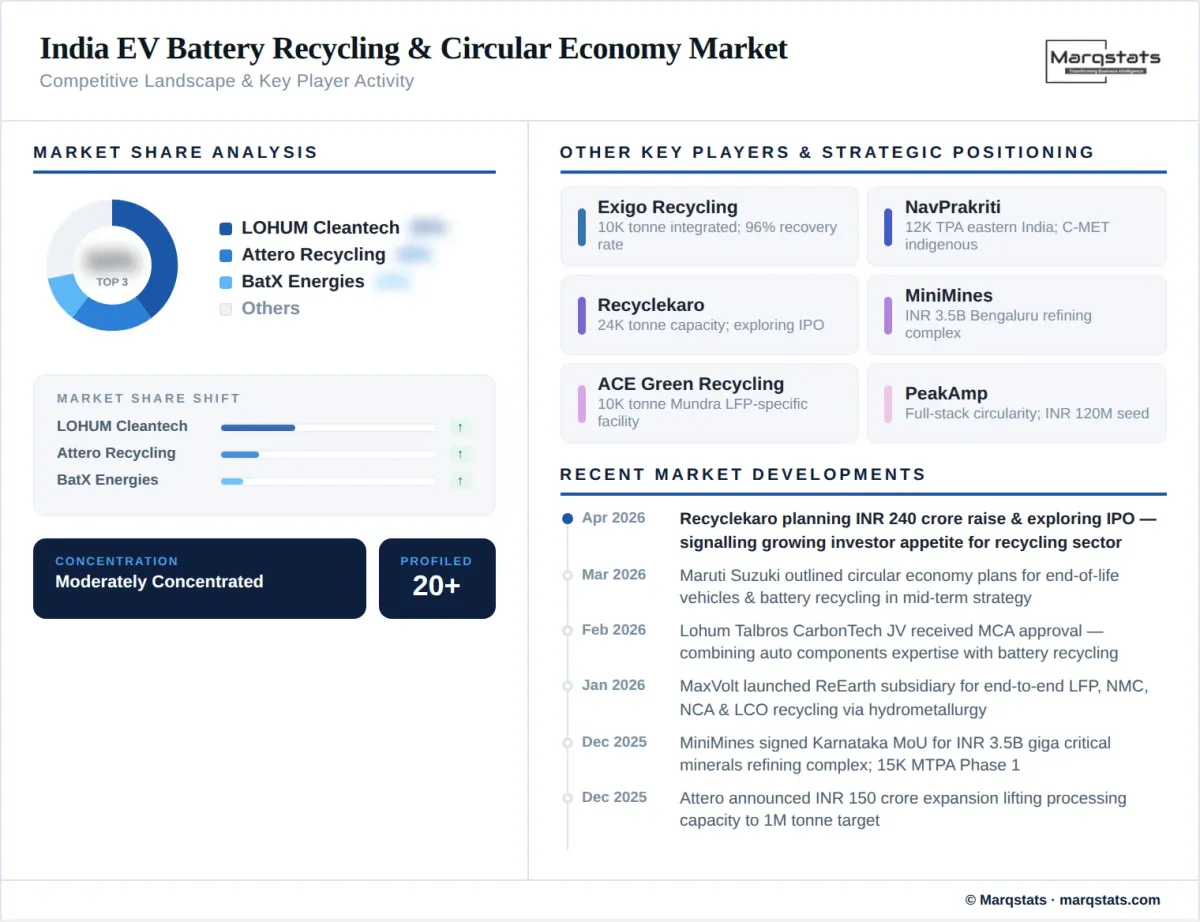
The India EV battery recycling market features a mix of specialized recycling startups, established industrial waste processors expanding into lithium-ion, OEM-backed circular economy initiatives, and emerging refining players targeting battery-grade mineral output. LOHUM Cleantech is the clear market leader, representing approximately 60–70% of India’s secondary EV LIB recycling and manufacturing market with 2 GWh recycling/refining capacity and 300 MWh repurposing capacity, expanding to 25–30 GWh by 2027. LOHUM’s March 2025 launch of India’s first battery-grade lithium refinery (1,000 MT/year) shifts it from recycler to circular material supplier. The February 2026 incorporation of Lohum Talbros CarbonTech JV with Talbros Automotive signals industrial-automotive integration.
Attero is the second major national player, targeting 1 million tonnes of LIB recycling by 2030 with INR 2,000 crore expansion roadmap and a partnership with Volvo Cars India. BatX Energies is emerging as a technology-driven player with government support (TDB/DST), VinFast partnership, and India’s first rare earth recycling initiative with Rocklink GmbH. Exigo operates 10,000 tonnes of integrated battery recycling with 96% recovery. NavPrakriti (12,000 TPA, eastern India), Recyclekaro (24,000 tonnes capacity, IPO exploration), PeakAmp (full-stack circularity platform), and MaxVolt ReEarth (end-to-end recycling subsidiary) represent the next tier of specialized players.
On the OEM and industrial side, Ashok Leyland committed INR 50 billion including a Global Centre of Excellence for battery recycling R&D. Maruti Suzuki outlined circular economy plans for ELV and battery recycling. Amara Raja’s recycling plant starts battery breaking operations in Q4 FY2026. Tata Elxsi’s Battery Aadhaar consortium (with Tata Motors, LOHUM, WRI, IIT Kharagpur) represents the digital traceability infrastructure that will enable the formal circular economy. MiniMines’ INR 3.5 billion Bengaluru refining complex targets battery-grade mineral supply at industrial scale. The competitive landscape is expected to consolidate around players that can combine formal collection networks, OEM partnerships, processing technology, and refining capability—moving beyond black mass production toward actual critical mineral extraction.
Companies Covered
The report profiles 20+ companies with full strategy and financials analysis, including:
Recent Market Activity
Table of Contents
Coverage & Segmentation
This report provides a comprehensive analysis of the India EV battery recycling and circular economy market covering the historical period (2021–2025) and forecast period (2026–2030), with 2025 as the base year. The study examines market size in USD, recycling capacity in kT/GWh, critical mineral recovery volumes, collection and channelization rates, and segment-level analysis across value chain stage (collection, diagnostics/second-life, recycling, refining), battery chemistry (NMC, LFP, LCO, mixed), processing technology (hydrometallurgical, pyrometallurgical, mechanical), and state-level geographic analysis. Company profiling covers 20 players across specialized recyclers, OEM circular economy initiatives, and refining startups. Policy analysis covers BWMR 2022 (with 2023–2025 amendments), the INR 1,500 crore Critical Mineral Recycling Scheme, EPR mandates, recovery targets, recycled-content requirements, and Battery Aadhaar traceability.
Research methodology combines bottom-up capacity and feedstock modelling from NITI Aayog circular economy data, CPCB recycler registrations, and announced capacity disclosures, validated against published company data and government scheme guidelines. Primary research encompasses interactions with recyclers, OEM sustainability teams, battery diagnostics providers, and policy stakeholders. Companion Marqstats reports on the India EV battery pack market, India electric bus battery pack market, India electric two-wheeler battery market, and India EV battery swapping market provide integrated ecosystem intelligence on the upstream battery demand that will generate future recycling feedstock.