Market Snapshot
Key Takeaways
Market Overview & Analysis
Report Summary
The India commercial vehicle telematics and fleet safety systems market encompasses the hardware, software, connectivity, and safety-electronics stack deployed across trucks, buses, LCVs, and SCVs to enable real-time vehicle tracking, remote diagnostics, driver behaviour management, predictive maintenance, and active safety compliance. The market operates across four distinct layers: compliance telematics (AIS-140 VLTDs, panic buttons, monitoring-centre integration), fleet operations telematics (live tracking, geofencing, fuel monitoring, trip analytics, ERP integration), fleet safety systems (AI dashcams, DMS, fatigue/distraction detection, driver scoring, incident evidence capture), and ADAS-linked active safety (AEB, LDW, BSIS, DDAWS, ESC — increasingly mandated by GSR 184(E) and aligned with ZF and Aptiv product roadmaps for M2/M3/N2/N3 categories).
India's commercial vehicle fleet is structurally well-suited for telematics adoption at scale. SIAM reported 951,991 CV sales in calendar 2024, with the MHCV segment accounting for a substantial share of OEM-connected platform volumes. Tata Motors alone reported 500,000+ connected commercial vehicles on Fleet Edge as of January 2024 — all medium and heavy trucks and buses are Fleet Edge-ready with embedded 4G SIM and AIS-140-compliant TCUs. Eicher says 100% of its vehicles are connected and monitored at its Uptime Centre. That installed base, combined with 10.3 lakh CV sales in 2025 (SIAM), provides the demand foundation for a market that is now transitioning from compliance-led tracking to risk-reduction and intelligent fleet operations. This report is a companion to the Marqstats India Telematics and Fleet Safety Systems Market report (india-telematics-fleet-safety), which covers the broader connected vehicle market including passenger vehicles; this study focuses exclusively on the commercial vehicle stack.
The regulatory pipeline is the single strongest growth catalyst. The March 2025 GSR 184(E) notification establishes India's most demanding CV safety technology requirement to date, mandating AEBS (AIS-162), DDAWS (AIS-184), BSIS (AIS-186), and two additional systems on buses and heavy trucks. Simultaneously, AIS-189's October 2025 effective date for new vehicle types has introduced mandatory Cybersecurity Management System requirements, adding a new compliance dimension to OEM product cycles. These mandates, combined with ARAI's December 2025 ADAS Test City inauguration, are compressing the validation and deployment timeline for a generation of connected safety systems.
Market Dynamics
Key Drivers
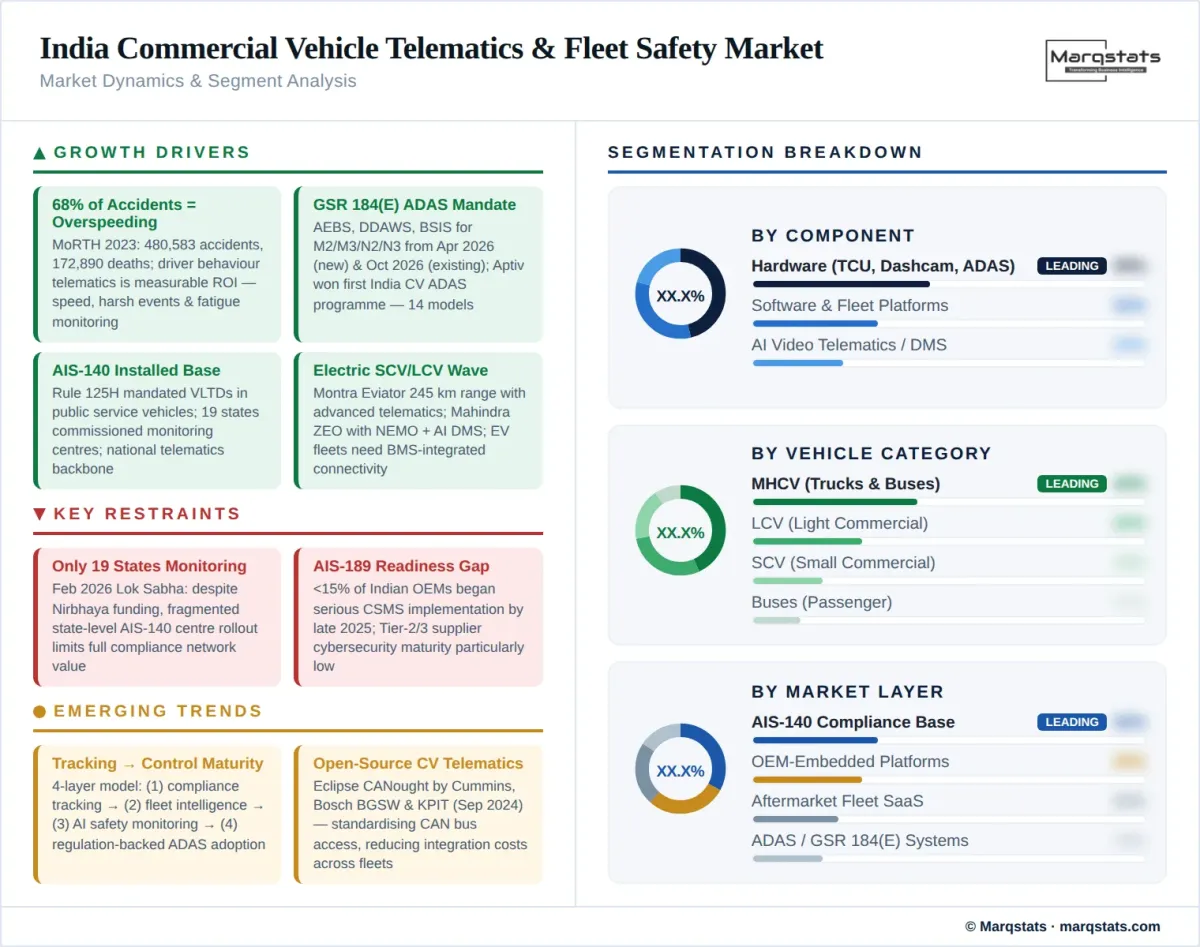
- Road fatality and overspeeding crisis requiring fleet behavioural controls: India's 2023 accident data from MoRTH shows overspeeding alone caused 68.4% of all road accidents and 68.1% of all deaths. For fleet operators, this makes driver behaviour telematics — speed alerts, harsh event detection, real-time coaching, and fatigue monitoring — a measurable, direct ROI investment, not merely a regulatory checkbox. Insurance, legal liability, and corporate safety governance are all reinforcing this demand signal.
- GSR 184(E) ADAS mandate creating a structurally new demand pool: The March 2025 MoRTH notification mandating AEBS, DDAWS, BSIS, and additional safety systems on M2/M3/N2/N3 from April 2026 (new models) and October 2026 (existing models) is the most significant demand-side intervention in India's CV safety market to date. Aptiv's January 2026 disclosure of its first India CV ADAS program (14 models, 30+ variants) confirms that OEMs are actively contracting for compliant safety systems, generating demand across sensors, ECUs, software validation platforms, and fleet safety telematics.
- AIS-140 compliance delivering the telematics installed-base foundation: Rule 125H's mandate for VLTDs and emergency buttons in public service vehicles, with AIS-140-compliant devices for PSV registrations from January 2019, has created a national telematics backbone. The February 2026 Lok Sabha reply confirmed this framework covers public service vehicles under Rule 125H with state-linked monitoring centres, though only 19 States/UTs had commissioned monitoring centres at time of reporting — indicating significant headroom for further rollout.
- Logistics efficiency imperative under the National Logistics Policy 2022: The NCAER/DPIIT assessment of India's logistics costs at 7.97% of GDP in 2023–24 quantifies the efficiency gap that telematics directly addresses. Route optimisation, idle-time reduction, fuel pilferage detection, and predictive maintenance — all delivered via fleet telematics — map directly to the NLP's stated objectives of logistics cost reduction, digital integration, and a top-25 LPI ranking by 2030.
- OEM embedded telematics shifting from differentiator to standard platform: Tata Fleet Edge (500,000+ CVs), Eicher My Eicher (110,000+ connected, 24x7 uptime centre), BharatBenz Truckonnect (standard above 16T), and Ashok Leyland iALERT have collectively made factory-fitted telematics the mainstream acquisition channel. OEMs are using connected platforms to create service revenue streams, improve uptime SLAs, and differentiate on total cost of ownership — turning telematics into a fleet relationship management tool rather than just a hardware fitment.
Key Restraints
- Fragmented state-level AIS-140 monitoring-centre rollout: The February 2026 Lok Sabha reply confirmed that despite a central implementation scheme approved under the Nirbhaya framework in January 2020, only 19 States/UTs had commissioned monitoring centres. This fragmentation limits the full value of AIS-140 compliance networks and creates uneven enforcement across geographies.
- AIS-189 implementation readiness gap: By late 2025, fewer than 15% of Indian OEMs had begun serious AIS-189 CSMS implementation, creating a potential compliance bottleneck as October 2025 effective dates for new vehicle types and October 2028 all-vehicle deadlines approach. Supply chain cybersecurity maturity is particularly low among Tier-2 and Tier-3 suppliers, adding complexity to full compliance.
- Commoditisation and price pressure at the compliance hardware layer: ARAI's type-approval list for AIS-140 devices includes a large number of approved vendors, making the compliance hardware segment highly competitive with compressed margins. Vendors without software, service depth, or integration capability face a structurally weak competitive position in the compliance layer.
- Driver acceptance challenges for inward-facing cameras and behaviour monitoring: AI-enabled driver monitoring systems using inward-facing cameras generate workforce resistance in India's owner-operator and small fleet segments. Managing driver privacy, union negotiations, and data governance around behavioural scoring is an adoption barrier that video telematics vendors must address operationally.
Key Trends
- Market transitioning from tracking to control — the four-layer maturity model: India's CV telematics market is evolving through four stages: (1) compliance tracking, (2) fleet operations intelligence (fuel, route, utilisation), (3) AI safety monitoring (video, DMS, driver coaching), and (4) regulation-backed ADAS adoption. Most organised logistics operators are now at stage 2–3, while OEM platforms and larger fleet operators are moving towards stage 3–4 as ADAS mandates crystallise.
- Open-source and standards-based CV telematics architectures gaining momentum: The September 2024 launch of Eclipse CANought by Cummins, Bosch BGSW, and KPIT — standardising CAN bus access for commercial vehicle telematics as part of the Eclipse Software Defined Vehicle project — signals a move toward open, modular fleet connectivity architectures that reduce integration costs and accelerate OTA update deployment across heterogeneous CV fleets.
- Electric SCV and LCV fleets creating the next telematics growth wave: Montra Electric's Eviator e-SCV (245 km certified range, 95% uptime guarantee backed by advanced telematics, factory-fitted in a 50,000-unit-capacity Chennai plant), Mahindra's ZEO SCV (NEMO telematics with real-time performance tracking, AI-enabled DMS with lane departure warning and headway monitoring), and growing e-SCV deployments are creating demand for telematics that integrates battery management, charging analytics, range prediction, and fleet operations into one platform.
- Tier-1 ADAS suppliers entering India CV market directly: Aptiv's January 2026 disclosure of India's first CV ADAS program, ZF's India product roadmap for M2/M3/N2/N3 ADAS modules (MOIS, ISA, DDAW, BSIS, REIS), and Bosch's Eclipse CANought contribution all signal that global ADAS Tier-1s are now actively building India-specific CV safety programs ahead of mandatory deadlines — converting the ADAS mandate from a future aspiration to an active procurement cycle.
Market Segmentation
The hardware segment — comprising AIS-140-compliant VLTDs, telematics control units (TCUs), OBD dongles, inward/outward AI dashcams, radar sensors, and ADAS modules — accounts for the largest revenue share in India's CV telematics market. The AIS-140 device base is large but commoditised, with ARAI's type-approval list showing extensive certified vendor competition. Higher-margin hardware growth is concentrated in AI dashcams and ADAS sensor modules ahead of GSR 184(E) compliance deadlines. Lumax Ituran's December 2024 completion of device validation with Daimler India across 15,000+ BharatBenz vehicles illustrates the scale of hardware validation programs underway. Cummins and Bosch's Eclipse CANought open-source project (September 2024) is driving standardisation of CAN bus access, reducing hardware integration barriers and enabling faster OTA deployment at scale.
Fleet management SaaS and AI analytics platforms represent the fastest-growing revenue segment, as organised logistics operators, school fleet operators, and e-commerce last-mile companies shift from hardware-only to integrated platform models. Fleetx's AI fleet and transport operations platform serves 350,000 vehicles with 300+ integrations and over 10 million trips tracked annually. TrackoBit competes on enterprise GPS, telemetry, maintenance cycles, and video telematics. MapmyIndia's InTouch enterprise solution combines live tracking, diagnostics, and sensor integration with Qualcomm's Snapdragon Auto Connectivity Platform — a January 2025 partnership designed to scale software-defined vehicle telematics for Indian OEMs. VE Commercial Vehicles' May 2024 JV with iTriangle Infotech is purpose-built to develop fleet management systems for Eicher truck and bus customers on iTriangle hardware.
The fleet safety systems segment — covering AI video telematics, driver monitoring systems (DMS), drowsiness and distraction detection, and ADAS electronics — is the highest-growth emerging segment, directly addressed by both the GSR 184(E) ADAS mandate and the market's shift to active risk management. Netradyne's AI-driven fleet safety platform focuses on full-drive-time video analysis, distraction/drowsiness scoring, and incident evidence capture. Fleetx's March 2026 deployment of AI dual-lens dashcams across 200 AbhiBus buses is a commercial-scale reference deployment for bus safety monitoring. Mahindra's ZEO SCV (October 2024) shipped with an AI-enabled DMS featuring lane departure warning, headway monitoring, and pedestrian collision warning at the SCV price point — signalling that ADAS is now entering sub-5-tonne electrics.
MHCV telematics is the largest revenue segment, dominated by OEM-embedded platforms. Tata Fleet Edge covers 500,000+ vehicles; Eicher Uptime Centre monitors 110,000+ vehicles 24x7; BharatBenz Truckonnect is standard above 16 tonnes. The GSR 184(E) ADAS mandate for N2/N3 categories — AEBS, DDAWS, BSIS effective April 2026 for new models — is converting MHCV from the compliance layer into the primary ADAS adoption market. Aptiv's January 2026 India CV ADAS program covering 14 models and 30+ variants is specifically designed for this regulatory deadline.
Buses represent the most tightly regulated and fastest-moving segment for fleet safety systems in India, driven by AIS-140 mandate compliance for public service vehicles, state transport undertaking (STU) digital mandates, and the GSR 184(E) ADAS requirements for M2/M3 categories. The AbhiBus-Fleetx partnership (March 2026) deploying AI dashcams across 200 buses for driver safety monitoring and operational analytics is a key commercial benchmark. ZF's India CV ADAS roadmap specifically references M2/M3 categories for ESC mandates and active safety modules. BharatBenz's December 2025 launch of the BB1924 intercity bus featured predictive maintenance via IoT-based telematics and driver training as standard elements.
LCV telematics adoption is growing rapidly, driven by e-commerce logistics, urban last-mile delivery, and the formalisation of gig-economy delivery fleets. Eicher's Pro X range (unveiled at Bharat Mobility Global Expo 2025, first deliveries to Magenta Mobility March 2025) features Uptime Centre 24x7 monitoring, AI/ML-driven remote diagnostics, and FOTA-enabled telematics. Mahindra's Bolero MaXX Pik-Up HD 1.9 CNG (June 2025), India's first CNG pickup with iMAXX connected vehicle telematics for real-time operational data, extends OEM-embedded telematics to the small commercial segment.
Electric SCVs are creating a distinct telematics sub-segment with battery management, range analytics, and charging network integration layered on top of standard fleet operations monitoring. Montra Electric's Eviator e-SCV, built at a new 50,000-unit-capacity Chennai plant (inaugurated March 2025), promises over 95% fleet uptime via advanced telematics. Mahindra's ZEO SCV (launched October 2024) features NEMO telematics for real-time performance tracking plus an AI-enabled DMS with ADAS features — a notably sophisticated safety stack for the sub-2-tonne segment.
AIS-140 compliance remains the entry-point application for a large portion of India's CV fleet, particularly public service vehicles, school buses, ambulances, and contract carriage operators. Rule 125H mandates VLTDs and emergency buttons; AIS-140 IS 16833 specifies device requirements covering real-time location, emergency alerts, OTA updates, SIM management, and back-end communications. While compliance telematics is a lower-margin application, it creates the installed base on which analytics, safety, and maintenance applications are subsequently deployed.
Fleet operations analytics — fuel monitoring, route adherence, geofencing, idle-time control, maintenance scheduling, and driver productivity — is the dominant value-creation application layer, particularly for organised logistics, 3PL operators, and OEM uptime platforms. India's logistics cost at 7.97% of GDP (NCAER/DPIIT, 2023–24) makes fuel and route inefficiency among the most commercially addressable problems for fleet operators. BharatBenz's Truckonnect platform covers trip analysis, driving analysis, geofencing, fuel-fill and fuel-drop alerts, DTC alerts, and vehicle health data — representing a mature OEM operations-telematics offering.
Driver safety is becoming a standalone buying priority for fleet procurement teams, driven by insurance cost pressures, regulatory compliance on DDAWS from 2026, and measurable incident reduction ROI. AI-powered dual-lens dashcams, DMS, drowsiness detection, harsh-event capture, and real-time coaching workflows are the primary products in this layer. With overspeeding causing 68.4% of India's road accidents, fleet operators that can demonstrate driver behaviour improvement and incident evidence capture are reducing both insurance premiums and legal liability exposure.
By Geography
Western India
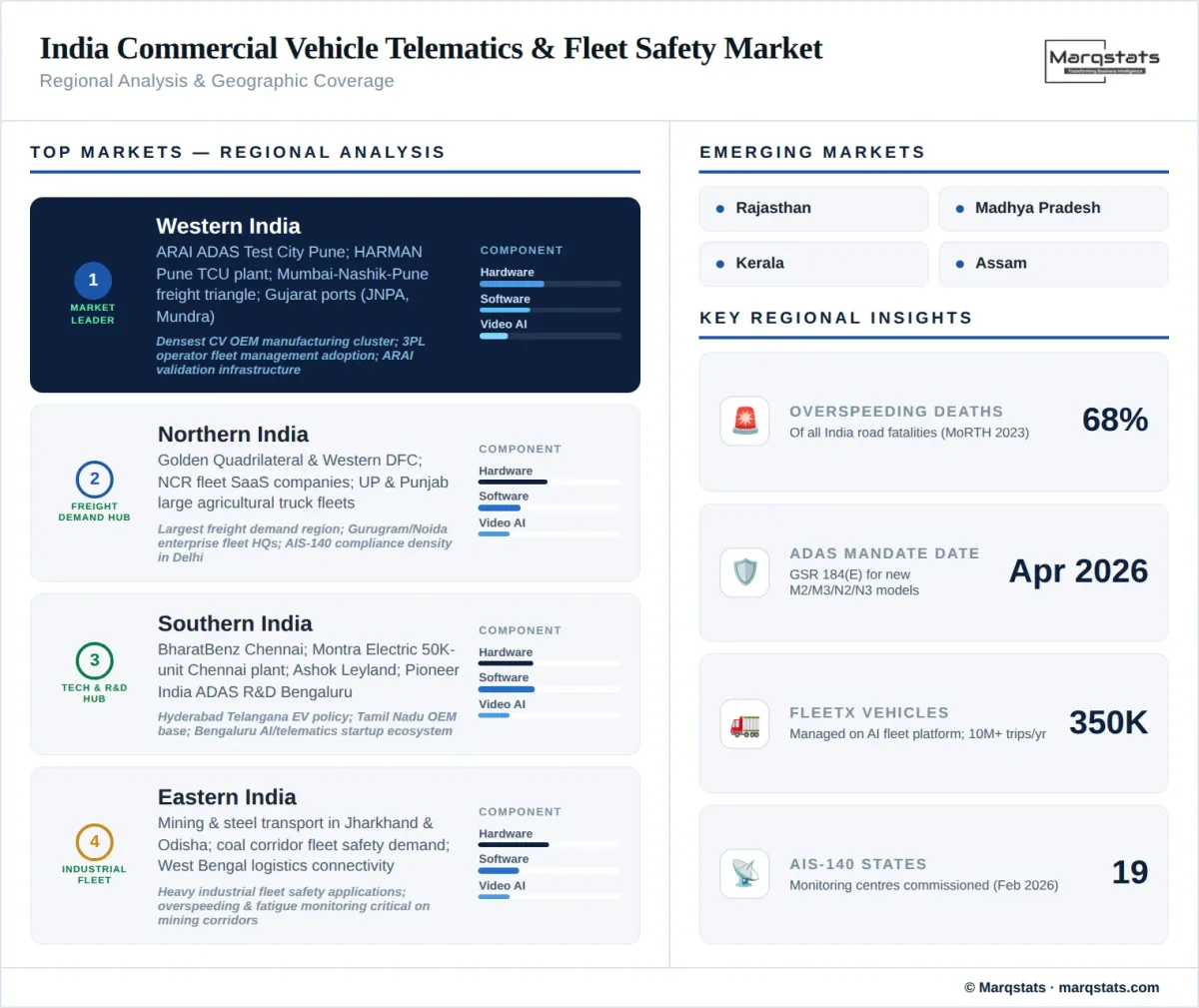
Western India — anchored by Maharashtra, Gujarat, and Rajasthan — is the leading CV telematics region by revenue and infrastructure. Maharashtra hosts ARAI's ADAS Test City (Takwe, Talegaon, Pune) and a dense cluster of CV OEM manufacturing, engineering, and logistics infrastructure. BharatBenz's Chennai plant and HARMAN's Pune TCU manufacturing facility both have supply chains rooted in the western India industrial corridor. The Mumbai-Nashik-Pune logistics triangle is among India's highest-density freight corridors, driving strong fleet management software adoption by 3PL operators. Gujarat's growing port infrastructure (JNPA, Mundra) and inland logistics activity are accelerating telematics adoption among long-haul MHCV operators.
Northern India
Northern India — Delhi-NCR, Haryana, Uttar Pradesh, Punjab, and Rajasthan — is the largest freight demand region and a primary target market for fleet safety systems vendors. The Golden Quadrilateral and Western Dedicated Freight Corridor traverse this region, creating concentrated demand from organised logistics, e-commerce fulfillment, and bulk commodity transportation operators. NCR-based fleet management SaaS companies serve large enterprise fleets headquartered in Gurugram, Noida, and Delhi. Uttar Pradesh and Punjab's large agricultural and general-cargo truck fleets are primary targets for AIS-140 upgrade and video telematics upsell programs.
Southern India
Southern India — Karnataka, Tamil Nadu, Telangana, and Andhra Pradesh — is the fastest-growing CV telematics region, driven by its concentration of OEM assembly, telematics R&D, and technology talent. Tamil Nadu is home to BharatBenz's manufacturing plant and a significant Ashok Leyland production base. Karnataka hosts Pioneer India's new Bengaluru R&D centre (May 2025) and several fleet-tech and ADAS software startups. TIVOLT Electric Vehicles / Montra Electric's Chennai plant (inaugurated March 2025, 50,000 units annual capacity) represents the leading edge of electric SCV telematics manufacturing in the region.
Eastern India
Eastern India — West Bengal, Odisha, Bihar, and Jharkhand — is an emerging CV telematics market, with adoption concentrated in state transport undertakings, mining sector heavy vehicles, and long-haul freight on the East Dedicated Freight Corridor. Bihar's state VLT and EAS portal implementation, aligned with the national AIS-140 framework, is creating the compliance-monitoring infrastructure on which analytics services can be layered. Mining sector fleet operators in Jharkhand and Odisha represent a high-value target for predictive maintenance and asset-tracking telematics given the high cost of unplanned downtime in heavy equipment operations.
Rest of India — Central and Northeastern States
Central India (Madhya Pradesh, Chhattisgarh) and Northeastern states have lower CV telematics penetration outside of STU compliance deployments and government-contracted logistics. MP and Chhattisgarh's manufacturing and agri-logistics sectors are growth opportunities for fuel monitoring and route analytics platforms as 4G/5G coverage improves. The Northeastern states benefit from India's border trade logistics expansion, creating demand for track-and-trace telematics on cross-border freight routes.
How Competition Is Evolving
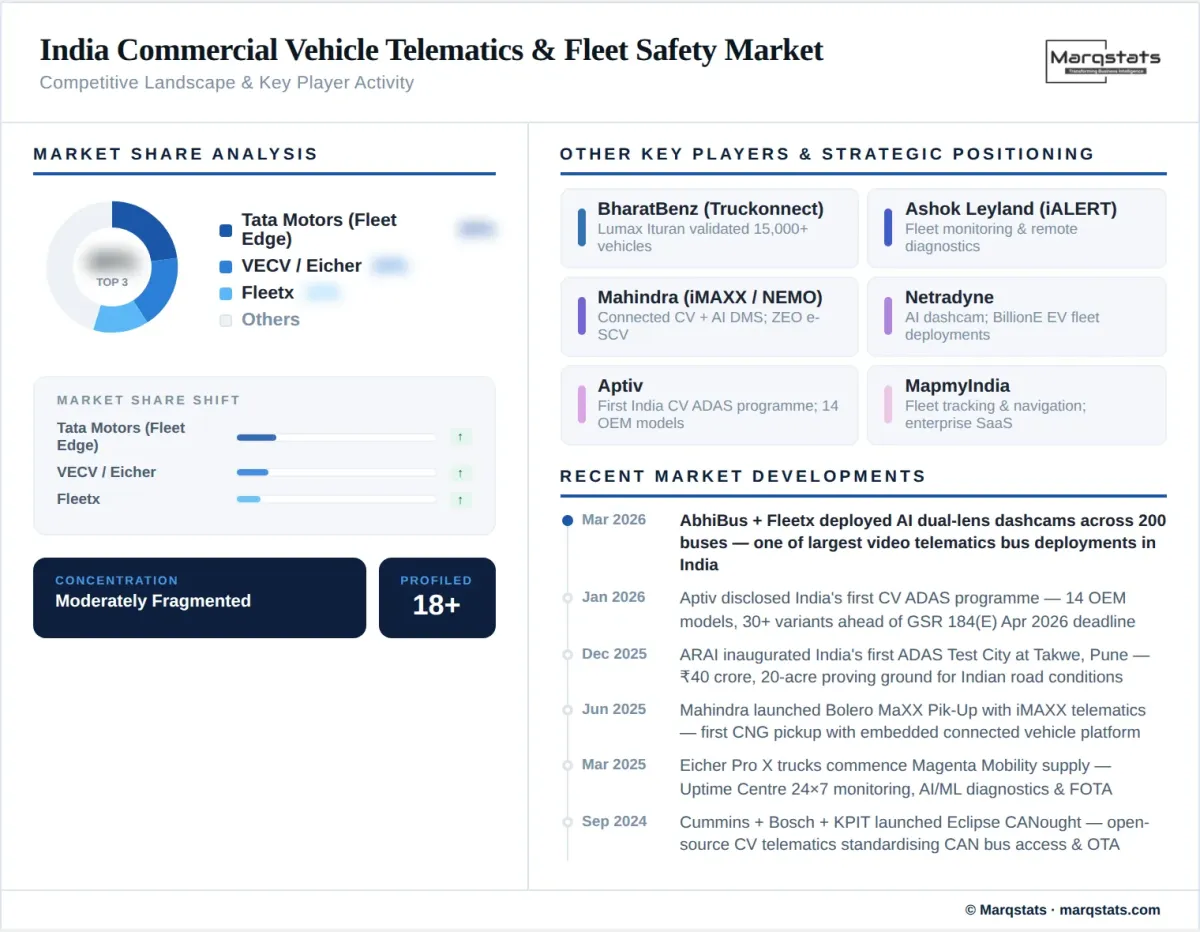
India's commercial vehicle telematics and fleet safety systems market is moderately fragmented across five competitive archetypes. OEM embedded telematics players — Tata Motors (Fleet Edge), Eicher/VECV (My Eicher, iTriangle JV), BharatBenz (Truckonnect), and Ashok Leyland (iALERT) — hold the strongest competitive positions by connected vehicle base and diagnostic data access, leveraging factory fitment and service network integration to create sticky platform relationships. Their strategic advantage is access to CAN/OBD diagnostic data, uptime-centre monitoring capabilities, and service-revenue cross-sell opportunities unavailable to aftermarket vendors.
The aftermarket fleet-tech software layer features Fleetx (350,000 vehicles, AI platform, ₹113 crore Series C), LocoNav/Sensorise (Eagle.ai post-acquisition, 10,000+ customers, 150,000 active devices), TrackoBit (enterprise GPS and video telematics), and MapmyIndia (enterprise InTouch with Qualcomm partnership). These platforms compete on multi-brand visibility, analytics depth, integration breadth, and AI-driven workflow automation. Their structural advantage is cross-OEM compatibility — fleet operators running mixed brands of Tata, Eicher, Mahindra, and BharatBenz vehicles need a common analytics layer, which OEM-specific platforms cannot provide.
The ADAS and active safety layer is being shaped by global Tier-1 suppliers. Aptiv's January 2026 disclosure of India's first commercial-vehicle ADAS win — covering 14 models and 30+ variants and targeting the GSR 184(E) April 2026 deadline — marks the entry of a global ADAS Tier-1 into India's CV regulatory market. ZF's India CV roadmap covers MOIS, ISA, DDAW, BSIS, REIS, and TPMS for M2/M3/N2/N3 categories. Bosch contributed to Eclipse CANought, the open-source CAN bus standardisation project for CV telematics. These players are competing not just on hardware but on type-approval-ready, validated safety stacks that OEMs can integrate within tight regulatory timelines. The competitive dynamic is speed-to-compliance as much as technology.
Companies Covered
The report profiles 18+ companies with full strategy and financials analysis, including:
Recent Market Activity
Table of Contents
Coverage & Segmentation
This report provides a comprehensive analysis of India's commercial vehicle telematics and fleet safety systems market covering the 2021–2030 period, with 2025 as the base year. The study examines the full telematics stack across medium and heavy commercial vehicles (MHCV — N2/N3), light commercial vehicles (LCV — N1), small commercial vehicles and electric SCVs, and buses (M2/M3). It covers compliance telematics hardware (AIS-140/IS 16833 VLTDs), OEM-embedded fleet management platforms, aftermarket fleet operations software, AI video telematics and driver monitoring systems, and ADAS electronics (AEBS/AIS-162, DDAWS/AIS-184, BSIS/AIS-186, and related safety systems mandated under GSR 184(E)). Regulatory sections include AIS-140 state-level rollout, GSR 184(E) ADAS timelines, AIS-189 cybersecurity requirements, and ARAI ADAS Test City validation infrastructure. Passenger vehicle telematics and the broader connected vehicle market are covered in the companion Marqstats report on India Telematics and Fleet Safety Systems Market (india-telematics-fleet-safety).
Primary research for this report included 40+ interviews with CV OEM product and connected-vehicle teams, fleet management SaaS product leads, ADAS supplier India representatives, logistics sector fleet managers, state transport undertaking procurement officers, and ARAI certification process specialists. Secondary research drew from MoRTH annual accident reports, Lok Sabha question replies, PIB policy notifications, SIAM CV sales data, NCAER/DPIIT logistics cost assessments, ARAI type-approval lists and press materials, company press releases and stock exchange filings, Eclipse SDV project publications, and Autocar Professional India. Market sizing used a bottom-up approach combining OEM-disclosed connected fleet data, SIAM sales volumes, AIS-140 device registration data, and public fundraise and M&A transaction values.