Market Snapshot
Key Takeaways
Market Overview & Analysis
Report Summary
The electric vehicle battery components market encompasses the core cell-level materials and sub-components: cathode active materials (NMC, NCA, LFP, LNMO, and emerging sodium-ion cathodes), anode active materials (natural graphite, synthetic graphite, silicon, silicon-graphite composites, and lithium metal), separators (polyethylene, polypropylene, ceramic-coated), electrolytes (liquid carbonate-based, solid-state polymer, solid-state ceramic/sulphide), current collectors (aluminium positive foil, copper negative foil), binders (PVDF, SBR/CMC), and conductive additives (carbon black, CNT). BMS, pack enclosures, bus bars, thermal management hardware, and module/pack structural components are treated as adjacent pack-system markets and are excluded from the core market scope. This distinction aligns with how US manufacturing policy (45X) defines qualifying battery components as electrode active materials, battery cells, and battery modules.
The market is being shaped by five concurrent forces: (1) chemistry positioning—LFP versus nickel-rich cathodes, graphite versus silicon anodes—creating a two-track supply chain; (2) manufacturing yield and cost competitiveness, where China’s cost advantage and higher production efficiency create structural challenges for new producers outside China; (3) traceability and compliance—EU battery passport, carbon footprint declarations, recycled-content mandates, and US FEOC restrictions; (4) localization—proximity to cell factories becoming a commercial requirement, not just a strategic bonus; and (5) recycling and circularity—the battery supply chain increasingly becoming “closed loop” with EU-mandated recovery thresholds and recycled-content from 2031.
Market Dynamics
Key Drivers
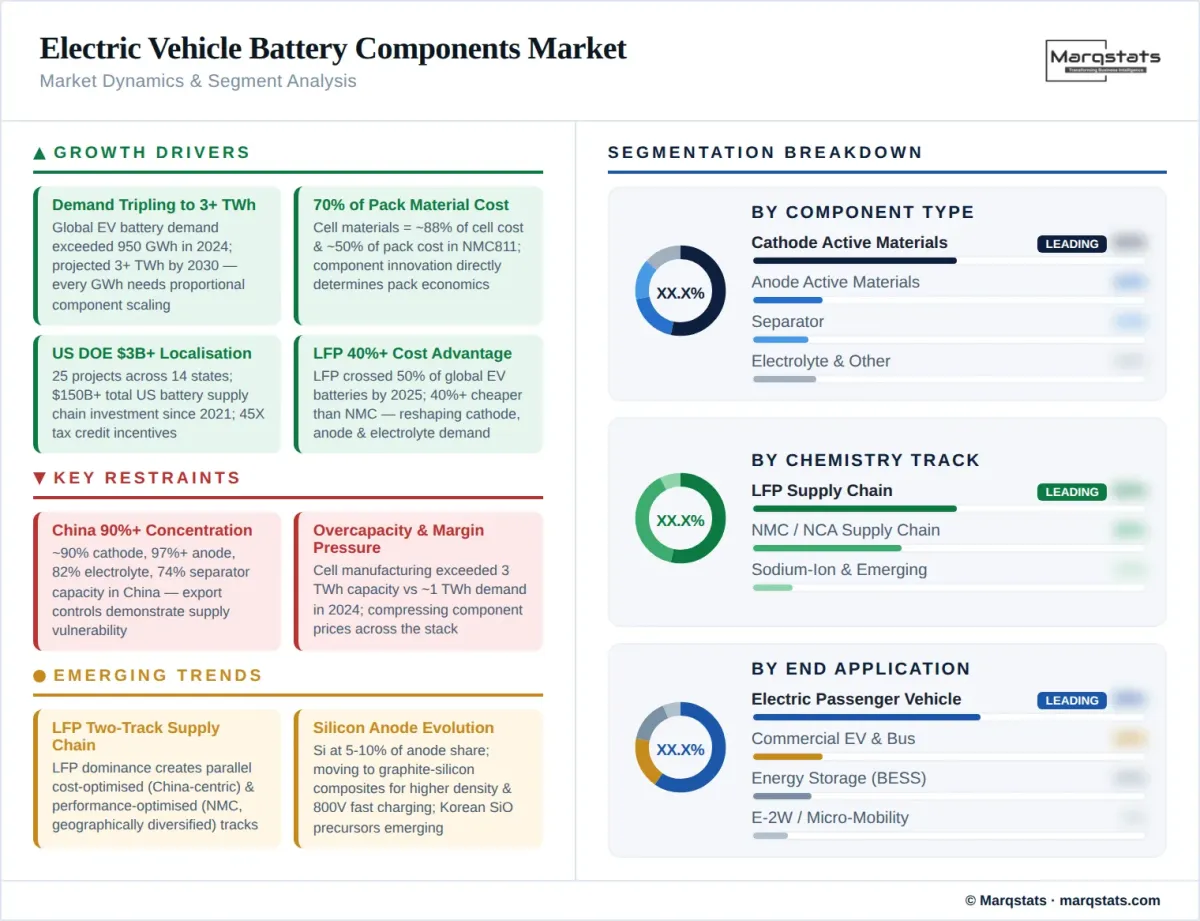
- EV battery demand tripling from ~1 TWh (2024) to 3+ TWh (2030): Global EV battery demand exceeded 950 GWh in 2024 and is projected to surpass 3 TWh by 2030. This volume tripling creates massive demand growth for every component layer—cathode, anode, separator, electrolyte, and current collectors. The global battery market reached approximately USD 130 billion in 2024, with EVs at 75% of total demand. Every GWh of additional battery production requires proportional scaling of upstream active materials, making the components market the most volume-leveraged layer in the EV value chain.
- Cell materials representing 70% of pack material demand and 50% of pack cost: In a mainstream NMC811 architecture, cathode, anode, separator, and electrolyte together account for approximately 88% of cell material cost and about 50% of total pack cost. This cost concentration means component-level innovation—higher-nickel cathodes, silicon-rich anodes, dry electrode processing, thinner separators—directly determines pack-level economics. OEMs and cell manufacturers cannot achieve battery cost targets without component-level breakthroughs.
- US DOE USD 3+ billion for battery materials localization across 14 states: The US DOE selected over USD 3 billion for 25 projects to boost domestic advanced battery and battery-material production, while broader investment announcements exceeded USD 150 billion in the US battery supply chain since 2021. Treasury’s 45X regulations define qualifying battery components as electrode active materials, cells, and modules—directly incentivizing domestic cathode and anode production. The 30D FEOC restrictions (battery components from 2024, critical minerals from 2025) further push localization by restricting EV tax credits for vehicles using components from designated foreign entities.
- EU Battery Regulation creating compliance-driven component demand: The EU Battery Regulation (2023/1542) requires lower carbon footprint declarations, social and environmental due diligence for lithium, cobalt, nickel, and natural graphite, recycled-content minimums from 2031, and QR-code battery passport requirements for all EV batteries sold in Europe. The EU Critical Raw Materials Act adds 2030 benchmarks of 10% extraction, 40% processing, and 25% recycling within the EU, with no more than 65% of any strategic raw material from a single third country. Together, these regulations create compliance-driven demand for locally produced, traceable, low-carbon battery components.
- 800V battery architecture driving demand for advanced components: The transition from 400V to 800V EV architectures (Porsche Taycan, Hyundai/Kia E-GMP, Renault RGEV Medium 2.0 targeting 800V by 2028) requires component upgrades: higher-voltage electrolytes with wider electrochemical stability windows, thinner and more thermally stable separators, advanced silicon-carbon composite anodes for faster charging acceptance, and higher-purity current collector foils. Renault’s futuREady strategy targets ultra-fast 10-minute charging by 2030 on its 800V platform—a target that directly depends on next-generation electrolyte and anode component performance.
Key Restraints
- China’s 90%+ concentration in cathode and anode manufacturing: China represents nearly 90% of global cathode capacity and over 97% of anode capacity. Only Korea (9% cathode) and Japan (3%) have meaningful non-China shares. This concentration means component supply disruptions—whether from export controls, trade disputes, or logistics bottlenecks—propagate across the entire global EV supply chain. China’s export controls on key battery-related materials since 2023 (some temporarily suspended in early 2026) demonstrate this vulnerability is not theoretical.
- Overcapacity building margin pressure across components: Global battery cell manufacturing capacity exceeded 3 TWh in 2024—approximately three times actual demand across EVs and storage. This overcapacity is building in both anode and cathode production, compressing component prices and squeezing margins for producers. New entrants outside China often struggle to reach profitable manufacturing yields, creating a double challenge: high capex investment plus compressed selling prices.
- Cobalt price volatility and critical mineral supply uncertainty: Cobalt, lithium, nickel, and natural graphite prices remain volatile, directly affecting cathode and anode material economics. The shift toward LFP reduces cobalt/nickel exposure but increases lithium price sensitivity. US 93.5% anti-dumping duties on Chinese anode-grade graphite (July 2025) and China’s export restrictions create additional pricing uncertainty for anode material sourcing outside China.
- Trade hardening fragmenting previously integrated supply chains: The US preliminary 93.5% anti-dumping duty on Chinese anode-grade graphite, EU’s 65% single-source cap under the Critical Raw Materials Act, and China’s reciprocal export controls are fragmenting a component supply chain that was historically integrated through China. Producers must now build parallel regional supply chains—adding cost, complexity, and time-to-market versus the efficiency of the pre-trade-hardening Chinese-centred model.
Key Trends
- LFP crossing 50% share, creating a two-track component supply chain: LFP accounted for over half of global EV batteries by 2025, at more than 40% cheaper than NMC. This creates two parallel component demand tracks: LFP supply chains emphasising lithium iron phosphate cathodes, graphite anodes, cost-optimised separators, and high-yield manufacturing (centred in China); and nickel-rich supply chains emphasising NMC811/NCA cathodes, silicon-graphite anodes, advanced electrolytes, and performance-optimised cell designs (more geographically diversified). Component suppliers must decide which track—or both—to serve.
- Silicon anode evolution from 5–10% share toward graphite-silicon blends: Graphite currently accounts for 90–95% of anode applications, with silicon at 5–10%. The market is moving toward graphite-silicon composite anodes that deliver higher energy density and faster charging acceptance, particularly for 800V architectures. Next-generation silicon-rich and silicon-dominant anodes represent a longer-term technology shift. Korean producers unveiled silicon powder and silicon oxide (SiO) precursors at InterBattery 2026 as core ingredients in next-generation anode materials. Norway’s Vianode opened its first full-scale synthetic anode graphite plant in 2024, representing non-China localization of the anode layer.
- Solid-state electrolyte development advancing toward commercialisation: Solid-state batteries promise step-change improvements in energy density, safety, and fast-charging, with solid electrolytes (polymer, ceramic, sulphide) replacing liquid carbonate-based electrolytes. While full commercial deployment remains post-2028 for most programmes, solid-state electrolyte R&D is influencing investment decisions and component roadmaps across the industry. The electrolyte segment will undergo the most fundamental technology transformation of any battery component layer over the next decade.
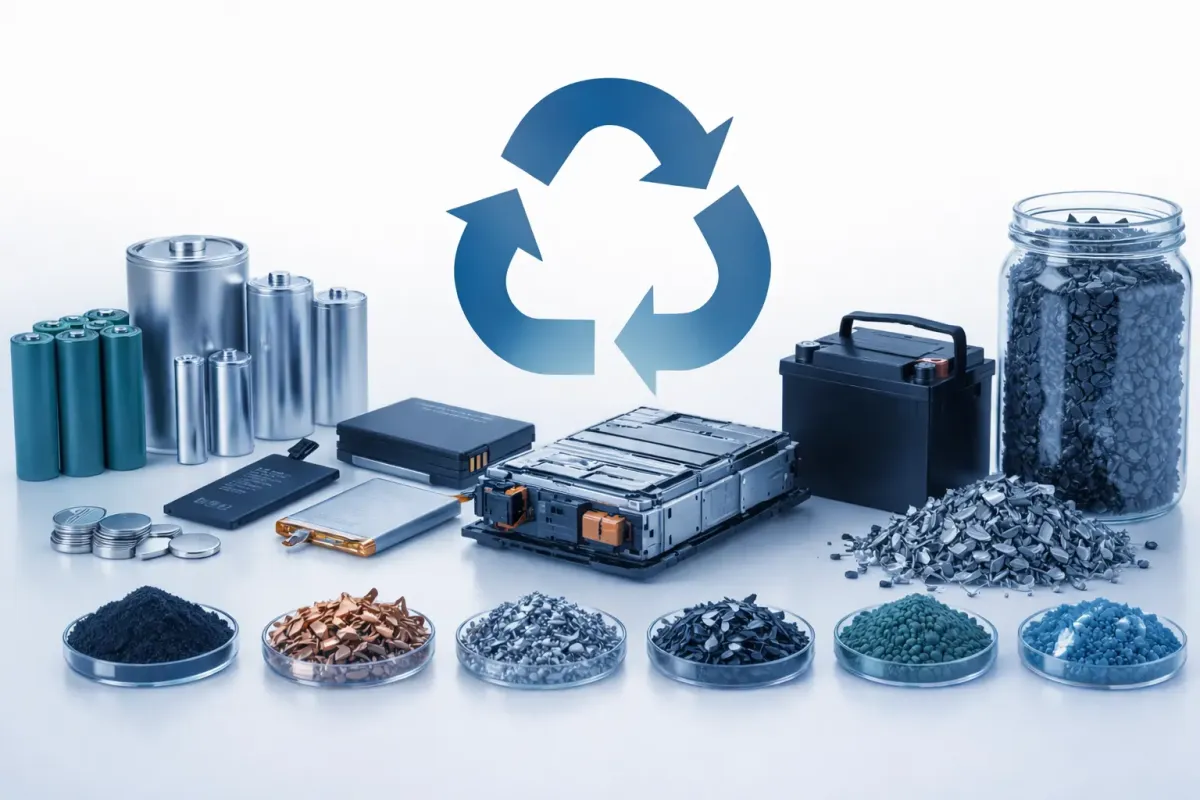
- Recycled-content mandates creating circular component demand from 2031: The EU Battery Regulation mandates minimum recycled content in new EV batteries rising from 2031, with lithium, cobalt, nickel, and lead recovery thresholds. This creates a structural demand channel for recycled cathode and anode materials—recycled copper foil, recycled lithium carbonate, recycled nickel sulphate—alongside primary component production. Companies building closed-loop processing at scale (recycled copper foil, anode materials from end-of-life batteries) are positioning for this regulatory-driven circular demand.
- Cell-to-pack and cell-to-body architectures changing component interfaces: SEAT/CUPRA’s Martorell plant began mass production of battery systems using VW Group’s Unified Cell with cell-to-pack technology in March 2026, producing 1,200 batteries per day (300,000/year). Renault’s futuREady platform uses cell-to-body design with 20% fewer components. These pack-level architecture changes affect component specifications—separator thickness, electrolyte formulation, current collector design—because cells must perform structural as well as electrochemical functions.
Market Segmentation
The largest component segment at approximately USD 55 billion (2024), cathode materials carry the biggest critical mineral bill and are most directly affected by chemistry shifts. NMC (nickel manganese cobalt) cathodes in 811, 622, and 532 formulations serve performance-led applications requiring high energy density. NCA (nickel cobalt aluminium) serves premium EVs. LFP (lithium iron phosphate) now dominates by volume (50%+ of global EV batteries), offering 40%+ cost advantage versus NMC. LNMO (lithium nickel manganese oxide) and sodium-ion cathodes represent emerging alternatives. Chinese producers lead: Hunan Yuneng (~9% global share), Dynanonic, and XTC New Energy Materials, with the cathode field remaining more fragmented than anodes. The LFP surge concentrates even more cathode value in China.
The most geopolitically sensitive component segment at approximately USD 9 billion (2024), with China controlling over 97% of manufacturing capacity. Natural graphite and synthetic graphite account for 90–95% of current applications. Silicon represents 5–10% and is the fastest-evolving technology layer, with graphite-silicon composites targeting higher energy density and faster charging. BTR New Energy Material leads globally at ~22% share, followed by Shanghai ShanShan (~19%). US 93.5% anti-dumping duties on Chinese anode-grade graphite (July 2025) make this the most trade-sensitive component. Localization efforts include Vianode’s synthetic graphite plant in Norway (2024) and the Northern Graphite–Al Obeikan JV in Saudi Arabia (2026).
Approximately USD 5 billion (2024), separators are critical for safety (preventing internal short circuits) and increasingly for fast-charging performance. Demand exceeds 200 kilotonnes globally. Polyethylene (PE), polypropylene (PP), and ceramic-coated variants serve different chemistry and safety requirements. Chinese producers dominate, but Japanese (Asahi Kasei) and Korean (SKIET) suppliers remain important, especially for premium nickel-rich cells. Thinner separators (sub-12 μm) and ceramic coatings for thermal stability are the key technology trends, driven by higher energy density cells and 800V architectures.
Approximately USD 5.5 billion (2024) with demand around 700 kilotonnes. Liquid carbonate-based electrolytes dominate current production. The segment faces the most fundamental technology transformation of any component: solid-state electrolytes (polymer, ceramic, sulphide) represent a potential step-change in safety, energy density, and fast-charging capability. Chinese producers (Shenzhen Capchem, Tinci, Kaixin, Guotai-Huarong) lead liquid electrolyte production. Higher-voltage electrolytes with wider electrochemical stability windows are required for 800V battery architectures and next-generation high-nickel cathodes.
Current collectors (aluminium positive foil at 2.4% of cell material cost, copper negative foil at 7.5%) are not headline items but become more important as manufacturers chase thinner electrodes, faster charging, and higher-yield manufacturing. Recycled copper foil from end-of-life batteries is an emerging circular-economy product. PVDF binders, SBR/CMC water-based binders, and carbon nanotube (CNT) conductive additives form the supporting layers. Korean producers exhibited electro-peelable adhesives at InterBattery 2026 that reduce battery recycling and component repair time by 95%.
Over 50% of global EV batteries by 2025, 40%+ cheaper than NMC. LFP dominates cost-sensitive EVs, entry/mid-range segments, and energy storage. The LFP component stack requires lithium iron phosphate cathode, graphite anode, cost-optimised separator, and standard carbonate electrolyte. China’s dominance is most pronounced in LFP production. CATL, BYD, and other Chinese cell manufacturers drive the majority of LFP component demand.
NMC811 and higher-nickel formulations remain essential for performance-led EVs requiring maximum energy density and range. The NMC component stack demands more expensive nickel/cobalt-containing cathode precursors, graphite or graphite-silicon anodes, thermally stable separators, and advanced electrolytes. NMC holds the majority of non-China cell production (Korea, Japan, Europe). Mercedes-AMG’s GT 4-Door Coupé uses directly cooled battery cells with laser-welded modules and non-conductive oil cooling—a premium NMC application requiring the highest-specification components.
NCA (nickel cobalt aluminium) cathodes serve specific OEM platforms. Sodium-ion batteries are entering commercial production for low-cost applications. LNMO (lithium nickel manganese oxide) offers higher voltage without cobalt. Morrow Batteries’ partnership with JR Energy Solution targets LFP and LNMO electrode foundry services in Europe. Each emerging chemistry creates distinct component demand profiles.
By Geography
China
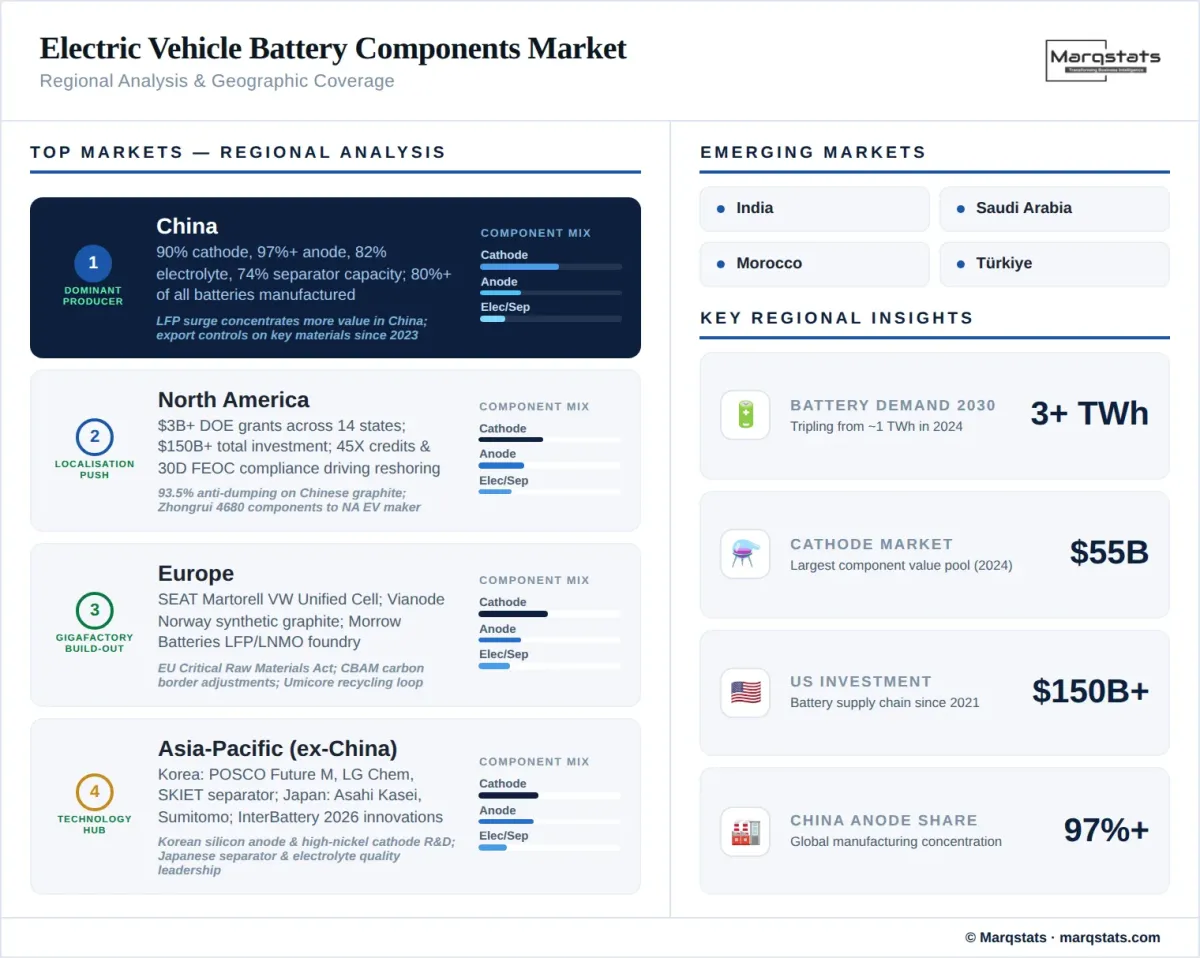
The dominant force in every component segment. China controls approximately 90% of global cathode capacity, 97%+ of anode capacity, 82% of electrolyte production, and 74% of separator production. China manufactured well over 80% of all batteries in 2025. LFP’s rise further concentrates value in China. Export controls on key battery materials since 2023 (some temporarily suspended) demonstrate China’s ability to leverage this dominance as a geopolitical tool. RENERA (Russia) presented a localization roadmap at Graphite 2026, estimating 100% cell localization would exceed RUB 140 billion—illustrating the scale of investment needed to replicate China’s integrated component ecosystem.
North America
The most aggressive policy environment for component localization. US DOE selected USD 3+ billion for 25 projects across 14 states. Total battery supply-chain investment announcements exceeded USD 150 billion since 2021. Treasury 45X regulations incentivize domestic electrode active material production. 30D FEOC restrictions create compliance-driven demand for non-China components. The 93.5% anti-dumping duty on Chinese anode graphite (July 2025) directly reshapes anode sourcing. Zhongrui Korea began shipping 4680 cylindrical battery riveting components to a leading North American EV maker—demonstrating the component supply chain’s complexity. Türkiye is establishing a Venture Capital Investment Fund targeting battery and EV component startups to support automotive export growth.
Europe
Compliance-driven localization led by the EU Battery Regulation (carbon footprint, recycled content from 2031, battery passport) and Critical Raw Materials Act (40% processing, 25% recycling by 2030, 65% single-source cap). SEAT/CUPRA Martorell began mass-producing battery systems using VW Unified Cell with cell-to-pack technology (March 2026, 300,000 units/year). Morrow Batteries partnered with JR Energy Solution for electrode foundry services in Europe. Renault’s futuREady platform targets 40% cost reduction through 800V cell-to-body architecture. Hyundai Mobis opened a Hungary plant to supply chassis and battery modules to Mercedes-Benz. Morocco’s COBCO began NMC and pCAM production in 2025, expanding the EU’s near-shore supply chain.
Asia-Pacific (Excluding China)
Korea and Japan remain the most relevant established alternatives in higher-end cathodes, separators, and cell technology. Korea holds approximately 9% of global cathode capacity, Japan approximately 3%. LG Chem is expanding automotive electronic material sales from KRW 1 trillion to KRW 2 trillion by 2030 including heat-dissipating adhesives for battery stability. Innox Group exhibited next-generation silicon oxide anode precursors and electro-peelable recycling adhesives at InterBattery 2026. India’s PLI-ACC scheme awarded 40 GWh but only 1 GWh is commissioned (Rajya Sabha Committee, March 2026). Saudi Arabia’s Northern Graphite–Al Obeikan JV (2026) targets anode material production.
Rest of World
Emerging localization nodes include Vietnam (Kim Long Motor’s Hue plant integrating an EV battery plant alongside commercial vehicle production), Norway (Vianode’s first full-scale synthetic anode graphite plant, 2024), and Morocco (COBCO NMC/pCAM production, 2025). These represent targeted entries into the hardest-to-localize parts of the value chain—active materials rather than just cell assembly—driven by proximity to European and North American cell factories.
How Competition Is Evolving
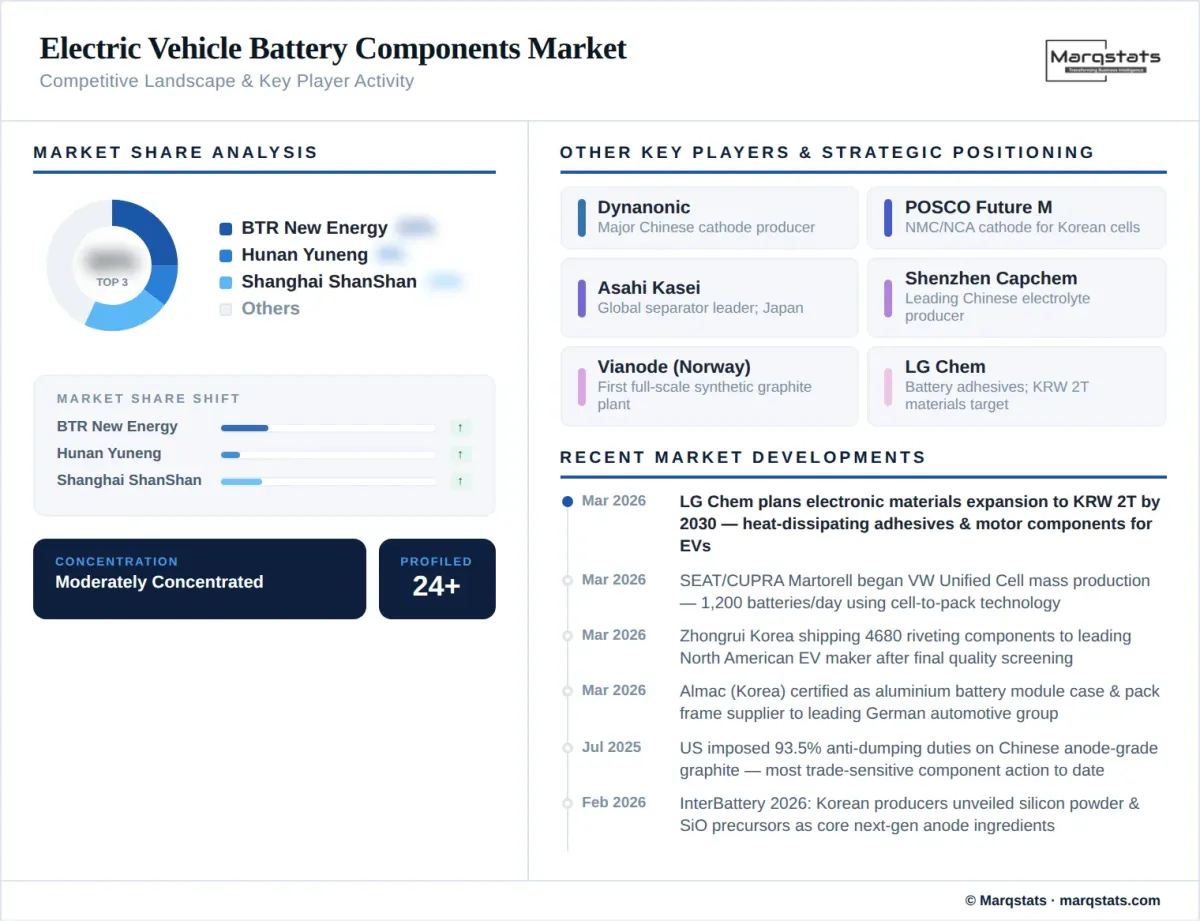
The electric vehicle battery components market’s competitive structure mirrors its technical stack. In cathode active materials, Chinese producers dominate: Hunan Yuneng leads at approximately 9% global share, followed by Dynanonic and XTC New Energy Materials, though the cathode field remains more fragmented than anodes. LFP cathode production is almost entirely China-based. In NMC/NCA cathodes, Korean producers (POSCO Future M, L&F) and Japanese producers (Sumitomo Metal Mining, Umicore operations) provide the primary non-China alternatives. Morocco’s COBCO represents emerging near-shore supply for European cell factories.
In anode active materials, concentration is even more extreme. BTR New Energy Material leads globally at approximately 22%, Shanghai ShanShan at approximately 19%, and Jiangxi Zichen Technology at approximately 10%. Silicon-anode producers are an emerging competitive tier, with Korean companies exhibiting silicon powder and SiO precursors at InterBattery 2026. Norway’s Vianode and Saudi Arabia’s Northern Graphite–Al Obeikan JV represent non-China anode localization.
In separators, Chinese producers dominate volume but Asahi Kasei (Japan) and SKIET (Korea) remain important for premium nickel-rich cells. In electrolytes, Shenzhen Capchem, Tinci, Kaixin, and Guotai-Huarong lead Chinese production, while solid-state electrolyte developers represent a disruptive competitive layer. In supporting components, LG Chem is expanding battery-stability adhesives and electronic materials to KRW 2 trillion by 2030. Almac (Korea) supplies aluminium battery module cases and pack frames to a leading German automotive group. Scalvy and Valeo are evaluating modular “Power Neuron” battery-integrated architectures that could change component interface requirements.
Companies Covered
The report profiles 25+ companies with full strategy and financials analysis, including:
Recent Market Activity
Table of Contents
Coverage & Segmentation
This report provides a comprehensive analysis of the global electric vehicle battery components market covering the historical period (2021–2025) and forecast period (2026–2030), with 2025 as the base year. The study examines market size in USD across component type (cathode, anode, separator, electrolyte, current collectors/binders/additives), battery chemistry (LFP, NMC, NCA, LNMO, sodium-ion), architecture trend (400V vs 800V, cell-to-pack, cell-to-body), and geography covering 20 countries across China, North America, Europe, Asia-Pacific, and Rest of World. Company profiling covers 25+ players across cathode, anode, separator, electrolyte, and supporting component segments. Policy analysis covers US 45X/30D FEOC, EU Battery Regulation 2023/1542, EU Critical Raw Materials Act, US anti-dumping duties on Chinese graphite, and China export controls.
Research methodology combines bottom-up modelling from GWh demand projections, component cost-per-kWh breakdown analysis, active material capacity disclosures, and trade flow data. Primary research encompasses 40+ interactions with cathode/anode producers, separator/electrolyte manufacturers, cell makers, OEM procurement teams, and policy specialists across China, Korea, Japan, Europe, and North America. Government data sources (US DOE grant announcements, EU regulatory texts, India PLI-ACC disbursement records) used for policy framework calibration.