Statistics & Highlights

Market Snapshot

Market size in USD Billion
$0.89B
2025
Base year
$1.09B
2026
Estimated
  
$2.49B
2030
Forecast
Largest market
Europe (Continental, Pirelli, Michelin, EU 67 dB, premium OEM density)
Fastest growing
Asia-Pacific (CEAT, Apollo India, Hankook Korea, China EV demand)
Dominant segment
Passenger Car EV Tires With Acoustic Foam (OE-first)
Concentration
Highly Concentrated
CAGR
22.78%
2026 – 2030
GROWTH
+$1.60B
Absolute
STUDY PARAMETERS
Base year2025
Historical period2021 – 2025
Forecast period2026 – 2030
Units consideredValue (USD BN), Tires With Foam (Million Units)
REPORT COVERAGE
Segments covered6 segments
Regions covered4 regions
Companies profiled15+
Report pages210+
DeliverablesPDF, Excel, PPT
Executive Summary

Key Takeaways

Market valued at USD 892 million in 2025, projected to reach USD 2,487 million by 2030 at 22.78% CAGR — driven by EV NVH requirements, premium OEM fitment, and EU Phase II noise regulations. Foam inserts are the most visible acoustic-tire innovation.
ContiSilent reduces interior noise by up to 9 dB(A), Michelin Acoustic by ~20%, Pirelli PNCS by 2–3 dB — Continental, Michelin, and Pirelli lead premium OE deployment. Hankook iON achieves 18% cabin reduction. Goodyear SoundComfort, Bridgestone B-Silent, and Dunlop Noise Shield round out the branded ecosystem.
EV adoption is the primary growth driver: silent powertrains make tire cavity noise the dominant cabin sound — Continental supplies 17 of 20 highest-volume EV OEMs. Pirelli says PNCS is “crucial” in electrification shift. Tesla Model Y custom tire liner reduces road noise by up to 40%. Autonomous vehicle voice-command requirements add future demand.
Open-cell polyurethane foam (~200 grams per tire) damps cavity resonance at 200–250 Hz — attached to inner tread surface. Must survive tire operating environment without affecting mounting, balancing, or heat dissipation. Manufacturing integration is the technical moat—not the foam chemistry alone.
EU Phase II tire noise regulation targeting 67 dB for passenger vehicles creates regulatory pull — UN Regulation 117 sets type-approval limits. EU tire label includes external rolling noise class (A–C). Regulation targets external noise, while foam mainly addresses interior cavity noise—but both drive quieter tire development.
CEAT CalmTyre and Apollo AQuT Tech bringing acoustic foam into Indian-origin EV tire portfolios — broadening from luxury OE into premium domestic replacement and EV-focused retail. Apollo combines cavity, pattern, and construction approaches. Market expanding beyond traditional European premium brands.
Market Insights

Market Overview & Analysis

Report Summary

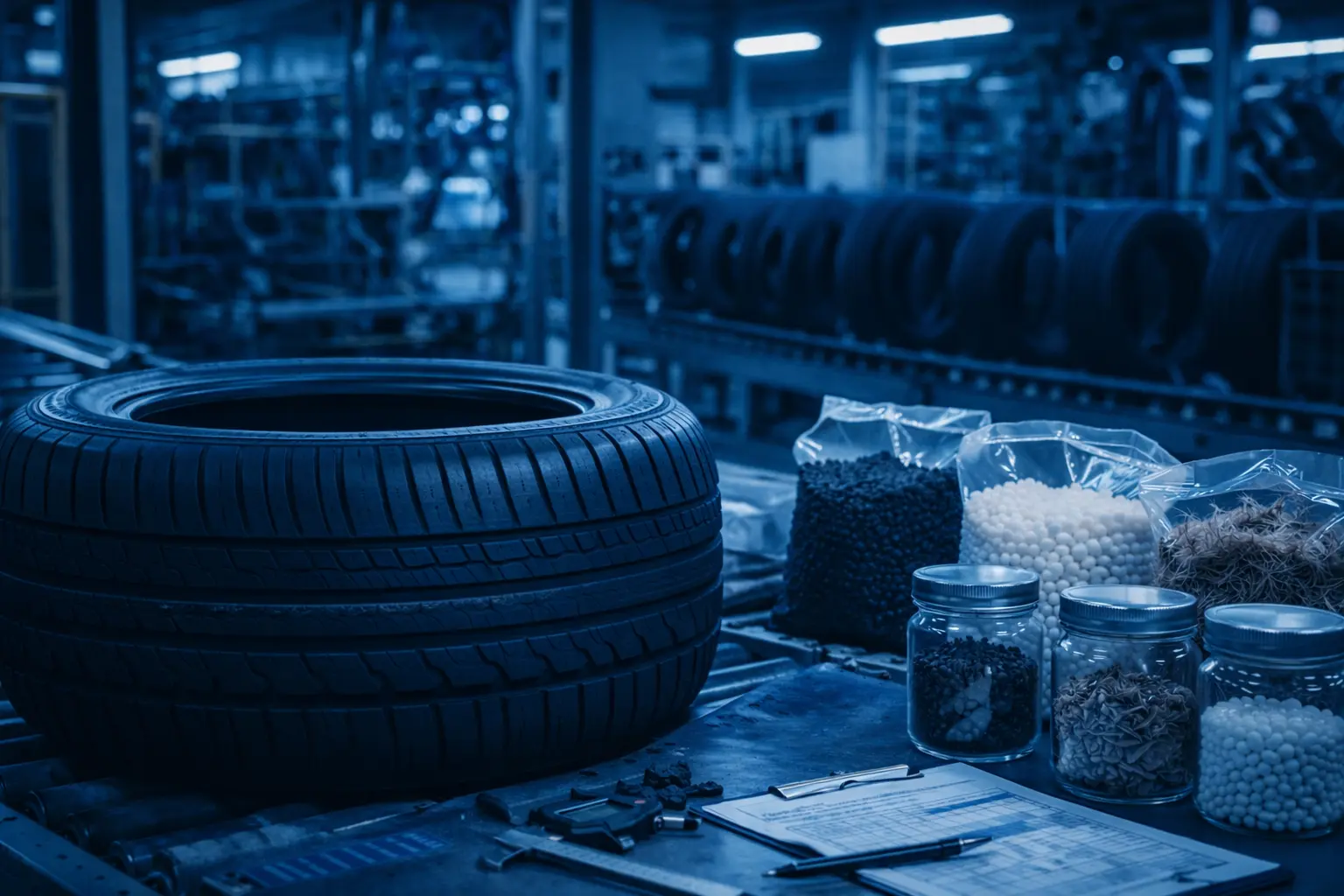
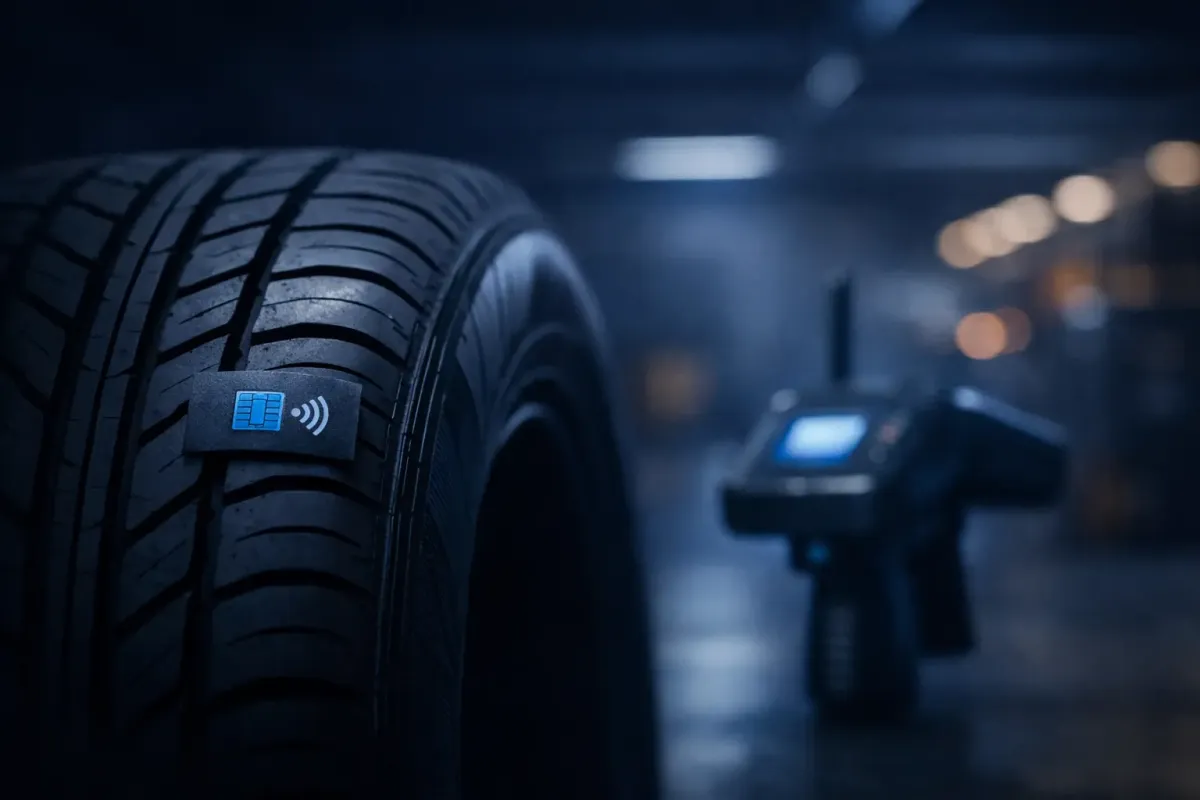
The automotive tire noise reduction foam market covers polyurethane foam inserts and sound-absorbing sponge technologies applied to the inner surface of passenger car, SUV, and light-truck tires to reduce tire cavity noise—the air column resonance vibration inside the tire that transmits into the vehicle cabin at 200–250 Hz. The scope includes OE factory-fitted acoustic foam tires (ContiSilent, PNCS, Acoustic Technology, Sound Absorber, B-Silent, SoundComfort, Noise Shield), replacement-market acoustic foam tires, the polyurethane foam materials and adhesive systems used in manufacturing, and the broader acoustic-tire technology ecosystem including tread-pattern simulation and construction optimisation. TPMS and ride-comfort suspension technologies are excluded.

The market is best understood as a technology-led quiet-tire segment where foam is the core visible innovation and EV NVH is the strongest demand driver. Companies like Michelin and Apollo combine foam with tread-pattern and construction tuning, so foam is the most important but not the only component of acoustic tire performance. Tire makers are trying to combine quietness with EV efficiency, higher load capacity, and durability rather than treating noise alone as the value proposition. Goodyear ElectricDrive 2 pairs SoundComfort foam with 50%+ sustainable materials and EV-focused performance. Continental’s EcoContact 6/6Q pairs ContiSilent with lower rolling resistance and longer EV range.

Market Dynamics

Key Drivers

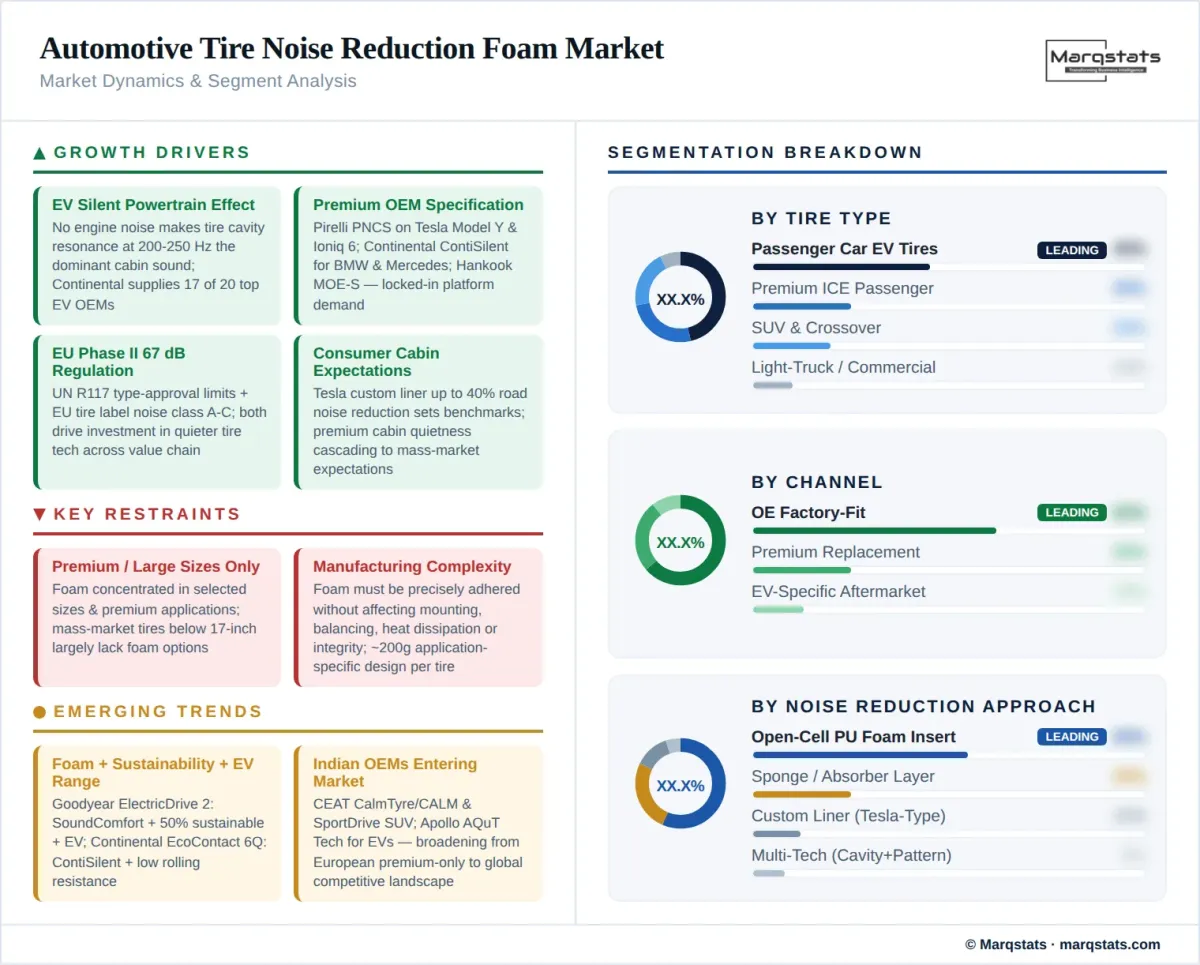
  • EV silent powertrains making tire cavity noise the dominant cabin NVH source: When engine noise disappears, tire cavity resonance at 200–250 Hz becomes the most perceptible interior sound. Continental, Michelin, and Pirelli all confirm this. Continental supplies 17 of 20 top EV OEMs. Pirelli describes PNCS as crucial for electrification. EV tire portfolios increasingly include acoustic foam as standard rather than optional.
  • Premium OEM specification driving OE-first deployment: Pirelli supplies PNCS across Tesla Model Y (T0), Hyundai Ioniq 6, and other EV fitments. Continental EcoContact 6/6Q includes ContiSilent with BMW and Mercedes OE markings. Hankook supplies Mercedes under MOE-S (Mercedes Original Extended Silent). Tesla uses custom tire liners reducing road noise by up to 40%. OEM homologation creates locked-in demand per vehicle platform.
  • EU Phase II tire noise regulation (67 dB) and UN R117 creating regulatory tailwind: EU tire label includes external rolling noise class A–C. UN Regulation 117 sets type-approval limits for tire sound, wet grip, and rolling resistance. EU 2025 Phase II targets 67 dB for passenger vehicles. While regulation targets external noise and foam mainly addresses interior noise, both drive investment in quieter tire technology across the value chain.
  • Autonomous vehicle acoustic requirements adding future demand: Autonomous vehicles require ultra-quiet cabins for voice-command systems, passenger communication, and premium ride experience. Without a driver managing road awareness, cabin noise directly affects passenger comfort and AI voice-recognition accuracy. This creates a future demand layer beyond current EV-NVH requirements.
  • Replacement tire market expanding beyond OE: Goodyear ElectricDrive 2 launched for US EV sedans and CUVs in 17 sizes (May 2024) with SoundComfort foam—positioning acoustic foam in mainstream EV replacement. CEAT EnergyDrive and SportDrive SUV CALM market foam-insert technology for Indian replacement. Apollo AQuT Tech enters EV-focused retail. The market is widening from luxury OE to premium replacement.

Key Restraints

  • Technology still concentrated in selected sizes and premium applications: Acoustic foam is not yet a full-market tire technology. Cost, complexity, and fitment priorities limit mass-market penetration. Evidence shows availability in premium OE, EV-specific, and selected replacement sizes rather than across all tire ranges. Mass-market passenger tires below 17-inch largely lack foam options.
  • Manufacturing integration complexity: Open-cell polyurethane foam must be precisely adhered to the inner tread surface without affecting tire mounting, balancing, heat dissipation, or structural integrity. Each application is tailored (Pirelli: ~200 grams, application-specific design). This makes foam a manufacturing-process technology, not a simple aftermarket addition.
  • Regulatory focus on external noise, not interior cabin: EU labeling and UN R117 target external rolling noise. Foam inserts primarily address interior cavity noise. This means foam-specific demand is driven more by OEM cabin-quietness requirements and consumer preference than by direct regulatory mandates for interior noise.

Key Trends

  • Combining acoustic foam with EV efficiency, sustainability, and durability: Goodyear ElectricDrive 2: SoundComfort + 50%+ sustainable materials + EV performance. Continental EcoContact 6/6Q: ContiSilent + lower rolling resistance + EV range. Apollo AQuT Tech: cavity + pattern + construction. The market rewards integrated quiet+range+torque packages, not standalone noise features.
  • Indian OEMs entering with domestic acoustic tire portfolios: CEAT CalmTyre/CALM and SportDrive SUV CALM market foam-insert technology for the Indian market. Apollo AQuT Tech launched for EV-focused applications. This broadens the market from European premium-only to a global competitive landscape including India’s growing EV segment.
  • Automotive-grade polyurethane foam advancing in weight, adhesion, and thermal performance: Foam weight minimisation (Pirelli ~200g), improved adhesive systems for vulcanisation survival, and thermal management optimisation are the active engineering frontiers. The technical race is no longer about whether foam works—it is about integration efficiency across sizes, platforms, and conditions.
  • Tesla and premium OEMs setting cabin-quietness benchmarks that cascade to mass market: Tesla’s custom tire liner reducing road noise by up to 40% on some models sets consumer expectations. Mercedes MOE-S, BMW OE marks, and Hyundai Ioniq 6 PNCS all embed acoustic performance in vehicle specifications. As EV penetration grows, these expectations cascade from premium to mainstream.
Automotive Tire Noise Reduction Foam Market Dynamics Segment Analysis Infographic
Segment Analysis

Market Segmentation

Passenger Car EV Tires
Leading

The core growth segment. Pirelli PNCS across Tesla Model Y, Hyundai Ioniq 6. Continental ContiSilent in EcoContact 6/6Q for BMW and Mercedes EVs. Hankook iON Sound Absorber for Mercedes MOE-S. Goodyear ElectricDrive 2 SoundComfort for US EV sedans/CUVs. EV tires command premium pricing and foam is becoming a standard feature in EV-specific lines.

Premium ICE Passenger Tires

The established base. ContiSilent, PNCS, and Acoustic Technology were originally developed for premium ICE vehicles where cabin refinement is a key selling point. BMW, Mercedes, Audi, and Porsche OE fitments. This segment continues but growth is shifting to EV applications.

SUV and Crossover Tires

Growing rapidly as electric SUVs expand. CEAT SportDrive SUV CALM specifically targets this segment. Pirelli Scorpion PNCS for electric SUVs. Continental PremiumContact/SportContact lines with ContiSilent for performance SUVs. SUVs have larger tire cavities creating more pronounced resonance, making foam particularly effective.

Light-Truck and Commercial

Emerging segment. Electric delivery vans and light commercial vehicles create NVH requirements. Still limited but expected to grow as electric LCV fleets expand and last-mile delivery operators value driver/passenger comfort.

OE Factory-Fit
Leading

The dominant channel today. Vehicle-specific homologation with OEM markings (T0, MOE-S, BMW star, etc.). Each fitment is developed in partnership between tire maker and OEM for the specific vehicle platform. OE drives initial volume and validates the technology for replacement demand.

Replacement Market

The faster-growing channel by percentage. Goodyear ElectricDrive 2 (17 sizes, US launch May 2024). CEAT CalmTyre, EnergyDrive, SportDrive SUV CALM for Indian replacement. Replacement buyers increasingly seek the same acoustic performance they experienced in OE fitment, driving like-for-like replacement with foam-equipped tires.

Regional Analysis

By Geography

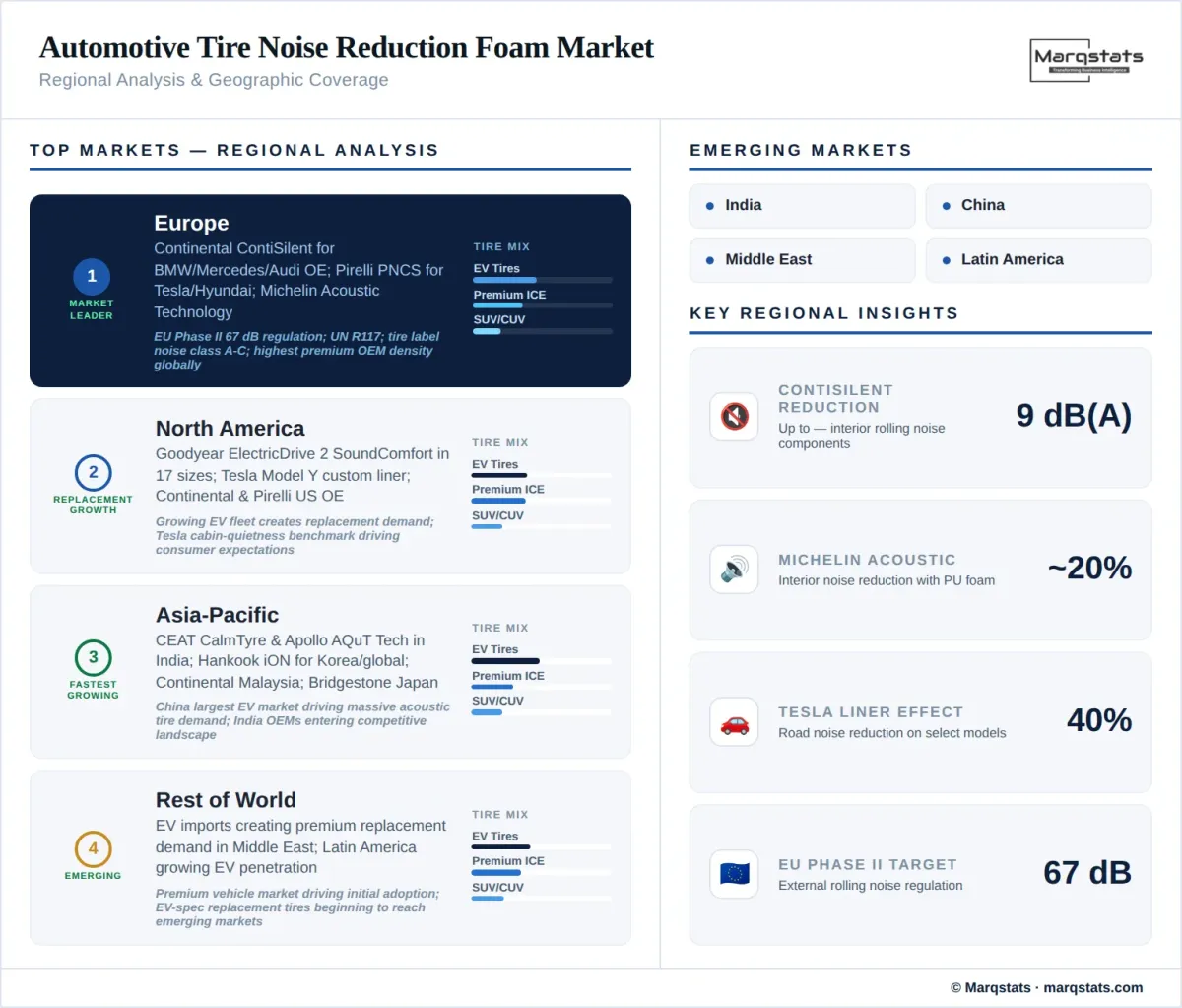
Europe

The market leader driven by premium OEM density, EV penetration, and noise regulation. Continental (Germany) ContiSilent across BMW, Mercedes, Audi OE. Pirelli (Italy) PNCS across Tesla, Hyundai, premium EV fitments. Michelin (France) Acoustic Technology. Bridgestone B-Silent. Dunlop Noise Shield. EU Phase II 67 dB regulation. UN R117. EU tire label noise class A–C.

North America

Strong replacement-market growth. Goodyear ElectricDrive 2 SoundComfort launched US May 2024 in 17 sizes for EV sedans/CUVs. Tesla Model Y custom tire liner up to 40% noise reduction. Continental and Pirelli supply OE to US-produced EVs. Growing EV fleet creates replacement demand for acoustic-foam tires.

Asia-Pacific

Fastest-growing region. India: CEAT CalmTyre/CALM and Apollo AQuT Tech entering domestic EV tire market. Continental 2025 EcoContact 6/6Q with ContiSilent launched in Malaysia. Hankook (South Korea) iON Sound Absorber for Mercedes and EV OE. Japan: Bridgestone B-Silent. China: largest EV market driving massive acoustic tire demand through domestic and global OEMs.

Rest of World

Emerging adoption through EV imports and premium replacement demand. Middle East premium vehicle market. Latin America growing EV penetration. African markets beginning to receive EV-spec replacement tires.
Automotive Tire Noise Reduction Foam Market Regional Analysis Infographic
Competitive Landscape

How Competition Is Evolving

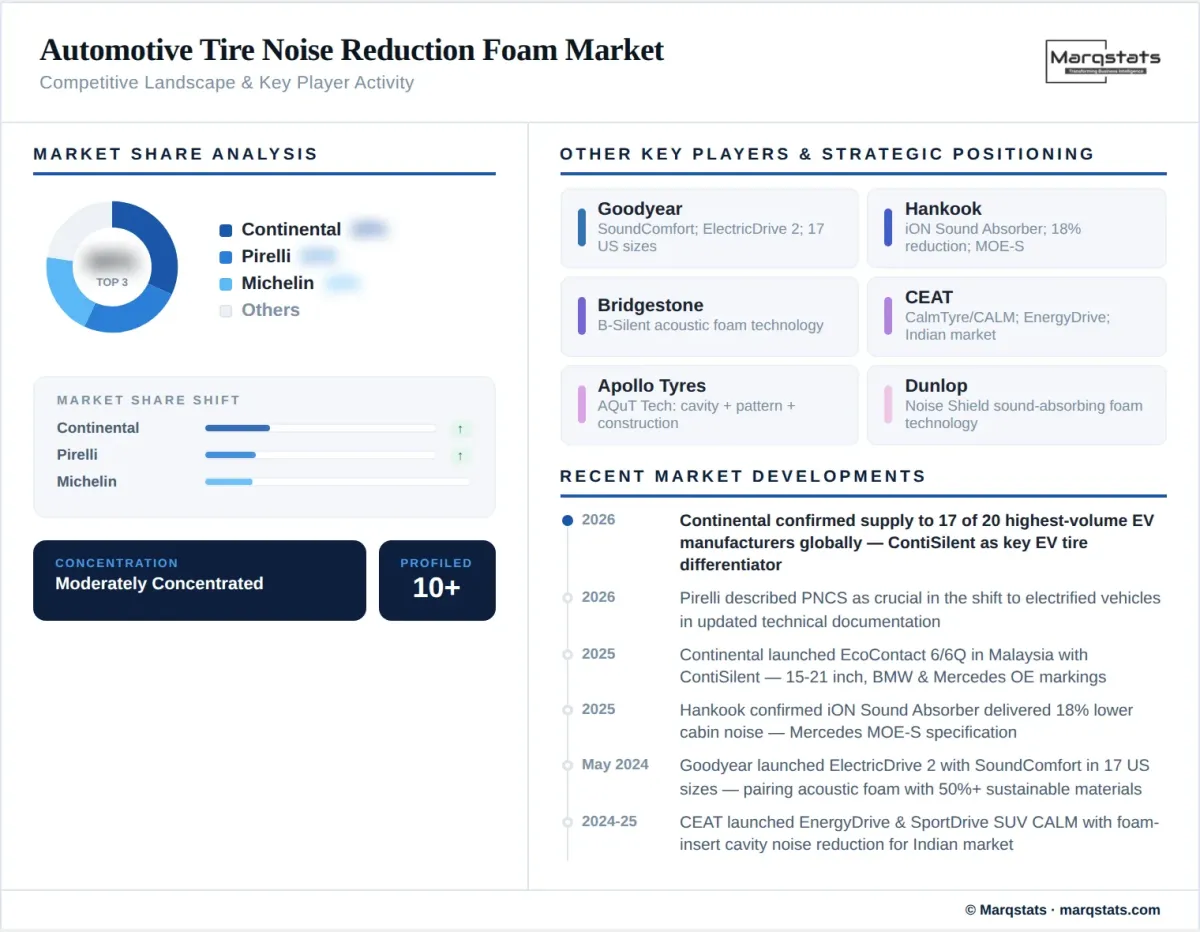
The market is led by six global tire manufacturers with branded acoustic foam technologies. Continental (ContiSilent: up to 9 dB(A) reduction, polyurethane foam, 17 of 20 top EV OEMs, BMW/Mercedes/Audi OE, EcoContact 6/6Q 2025 launch) is the strongest in commercial-fleet and broad OE deployment. Pirelli (PNCS: 2–3 dB, ~200g sponge, Tesla T0/Hyundai Ioniq 6, “crucial” for electrification) leads in premium EV homologation. Michelin (Acoustic Technology: ~20% interior noise reduction, polyurethane foam, tread simulation) has the strongest cabin-comfort claim.

Goodyear (SoundComfort: ElectricDrive 2 with 50%+ sustainable materials, US EV replacement 17 sizes May 2024) is positioning foam for mainstream replacement growth. Hankook (iON Sound Absorber: 18% cabin reduction, Mercedes MOE-S, iON EV-specific platform) is the strongest Asian challenger in European OE. Bridgestone (B-Silent) and Dunlop (Noise Shield) complete the branded lineup. In India, CEAT (CalmTyre/CALM: foam-insert cavity noise reduction, EnergyDrive, SportDrive SUV CALM) and Apollo (AQuT Tech: cavity + pattern + construction) are the first Indian-origin manufacturers to commercialise acoustic tire technology.
Automotive Tire Noise Reduction Foam Market Competitive Landscape Infographic
Major Players

Companies Covered

The report profiles 15+ companies with full strategy and financials analysis, including:

Continental (ContiSilent: up to 9 dB(A), polyurethane foam, 17/20 top EV OEMs)
Pirelli (PNCS: 2–3 dB, ~200g sponge, Tesla T0, Hyundai Ioniq 6, Scorpion)
Michelin (Acoustic Technology: ~20% reduction, polyurethane foam, tread simulation)
Goodyear (SoundComfort: ElectricDrive 2, 50%+ sustainable, 17 US sizes)
Hankook (iON Sound Absorber: 18% cabin reduction, Mercedes MOE-S)
Bridgestone (B-Silent: acoustic foam technology)
Dunlop (Noise Shield: sound-absorbing foam technology)
CEAT (CalmTyre / CALM: foam-insert cavity noise reduction, EnergyDrive, SportDrive SUV)
Apollo Tyres (AQuT Tech: cavity + pattern + construction, EV-focused)
Tesla (custom tire liner, Model Y up to 40% road noise reduction)
Mercedes-Benz (MOE-S marking with Hankook, Continental, Pirelli)
BMW (OE marking with Continental ContiSilent)
Hyundai (Ioniq 6 with Pirelli PNCS)
Note: Full company profiles include revenue analysis, product portfolio, SWOT, and recent strategic developments.
Latest Developments

Recent Market Activity

2026
Continental stated it supplies tires to 17 of 20 highest-volume EV manufacturers worldwide and has long optimised for quieter rolling noise as a key EV tire success factor.
2026
Pirelli described PNCS as crucial in the shift to electrified vehicles in its updated technical documentation.
2025
Continental launched EcoContact 6/6Q in Malaysia with ContiSilent, 15–21 inch sizes, BMW and Mercedes OE markings, combining noise reduction with lower rolling resistance.
2025
Hankook confirmed iON Sound Absorber delivered up to 18% lower cabin noise in internal testing, supplying Mercedes under MOE-S (Mercedes Original Extended Silent).
May 2024
Goodyear launched ElectricDrive 2 with SoundComfort foam inserts for US EV sedans and CUVs in 17 sizes — pairing acoustic foam with 50%+ sustainable materials.
2024–2025
CEAT launched EnergyDrive and SportDrive SUV CALM with foam-insert cavity noise reduction for the Indian market.
2024–2025
Apollo launched AQuT Tech for EV-focused tire applications — combining cavity, pattern, and construction approaches to noise reduction.
2024–2025
Tesla continued to use custom tire liners on Model Y and other models, with reports of up to 40% road noise reduction on select configurations.
Report Structure

Table of Contents

1. Introduction
1.1 Study Assumptions & Market Definition
1.1.1 Polyurethane Foam Inserts for Tire Cavity Noise Damping
1.1.2 Cavity Resonance at 200–250 Hz as Target Phenomenon
1.1.3 Foam as Core Innovation Within Broader Acoustic Tire Technology
1.2 Scope
1.2.1 By Tire Type
1.2.2 By Channel
1.2.3 By Region
1.3 Executive Summary
1.4 Market Snapshot
2. Research Methodology
2.1 Framework
2.2 Secondary Research
2.3 Primary Research (40+ Interactions)
2.4 Bottom-Up OEM Fitment, SKU Availability, and EV Volume Modelling
3. Acoustic Foam Technology
3.1 Open-Cell Polyurethane Foam: Material Properties
3.2 Adhesion to Inner Tread Surface
3.3 Weight (~200 grams Per Tire, Pirelli PNCS)
3.4 Manufacturing Integration: Vulcanisation Survival
3.5 Cavity Resonance Damping vs Tread Pattern Optimisation
3.6 No Compromise on Mounting, Balancing, Heat Dissipation
4. Regulatory Framework
4.1 EU Phase II Tire Noise Regulation (67 dB Passenger)
4.2 UN Regulation 117 Type-Approval Limits
4.3 EU Tire Label External Noise Class A–C
4.4 External Noise Regulation vs Interior Foam Application
4.5 Autonomous Vehicle Cabin Acoustic Requirements
5. Market Dynamics
5.1 Drivers
5.1.1 EV Silent Powertrains Making Cavity Noise Dominant
5.1.2 Premium OEM Specification and Homologation
5.1.3 EU Phase II and UN R117 Regulatory Tailwind
5.1.4 Autonomous Vehicle Voice-Command Requirements
5.1.5 Replacement Market Expanding Beyond OE
5.2 Restraints
5.2.1 Selected Sizes and Premium-Only Availability
5.2.2 Manufacturing Integration Complexity
5.2.3 Regulatory Focus on External Not Interior Noise
5.3 Trends
5.3.1 Combining Foam + EV Efficiency + Sustainability
5.3.2 Indian OEMs Entering With Domestic Portfolios
5.3.3 Polyurethane Foam Weight and Adhesion Advancing
5.3.4 Tesla/Premium OEMs Setting Cascading Benchmarks
6. Market Size & Forecasts, 2021–2030
6.1 By Tire Type
6.1.1 Passenger Car EV Tires
6.1.1.1 Pirelli PNCS (Tesla T0, Ioniq 6)
6.1.1.2 Continental ContiSilent (BMW, Mercedes EV)
6.1.1.3 Hankook iON Sound Absorber (MOE-S)
6.1.1.4 Goodyear ElectricDrive 2 SoundComfort
6.1.2 Premium ICE Passenger
6.1.3 SUV and Crossover
6.1.3.1 CEAT SportDrive SUV CALM
6.1.3.2 Pirelli Scorpion PNCS
6.1.4 Light Commercial
6.2 By Channel
6.2.1 OE Factory-Fit
6.2.1.1 Tesla T0 Marking
6.2.1.2 Mercedes MOE-S
6.2.1.3 BMW OE Star
6.2.2 Replacement Market
6.2.2.1 Goodyear 17 US Sizes (May 2024)
6.2.2.2 CEAT CalmTyre/EnergyDrive India
6.3 By Region
6.3.1 Europe
6.3.1.1 Germany (Continental)
6.3.1.2 Italy (Pirelli)
6.3.1.3 France (Michelin)
6.3.1.4 United Kingdom
6.3.1.5 Spain
6.3.1.6 Netherlands
6.3.1.7 Sweden
6.3.2 North America
6.3.2.1 United States (Goodyear, Tesla)
6.3.2.2 Canada
6.3.3 Asia-Pacific
6.3.3.1 India (CEAT, Apollo)
6.3.3.2 South Korea (Hankook)
6.3.3.3 Japan (Bridgestone)
6.3.3.4 China
6.3.3.5 Malaysia (Continental 2025 Launch)
6.3.4 Rest of World
7. Competitive Landscape
7.1 Branded Technology Comparison
7.2 Profiles
7.2.1 Continental (ContiSilent)
7.2.2 Pirelli (PNCS)
7.2.3 Michelin (Acoustic Technology)
7.2.4 Goodyear (SoundComfort)
7.2.5 Hankook (iON Sound Absorber)
7.2.6 Bridgestone (B-Silent)
7.2.7 Dunlop (Noise Shield)
7.2.8 CEAT (CalmTyre/CALM)
7.2.9 Apollo (AQuT Tech)
8. OEM Adoption and Vehicle Integration
8.1 Tesla Custom Tire Liner (40% Reduction)
8.2 Mercedes MOE-S Programme
8.3 BMW OE Acoustic Tire Specifications
8.4 Hyundai Ioniq 6 Pirelli PNCS
8.5 Autonomous Vehicle Future Requirements
9. Opportunities and Recommendations
9.1 EV Replacement as Largest Growth Channel
9.2 SUV Segment as High-Value Expansion
9.3 Indian and Asian Market Entry
9.4 Recommendations
9.4.1 For Tire Manufacturers
9.4.2 For Foam Material Suppliers
9.4.3 For OEMs
9.4.4 For Investors
10. Appendix
10.1 Methodology
10.2 Abbreviations
10.3 Tables
10.4 Figures
10.5 Disclaimer
10.6 About Marqstats
Study Scope & Focus

Coverage & Segmentation

This report covers the global automotive tire noise reduction foam market 2021–2025 (historical) and 2026–2030 (forecast), base year 2025. Market size in USD across tire type (passenger EV, premium ICE, SUV/crossover, light commercial), channel (OE, replacement), and geography (15 countries across Europe, North America, Asia-Pacific, RoW). 15+ company profiles. Regulatory analysis of EU Phase II 67 dB, UN R117, EU tire label noise class.

Bottom-up from OEM foam-tire fitment counts, tire-maker size/SKU availability disclosures, EV production volumes requiring acoustic tires, foam material cost per tire, replacement-market pricing, and regulatory-driven OE specification tracking. Primary research: 40+ interactions with tire manufacturer NVH engineers, foam material suppliers, OEM tire-homologation teams, EV programme managers, and replacement-tire distributors across Europe, North America, India, and East Asia.
Frequently Asked Questions

FAQs About the Automotive Tire Noise Reduction Foam Market

Valued at ~USD 892M in 2025, projected to USD 2,487M by 2030 at 22.78% CAGR. Driven by EV NVH requirements, premium OEM specification, and EU Phase II 67 dB regulation. ContiSilent, Pirelli PNCS, Michelin Acoustic Technology, Goodyear SoundComfort, Hankook Sound Absorber are the branded leaders.
Open-cell polyurethane foam (~200g per tire) is attached to the inner tread surface to damp cavity resonance—the air column vibration at 200–250 Hz that transmits as tonal hum into the cabin. ContiSilent reduces by up to 9 dB(A), Michelin Acoustic by ~20%, Pirelli PNCS by 2–3 dB. The foam must survive tire operating conditions without affecting mounting, balancing, or heat dissipation.
When engine noise disappears in EVs, tire cavity and rolling noise become the dominant cabin sound. Continental says quiet rolling noise is a key EV tire success factor. Pirelli says PNCS is crucial for electrification. Continental supplies 17 of 20 top EV OEMs. Tesla uses custom tire liners reducing noise by up to 40%.
Continental (ContiSilent: 9 dB(A), 17/20 EV OEMs), Pirelli (PNCS: 2–3 dB, Tesla T0, Ioniq 6), Michelin (Acoustic Technology: 20%), Goodyear (SoundComfort: ElectricDrive 2, 17 sizes), Hankook (iON Sound Absorber: 18%, Mercedes MOE-S), Bridgestone (B-Silent), Dunlop (Noise Shield). India: CEAT (CalmTyre/CALM), Apollo (AQuT Tech).
EU Phase II targets 67 dB for passenger vehicles. UN R117 sets type-approval limits. EU tire label includes noise class A–C. Regulation targets external noise while foam mainly addresses interior—but both drive quieter tire investment. Autonomous vehicle voice-command requirements add future demand.
Tesla (custom liner, Model Y, up to 40% reduction). Mercedes-Benz (MOE-S with Hankook/Continental/Pirelli). BMW (OE marking with Continental ContiSilent). Hyundai (Ioniq 6 with Pirelli PNCS). OEM homologation creates locked-in demand per vehicle platform.
Yes, expanding. Goodyear ElectricDrive 2 launched 17 US sizes (May 2024). CEAT CalmTyre/EnergyDrive/SportDrive SUV CALM for India. Replacement buyers seek same acoustic performance from OE experience. But availability is still concentrated in premium and EV-specific sizes.
Yes: OEM fitment mapping, foam technology comparison, EV NVH benchmarking, regulatory impact, replacement size availability, India market entry, foam material cost analysis. Contact sales@marqstats.com or +91 934-180-0264.
PDF (210+ pages), Excel by tire type/channel/region (15 countries), PowerPoint, 12 months analyst support.