Market Snapshot
Middle bar: base-year value × (1 + CAGR), rounded to two decimals. This is a calculated illustration, not a separately researched annual estimate.
The global agentic AI platform market is undergoing a period of explosive expansion, driven by the convergence of large language models (LLMs), autonomous reasoning frameworks, and surging enterprise demand for intelligent workflow automation. Valued at approximately USD 7.06 billion in 2025, the market is projected to reach USD 47.20 billion by 2030, growing at a compound annual growth rate (CAGR) of 46.18% during the forecast period of 2026–2030. Agentic AI platforms represent a fundamental architectural shift from traditional generative AI tools — moving beyond prompt-response interactions toward autonomous, multi-step task execution with minimal human oversight.
The market encompasses platform software, professional services, and infrastructure components that enable enterprises to build, deploy, orchestrate, and govern autonomous AI agents. These agents are capable of reasoning across complex workflows, invoking enterprise tools, retaining contextual memory, and executing decisions within defined guardrails. Key application domains span customer service and virtual assistants, IT service management, financial operations, sales lifecycle automation, HR service delivery, and software development — with the banking, financial services, and insurance (BFSI) vertical commanding the largest revenue share in 2025.
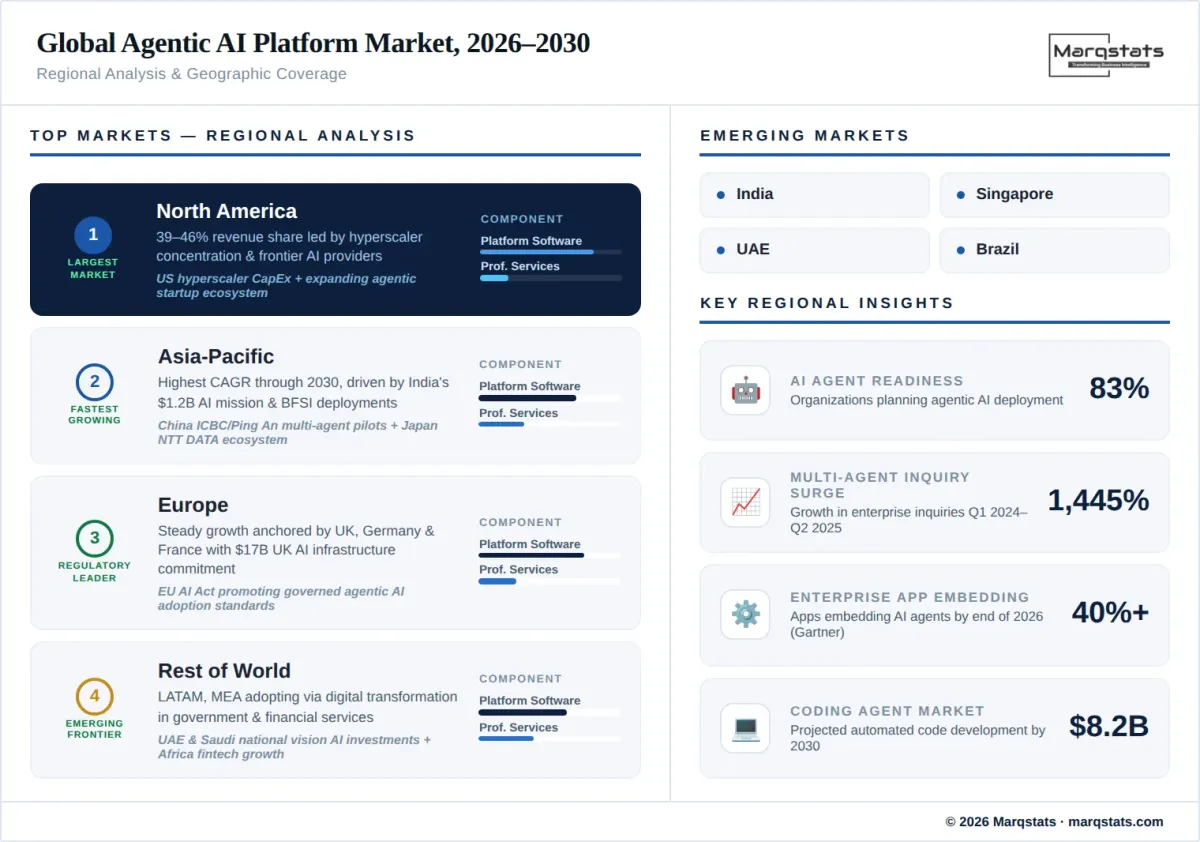
North America dominates the market with an estimated 39–46% revenue share in 2025, buoyed by the concentration of hyperscaler infrastructure, frontier AI model providers, and early enterprise adopters. Asia-Pacific is the fastest-growing region, propelled by government-led AI investment programs — including India's USD 1.2 billion national AI mission — and rapid enterprise-scale deployments across BFSI, telecommunications, and manufacturing. The competitive landscape is moderately concentrated, with platform leaders including Microsoft Corporation, Salesforce Inc., Google LLC, Amazon Web Services Inc., OpenAI, and ServiceNow Inc. shaping the trajectory of enterprise agentic adoption through platform launches, multi-agent orchestration tools, and open interoperability protocols.
Key Takeaways
Market Overview & Analysis
Report Summary
The agentic AI platform market encompasses the full technology stack required for enterprises to design, deploy, manage, and govern autonomous AI agents capable of multi-step reasoning, tool invocation, contextual memory retention, and adaptive decision-making. Unlike traditional generative AI applications that operate on a single prompt-response paradigm, agentic AI platforms enable agents to decompose complex objectives into sequential tasks, interact with enterprise systems, and execute workflows with minimal human intervention. The market scope includes platform software (orchestration engines, reasoning frameworks, agent builders, and governance dashboards), professional services (integration, training, and managed services), and cloud infrastructure optimized for agent workloads.
The current market state reflects a structural transition from experimental generative AI pilots toward production-ready agentic deployments. Industry surveys indicate that approximately 30% of surveyed organizations are actively exploring agentic options and 38% are piloting solutions, though only 14% have deployment-ready systems and 11% are in full production. Industry analyses indicate that by the end of 2026, over 40% of enterprise applications will embed role-specific AI agents, up from less than 5% in 2025 — a 1,445% surge in multi-agent system inquiries was recorded between Q1 2024 and Q2 2025 alone.
The market's growth trajectory is underpinned by declining inference costs driven by record hyperscaler capital expenditure — Meta earmarked USD 65 billion for AI datacenters through 2025, while Microsoft doubled AI capacity and AWS broadened its Bedrock agent services. These infrastructure investments have lowered GPU-hour pricing and widened access to high-end accelerators, enabling mid-market firms to run long-lived agents economically. Simultaneously, the emergence of open-source agent frameworks such as LangChain, CrewAI, and Microsoft AutoGen has democratized agent development, while standardized protocols like MCP and A2A are establishing the interoperability foundation for cross-platform agent collaboration.
Market Dynamics
Key Drivers
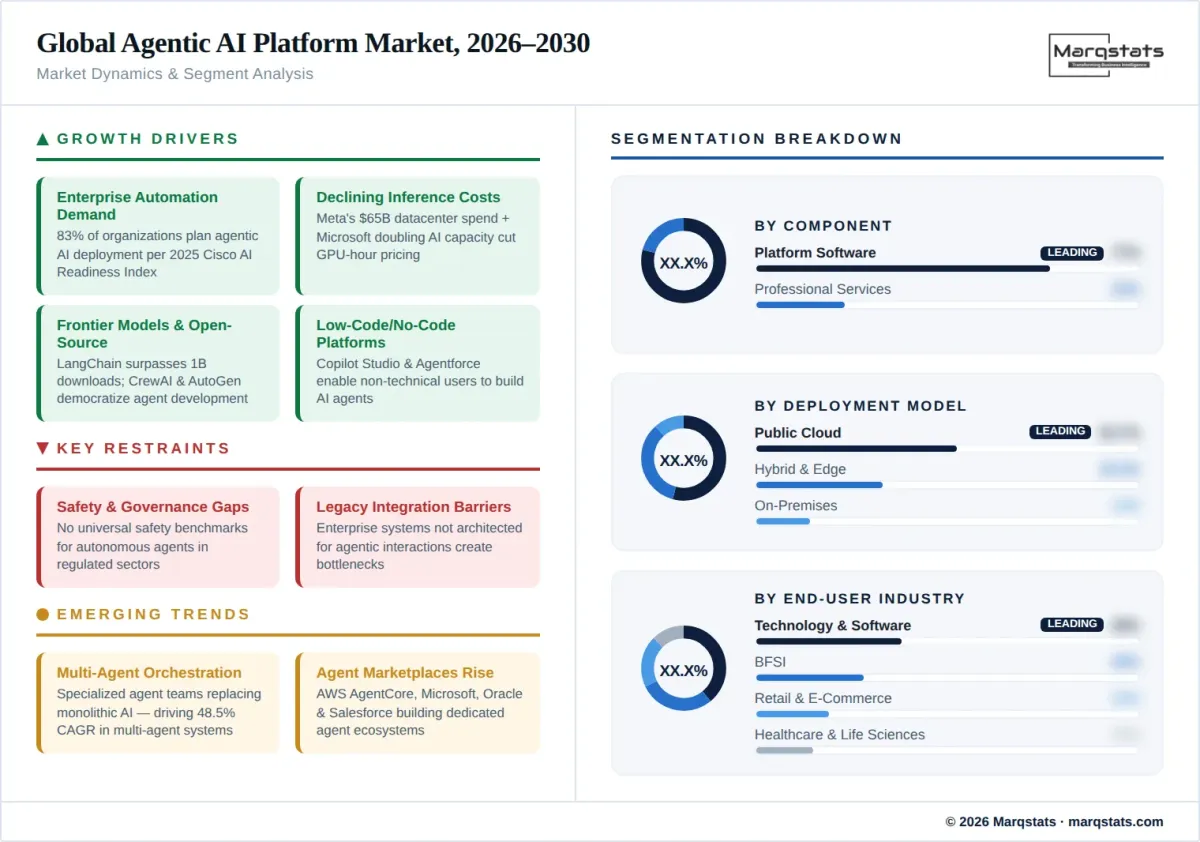
- Surging enterprise demand for intelligent workflow automation: Organizations across sectors are shifting from rule-based robotic process automation (RPA) to agentic AI systems capable of autonomous, multi-step decision-making. Nearly 83% of organizations surveyed in the 2025 Cisco AI Readiness Index indicated plans to deploy agentic AI systems, reflecting a structural pivot toward agents that reason, plan, and act across complex business processes.
- Declining inference costs and expanding cloud infrastructure: Record capital expenditure by hyperscalers — including Meta's USD 65 billion AI datacenter investment and Microsoft's doubling of AI capacity — has significantly reduced GPU-hour pricing. Public cloud platforms now offer broad access to high-end accelerators, enabling small and mid-size enterprises to deploy and sustain long-lived AI agents economically.
- Proliferation of frontier foundation models and open-source frameworks: The rapid advancement of large language models from OpenAI, Anthropic, Google, and Meta has provided the reasoning backbone for agentic systems. Simultaneously, open-source orchestration frameworks such as LangChain, CrewAI, and Microsoft AutoGen have lowered the technical barriers to building multi-agent applications, with LangChain alone exceeding one billion cumulative downloads.
- Rise of low-code and no-code agentic platforms: Platforms such as Microsoft Copilot Studio Lite and Salesforce Agentforce now enable non-technical business users to design and deploy AI agents using natural language. This democratization is accelerating adoption beyond IT departments into lines of business including HR, finance, procurement, and customer operations.
- Interoperability protocol maturation: The establishment of standardized protocols — Anthropic's Model Context Protocol (MCP) for agent-to-tool connectivity, Google's Agent-to-Agent (A2A) protocol for cross-vendor agent communication, and IBM's Agent Communication Protocol (ACP) — is creating the foundational infrastructure for composable, multi-vendor agent ecosystems.
Key Restraints
- Lack of standardized multi-agent safety and governance benchmarks: The absence of universal safety testing frameworks for autonomous agents raises compliance concerns and slows production rollouts, particularly in heavily regulated sectors such as healthcare, finance, and government. Enterprises remain cautious about granting agents the autonomy to execute consequential decisions without mature guardrails.
- Legacy system integration complexity: Most enterprise systems were not architected for agentic interactions. Agents still rely heavily on conventional APIs and data pipelines to access enterprise resources, creating bottlenecks and limiting the autonomous capabilities that define agentic value. Industry analyses identify legacy integration as one of the three fundamental infrastructure obstacles blocking full agentic potential.
- Agent hallucination and reliability concerns: Despite advances in reasoning models, AI agents can still produce hallucinated outputs or take incorrect actions when operating across multi-step workflows. Ensuring consistent accuracy across extended autonomous task chains remains a significant technical challenge, with enterprises demanding near-zero error rates for mission-critical operations.
- Consumption-based pricing uncertainty: Most agentic AI platforms employ token-based or credit-based consumption pricing models, making total cost of ownership difficult to predict for large-scale deployments. Without mature FinOps frameworks for agent workloads, enterprises struggle to budget for and optimize agent operating costs.
Key Trends
- Multi-agent orchestration is replacing monolithic AI deployments: Enterprises are transitioning from single all-purpose agents to orchestrated teams of specialized agents managed by central orchestrators. This mirrors the microservices revolution in software architecture, with platforms providing 'puppeteer' coordinators that route tasks to purpose-built agents — a pattern driving the 48.5% CAGR in the multi-agent systems segment.
- Emergence of agent marketplaces and ecosystem platforms: Major vendors are building dedicated agent marketplaces — including AWS AgentCore, Microsoft's reimagined Marketplace with AI agent categories, Oracle's Fusion-native agent marketplace, and Salesforce's Agentforce 360 ecosystem. These platforms enable third-party developers and ISVs to publish, discover, and deploy agents within enterprise workflows.
- Hybrid and edge agent deployments gaining traction: While public cloud retains a 52.7% share, hybrid and edge deployments are recording the fastest growth at a 37.8% CAGR as enterprises host sensitive workloads on-premises while retaining cloud elasticity. AI-capable edge devices such as NVIDIA Jetson and AI PCs with dedicated NPUs enable agents to operate offline, reducing inference costs and enhancing privacy compliance.
- Domain-specific vertical agents outperforming general-purpose solutions: Industry-specific agents trained on domain data — for legal, healthcare, financial services, and manufacturing — are demonstrating superior accuracy and reliability compared to generic horizontally deployed agents. The vertical AI agents segment is projected to register the highest CAGR of 62.7% through 2030.
Market Segmentation
Platform software constitutes the largest component segment, accounting for over 77% of market revenue in 2025. This segment encompasses the integrated orchestration engines, reasoning frameworks, agent builder environments, governance dashboards, and security tooling that form the core of agentic AI deployments. Leading offerings include Microsoft Copilot Studio, Salesforce Agentforce 360, Google Vertex AI Agent Builder, and AWS Bedrock AgentCore — each providing end-to-end capabilities for designing, deploying, and managing autonomous agents within enterprise environments.
The professional services segment — covering system integration, advisory, managed services, and training — is the fastest-growing component, driven by the complexity of enterprise agentic deployments. Major consulting firms including Accenture, KPMG, and IBM Consulting have launched dedicated agentic AI practices to support organizations in strategy development, data readiness assessment, agent governance design, and production deployment. KPMG Velocity, for instance, launched Global Business Services enabled by ServiceNow's AI platform to streamline finance, procurement, HR, and IT workflows.
Public cloud deployments dominate with an estimated 52.7% share in 2025, benefiting from hyperscaler convenience, broad service catalogs, and the ease of scaling agent workloads on demand. AWS, Microsoft Azure, and Google Cloud Platform serve as the primary environments where enterprises build and run agentic applications, leveraging native model access and pre-integrated orchestration tooling.
Hybrid and edge deployments represent the fastest-growing deployment segment at a 37.8% CAGR, expanding from an estimated USD 3.3 billion in 2025 to a projected USD 16.1 billion by 2030. Enterprises running latency-critical agents in manufacturing environments and privacy-bound healthcare applications increasingly host sensitive workloads on-premises while retaining cloud elasticity for non-sensitive interactions. Hardware advances — including NVIDIA Jetson edge servers and AI PCs with dedicated NPUs — enable containerized agent runtimes that auto-sync policies between cloud and edge.
BFSI is the largest end-user vertical, accounting for approximately 74% of early agentic AI platform adoption in 2025. Financial institutions are deploying AI agents for fraud detection and response, customer service automation, regulatory compliance monitoring, claims processing, and algorithmic trading support. Major deployments include ICBC and Ping An piloting multi-agent systems in China and leading global banks integrating agents into customer-facing and back-office operations.
Retail and e-commerce is projected to register the fastest vertical CAGR of 39.05% through 2030, as autonomous agents power customer support, personalized shopping assistants, supply-chain optimization, and inventory management. Salesforce Agentforce 3 introduced agents capable of end-to-end customer engagement, while Shopify has signaled its strategic commitment to agentic commerce, positioning AI shopping agents as a new front door for e-commerce.
Healthcare represents a high-growth vertical as AI agents are deployed for clinical decision support, patient engagement, drug discovery workflow acceleration, and administrative automation. In September 2025, Causaly launched its Agentic Research platform — the first agentic AI solution specifically designed for life sciences R&D. AstraZeneca's acquisition of Modella AI in early 2026 underscored the pharmaceutical industry's shift toward full in-house ownership of agentic AI capabilities.
The technology and software sector commands the largest revenue share by end-use industry at approximately 38%, as software companies are both the builders and earliest adopters of agentic platforms. Automated code development is the largest single use case, projected to reach USD 8.2 billion by 2030. The coding and software development agent role segment is projected to register a 52.4% CAGR through 2030.
By Geography
North America
North America dominates the global agentic AI platform market with an estimated 39–46% revenue share in 2025, anchored by the concentration of hyperscaler infrastructure (AWS, Microsoft Azure, Google Cloud), frontier model providers (OpenAI, Anthropic, Google DeepMind), and deep enterprise adoption across technology, financial services, and government sectors. The United States accounts for the vast majority of regional revenue, supported by aggressive hyperscaler capital expenditure and an expanding ecosystem of agentic AI startups. In March 2026, NVIDIA announced at its GTC conference a projected USD 1 trillion cumulative demand for AI infrastructure through 2027, reflecting the scale of investment powering agentic platform growth. Canada contributes through its AI research ecosystem centered on Toronto, Montreal, and Edmonton, with growing government digitization initiatives.
Europe
Europe represents a significant and steadily growing market for agentic AI platforms, driven by innovation-focused government initiatives, strong AI research ecosystems, and the region's emphasis on data privacy and ethical AI practices. The United Kingdom, Germany, and France lead regional adoption. In January 2025, three major technology companies — Vantage Data Centres, Nscale, and Kyndryl — committed approximately USD 17 billion in investments to establish AI infrastructure in the UK. The European Union's AI Act, while introducing regulatory complexity, is also promoting responsible deployment practices that could position European enterprises as leaders in governed agentic AI adoption. European businesses are leveraging agentic platforms to improve operational efficiency, enhance customer experiences, and ensure regulatory compliance.
Asia-Pacific
Asia-Pacific is the fastest-growing region, projected to register the highest CAGR through 2030. Growth is driven by ambitious government-led AI initiatives — notably India's USD 1.2 billion national AI mission — enterprise-scale deployments in BFSI and telecommunications, and expanding cloud infrastructure and developer ecosystem maturity. China's major financial institutions including ICBC and Ping An are piloting multi-agent systems, while Singapore-based Grab and DBS Bank have deployed agentic copilots for customer experience and employee productivity. Japan's NTT DATA announced its Smart AI Agent Ecosystem in May 2025, incorporating LLMs and SLMs for cross-industry agentic solutions.
Rest of World
Latin America, the Middle East, and Africa represent emerging markets for agentic AI platforms, with adoption driven by digital transformation programs in government, telecommunications, and financial services. The Middle East — particularly the UAE and Saudi Arabia — is investing heavily in AI infrastructure as part of national vision programs, creating a conducive environment for agentic platform deployment. Africa's growing fintech ecosystem presents opportunities for agent-powered customer service and financial inclusion applications. While current market share remains modest, these regions are expected to contribute meaningfully to global growth as cloud infrastructure expands and enterprise AI maturity advances.
How Competition Is Evolving
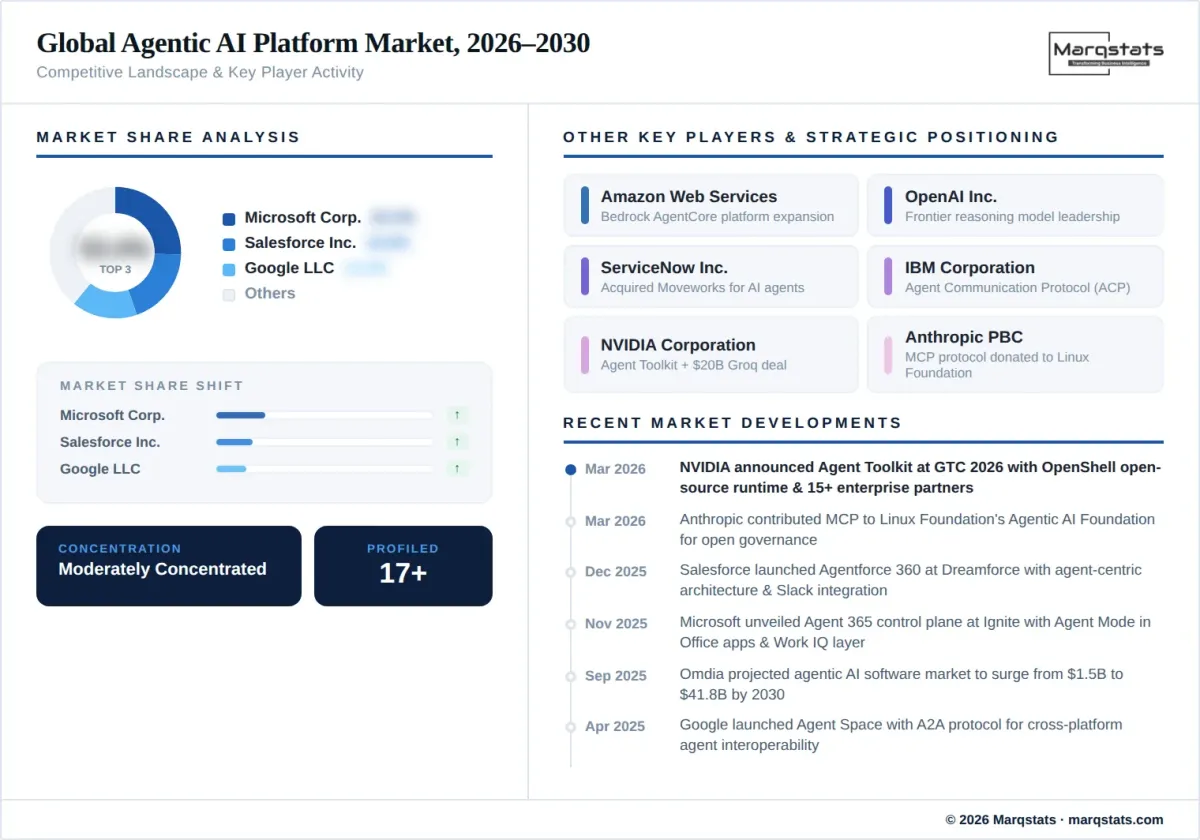
The global agentic AI platform market is moderately concentrated, with the top five players holding just over half of total revenue. The competitive landscape is characterized by a convergence of hyperscaler cloud providers, enterprise SaaS incumbents, frontier AI model companies, and a rapidly expanding ecosystem of specialized startups. Market leadership is being defined not by individual agent capabilities alone, but by the breadth of orchestration frameworks, the depth of enterprise integrations, the maturity of governance controls, and the ability to support multi-vendor, multi-agent interoperability at production scale.
Major competitive strategies include platform consolidation — exemplified by Salesforce's rebranding around Agentforce 360, Microsoft's Agent 365 control plane, and Google's Agent Space launch — as well as aggressive partnership formation across the AI infrastructure stack. ServiceNow's agreement to acquire Moveworks in March 2025 signaled the beginning of a consolidation wave, while NVIDIA's USD 20 billion deal with Groq for inference-optimized hardware underscored the hardware-software convergence shaping the competitive landscape. Consumption-based pricing models — including Salesforce's Flex Credits, Microsoft's Copilot Credits, and AWS's AgentCore billing — are emerging as a key competitive differentiator as enterprises seek cost predictability.
Open-source frameworks and community-driven ecosystems play a critical competitive role. LangChain, with over one billion cumulative downloads, serves as the dominant open-source orchestration framework, while CrewAI, Microsoft AutoGen, and NVIDIA's NemoClaw agent stack are accelerating developer adoption. The formation of the Agentic AI Foundation under the Linux Foundation — including Anthropic's contribution of MCP to open governance — signals a maturing ecosystem where interoperability standards will increasingly shape vendor positioning and market share.
Companies Covered
Companies covered in the report include:
Recent Market Activity
Table of Contents
Coverage & Segmentation
This report provides a comprehensive analysis of the global agentic AI platform market covering the period 2021–2030, with 2025 as the base year, historical analysis spanning 2021–2025, and forecasts for 2026–2030. The study examines market size and growth trajectories across component segments (platform software, professional services), deployment models (public cloud, hybrid, edge), end-user industries (BFSI, retail, healthcare, technology, and others), agent system architecture (single-agent, multi-agent), and geographic regions (North America, Europe, Asia-Pacific, Rest of World).
The analysis draws on a combination of primary and secondary research methodologies. Primary research includes structured interviews with enterprise technology leaders, platform vendors, and industry consultants, supplemented by analysis of vendor product announcements, earnings disclosures, and strategic partnerships. Secondary sources include independent enterprise surveys; government databases and AI policy frameworks; trade publications; patent filings; open-source community adoption metrics; and proprietary market modeling. Market sizing employs a bottom-up approach validated against top-down estimates from hyperscaler revenue disclosures, venture capital investment data, and enterprise AI spending surveys.