Executive Summary
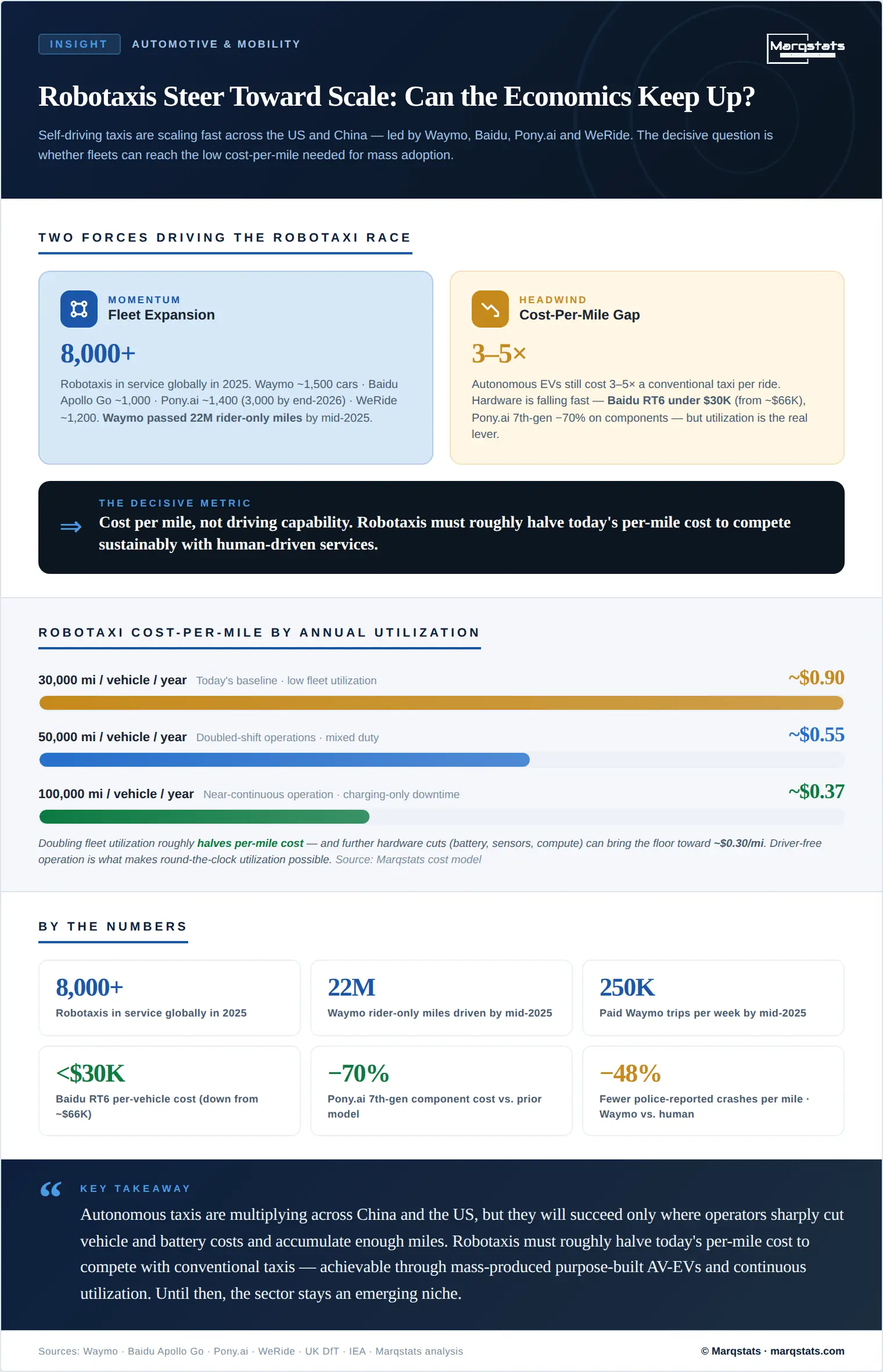
Autonomous ride-hailing services, known as robotaxis, are multiplying across the United States and China while remaining embryonic elsewhere. Major technology firms now operate fleets in the high hundreds to low thousands. Waymo runs about 1,500 fully self-driving cars, Baidu's Apollo Go about 1,000, Pony.ai about 1,400, and WeRide about 1,200. Roughly 8,000 robotaxis were in service worldwide in 2025. Fleets are expanding quickly; Pony.ai plans 3,000 vehicles by the end of 2026, and Baidu intends to export its model internationally.
The immediate challenge is economic rather than technological. Cost per autonomous EV runs three to five times that of a conventional taxi. High hardware and battery costs require sustained high utilization before operators break even. Companies are pursuing economies of scale and cheaper vehicles. In China, Pony.ai's seventh-generation robotaxi cuts component costs about 70 percent against its prior model, and Baidu reports its latest RT6 robotaxi costs under USD 30,000 per vehicle, down from about USD 66,000 five years earlier. Mass production with OEM partners such as Toyota, alongside lower sensor prices, underpins future profitability. A Marqstats model indicates that raising annual mileage per vehicle from 50,000 to 100,000 miles can halve per-mile cost, even before further hardware savings.
Regulators are adapting in parallel. The United Kingdom accelerated its autonomous-vehicle pilot programme; from spring 2026, companies can run taxi- and bus-like self-driving services without human drivers. Eighteen European Union countries signed a mid-2026 pact to harmonise AV testing across borders. United States authorities have begun granting exemptions to purpose-built robotaxis, with Zoox cleared in 2025, though federal safety rules remain in flux. The policy picture is fragmented. China has welcomed robotaxi pilots, with more than a dozen cities permitting driverless taxis, while Europe cites a strict safety culture and fragmented rules for its slower deployment.
Fleet Growth: Who Is Ahead
A few dominant operators drive the surge in robotaxi rides. In the United States, Waymo, owned by Alphabet, runs about 1,500 vehicles across Phoenix, San Francisco, Los Angeles, and Austin, logging 250,000 paid trips per week by mid-2025. The company plans to add 2,000 Jaguar I-PACE robotaxis through 2026 and targets expansion into Atlanta, Miami, and Washington, D.C. In China, Baidu's Apollo Go reached a 1,000-vehicle fleet in early 2025 and provided 1.4 million rides in the first quarter, up 75 percent year-on-year. Pony.ai and WeRide, both Nasdaq-listed Chinese AV firms, each operate on the order of 1,000 to 1,500 vehicles.
The geographic imbalance is stark. China, through Pony.ai, WeRide, Baidu, and AutoX, holds most global capacity, with the United States holding much of the remainder. Total robotaxis, above 8,000 units, remain a small fraction of the global taxi and ride-hail fleet, though the growth rate is rapid; China's pilot cities are adding hundreds of driverless licences each year.
Cumulative rides and utilization offer another measure of scale. By mid-2025, Waymo vehicles had driven more than 22 million rider-only miles, and Apollo Go had logged 11 million trips across 15 cities. These figures trail human taxi systems, yet momentum is clear. In San Francisco, Waymo has become the second-largest ride-hail operator, overtaking Lyft, which signals disruptive potential in dense urban areas. Uber, Lyft, Bolt, and Didi have partnered with robotaxi firms; Waymo already appears on Uber's app in Phoenix, and Uber has announced plans to carry Cruise vehicles once Cruise relaunches.
Absolute deployment remains small against the total car fleet. Progress depends on three factors: cutting capital and operating costs, sustaining rapid fleet growth, and navigating evolving regulation.
Cracking the Unit Economics
Cost is the defining hurdle. Early robotaxis were built from expensive EVs retrofitted with lidar, cameras, and compute; Waymo's early Jaguar-based vehicles cost about USD 150,000 each. Hardware and software bills remain high. Baidu's previous-generation RT5 cost about USD 66,000 per vehicle, whereas the new RT6 falls below USD 30,000. Pony.ai reports its seventh-generation robotaxi reduces component costs about 70 percent against the prior model, and WeRide has cut sensor costs more than 70 percent over five years.
The long-term aim is fleets of purpose-built autonomous EVs at near-mass-market prices, a point the sector has not yet reached. High amortized capital costs keep per-mile expense well above a human taxi. A Marqstats cost model shows the sensitivity: at baseline hardware costs, each mile costs about USD 0.90 at 30,000 annual miles, falling to about USD 0.37 at 100,000 miles. Doubling fleet utilization roughly halves unit cost, and further cuts in battery or AV hardware prices trim a further 20 to 30 percent. Under a high-utilization scenario of 100,000 miles per year, even halving AV hardware cost only lowers per-mile cost from about USD 0.37 to USD 0.30. Operators therefore lean heavily on utilization, since autonomous EVs carry no driver downtime and can run around the clock, save for charging.
Dynamic pricing offers another margin lever. Chinese robotaxi pilots initially undercut conventional cabs through heavy fare subsidies. After pushback from taxi associations, several cities imposed fare floors or removed subsidies. Where robotaxis cannot meaningfully undercut human-driven services, the advantage narrows. In markets such as India, some assessments place the addressable EV taxi opportunity above USD 48 billion by 2030, contingent on the projected fall in costs.
Several Chinese companies follow a coordinated model: automakers mass-produce affordable EV chassis, technology firms supply the autonomy stack, and platforms provide demand. Pony.ai has partnered with Toyota, which will supply about 1,000 bZ4X robotaxis in 2026, and WeRide works with automaker partners. Moving to OEM-level manufacturing is intended to push unit costs toward the USD 30,000 level.
Safety and Public Trust
Safety perception and public acceptance will shape uptake alongside economics. Real-world data indicates autonomous driving can reduce crashes; Waymo reports 48 percent fewer police-reported crashes and 84 percent fewer airbag-deployment crashes per mile than human drivers. High-profile incidents have raised scrutiny, however. Cruise paused its San Francisco fleet in late 2023 after an accident, then restarted limited driverless testing in mid-2024. Liability and consumer trust remain ongoing concerns. Regulators see potential safety gains; United States transport officials emphasise fewer human-error crashes, and the United Kingdom's new law requires AVs to be at least as safe as a skilled human driver before use. The stringent bar may slow near-term novelty, yet supports trust and insurance frameworks over time.
The Regulatory Roadmap
Deployment timelines vary sharply by region. Europe has lagged; only in mid-2026 did 18 countries, including France, Germany, and Italy, commit to a coordinated cross-border testing framework, a first move away from fragmented national rules. Early European pilots began across 2024 and 2025. Uber launched a small robotaxi pilot with Pony.ai in Zagreb in April 2026, and Waymo, Wayve, and Baidu each plan London trials in late 2026. Commercial services remain a few years out, with paid services in Europe expected around 2027.
The United States has no single AV law; the federal regulator and California authorities permit testing and fleet operation case by case. California first allowed driverless robotaxis in limited zones in 2022, subject to heavy safety-data sharing. A multi-city rollout therefore requires navigating dozens of state and local processes. The federal regulator expanded exemptions in 2025, first granted to Zoox.
China has promoted AV pilots since 2018. By 2025, more than 15 cities, including Wuhan, Shanghai, Beijing, Shenzhen, and Guangzhou, authorised limited driverless ride-hail zones. A policy pause followed subsidy disputes in 2024, after which momentum resumed. China and the United States lead in actual deployment, while Europe, the United Kingdom, and others sit in pilot mode.
Conclusion
Robotaxis have moved from concept to street reality, yet the timing of mainstream adoption remains open. Technology firms and automakers have shown that driverless fleets can operate safely, and governments are laying the groundwork for pilots. Financial viability is the final frontier. Autonomous taxis will undercut human drivers sustainably only once vehicle and hardware costs fall sharply and utilization stays high. Until then, services will remain concentrated in well-funded demonstrations and dense urban hubs across China and the United States. Should the sector crack scale, as EV batteries did over the past decade, it may reshape mobility and transport costs worldwide. For now the picture is split: rising fleet counts and maturing technology on one side, stubbornly high per-unit economics on the other.