The Spatial Architecture of Indian Expressways
The expansion of India's National Highway network to over 1.46 lakh kilometres has structurally reorganized the country's logistics and transit base. As high-speed economic corridors and greenfield expressways proliferate, the automotive sector faces a major technological pivot: moving electric vehicle (EV) charging from localized urban clusters to high-density inter-city highway networks. In 2025, India recorded a historic 2.3 million EV registrations — 8% of all new vehicle sales — making a dense, reliable highway EV charging density network an immediate macroeconomic necessity.
This grid expansion is defined by a sharp transition. India had only about 6,586 public charging stations in 2023; rapid policy pushes and private capital raised the operational count to 29,277 by August 2025, and past 39,500 chargers — including 8,414 dedicated DC fast chargers — by late 2025.
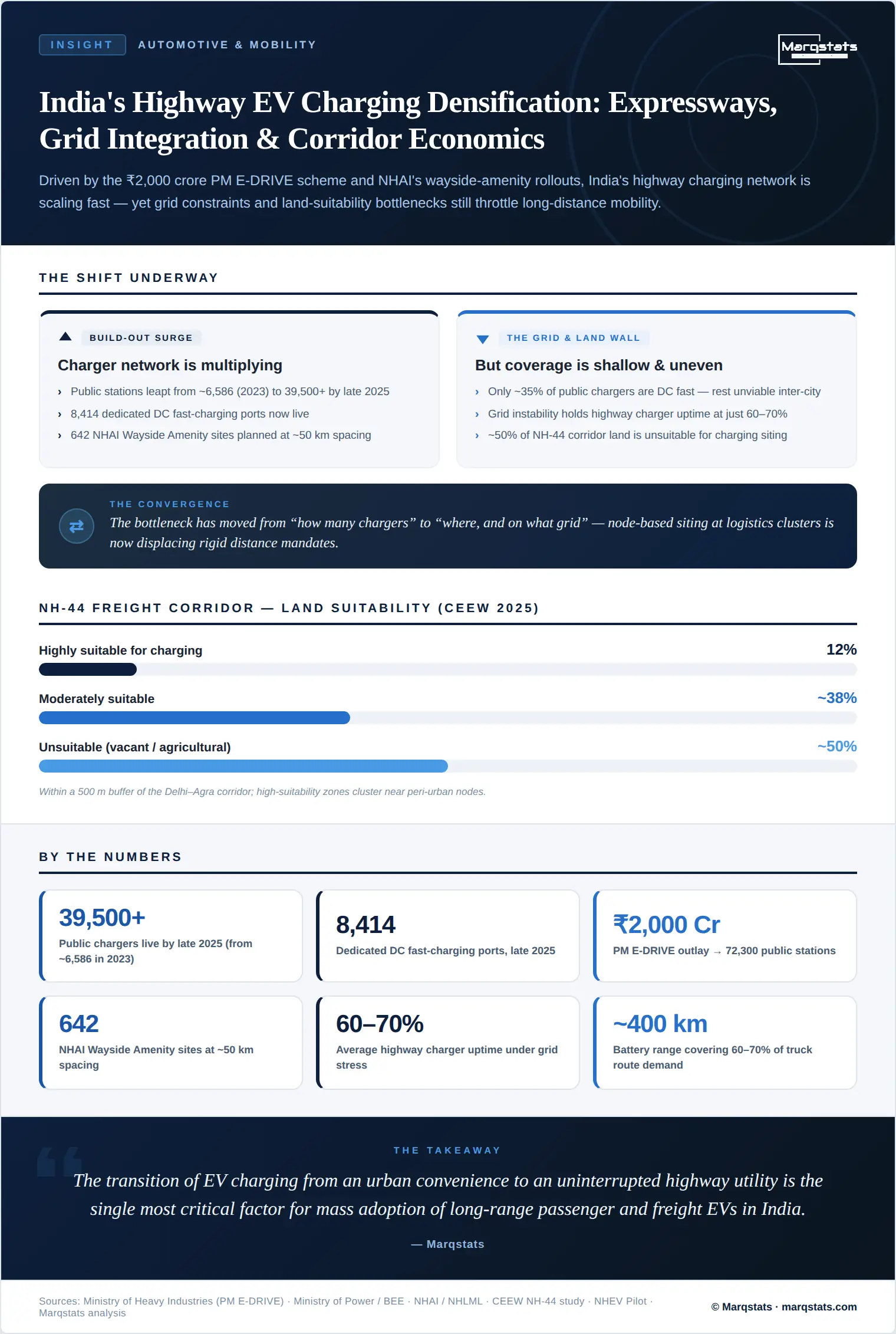
Despite this growth, a stark urban–highway skew persists. Nationally, only about 35% of public chargers are DC fast chargers, the remainder being slower AC setups unviable for inter-city travel. State leaderboards (BEE, 2025) show Karnataka ahead with 6,097 active stations, followed by Maharashtra (4,155), Uttar Pradesh (2,326), Delhi (1,967), and Tamil Nadu (1,781), each anchoring distinct corridors — Bengaluru–Mysuru, the Mumbai–Pune Expressway, the Yamuna and Agra–Lucknow Expressways, the Delhi–NCR and Gurugram corridor, and Chennai–Bengaluru, respectively. Coverage on the corridors themselves is patchy: the Mumbai–Pune Expressway offers dense provision at roughly 50 to 70 km intervals and the Delhi–Jaipur (NH-48) corridor has fast chargers every 80 to 100 km, while other critical national arteries carry deep infrastructure gaps.
The Grid Constraint: Power Dynamics of Ultra-Fast DC Charging
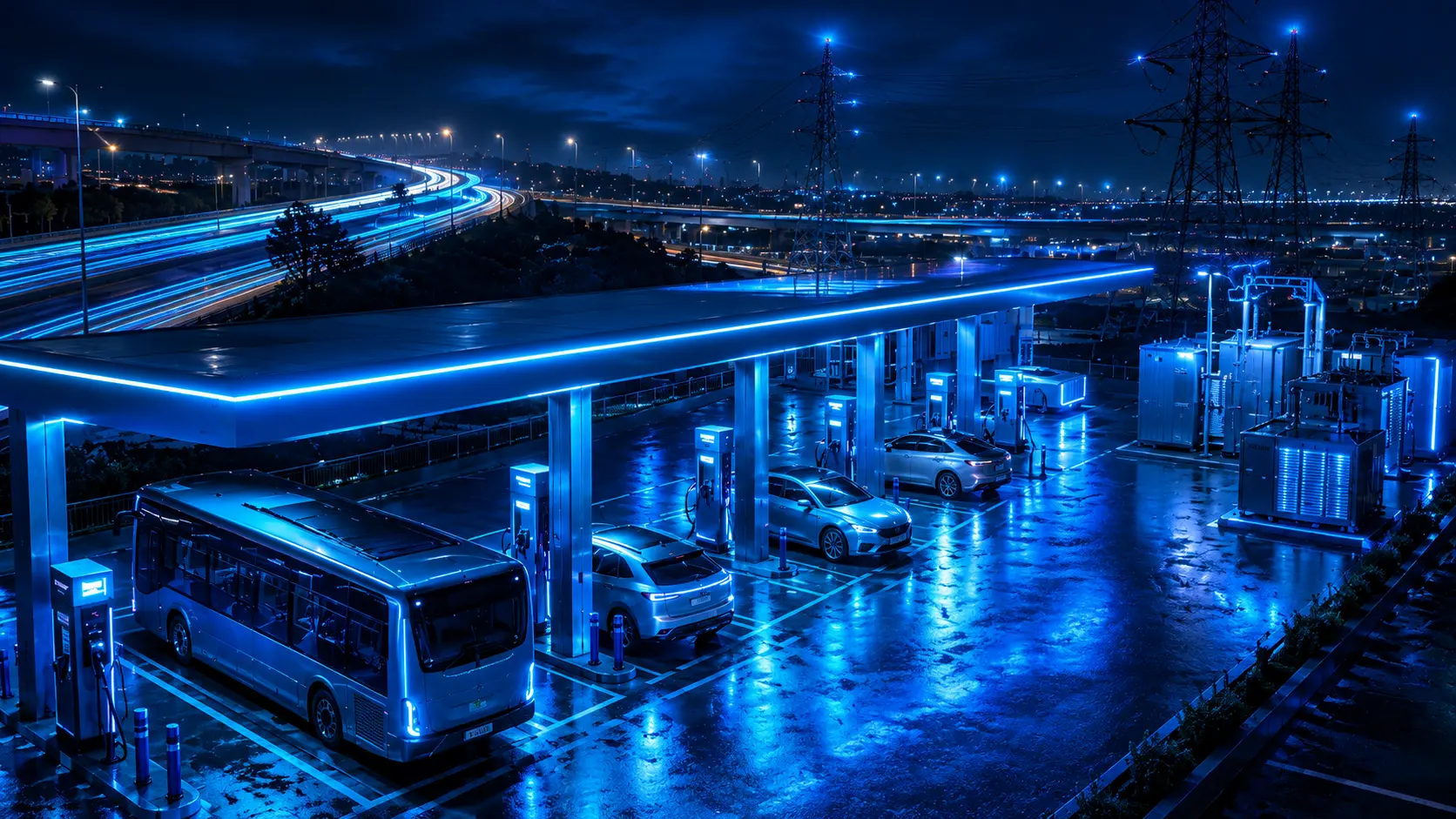
At the core of the highway bottleneck is the load mismatch between slow AC charging and ultra-fast DC fast-charging (DCFC). Onboard AC chargers in mass-market Indian passenger cars are limited to about 7.2 kW — sufficient for overnight residential parking, yet far too slow for an inter-city stop. Replenishing a 40 to 60 kWh pack on an expressway requires bypassing the onboard converter entirely; DC fast chargers delivering between 30 kW and 240 kW feed power directly to the battery, compressing dwell time to under an hour.
However, deploying multiple 150 kW DC fast chargers at a single waystation creates severe localized demand spikes that standard rural grid feeders cannot absorb without comprehensive upgrades. Peak active power demand at a charging plaza scales with the number of active ports and the per-port rating, adjusted for transmission and transformation efficiency. When a high-power plaza is activated, it pulls a high current through weak, remote rural feeders, inducing a significant voltage drop across the line — a function of line resistance, reactance, and system power factor — which often triggers local grid instability, feeder trips, and hardware degradation, holding average operational uptime of highway chargers to just 60% to 70%.
As a consequence, Charge Point Operators (CPOs) face a multi-month, bureaucratic process when seeking the 300 kW-plus substation upgrades required from state electricity distribution companies (DISCOMs). Without integrated planning between the Central Electricity Authority (CEA) and DISCOMs, operators remain highly exposed to volatile upgrade costs and connection lead times.
“Upgrading highway stations to handle multi-port ultra-fast DC charging requires a 300 kW-plus service upgrade — a multi-month process involving utility studies and substation reinforcement.”
— Charge Point Operator representative (interviewed February 2026)
Wayside Amenities and Highway Land Siting
The physical siting of charging infrastructure is governed by the National Highways Authority of India's (NHAI) masterplan to develop over 642 prime Wayside Amenity (WSA) sites by 2025, spaced at 50 km intervals across major expressways. These sites integrate fuel dispensing, rest zones, retail, and EV fast-charging under a single public-private partnership (PPP) model. However, finding land that combines grid access, commercial viability, and traffic volume remains a major barrier.
A 2025 study by the Council on Energy, Environment and Water (CEEW) on the Delhi–Agra (NH-44) freight corridor illustrates the constraint. Approximately 50% of land within a 500-metre buffer of the corridor is unsuitable for charging infrastructure, consisting of vacant or agricultural land lacking access roads and basic commercial activity; only 12% of the corridor area was classified as highly suitable. The high-suitability zones cluster exclusively near peri-urban and urban nodes, such as the Gadpuri-to-Agra stretch with its natural hubs of commercial activity. This shows that rigid distance-based mandates — such as the Ministry of Power's requirement for a charging station every 25 km on highways — must give way to flexible, node-based deployment centred on existing logistics clusters.
Corridor Economics: Annuity PPP Models and Private CapEx
High upfront capital expenditure makes return on investment highly sensitive to utilization. A single 60 kW DC charger costs Rs 3 lakh to Rs 7 lakh for the equipment alone, yet average station utilization across the highway network remains below 15% to 25%, a difficult commercial environment for CPOs.
To address this, new public-private partnerships have pioneered alternative funding. The National Highway EV (NHEV) pilot prototyped the Annuity Hybrid E-Mobility (AHEM) model on the 500 km Jaipur–Delhi–Agra lighthouse corridor, securing a Rs 3,672 crore credit outlay from HDFC Bank to deploy 3.2 MW NHEV 3G energy stations. To bypass local DISCOM limits, these stations pair 800 kW solar compact substations, battery storage, and vertical highway wind turbines to deliver fully renewable-powered charging independent of the thermal grid. The CEEW freight study reinforces the commercial case: over 60% of heavy-duty truck highway demand can be met with a 400 km battery range, aligning closely with the average 44-minute driver break at peri-urban logistics hubs.
The Policy Architecture: PM E-DRIVE and Nodal Aggregation
The Ministry of Heavy Industries' (MHI) PM E-DRIVE scheme, in effect from October 1, 2024 through March 31, 2026, is the primary policy driver for national charging infrastructure. The scheme allocates a total outlay of Rs 2,000 crore to establish 72,300 public charging stations — comprising 22,100 fast chargers for electric four-wheelers, 1,800 high-capacity chargers for electric buses, and 48,400 chargers for electric two- and three-wheelers.
To streamline the user experience, Bharat Heavy Electricals Limited (BHEL) is acting as the central demand aggregator and is developing a unified digital super-app integrating real-time slot booking, payment processing, live charger-availability status, and national deployment dashboards.
Freight Decarbonization and Zero-Emission Trucking
While passenger-vehicle charging drives early utilization, the long-term sustainability of highway grids depends on electrifying medium- and heavy-duty trucks (MHDTs). Commercial logistics is the highest-volume source of transport emissions and imported-fuel demand in India, and the CEEW NH-44 assessment shows truck electrification is highly feasible with only minor battery improvements.
A modest range of about 400 km satisfies the daily route requirements of over 70% of medium-duty trucks and 60% of heavy-duty trucks. The average driver-break dwell time — 38 minutes for medium-duty and 44 minutes for heavy-duty vehicles — aligns closely with the time needed to top up using high-power 90 kW to 240 kW DC fast chargers, without disrupting tight logistics schedules.
Because truck traffic and origin-destination pairs are highly predictable, concentrating around logistics hubs in Mathura, Agra, Faridabad, and Palwal, freight corridors offer stable, high-volume demand profiles for CPOs. Early adoption is most viable in high-volume, low-value cargo chains such as cement and construction materials, and in temperature-controlled cold-chain reefers for dairy and agricultural products, both of which can support dedicated mega-charging plazas or battery-swapping stations at urban-fringe logistics nodes.
Sources
Ministry of Heavy Industries (MHI), Government of India — PM E-DRIVE operational guidelines and subsidy outlays, including the Rs 2,000 crore deployment map for 72,300 public charging stations. heavyindustries.gov.in
Ministry of Power (MoP) / Bureau of Energy Efficiency (BEE) — national public charging-station database, state-wise leaderboards, and inter-city charging-spacing guidelines. powermin.gov.in
National Highways Authority of India (NHAI) / National Highway Logistics Management Limited (NHLML) — Wayside Amenities development masterplan, lease-model tenders, and corridor spacing criteria. nhai.gov.in
Council on Energy, Environment and Water (CEEW) — Assessment of Charging Infrastructure on the Delhi–Agra Highway (NH-44), 2025: land suitability, node-clustering, and battery-range sensitivity for freight. ceew.in
National Highway EV (NHEV) Pilot Project — reports on the Jaipur–Delhi–Agra lighthouse corridor, the Annuity Hybrid E-Mobility model, credit structures, and 3.2 MW solar compact energy stations. nhev.in
Press Information Bureau (PIB) / Ministry of Heavy Industries — releases on inter-ministerial meetings, BHEL demand aggregation, and the unified digital super-app. pib.gov.in
Observer Research Foundation (ORF) — 2025 execution studies on DISCOM substation permit delays, land-acquisition bottlenecks, and CPO utilization patterns. orfonline.org