The Structural Imperative of Vehicular Protection
India's road network has expanded to over 67 lakh kilometres, the second-largest in the world. While this build-out has accelerated economic growth and regional connectivity, it has also precipitated a severe public-health crisis. According to the MoRTH Road Accidents in India 2024 report, the country recorded 4.88 lakh road accidents and 1.77 lakh fatalities in the calendar year — an average of approximately 485 deaths a day. Within this picture, vehicle safety in India has moved from the margins of the buying decision to its centre.
The crisis is defined as much by rising lethality as by accident volume. Severity — fatalities per 100 accidents — has climbed steadily from 21.6 in 2005 to an unprecedented 36.3 in 2024, indicating that collisions on high-speed corridors are becoming more lethal. Historically, safety was marketed as a premium, high-cost option reserved for luxury models. A combination of strict regulatory mandates, a localized crash-testing ecosystem, and a fundamental shift in consumer awareness is now converting advanced safety features into non-negotiable baseline requirements.
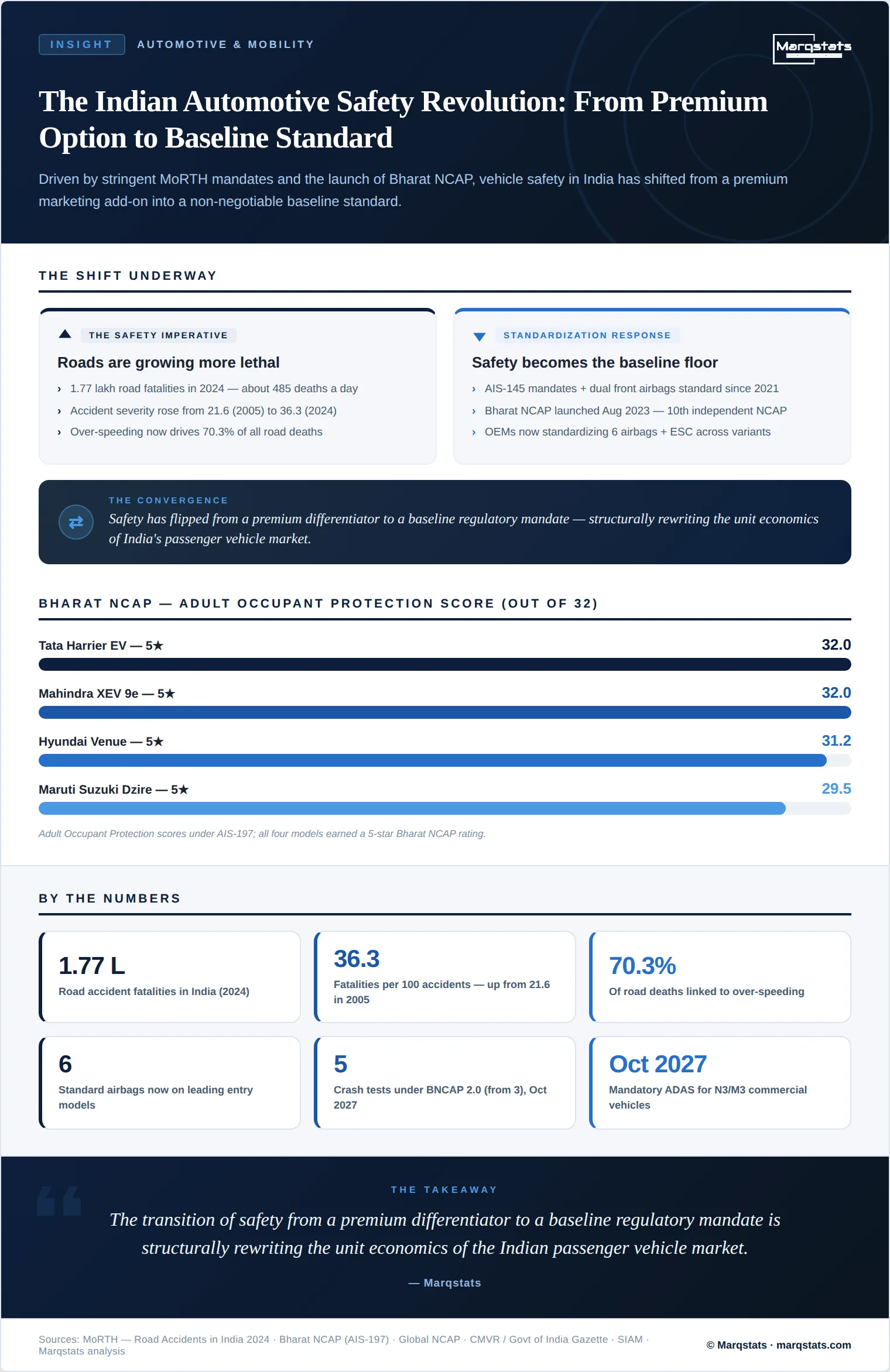
This transition marks a departure from historic design philosophy. The kinetic energy absorbed by a crumple zone in a collision follows E = ½mv², so impact energy rises with the square of velocity; even modest speed increases sharply amplify the structural load a body shell must withstand. With over-speeding contributing to 70.3% of road deaths in India, the physical limits of legacy structures have forced regulators and manufacturers to move from basic active-safety systems to comprehensive passive and crash-worthy architectures. The shift is structurally rewriting the unit economics of the Indian passenger-vehicle market.
The Regulatory Progression: Dual Airbags to Market-Led Standardization
The transformation of the Indian passenger-car safety regime is built on a series of progressive mandates issued under the Central Motor Vehicles Rules (CMVR). The first major wave of standardization arrived through Automotive Industry Standard 145 (AIS-145):
July 2019: driver-side airbags, speed-warning alerts (sounding above 80 km/h and continuously above 100 km/h), reverse parking sensors, and front seatbelt reminders became mandatory for all passenger vehicles.
October 2019: frontal offset crash testing (AIS-098) and lateral collision tests (AIS-099) became standard for all on-sale passenger vehicles, forcing the retirement of several structurally unstable architectures.
April 2021: dual front airbags were mandated for all new models, with existing models required to comply by December 31, 2021, eliminating single-airbag configurations from the budget segments.
While MoRTH evaluated a mandatory six-airbag rule for passenger cars carrying up to eight people, the industry raised concerns over lead time, supply-chain capacity — requiring an additional 10 million airbag units annually — and the financial impact on the price-sensitive entry segment. Integrating side and curtain airbags into budget cars not designed to support them would require comprehensive chassis and roof re-engineering, increasing acquisition costs by an estimated Rs 30,000 to Rs 50,000.
Consequently, the government deferred the mandatory six-airbag rule in 2023, shifting to market-driven adoption through a localized voluntary testing programme: the Bharat New Car Assessment Programme (Bharat NCAP). The pivot triggered an immediate competitive response. In October 2023, Hyundai Motor India became the first mass-market carmaker to standardize six airbags across its entire range, including entry models such as the Grand i10 Nios and Exter. In November 2024, Maruti Suzuki — the country's largest manufacturer by volume — redesigned its high-volume compact sedan, the Dzire; the fourth-generation model carried six airbags, Electronic Stability Control (ESC), and pedestrian protection as standard, becoming the first Maruti Suzuki vehicle to secure a perfect 5-star adult-occupant rating from Global NCAP.
“We saw a profound shift in consumer inquiries after 2023 — buyers who previously asked only about mileage and resale value now explicitly demand crash-test sheets and airbag counts.”
— Dealership principal, National Capital Region, interviewed March 2026
Localized Crash Testing: Bharat NCAP as a Market Catalyst
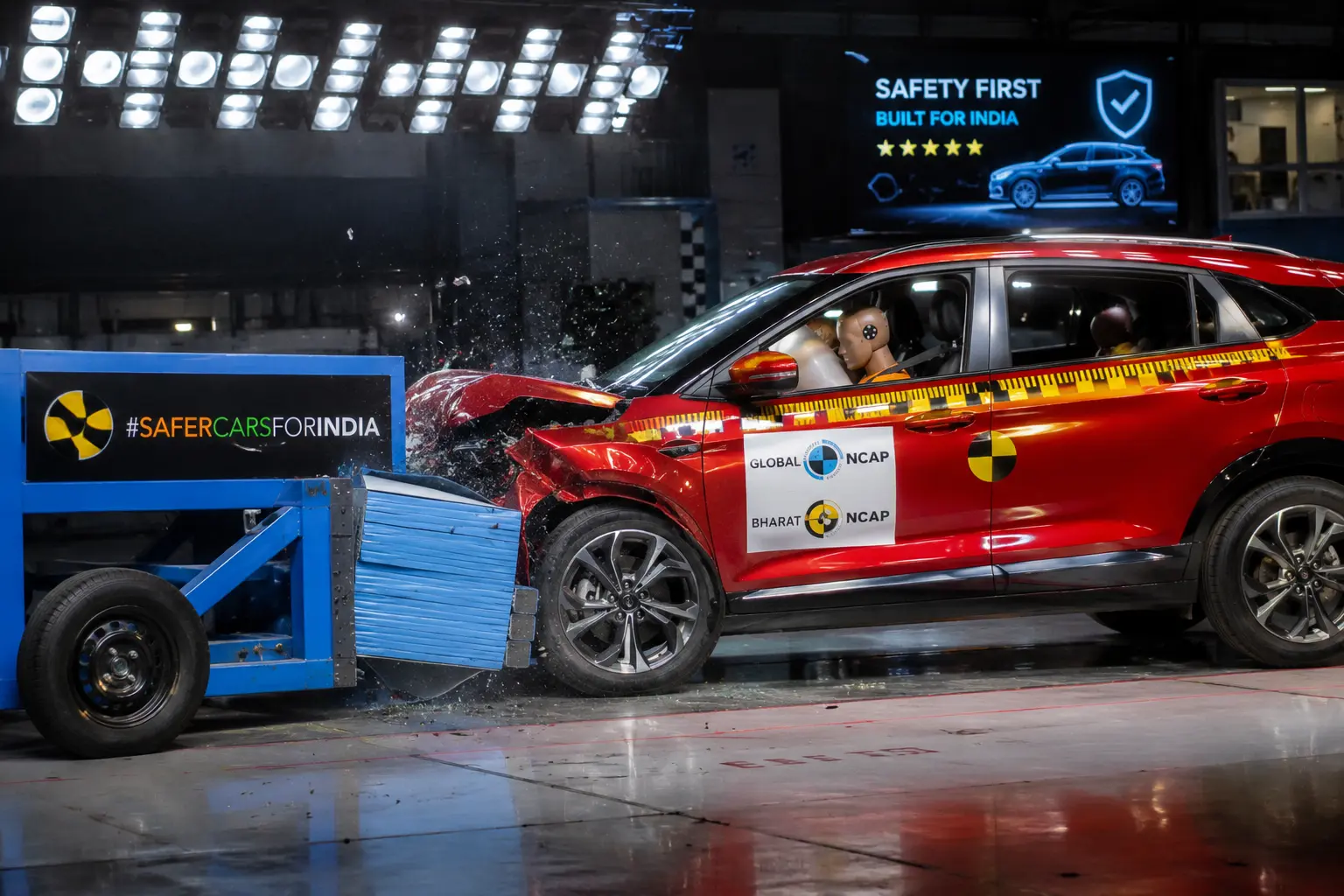
Launched in August 2023 by MoRTH under Automotive Industry Standard 197 (AIS-197), Bharat NCAP is the world's tenth independent New Car Assessment Program. Designed for right-hand-drive passenger vehicles under 3,500 kg, it evaluates Adult Occupant Protection (AOP), Child Occupant Protection (COP), and Safety Assist Technologies (SAT).
The local programme has reduced crash-testing costs for OEMs while improving transparency for consumers. Testing previously required shipping vehicles to international labs; domestic validation now happens at a fraction of the cost. Its influence is visible in the rapid rise of 5-star ratings across internal-combustion and electric platforms alike. Recent Bharat NCAP and Global NCAP results cluster strong performers at the top of the scale: the Tata Harrier EV and Mahindra XEV 9e each recorded a perfect 32 of 32 adult-occupant score with a 5-star Bharat NCAP rating; the Hyundai Venue (31.15/32) and Maruti Suzuki Dzire (29.46/32) followed closely, while the Volkswagen Virtus secured 5 stars under Global NCAP.
This verification has reshaped product design. Dedicated electric platforms, such as Mahindra's INGLO architecture powering the XEV 9e and BE 6, have achieved perfect or near-perfect adult-occupant scores, incorporating structural reinforcements that shield battery packs and mitigate fire risk during high-energy collisions.
The Next Frontier: Bharat NCAP 2.0 and the 100-Point Paradigm
In late 2025, MoRTH notified draft rules for the next phase of India's safety-assessment framework, Bharat NCAP 2.0, under a revised AIS-197 protocol. Scheduled to take effect in October 2027 — immediately after the current protocol expires on September 20, 2027 — Version 2.0 introduces a stricter, more comprehensive evaluation system. Unlike the current protocol, which separates evaluations into independent star thresholds, Bharat NCAP 2.0 adopts a holistic 100-point model across five pillars:
Crash Protection (55%): cabin structural integrity and occupant deceleration management during high-speed impacts.
Vulnerable Road-User Protection (20%): bumper, hood, and windshield compliance to minimize injuries to pedestrians, cyclists, and motorcyclists.
Safe Driving (10%): standard fitment of driving-assist systems, blind-spot monitoring, and drowsiness detection.
Accident Avoidance (10%): active electronic packages designed to prevent collisions entirely.
Post-Crash Safety (5%): emergency access systems, rollover indicators, and post-collision hazard controls.
To prevent manufacturers from relying solely on structural crashworthiness, Bharat NCAP 2.0 sets strict minimum eligibility criteria. ESC and side curtain airbags become mandatory standard equipment for any model seeking a star rating. A model scoring zero in any pillar, or registering red-zone high-severity dummy injuries, is automatically disqualified from a 5-star rating regardless of cumulative score. The physical crash-test suite expands from three tests to five, using both male and female adult dummies:
64 km/h offset frontal impact.
50 km/h full-width frontal impact, added to simulate head-on collisions with rigid barriers.
50 km/h mobile lateral barrier impact.
32 km/h oblique pole side impact.
50 km/h mobile rigid rear impact, added to evaluate rear-end collisions common on highway corridors.
Fleet Transitions: Mandatory ADAS in the Commercial Segment
While passenger-vehicle safety has advanced through a mix of consumer demand and regulatory pressure, MoRTH is using strict legal mandates to address high fatality rates in commercial logistics. Heavy commercial vehicles represent a small fraction of the vehicle population yet account for a disproportionate share of fatal highway accidents, primarily owing to driver fatigue, brake fade, and poor highway speed management.
In a major step, MoRTH issued a final gazette notification mandating Advanced Driver Assistance Systems (ADAS) for heavy commercial vehicles in Category N3 (heavy-duty trucks) and Category M3 (heavy-duty passenger buses): all new platforms introduced after October 1, 2027 must carry active ADAS technologies, and existing models in production must be re-engineered to meet the specifications by April 1, 2028. The commercial ADAS package includes three active technologies designed to intervene before a crash:
Advanced Emergency Braking System (AEBS, AIS 162): radar- and camera-based sensors detect stationary or slow-moving obstacles and apply the brakes automatically if the driver fails to respond.
Lane Departure Warning System (LDWS, AIS 188): alerts the driver when the vehicle drifts out of its lane without the turn indicator engaged, mitigating rollover risk.
Driver Drowsiness and Attention Warning (DDAW, AIS 184): tracks steering inputs and facial indicators to detect fatigue, a major cause of accidents on long-haul night transits.
To support these systems, national braking regulations have been upgraded to the stricter IS 11852:2019 standard, requiring commercial vehicles to move from basic pneumatic brakes to electronic setups that integrate with ESC and autonomous braking. The additions are estimated to raise truck manufacturing costs by Rs 50,000 to Rs 1,00,000 per unit, with the long-term payoff in reduced insurance claims and improved highway safety expected to be substantial.
Sources
Bharat NCAP Official Portal (MoRTH) — technical safety ratings and vehicle evaluation metrics (AOP/COP scores) under AIS-197. bncap.in
Ministry of Road Transport and Highways (MoRTH) — Road Accidents in India 2024 annual safety report covering accident rates, highway fatalities, crash severity, and speed-violation statistics. morth.gov.in
Press Information Bureau (PIB) / MoRTH — release on mandatory active-safety devices (ADAS, AEBS, LDWS, ESC) for heavy commercial vehicles (N3/M3) effective October 2027. pib.gov.in
Global New Car Assessment Program (GNCAP) — Safer Cars for India records, voluntary test results, and crash-test reports. globalncap.org
Government of India Gazette / Central Motor Vehicles Rules (CMVR) — regulatory notifications for AIS-145, dual-airbag mandates, and draft rules for Bharat NCAP 2.0. egazette.gov.in
Society of Indian Automobile Manufacturers (SIAM) — industry papers on safety engineering, material compliance, and consumer safety preferences. siam.in