
The Biofuel Mandate and Energy-Security Dynamics
The global road-transport sector is undergoing a profound diversification. While battery-electric platforms continue to expand across core urban zones, a parallel shift is taking place under the banner of the flex fuel vehicle boom. Across major developing economies, movement away from fossil-fuel dominance is increasingly led by flexible-fuel vehicles (FFVs) capable of operating on high-concentration ethanol blends. This shift is not merely a localized environmental initiative; it is a macroeconomic hedge against global crude-oil price shocks and geopolitical instability.
The macroeconomic catalyst for this transition is anchored in energy independence. India currently imports approximately 88.5% of its crude-oil requirement. In fiscal year 2024–2025, the national fossil-fuel import bill exceeded USD 165 billion, equivalent to roughly Rs 22 lakh crore. With periodic crude-oil spikes tied to conflict in the Middle East, the financial and logistical exposure of import-dependent economies has reached a critical threshold.
“India's ethanol journey is transforming our farmers from 'annadatas' (food providers) to 'urjadatas' (energy providers), while strengthening national energy security.”
— Shri Hardeep Singh Puri, Minister of Petroleum and Natural Gas
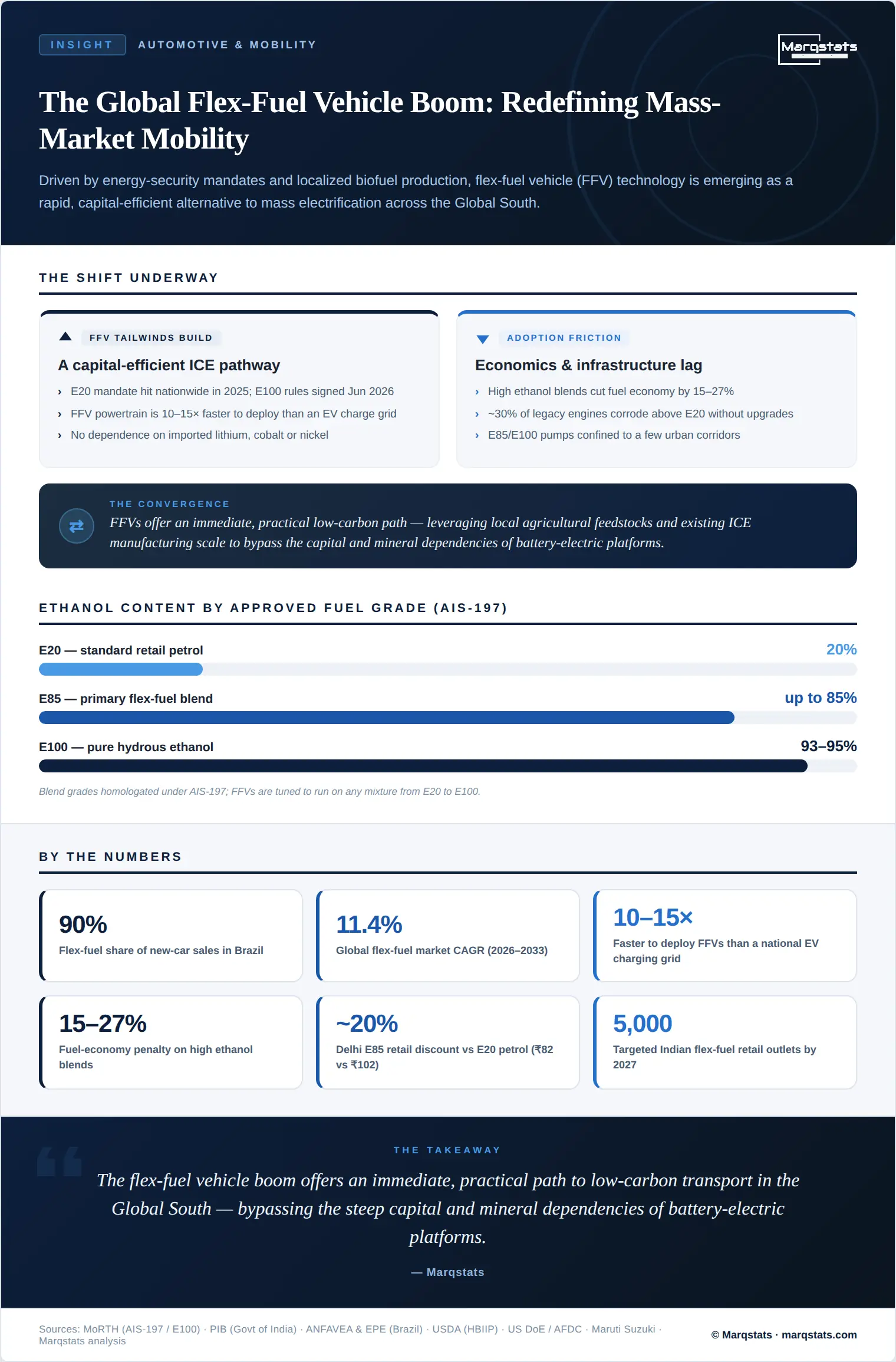
In response to this structural exposure, the Ministry of Road Transport and Highways (MoRTH) accelerated its alternative-fuel roadmap, achieving a nationwide E20 (20% ethanol, 80% petrol) blending mandate in 2025. The policy breakthrough followed on June 13, 2026, when the regulatory framework for pure ethanol (E100) and ethanol-gasoline blends was finalized under Automotive Industry Standard 197 (AIS-197). This formalization allows manufacturers to design and homologate vehicles tuned for any mixture from E20 to E100, providing the legal foundation for mass-market FFV rollout.
The operational trade-off is volumetric. Pure hydrous ethanol carries roughly two-thirds the volumetric energy of petrol, so running on high-concentration blends produces a corresponding reduction in fuel economy. That single property — lower energy per litre — frames every commercial and engineering decision that follows, from retail pricing to engine calibration.
Chemical and Mechanical Engineering of Flex-Fuel Engines
The core technological challenge of the flex fuel vehicle boom lies in materials science and electronic engine management. Ethanol is highly polar, hygroscopic, and inherently corrosive to many of the metals and polymers used in legacy internal-combustion engines.
When exposed to high-blend ethanol, unmodified fuel systems suffer rapid chemical degradation. Standard fuel tanks, steel fuel lines, and conventional pumps are prone to galvanic corrosion, rust, and premature structural failure, while elastomers and plastic seals swell and crack. Engineering studies indicate that roughly 30% of legacy or unmodified engines run on materials that face severe corrosion if operated on blends exceeding E20.
To achieve E85 and E100 compliance, contemporary FFVs apply extensive hardware modifications:
Corrosion-resistant fuel lines: standard rubber and steel lines are replaced with fluororubber (FKM) hoses and anodized or stainless-steel tubes.
Upgraded injectors and pumps: high-flow, corrosion-resistant injectors and pumps with sealed internal electrical contacts handle the chemical properties of hydrous ethanol.
Enhanced cylinder heads and valves: intake and exhaust valves are coated with cobalt-based alloys to withstand higher combustion temperatures and distinct wear patterns.
The Engine Control Unit (ECU) must adjust parameters in real time using an inline capacitive flex sensor. Because ethanol's dielectric constant (around 24) is far higher than gasoline's (close to 2), the sensor measures the change in dielectric permittivity of the flowing fuel and, with thermistor temperature compensation, sends a digital signal indicating the precise ethanol percentage in the tank. The ECU then recalculates the stoichiometric air-fuel ratio — which falls from roughly 14.7:1 for gasoline to about 9.0:1 for ethanol — and modifies injection pulse-width and ignition timing to optimize performance and prevent knock.
“The average national blend in Brazil has risen to as much as 50% with FFVs, despite the base mechanical blend remaining at E27, because consumers find the economic rationale to use pure hydrous ethanol.”
— Automotive industry spokesperson, interviewed June 2026
Ethanol combustion also creates unique emissions-testing challenges. Higher water-vapour output causes severe condensation in standard dilute measurement systems during cold-start cycles, interfering with nitrogen-oxide and acetaldehyde detection. Laboratories therefore use heated transfer lines and sampling systems maintained at elevated temperature to preserve the gas phase and ensure regulatory compliance.
Retail Dynamics and Infrastructure: The Brazil Paradigm
While the engineering framework for FFVs is mature, commercial feasibility depends heavily on fuel-dispensing infrastructure and retail pricing. The global reference point for this ecosystem is Brazil.
Following the Proálcool program of the 1970s and the subsequent Rota 2030 rules, Brazil built a market where FFVs account for roughly 90% of new light-vehicle sales. This penetration is supported by a mandate requiring every retail fuel station in the country to offer hydrous ethanol alongside gasoline.
Other emerging markets face a classic chicken-and-egg infrastructure problem. In India, E100 and E85 dispensing pumps are currently restricted to a few corridors, primarily Delhi-NCR and the Mumbai–Pune–Nagpur belt. To address the bottleneck, the government has set a target of 500 operational flex-fuel retail outlets by December 2026, expanding to 5,000 outlets across major urban centres by the end of 2027.
In the United States, higher-blend expansion is supported by federal funding. The U.S. Department of Agriculture (USDA) administers the Higher Blends Infrastructure Incentive Program (HBIIP), which has invested over USD 323 million across 399 awards to retrofit stations with E85 and E15 dispensers, with a further USD 60 million in grants in early 2025 to expand capacity across 24 states.
The decisive variable for mass adoption remains relative retail price. Because high-blend ethanol delivers a 15% to 27% reduction in fuel economy, it must be priced at a meaningful discount to petrol to offer a favourable total cost of ownership. In Delhi, E85 launched at Rs 82 per litre against Rs 102.12 for standard E20 petrol — a discount of roughly 20%. At that gap, consumers offset the mileage penalty and recover the vehicle purchase premium within about three years. To reinforce the incentive, central excise duty has been waived on petrol blends containing between 22% and 30% ethanol.
Market Launches and the Commercial Case
Momentum behind the flex fuel vehicle boom has accelerated as manufacturers weigh the slower-than-expected build-out of EV charging networks. In India's two-wheeler sector, which carries an active fleet of over 300 million vehicles, the electric share of new sales has held flat at around 7% across the past two years.
For legacy manufacturers, converting existing engine assembly lines to flex-fuel variants is a capital-efficient alternative. Developing an FFV powertrain is estimated to be 10 to 15 times faster and far less capital-intensive than building a nationwide fast-charging grid. FFVs also avoid the upstream emissions of battery-cell manufacturing and dependence on imported lithium, cobalt, and nickel. This industrial advantage has triggered a wave of product launches:
Maruti Suzuki Wagon R Bioflex: launched on June 4, 2026 as India's first mass-market flex-fuel passenger car. Built on the ZXI Plus manual trim with the 1.2-litre K12N engine, it produces 90.9 PS and 113.7 Nm on E20 and operates on any blend up to E85. Priced at Rs 7.24 lakh ex-showroom, it carries an Rs 85,000–86,000 premium over the petrol variant and is initially restricted to commercial fleet operators aligned with early urban fuelling corridors.
Hero MotoCorp Splendor+ and HF Deluxe: flex-fuel-compatible variants of the highest-volume commuter motorcycles, designed to run on any blend from E20 to E85, launched in June 2026.
Honda CB300F Flex Fuel: an E85-compatible motorcycle introduced in late 2024, the first entry in the high-blend two-wheeler segment.
Toyota Corolla Altis strong-hybrid pilot: a pilot fleet pairing a 1.8-litre engine, electric motor, and CVT with high-blend biofuel to maximize thermal and volumetric efficiency.
Sources
Ministry of Road Transport and Highways (MoRTH), Government of India — regulatory gazette notifications for E100 approval, AIS-197 revision guidelines, and Central Motor Vehicle Rules amendments. morth.gov.in
Press Information Bureau (PIB), Government of India — official releases on the finalization of pure-ethanol rules and statements on TCO benefits and localization of E85-compatible two-wheelers. pib.gov.in
Associação Nacional dos Fabricantes de Veículos Automotores (ANFAVEA), Brazil — technical papers and historical data on the Proálcool program, flex-fuel fleet statistics, and Rota 2030 frameworks. anfavea.com.br
Empresa de Pesquisa Energética (EPE), Brazil — light-duty vehicle energy demand 2018–2030, licensing rates, ethanol price sensitivity, and distribution mandates. epe.gov.br
U.S. Department of Agriculture (USDA) — funding opportunities and grant awards for the Higher Blends Infrastructure Incentive Program (HBIIP). usda.gov
U.S. Department of Energy (DOE) / Alternative Fuels Data Center (AFDC) — technical briefs on material compatibility, energy density, and flex-fuel sensor principles. afdc.energy.gov
Renewable Fuels Association (RFA) — 2026 ethanol industry production metrics, greenhouse-gas reductions, and retail price gaps across E15, E85, and E10. ethanolrfa.org
Maruti Suzuki India Limited — corporate releases and technical specifications for the Wagon R Bioflex and fleet-deployment communications. marutisuzuki.com