The Geopolitical Crucible of Crude Volatility
The vulnerability of global transport networks to geopolitical shocks has reached a critical juncture. Tensions around the Strait of Hormuz and escalating conflict across West Asia have triggered severe crude-oil price spikes, exposing the fragility of import-dependent economies. A physical disruption at a major maritime chokepoint can quickly destabilize fiscal planning, trigger domestic inflation, and strain a current-account balance. In response, several countries are deploying domestically produced biofuels as a geopolitical shield to protect their economies and secure fuel-supply stability.
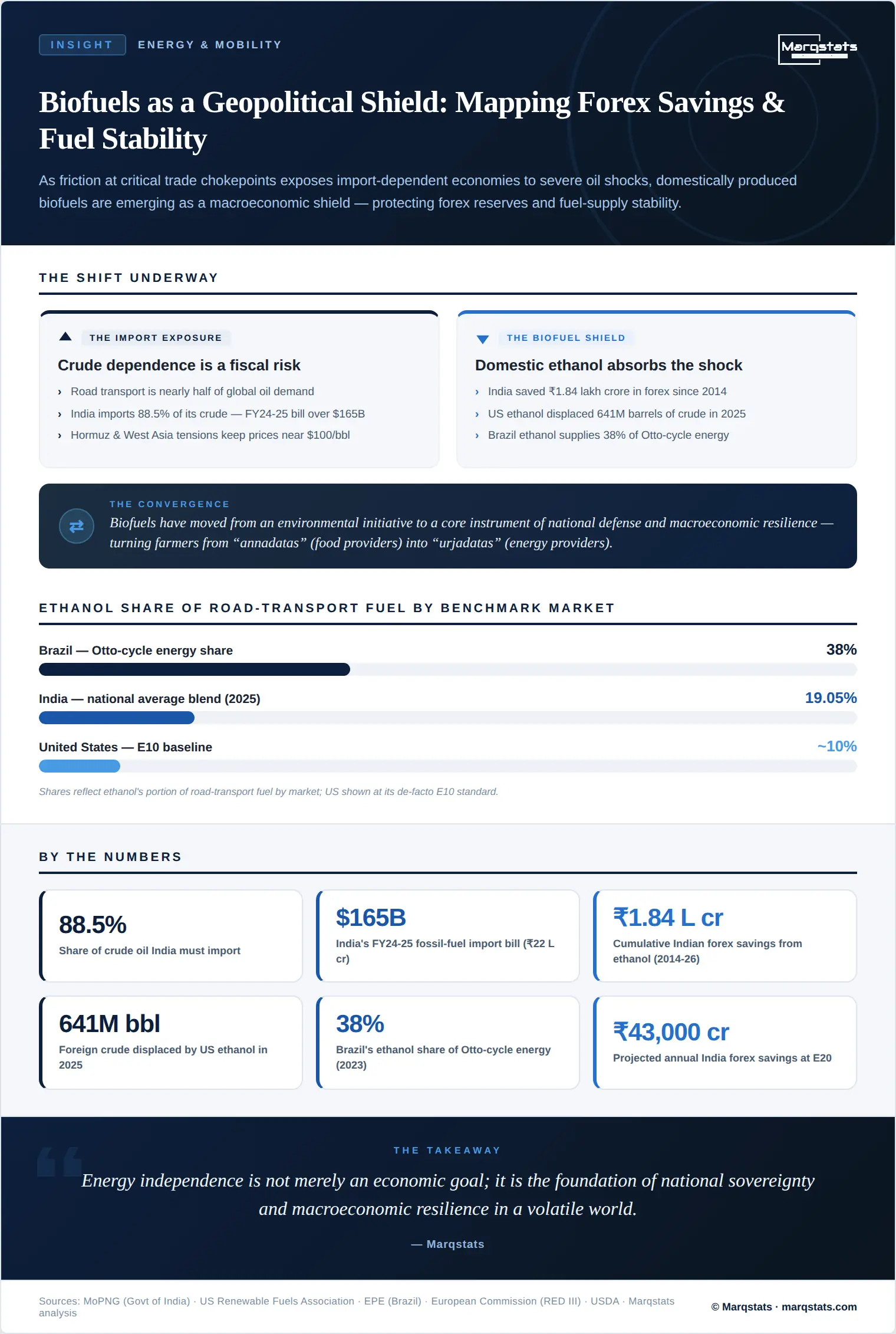
For large emerging economies, energy independence is a matter of national sovereignty. Road transport accounts for nearly half of global oil consumption, making it the primary source of import exposure. When global oil prices hover near USD 100 per barrel, the outflow of foreign currency to oil exporters accelerates, shifting wealth away from domestic development. By substituting imported fossil fuels with domestically produced ethanol and biodiesel, nations can convert agricultural sectors into strategic energy reserves and turn road transport into a buffer against global supply shocks.
Quantifying the Shield: Foreign Exchange and Crude Displacement
Measuring the economic impact means modelling how blending translates into physical crude displacement and foreign-exchange (forex) savings. Because ethanol carries lower volumetric energy than petrol, a larger volume of ethanol is needed to deliver equivalent energy. Once the average refinery gasoline yield per barrel of crude is accounted for, each unit of domestically blended ethanol maps to a measurable volume of displaced crude imports — and the net forex saving is that displaced volume multiplied by the average imported-crude price per barrel. The country cases below quantify the result.
United States: Domestic Scaling and OPEC Decoupling
The United States remains the world's dominant ethanol producer, accounting for over half of global output and producing 31.9 billion gallons in the most recent cycle. In 2025, U.S. biorefineries processed a record 5.7 billion bushels of corn, transforming USD 24 billion of raw grain into USD 36 billion of high-octane fuel and high-protein coproducts.
Despite rising domestic extraction, the U.S. still imports roughly one-third of its crude, sending over USD 23 billion a year to OPEC nations. However, the Renewable Fuel Standard (RFS) has decoupled the domestic transport sector from absolute import dependency: in 2025 alone, American-made ethanol displaced more than 641 million barrels of foreign crude imports, keeping capital within the rural economy.
India: The Drive Toward E20 and Fiscal Preservation
India is one of the most striking examples of biofuels used as a fiscal shield. The country imports approximately 88.5% of its crude requirement, producing a large outflow of foreign currency. In fiscal year 2024–2025, India's fossil-fuel import bill exceeded USD 165 billion (about Rs 22 lakh crore), leaving the treasury highly exposed to price volatility. To address this, the Ministry of Petroleum and Natural Gas (MoPNG) accelerated its Ethanol Blended Petrol programme, advancing the 20% national target (E20) to the 2025–2026 cycle; by July 2025 the national average blending rate had reached 19.05%, approaching full implementation ahead of schedule.
Brazil: The Otto Cycle Benchmark
Brazil's long-term strategy offers a blueprint for structural fuel displacement. Reaching back to the Proálcool program and reinforced by the modern Rota 2030 rules, Brazil has integrated sugarcane-based ethanol into its primary energy mix. Rather than relying on import mandates alone, the system offers motorists a direct choice at the pump between pure hydrous ethanol (E100) and gasohol (blends of E27 to E32). In 2023, bioethanol represented 38% by energy content of the combined gasoline and ethanol consumed in Otto-cycle engines, effectively substituting over half of the gasoline that would otherwise have been imported.
Fuel Price Stability: Buffering the Retail Consumer
Beyond macroeconomics, the biofuel shield acts as a price buffer for retail consumers. In high-oil-price conditions, conventional fuel costs rise rapidly, straining households and businesses. Domestically produced biofuels mitigate these spikes through two mechanisms.
Direct Wholesale Discounting
Ethanol typically trades at a discount to wholesale petroleum-based gasoline, and during global supply shocks the gap widens, allowing fuel-marketing companies to lower the cost of blended fuels at the pump. The effect is visible in India's recent high-blend rollout: in June 2026, E85 launched at select retail outlets in New Delhi at Rs 82 per litre — about Rs 20 below conventional E20 petrol — letting flex-fuel users offset the mileage penalty of ethanol and recover the upfront vehicle premium within roughly three years.
The “Annadata to Urjadata” Agricultural Cushion
Biofuel expansion also protects the agricultural sector from global volatility. By diversifying feedstock, policymakers have built a structural safety net for rural economies. In India, the feedstock mix has shifted from sugarcane dominance to include maize, broken rice, and damaged food grains; maize-based ethanol grew from 0% in 2021–2022 to 42% of national fuel-ethanol supply by 2026, establishing a reliable price floor for grain farmers. This shift from food providers to energy providers ensures that money once spent importing foreign crude is redirected into rural communities.
“By shifting our energy sourcing from imported fossil fuels to domestic agricultural feedstocks, we ensure that every rupee spent on fuel remains within our local economy, directly supporting our farmers.”
— Senior Strategy Officer, Indian Oil Corporation Ltd. (interviewed May 2026)
Global Policy Frameworks: REPowerEU, RED III, and Brazil's Fuel of the Future
Deployment of biofuels as a geopolitical shield is structurally supported by legally binding policy frameworks across major trading blocs.
Europe's Energy Sovereignty: REPowerEU and RED III
Following global energy-market disruption, the European Commission implemented the REPowerEU plan to phase out fossil-fuel imports and accelerate the clean-energy transition, adding the AccelerateEU package in April 2026 to lift public and private investment in secure, domestically sourced renewable fuels. The revised Renewable Energy Directive (RED III) is the primary legal driver for biofuel integration: Member States must ensure renewables reach at least 42.5% (ultimately 45%) of overall EU energy consumption by 2030. For transport, RED III sets a 29% renewable-energy share or a 14.5% greenhouse-gas-intensity reduction by 2030, with a minimum 5.5% share for advanced biofuels and renewable fuels of non-biological origin (RFNBOs). The ReFuelEU Aviation initiative reinforces this, mandating a minimum 2% sustainable aviation fuel (SAF) at EU airports from 2025, scaling to 6% by 2030.
Brazil's Fuel of the Future Law
Brazil has formalized its next phase through Law No. 14,993/2024, the Fuel of the Future Law, which provides a comprehensive framework for carbon capture, utilization, and storage and establishes national programs to incentivize sustainable aviation fuel, green diesel, and biomethane. Under the framework, any adjustment to national blending mandates requires formal approval from the National Energy Policy Council (CNPE), keeping energy transitions calibrated with domestic agricultural output and grid stability. Across both blocs, biofuel integration has moved from an environmental initiative to a core component of national defence and economic planning.
Strategic Imperatives for the Energy and Automotive Sectors
To maximize the value of the biofuel shield, energy providers, automotive OEMs, and policymakers must focus on three areas:
Materials science and hardware optimization: manufacturers must standardize corrosion-resistant fuel systems across ICE lineups — stainless-steel lines, fluororubber (FKM) gaskets, and specialized valve coatings — to support higher blends such as E85 and E100 without compromising reliability.
Feedstock diversification and 2G biofuels: to ease the food-versus-fuel debate, energy and agricultural firms must invest in second-generation lignocellulosic ethanol using crop residues, municipal waste, and non-food cover crops, scaling output while preserving arable land for food.
Infrastructure investment and retail integration: governments must help fuel-marketing companies expand dispensing networks, accelerating dedicated E85 and E100 pumps through programs such as the USDA's Higher Blends Infrastructure Incentive Program and India's targeted retail-corridor expansion.
Sources
Ministry of Petroleum and Natural Gas (MoPNG), Government of India — releases and gazettes on E20 blending milestones, the E85 commercial launch, and cumulative forex-savings calculations. pib.gov.in
U.S. Renewable Fuels Association (RFA) — 2026 ethanol industry production, corn feedstock processing, crude-displacement statistics, and OPEC import-cost metrics. ethanolrfa.org
Energy Research Office (EPE), Ministry of Mines and Energy, Brazil — biofuels analysis and Otto-cycle fuel-consumption datasets. epe.gov.br
European Commission — REPowerEU framework and the revised Renewable Energy Directive (RED III, Directive (EU) 2023/2413) transport targets. ec.europa.eu
U.S. Department of Agriculture (USDA) — HBIIP grant awards and funding guidelines for higher-blend infrastructure. usda.gov
Ministry of Road Transport and Highways (MoRTH), Government of India — AIS-197 guidelines for pure ethanol (E100) and flex-fuel type approvals. morth.gov.in
European Alternative Fuels Observatory (EAFO) — alternative-fuel registrations, biomethane integration, and ReFuelEU Aviation monitoring. alternative-fuels-observatory.ec.europa.eu
National Agency of Petroleum, Natural Gas and Biofuels (ANP), Brazil — concessions and Fuel of the Future (Law 14,993/2024) implementation procedures. gov.br/anp