
The Financial Architecture of Energy-as-a-Service
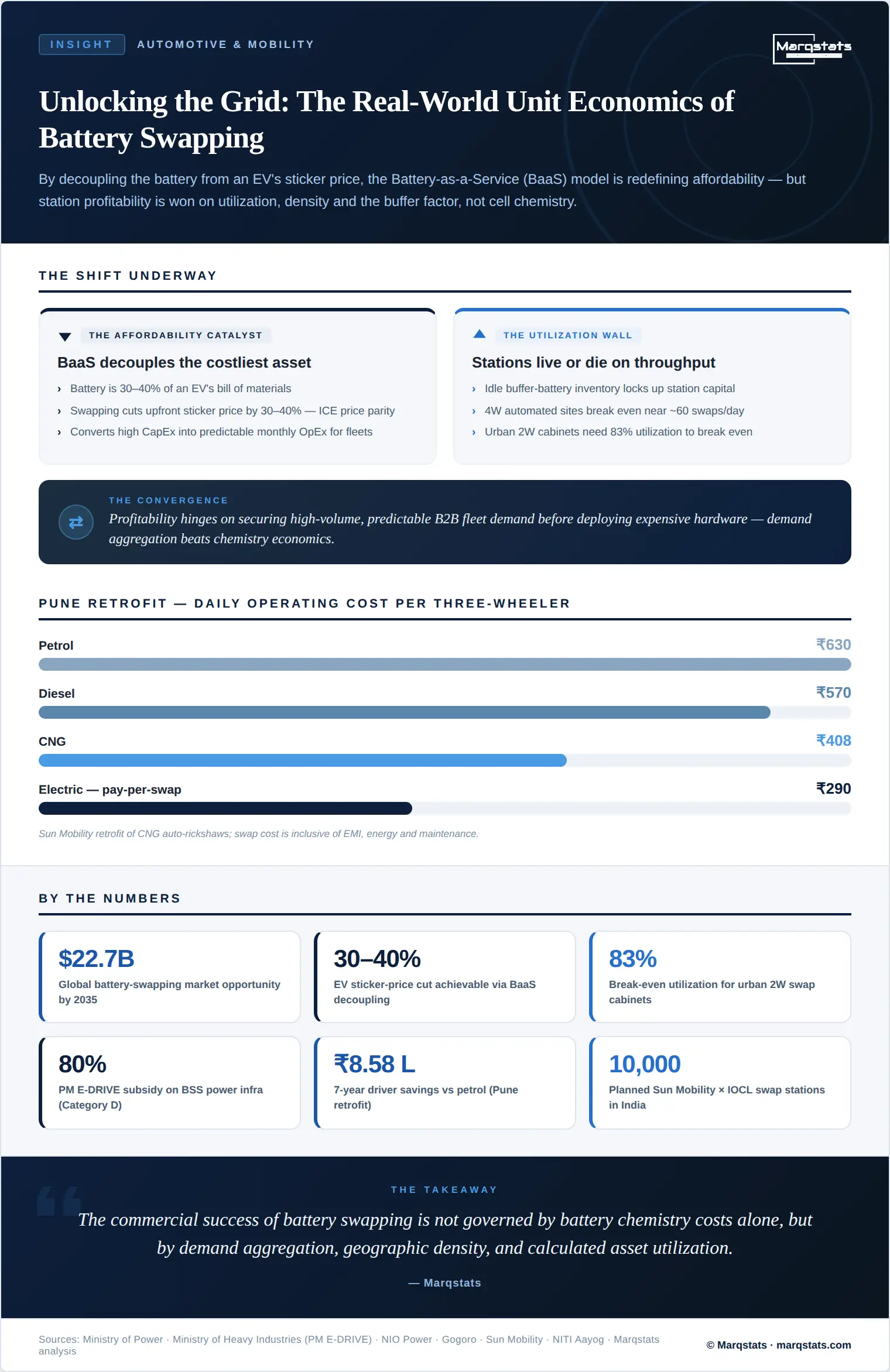
The global transition to electric mobility has reached a juncture where upfront purchase premiums and charging downtime remain the two most formidable barriers to mainstream adoption. While high-power DC fast-charging networks continue to expand, a parallel and commercially superior energy-delivery framework is scaling rapidly in high-utilization segments: battery swapping. At the core of this shift is the science of battery swapping unit economics — a multi-variable commercial model that separates the most expensive component of an electric vehicle, the battery pack, from the vehicle chassis. Marqstats estimates place the global battery-swapping opportunity near USD 22.7 billion by 2035.
By converting the battery from a depreciating hardware asset into a subscription-based utility under the Battery-as-a-Service (BaaS) framework, swapping reduces upfront acquisition barriers. The model transfers the financial risk of battery degradation, physical depreciation, and technological obsolescence from the end-user to the network operator. For fleet managers, delivery riders, and taxi operators, this pivot turns idle charging hours into continuous, revenue-generating uptime.
Decoupling the Asset: The BaaS Affordability Catalyst
In standard electric vehicles, the battery pack typically represents 30% to 40% of the total manufacturing bill of materials. Under the BaaS model, operators can lower the initial sticker price of an EV by 30% to 40%, placing electric models at direct price parity with — or below — equivalent internal-combustion-engine (ICE) vehicles.
This decoupling is a powerful market-entry mechanism, particularly in price-sensitive emerging markets where upfront capital constraints limit EV adoption. In the four-wheeler passenger segment, NIO has demonstrated the commercial power of the strategy: by offering buyers a substantial upfront deduction on the vehicle's retail price in exchange for a predictable monthly battery subscription, the model converts high capital expenditure into manageable, recurring operating expense.
For smaller-format electric two- and three-wheelers, the economic benefit is even more pronounced. In dense urban delivery operations, where daily distance is high, riders can subscribe to unlimited swap plans costing less than the corresponding daily spend on petrol or diesel. This structural cost advantage has made battery swapping the primary energy-delivery choice for urban delivery, logistics, and paratransit fleets.
“By converting the driver's energy expense from a volatile petrol cost to a predictable monthly swapping subscription, we secure both customer loyalty and long-term fleet commitment.”
— Executive Director, Corporate Strategy, Indian Oil Corporation Ltd. (interviewed 2026)
Unlike a standard plug-in charging point, a battery-swapping station (BSS) must finance the physical station hardware and grid-connection infrastructure as well as a circulating buffer inventory of spare batteries. The capital-expenditure (CapEx) profile varies significantly between vehicle segments:
Four-wheeler passenger stations: high-capacity, fully automated stations (such as those deployed by NIO) are highly capital-intensive. A first- or second-generation station — land lease, high-throughput robotics, grid-tie hardware, and a baseline inventory of 13 to 28 large packs — historically cost between 1.5 million and 3 million yuan (about USD 230,000 to USD 460,000). However, specialized high-power sites can scale to 5 million yuan (about USD 772,800). By early 2026, fourth-generation hardware-only costs had optimized to roughly 1.5 million yuan (about USD 210,000), aided by falling cell costs.
Two- and three-wheeler cabinets: decentralized, smaller-format cabinets (deployed by operators such as Gogoro and Sun Mobility) carry a far lower CapEx profile. A manual or semi-automated cabinet holding 20 portable packs can be deployed for as low as Rs 1 lakh (about USD 1,200). In a balanced commercial network — such as Sun Mobility's retrofitting project in Pune — total energy-infrastructure cost worked out to Rs 8 crore for 25 swapping stations and 1,850 swappable batteries, an average of Rs 32 lakh per station inclusive of the localized battery buffer pool.
The circulating battery-to-vehicle ratio — the buffer factor — is the most critical determinant of station CapEx. To avoid vehicle queues at peak hours, operators must hold a surplus of batteries on site. Set the buffer too high and capital is locked in idle packs, depressing return on investment; set it too low and the station experiences stockouts, rider wait times, and lower satisfaction.
OpEx and the Path to Break-Even: Scaling the Utilization Wall
Operating expenditure (OpEx) for a swapping network spans commercial real-estate leasing, utility power-purchase costs, on-site labour, routine maintenance, and battery-degradation reserves. Financial viability depends heavily on daily transaction throughput, measured as swaps per station per day. Because fixed costs of land, hardware depreciation, and grid connection are high, a station must clear a minimum utilization threshold to cover daily operating cost.
For large-format automated four-wheeler stations, the break-even threshold has historically sat near 60 swaps per station per day. In early 2026, daily averages across mature networks reached 40 to 45 swaps at peak and roughly 30 off-peak, signalling that stations are steadily approaching structural profitability as compatible vehicle parcs expand. For a decentralized 20-store two-wheeler network using standard 1.2 kWh reference packs, total capacity is designed for about 480 swaps per day; break-even in this suburban configuration requires at least 400 swaps per day — a high utilization target of 83%. The path to profitability therefore relies on securing high-volume, predictable demand from commercial business-to-business fleet commitments before expensive physical infrastructure is deployed.
To improve margins, swapping stations act as intelligent, grid-connected virtual power plants. Rather than relying on costly fast-charging at peak hours, networks charge their pools slowly overnight on cheaper industrial time-of-use tariffs. This controlled, slow-charging environment delivers two economic benefits:
Extended battery lifespan: slow-charging avoids the localized heat accumulation of ultra-fast DC charging, extending pack lifecycle by up to 30% and reducing the amortization cost of the battery-asset pool.
Grid optimization and solar integration: stations can pair localized solar generation and stationary storage to cut peak grid demand, reducing overall electricity-purchase cost by up to 40%.
Commercial Vehicle Retrofitting: The Sun Mobility Case Study
The fastest path to scaling a swapping network runs through commercial fleet conversions. Three-wheeler cargo and passenger vehicles (auto-rickshaws) are well suited to swapping: daily distances are long, routes are predictable, and operators are highly sensitive to downtime. In Pune, Maharashtra, a deployment pioneered by Sun Mobility demonstrates the micro-economic case, converting 500 near-end-of-life CNG auto-rickshaws to electric through retrofitting.
Cost of conversion: retrofitting a diesel or CNG three-wheeler with an electric powertrain costs Rs 1,00,000. A Rs 30,000 central FAME subsidy and a Rs 50,000 state incentive reduce the effective net cost to the driver to only Rs 20,000.
Operating-cost comparison: a retrofitted electric auto-rickshaw on a pay-per-use swap model runs at a total daily cost of Rs 290 (inclusive of financing EMI, swap energy, and maintenance), against Rs 630 for petrol, Rs 570 for diesel, and Rs 408 for CNG.
Net driver savings: that structure yields daily savings of Rs 340 versus petrol, Rs 280 versus diesel, and Rs 117 versus CNG. Over a seven-year operating life, a swap-compatible retrofit saves a driver up to Rs 8,57,546 against petrol models, directly improving the livelihoods of small-scale operators.
Policy Drivers and Regulatory Standardization
To mitigate the high CapEx risk of swapping, governments are deploying fiscal incentives and policy frameworks. In India, the Ministry of Heavy Industries' PM E-DRIVE scheme has allocated Rs 2,000 crore to expand public EV charging and swapping grids. Under the scheme's Category D guidelines, public swapping stations qualify for an 80% capital subsidy on upstream power infrastructure — transformers, cabling, and sub-stations — sharply reducing initial grid-connection cost for operators and accelerating the path to localized break-even.
International regulators are mandating structural change in parallel. The EU Battery Regulation 2023/1542 requires that portable and light-transport batteries be easily replaceable by the end-user or independent operators across 2025–2026, and mandates digital battery passports tracking carbon intensity and material sourcing by 2027. This pressure is pushing global manufacturers to standardize battery form factors, opening the way to cross-brand interoperability across Europe's commercial logistics networks.
Sources
Ministry of Power, Government of India — Guidelines for Installation and Operation of Battery Swapping and Charging Stations (2025): safety protocols, grid-interconnection requirements, and billing standards. powermin.gov.in
Ministry of Heavy Industries (MHI), Government of India — PM E-DRIVE operational guidelines and subsidy outlays, including the Rs 2,000 crore allocation and 80% upstream support for Category D stations. heavyindustries.gov.in
NIO Power — corporate filings and technical briefs on swapping-station deployment, break-even metrics, and fourth-generation CapEx structures. nio.com
Gogoro Inc. (NASDAQ: GGR) — Form 20-F and Q1 2026 financial reports detailing subscription economics and GoStation deployment. investor.gogoro.com
Sun Mobility Private Limited — Pune 500 e-auto-rickshaw retrofit proposal: project financials, retrofit costs, and comparative daily operating TCO. sunmobility.co.in
European Parliament and Council — Regulation (EU) 2023/1542, mandating battery replaceability and digital battery passports. eur-lex.europa.eu
NITI Aayog, Government of India — Draft Battery Swapping Policy (2022): technical requirements, unique identification numbers, and interoperability standards. niti.gov.in
Bureau of Indian Standards (BIS) — AIS 156 and AIS 038 Rev 2 for EV battery safety, crash-worthiness, and coupling safety of swappable packs. bis.gov.in